
Life in Freedom: A Conversation with Brian

For many years, Brian lived a charmed life in North Korea. He had a loving family, a university education, and a full stomach, but everything changed when the government stopped providing rations and wages for work. To make extra money, Brian's father began working as a broker, helping desperate North Koreans escape to China.
When his father was outed in a newspaper for helping a high profile defector escape, the entire family was put in danger. Brian's parents immediately fled to China. He followed soon thereafter, but was captured upon arrival by Chinese police. He spent the next two weeks in a detention center in China, where he was routinely beaten. Thankfully, LiNK was able to pay for his release so he could avoid repatriation.
Since resettling in South Korea, Brian's been very busy. He began attending university shortly after he arrived, hoping to become a journalist in the future so he can write about North Korea for an international audience. This year, he got married to another North Korean defector and they're now expecting their first child.
Our resettlement coordinator Jihyun was able to catch up with Brian recently to talk about what his life has been like since resettling.

Jihyun: What is the best thing that happened to you this week?
Brian: My pregnant wife and I found out that we are having a daughter! Yeah, we are so happy!I felt so bad watching my wife going through morning sickness. She couldn’t eat properly until recently.
Jihyun: So did you not eat when she couldn’t eat because you felt so bad for her?
Brian: Oh, no. I still ate well, because...you know, I was hungry. Haha.
Jihyun: Oh yeah, I understand. Of course you had to eat well so you could protect and take good care of her when she couldn’t eat. (Brian, his wife, and the photographer laugh.)

Jihyun: What was the most difficult thing when you got out of Hanawon (resettlement center for North Korean defectors)?
Brian: When I first graduated from Hanawon, I still had a thick North Korean accent so people looked at me whenever I started talking, which made me so uncomfortable.
Jihyun: What was your biggest challenge in North Korea? What's your biggest challenge in South Korea?
Brian: In North Korea I didn’t have a lot of difficulty because I was lucky to have a well-off family there. In fact, after I came to South Korea I started having a lot of difficulties because I had to adjust to the new society.
I think getting a job is one of the most difficult challenges for many resettled North Korean refugees. Especially since I am about to graduate from college and have a wife and a baby coming, I feel a little pressure. I just want more South Korean companies to hire more resettled North Koreans without discrimination/stereotype. I have heard from many of my North Korean friends that they have a hard time getting jobs because many companies have negative stereotypes about North Korean people, so they don’t want to hire North Korean candidates.
I am not saying that they have to hire us because we are from North Korea, but I want more companies to willingly hire us if we are qualified regardless of our background.
Also, I believe North Korean defectors in South Korea are still underprivileged in society and have a lot of obstacles. I hope there will be more effective job training and employment programs until more resettled North Koreans settle down in their specific work fields.

Jihyun: What is it like living in freedom in South Korea?
Brian: I really appreciate the freedom that I have here. In some of my college classes, I got to study the South Korean constitution that guarantees our freedom. There are so many types of freedom that I can enjoy. I can’t even count them because there are so many. One thing is the freedom of traveling anywhere I want. Back in North Korea, even traveling to another area was so difficult. Here, as long as I don’t cause trouble or break the law, no one can take away my freedom of movement.

Jihyun: Have you helped any other defectors resettle in South Korea? How?
Brian: Well, I wish I could do more, but right now what I can do is to help other resettled North Korean refugees who want to go to college by sharing my experience and giving them useful tips and advice about college life.
Jihyun: Have your perceptions of Americans and South Koreans changed?
Brian: In North Korea I didn’t really think South Koreans were very different than us because I thought we were all Koreans—the same blood. However, my perception of Americans changed a lot especially after I met LiNK staff and learned about LiNK's supporters.
I used to think Americans were so weird and selfish, because that was how I was taught about Americans in North Korea.
When I was caught by the Chinese police in China, LiNK helped me so much to be released and come to South Korea. I was so moved by that.

Jihyun: What advice would you give to a friend who just arrived in South Korea?
Brian: I want to share everything I have learned with him. I would say to him that he has to do what he wants. There are many options that you can choose for what you are going to do in this new society. If you don’t want to regret your decision in the future, you have to do what you like.

Jihyun: How often do you think about North Korea? What do you think about?
Brian: Not quite often, but I start thinking about North Korea when I am stressed out about my studies or finding a job, because I didn’t really worry about those kinds of things back in North Korea. When I am thinking of North Korea, I usually picture hanging out with my friends there. We played a lot of games, including card games. Also I liked drinking with my good friends too, haha.
Lastly I want to take this chance to say thanks to LiNK staff, volunteers, and supporters. I always appreciate them and thinking about them gives a lot of hope and motivation to do my best for my life.
Squid Game and the Stories of North Korean Defectors

**Warning: Contains plot spoilers
Netflix’s Squid Game has taken the world by storm, becoming the platform’s most-watched show debut and infiltrating popular culture. The high-stakes thriller juxtaposes nostalgic kid’s games with brutal consequences, hooking viewers with a compelling cast and pointed social commentary.
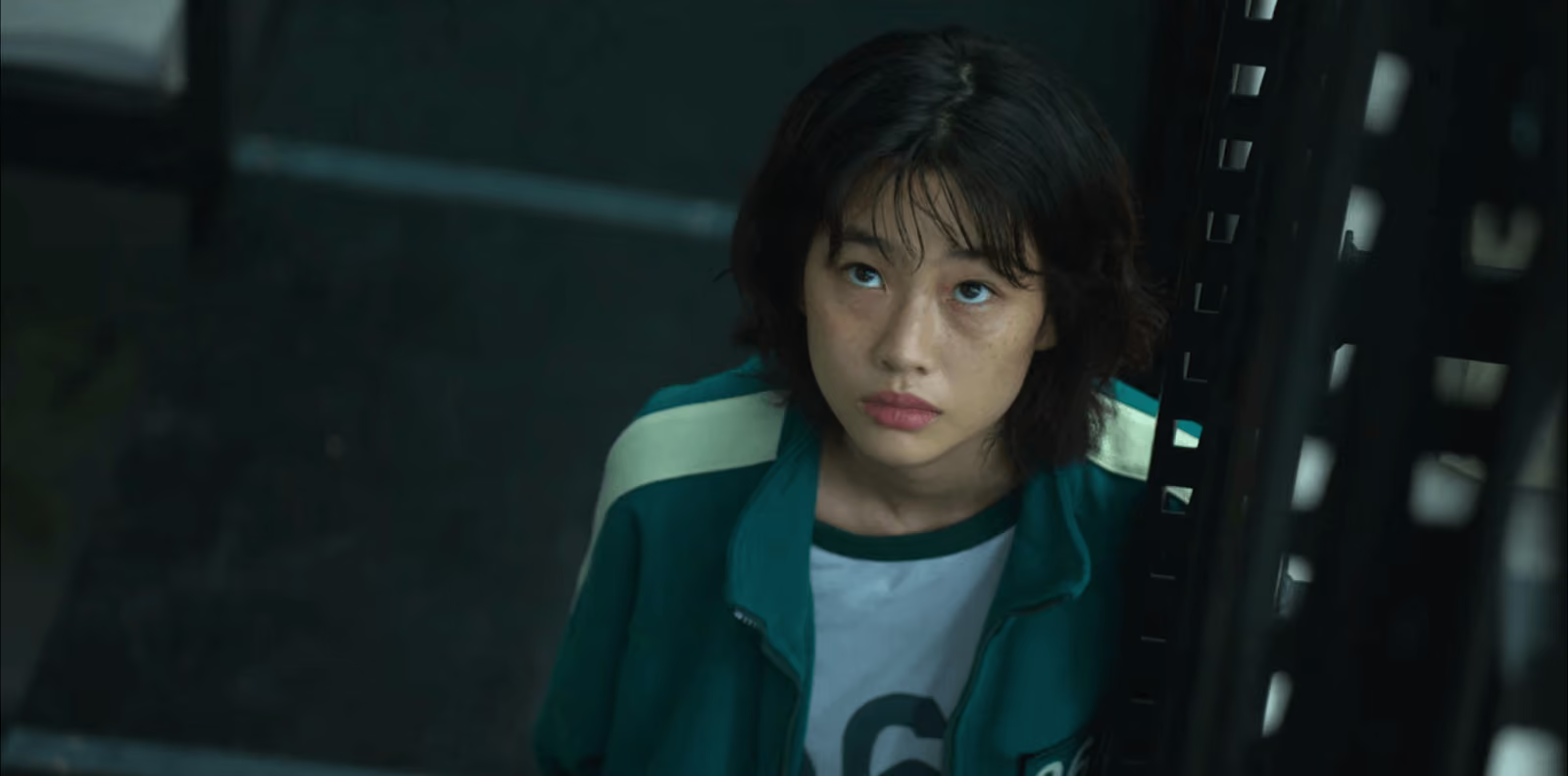
One of Squid Game’s most captivating characters is Kang Sae-byeok, a tough-as-nails North Korean defector who wants nothing more than to reunite her family. While she and her little brother managed to safely reach South Korea, their father was killed during the border crossing and mother was captured.
Sae-byeok’s story reflects the real experiences of the North Korean refugees we work with who have risked everything for freedom. Many were separated from family, have little support when resettling, and face prejudice.
The Perils of Defecting
Crossing the heavily guarded border between North and South Korea is virtually impossible. Instead, refugees must escape through China and journey 3000 miles through a modern-day-underground-railroad to safety in Southeast Asia. This has only become more difficult with pandemic-related restrictions on movement and border lockdowns.

If caught fleeing North Korea or arrested in China, which doesn’t recognize defectors as refugees, North Koreans will be sent back and face harsh punishment - brutal beatings, forced labor, and even internment in a political prison camp.
This is the reality that people like Sae-byeok’s mother face.
Still, thousands of North Koreans have risked everything to seek a better life. An estimated 33,000 refugees have resettled in South Korea.
“I wasn’t sure if I would see my family again because of the possibility of getting caught while escaping to China. Before I left, I got some opium and carried it underneath the collar of my shirt so I could take it to kill myself in case I got caught.”
- Joy, escaped through LiNK’s networks in 2013
Continue reading Joy’s story to freedom here.
Difficulty Assimilating
Once they reach safety and begin their new lives, refugees face a new set of challenges. Some have described the experience as stepping out of a time machine, 50 years into the future. Amidst figuring out the everyday intricacies of modern life, many refugees are still coping with the trauma of their past.
In addition to struggling to make ends meet, Sae-byeok faces social pressure and stigma as a North Korean. She deliberately masks her North Korean accent around everyone except her brother and is subjected to remarks about being a “communist” and “spy.”
While it is not specified how her brother ended up in an orphanage, one can assume that Sae-byeok left him there in hopes that he’ll receive care and education that she cannot provide. Tragically, the difficulties of establishing a new life in South Korea separated her from her family once again.

“At first I struggled a lot. There were many times when I either didn’t understand South Koreans or they didn’t understand me due to our different accents and words...Another difficulty was loneliness…I still feel lonely from time to time. I really miss my family.”
- Hae-Sun, rescued while hiding in China in 2013
Read more from Hae-Sun’s experience starting a new life in South Korea here.
Working with Brokers
Hoping to bring her mother to South Korea, Sae-byeok was in contact with shady brokers who scammed her of her money. It can cost tens of thousands of dollars to fund these risky escapes, especially directly out of North Korea, and then from China to Southeast Asia.
With the prize money from the games, Sae-byeok hoped to reunite her family and live under one roof again.

This is Not Where the Story Ends
Working with the right people who can help safely smuggle people across borders is the real deal. Liberty in North Korea helps North Korean refugees escape safely through a modern-day underground railroad, without ANY cost or condition.*LiNK’s rescue efforts begin in China
LiNK reunites families, supports their new lives in resettlement, and helps individuals, like Sae-byeok, reach their full potential in freedom.
When LiNK’s field staffer told me I was finally safe, I was overwhelmed. I had endured so much to make it this far - hard labor, imprisonment, and torture. And even though I was overjoyed to make it to freedom, I was deeply saddened that [my daughter] Hee-Mang wasn’t with me… I hold onto the dream that one day we will live together again.”
- Jo-Eun, escaped North Korea through LiNK’s network in 2018
Read the story of Jo-Eun’s journey to freedom here.
--------------------
When North Koreans successfully resettle, they become some of the most effective agents of change on the issue by sharing their stories with the world and sending money and information back to their families in North Korea.
Kang Sae-byeok’s story has come to an end, but you can do something to stand with the North Korean people today.
→ Watch undercover footage from real rescue missions.
→ Read more stories from North Korean refugees.
→ Donate to make rescue missions possible.
→ Connect with the global movement for the North Korean people by following us on Instagram, Facebook, Twitter, and YouTube.










