LiNK Statement on the Executive Order on Immigration and Refugees
Dear Friends,
We write today to provide an update on how the recent Executive Order (EO) on immigration and refugees will affect North Korean refugees and our work.
The EO suspends the U.S. Refugee Admissions Program globally for 120 days, for a review process to “determine what additional procedures should be taken to ensure that those approved for refugee admission do not pose a threat to the security and welfare of the United States” (Sec. 5.a).
North Koreans who have escaped the most repressive country in the world are not exempt from this suspension, meaning North Koreans seeking refuge in the United States will not be able to gain admission during at least the next four months. We know from experience that it is already not easy for North Koreans to gain refugee status to resettle in the United States as there is a strong vetting process currently in place. It can take many months, even over a year, and involves repeated in-depth interviews and screenings by various U.S. government agencies. We therefore believe it to be unnecessary and unfortunate to suspend the entire U.S. Refugee Admissions Program and further delay the start of these refugees’ lives in freedom.
We are proud of our work helping North Korean refugees in their escape and assisting them in reaching countries like the United States and South Korea where they can begin new lives in safety and freedom. We are thankful to all our supporters who have made this work possible and have welcomed these individuals into their communities. It has been incredible to see our North Korean friends here in America learn English, enroll in universities, get married and begin families, find gainful employment, and even start their own businesses.
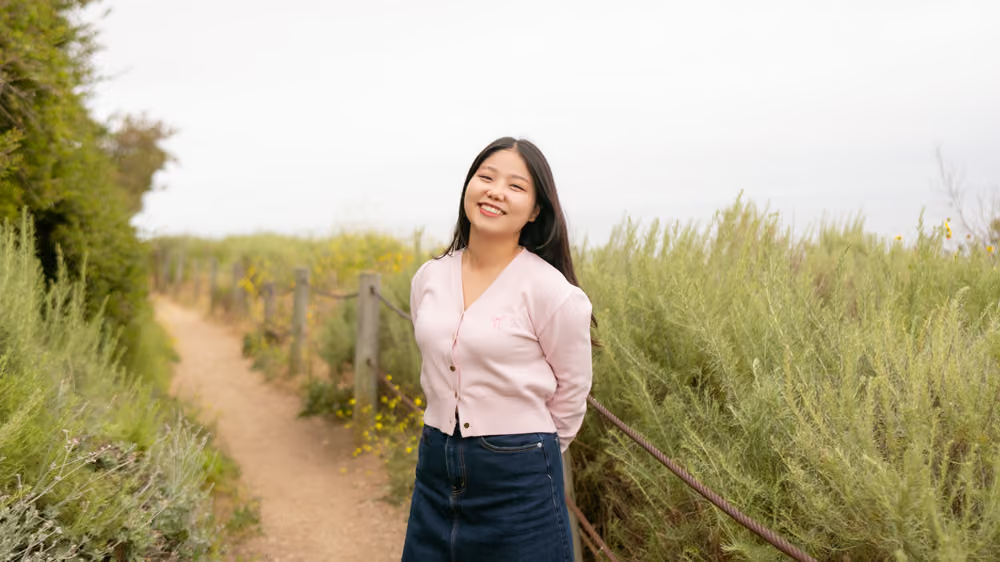
A while ago we asked Anna--a North Korean refugee who we helped resettle in the US--her thoughts as she celebrated Independence Day. She said, "This country accepted me, embraced me, and gave me an opportunity to spread my wings."
Today, we renew our commitment to protecting North Korean refugees and to helping them resettle in societies where they can live in safety, freedom, and dignity and live fulfilling lives as valuable members of their new societies. Thank you, as ever, for your support.
Joy's Story: Part 3 - A Difficult Decision

Read parts one and two of Joy's story that detail her life in North Korea and how she was sold as a bride in China.
When I started living with the Chinese man I was sold to, I thought of escaping after six months. I just did what the Chinese man wanted without thinking about birth-control—I never had proper sex education. Two months later, he and his family took me to a hospital for a pregnancy test. I was pregnant. I am so sorry to my daughter for this, but after I got pregnant was so miserable and I felt like I was stuck in this situation because of the baby. I knew that I couldn’t escape until I gave birth to my daughter and raised her for a while. I was not happy, but the Chinese man and his family were. I am very sorry to my daughter for how I felt about having her back then, but the pregnancy was not what I wanted and I didn’t love the Chinese man. I actually tried to abort the baby by jumping down from a high tree many times but it didn’t happen.
I ended up having a daughter and raised her for two years before I escaped.

When I was still raising my daughter and living with the Chinese man and I was losing hope about my life, the North Korean broker who sold me into marriage got back to me and introduced me to some people who later connected me to LiNK’s network. She told me that she felt really bad for selling me to the Chinese man but she had to do it to survive in China as a North Korean herself. When she told me about going to South Korea and life there, I felt like that was my last chance to have my life back again. At that point, I was no longer breastfeeding and my baby had started to talk, so I thought the Chinese man’s parents could take care of her. I decided to leave for South Korea.
I was so sad to leave my two-year-old daughter in China.
Before I left, I thought of taking her with me, but she was still very young and I was not sure if I was going to make it to South Korea safely so I didn't want to risk her life.
To this day I feel guilty and sorry about having left her so I could have freedom and better life. I know my daughter has been hurt a lot by my leaving.

Before I started moving to get out of China I stayed with some other defectors before I got connected to LiNK's network. At the time, I cried every day thinking of my daughter. Even when I was sleeping in the house, I kept waking up to see if my little daughter was sleeping well on my arm and realized that she was not with me anymore.
I didn't want to cry in front of other defectors, so I cried behind a curtain and I found another North Korean woman crying there because she also left her child. We ended up hugging each other and crying together.
Since I resettled to South Korea a few years ago, I have been talking with my daughter through online video calls as often as possible. She is doing well and is now in elementary school, but I can tell she has been so hurt by my absence in her life. It breaks my heart when she asks me why I am not with her. Whenever there is homework about family or whenever her teacher asks her to bring her mom, she gets so sad and I feel so helpless and remorseful. I plan to visit her in China on one of my summer breaks from college.
It is so ironic because I was so hurt a lot by my mom for leaving me and my family when I was a little kid and I did the same thing to my own daughter.
Now I understand why my mom had to make such a decision...Hopefully there will be a day my daughter can understand and forgive me.