
A Reason to Live: An Interview with Hae Sun

Hae Sun was rescued while hiding in China in 2013. Now safely resettled in South Korea, she attends a two-year college as a business/Chinese major and she just finished her first semester. Choosing to go to college was not an easy decision for her. She was adjusting to the many differences in South Korean society and dealing with loneliness, low self-esteem, and anxiety issues. But, ultimately her drive to pursue her dreams was stronger than the challenges she faced. Now, she’s excited to achieve the goals she has set out for herself.
“When I got my acceptance letter to a two-year college in South Korea, I thought of my mom who is still in North Korea. I wished she could’ve heard the good news and congratulated me. I haven’t heard from her since I left North Korea a few years ago. I don’t even know whether she is still alive. I know she would be very proud of me for attending college.” - Hae Sun
Our resettlement coordinator Jihyun recently met up with Hae Sun to see how she has been doing since starting college. Read their conversation below:

Jihyun: “How was your first semester?”
Hae Sun: It was not easy at all. In the beginning, I struggled so much. There were so many things my South Korean classmates easily understood that I didn’t because of the different education systems between North Korea and South Korea. I also didn’t study for more than 10 years because I didn’t get a proper middle school/high school education in North Korea and spent a long time hiding in China.
I didn’t do well for my midterms, but did better for my finals. Throughout the semester there were many moments when I really wanted to give up and drop out of school because studying was so hard and things were difficult for me, but I didn’t give up.

Jihyun: “Other than studying what else was difficult during your first semester?”
Hae Sun: Well, making friends in college was not easy. You know, I am at least 10 years older than most other freshmen. I am still afraid that they might not feel comfortable being around me because I am a lot older and culturally different from them. Some students have been so nice to me and I shouldn’t think that way, but I still get self-conscious about my age and background, which I know hinders me from getting close to them. Next semester I will try to be around other students more without worrying about my age and background.

Jihyun: What was the best part of your first semester?
Hae Sun: I was able to clearly understand a lot of Chinese grammatical stuff, which I had struggled with for a while. I was hiding in China for a long time so I learned conversational Chinese through talking with Chinese people, but I never learned it in school, so there were still a lot of grammatical rules I didn’t understand. Since I started studying Chinese as my major, I have learned a lot of those rules. I am so so happy about it and thankful for my education.

Jihyun: “What was one of new things you started doing after coming to South Korea?”
Hae Sun: Volunteer work to help people in need. In North Korea, I never thought of helping other people because I had so many difficulties then. I have been part of a group of volunteers for the past year that gives food to homeless people in train stations in Seoul. The group consists of young resettled North Korean refugees like me and South Korean college students.
Even after I resettled to South Korea, I didn’t think of helping others because I didn’t have a lot and thought I had to resettle successfully first. But while volunteering through the group, I have realized that I don’t need to have a lot of money or time to help other people.
Sharing what I have with others and helping them makes me happy now. In North Korea and China when I was always in need, I thought only receiving could make me happy, but now I know giving also makes me happy. That is why I do the outreach volunteer work for the homeless.

Jihyun: What were some of the difficulties you had when you first came to South Korea?
Hae Sun: Before I came to South Korea, I thought I would be fine communicating with people here because we speak the same language, but I was not aware of a lot of the differences between the South Korean language and the North Korean language because the two countries have been separated for almost 70 years.
At first I struggled a lot. There were many times when I either didn’t understand South Koreans or they didn’t understand me due to our different accents and words. Although there are still words and expressions I don’t completely understand, I am a lot more used to it than when I first came here. I have learned a lot of new words and expressions while working different jobs with South Koreans and through attending college here.
Actually at the beginning of this semester, I didn’t understand a lot of words that other students would use because I am even more unfamiliar with words young people use here. Still, I get confused about some South Korean expressions and words and sometimes I still don’t understand what my professors say. I used to get stressed out about it so much, but now I try to give myself more grace about my language issues. I mean I will keep learning new things and trying to get used to them for the rest of my life here. I will just face them instead of avoiding or getting stressed about them. That is why I am in college so that I can learn, right?
Another difficulty was loneliness…I still feel lonely from time to time. I really miss my family. I actually had depression when I first came to South Korea because of loneliness. Now I don’t have depression anymore because of new friends I have made since I came to South Korea. My church community has especially made me feel loved and encouraged and has been helping me overcome loneliness and depression.

Jihyun: What is freedom to you?
Hae Sun: Freedom enables me to do what I want and visit the places and countries where I want to go as long as I have the willpower and make the effort. None of this was possible back in North Korea.

Jihyun: What do you want to say to people around the world who support you and other North Koreans?
Hae Sun: I really thank them from the bottom of my heart. They have never met me and they don’t know me, but they have supported me so much. Thanks to their support I am now enjoying my freedom and pursuing my college education. What is more moving to me is they have given me all the support without asking anything in return. I am so touched by their unconditional support. I cannot thank the supporters enough.

Jihyun: How do you want people in the world to see North Korea and the North Korean people?
Hae Sun: I want the world to distinguish between its people and its leaders. I know that the regime is bad and has done a lot of evil things, but the ordinary people are innocent.

Jihyun: What is the most important value in life?
Hae Sun: Having goals to achieve. I didn’t have a lot of goals until I came to South Korea. After escaping in my early 20s, I didn’t have any goals other than just surviving and not getting repatriated back to North Korea...I didn’t even want to live a long life. I just wanted to live until I turned 30. But now, I want to live for a long time because I have a lot of goals to achieve.
I would feel so sad if I only lived until I turned 30 now. That is not enough time to do all the things I want to do.

Jihyun: What are your future goals?
Hae Sun: I always wanted to go to college in North Korea and China, but it was not possible due to my social status and other obstacles in those countries. I am living that dream by attending college with a major I really enjoy studying. Now my goal for the future is to successfully finish college and get a job I am passionate about. I don’t know what kind of job I want yet, but I know I will find one if I keep doing my best in college.
You can help other North Korean refugees escape China and resettle successfully by donating to our work. Donate now.
North Korean Defector Economist: How We Analyze North Korea Needs to Change
By: HyeGyeong Joo
HyeGyeong is a PhD student in the Department of Economics at Korea University, specializing in theoretical economics. Her research looks at developing theoretical models of the North Korean economy. Since 2022, HyeGyeong has also participated in LiNK’s English Language Program.
When I think about my past, I often feel a great sense of loss and sorrow for the people I left behind in North Korea. As a PhD student studying North Korean economics here in South Korea, I feel a strong desire to use my research to help improve the lives of North Korean people. In many ways, helping those I left behind also gives meaning to my own journey.
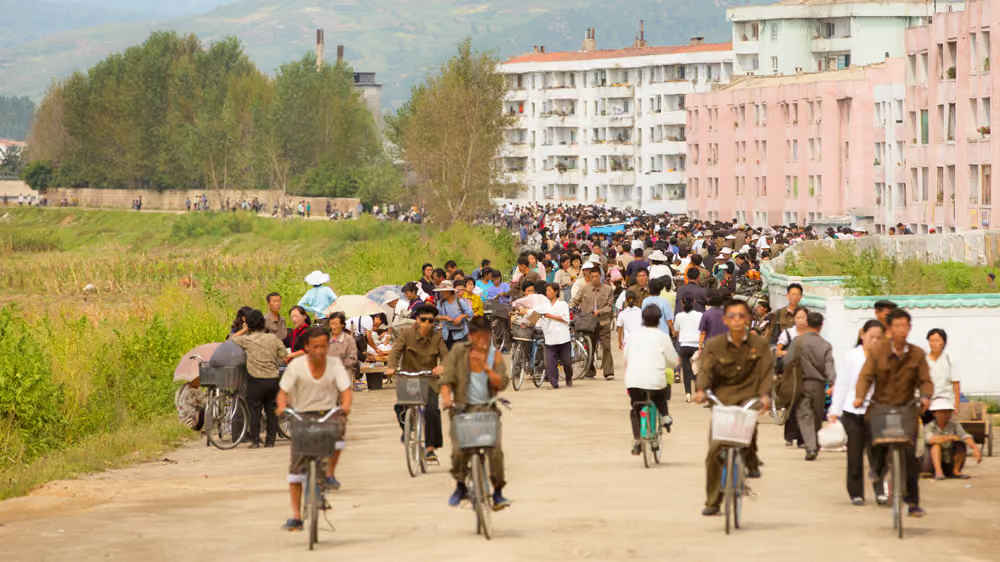
Whenever I watch the news or read academic papers on North Korea, I feel saddened by the way North Korean people are discussed and represented. Over time, I have come to believe that the way we analyze North Korea needs to change.
I believe there is a fundamental limitation in existing research on the North Korean economy, as much of it has traditional socialist planned economy analysis. Earlier studies have suggested that North Korea would either collapse or undergo a system transition as other socialist countries have done. However, after the breakdown of the Public Distribution System (PDS) in the mid-1990s and the emergence of the shadow economy (including through the Jangmadang—illegal markets), these approaches began to reveal their limitations.
As a result, the North Korean economy came to be understood not as a simple planned economy, but as a mixed economy in which state control and market activities coexist. However, these studies do not sufficiently explain why the North Korean regime allows marketization to persist at a certain level instead of completely suppressing it.
In order to explain the interaction between the government and ordinary North Korean citizens, who are the primary actors in Jangmadang activities, I divide the North Korean system into three groups: the regime, the elites, and ordinary citizens.
In particular, elites are important economic actors because they function as intermediaries between the regime and the people. My argument is that this phenomenon can be better understood by analyzing how these three groups strategically interact with one another.
These three groups pursue their interests in different ways, and their goals also differ significantly. The leadership wants to continue dynastic rule and ensure stable succession, the elite seek to secure their positions and avoid political risks such as purges, and ordinary citizens primarily seek survival and improved living conditions.
The interests of these three groups sometimes conflict with one another and sometimes align. In my opinion, these three groups in North Korea are currently remaining in a state of equilibrium.
This equilibrium means that these three groups can achieve their maximum interests under the current conditions in North Korea. Precisely because of this equilibrium, North Korea has been able to maintain both regime stability and limited marketization simultaneously.
That is why I believe we must identify what kind of shocks could cause this equilibrium to collapse. If such a change were to occur, it could become a new turning point for North Korea.
A new turning point for North Korea could lead the country toward a new political and economic order. The important thing is that we must identify what kinds of shocks could trigger such a transformation.
I hope for a North Korea that has changed—a place where its people can live freely. For me, North Korea is not just a state; it is my hometown, where I was born and raised, and where my family still lives. This is precisely why I am committed to a different approach to the North Korean issue—because my only goal is to see genuine change in North Korea, and I truly want to help bring about that change.
I want my article to inspire you to see something different the next time you watch the news or media coverage about North Korea. The next time you come across a piece of media about North Korea, I hope you take a moment to think about the real North Korean people. And perhaps you may also reflect on this article and consider what kinds of shocks could transform the current equilibrium of North Korea.
I hope you will join me on this journey.
–
HyeGyeong is a participant of the LiNK English Language Program (LELP), which serves to not only help North Korean defectors build confidence and skills in English, but develop their capacity as advocates for this issue. To that end, we partnered with select LELP “columnists” to write and polish personal essays through multiple rounds of external feedback and revision. Our goal is to have more North Koreans share their stories directly and lead efforts to change the narrative.
We believe the North Korean people can achieve their liberty in our lifetime.
Opportunities like LELP invest in the people building that future now. Help more North Koreans find their voice, reach their goals, and lead change on this issue.










