
The Making of 'I Am Sun Mu' – an Interview with Director Adam Sjoberg

Filmmaker and photographer Adam Sjoberg has been working for the last two and a half years on a new documentary about our friend and renowned resettled North Korean artist Sun Mu. The film, titled I Am Sun Mu, follows Sun Mu as he prepares a new exhibition. We have known Adam for a while—he directed Danny From North Korea—but he is also known for previous works such as Shake the Dust and many other internationally-recognized films.
Check out our interview below with Adam on his most recent documentary.

When did you begin working on I Am Sun Mu?
Justin Wheeler introduced me to Sun Mu in January of 2013. We had dinner and discussed the possibility of doing a documentary about his life and work. Because Sun Mu can’t show his face and has to go to great lengths to protect his identity, he was understandably careful about getting involved in a feature film about his life. However, because of the long-term relationship he’s built with LiNK, and my approach to filmmaking, he decided it was a good partnership. I’m super thankful that he said yes. A year after we initially met, he was invited to China to show his work in a solo exhibition. This was an unprecedented event for a North Korean artist—and a bold decision on the part of the curator. I decided this was a perfect opportunity to film him and use the exhibit as a narrative arc with which to tell the rest of his story.
What was your favorite part of the process?
The whole filming process has been a joy to work on. I loved some of the quieter moments of filming it when it would just be Sun Mu and me in his studio. He would be painting or working away on a piece, and I would just be a “fly on the wall” filming. That collaborative effort was really inspiring. I’ve also loved working with a team of creatives that are so talented. Mariana Blanco, our editor, has been crucial to getting the film completed. Ryan Wehner has been making some beautiful animations of Sun Mu’s work that really help bring Sun Mu’s back-story to life. And composer Joel P. West has been working on a unique and beautiful thematic score to round out the film. I love working as a team with people that inspire me.

What are some cool things you learned while you filmed?
There has been so many things that I’ve learned. I already had a basic knowledge of the history of the Korean peninsula, but I’ve learned even more about it—as well as the nuances of the Kim’s rule and influence on every portion of North Korean life. Hearing Sun Mu discuss his life in North Korea, as well as his process of “un-brainwashing” after he left was fascinating. But most importantly, developing a friendship with Sun Mu over the last two years has helped me see past the politics and stereotypes surrounding the issue. Part of the beauty of Sun Mu’s paintings is that they don’t sit in any particular political space. He misses his homeland and longs for a more idealized, free North Korea. His work reflects his torn heart: He is not North Korean or South Korean. He’s simply Korean, which is why so many of his paintings focus on the idea of reunification, which is often seen as an archaic solution to the future of the two Koreas. But I don’t think he’s painting about reunification because he’s sure it will happen, only that he hopes it will.
What was most challenging for you with creating the documentary?
I don’t want to give too much away, but things did not go as expected at Sun Mu’s exhibit. That created safety and security challenges. Beyond that, making a feature-length film is a tough job. There are so many parts of Sun Mu’s life that I wish I could tell. The more I filmed him, the more I wanted to include. But in the end, you have to decide what stories push the overall narrative forward and keep people interested. It was tough to lose some scenes, but there are always DVD extras!

Do you have a favorite scene?
Can I pick two? My favorite is probably a scene where Sun Mu describes the day he escaped. It’s mostly a compilation of his paintings brought to life with animation. Afterwards, Sun Mu sings a song while playing the guitar that he used to play back in North Korea. Another favorite scene is of Sun Mu painting with his daughters. He then describes a couple of paintings he made of them—one of which is of his oldest daughter holding a “letter that cannot be sent” to her grandmother. It’s powerful.
Why do you create documentaries? Why did you choose to do this one in particular?
I create documentaries because I have a passion for helping people tell their stories. I love the genre because of how it opens up people’s eyes to the world. Ever since getting involved with Liberty in North Korea back in 2010, I’ve been interested in this issue. The crisis in North Korea is often overlooked, thought of only in terms of its politics, and is considered by many to be a complicated “cause” in which to be involved. I’ve worked with commercial brands that haven’t wanted to align themselves with LiNK because their manufacturing is in China. But it’s one of the greatest ongoing tragedies in the world today—and I’m proud to be associated even a little bit with what LiNK is fearlessly doing.

Who is this documentary for?
Hopefully it’s for everyone. We tried to make a film that is not just about North Korea, but about a person—an artist. It has a little bit of everything in it: a few laughs, a story of family, a story of escape, and a story of an artist trying to make it. Sun Mu is a very poetic person, and so I think people will be drawn in by his narrative.
What are you most excited for people to see in the documentary?
The climax of the film is pretty exciting and emotional, but I’m most excited for people just to get to know Sun Mu.
Why should people watch this? Why is this important?
As I’ve mentioned above, this is an issue that is often only seen in the media regarding it’s politics, or else in comedies or shock-docs. I want people to see a more human side: to not walk away thinking of the Kims, but of the many people in North Korea who live under one of the most oppressive regime in the world. Not just of their plight, but of their potential.
Where/when can someone see the documentary?
There will be a website up soon with more information. It will take some time before we secure international and domestic distribution. Stay tuned to what LiNK is doing. We’ll try to keep everyone in the loop once it’s out for the world to see!
UPDATE: January 2017! We're excited to announce that I Am Sun Mu is now available on Netflix, iTunes, Amazon, YouTube, and other video on demand platforms! Watch it, rate it, and share!
Want some of Sun Mu's art for your home? Check out the Sun Mu canvas prints on the LiNK Shop!
Disrupting the North Korean Regime’s Control: Increasing Information Access
North Korea is the most closed and isolated information environment in the world. The regime’s control hinges upon suppressing outside sources of information that could contradict or undermine their ideology. This makes their system of repression extremely effective; it also highlights a critical weakness, one that creates an opportunity for us to effect change inside the country.
Information is power. It enables people to scrutinize the world around them, hold governments accountable, and aspire towards a better life.
At Liberty in North Korea, we’re empowering people inside North Korea with tailor-made tools and technologies that increase their information access, and make that access safer and easier. But what does this actually look like? We asked our Chief Strategy Officer, Sokeel Park, to answer some frequently asked questions about our Information Access Programs (IAP).
1. Without the internet, is it really possible to increase information access inside North Korea?
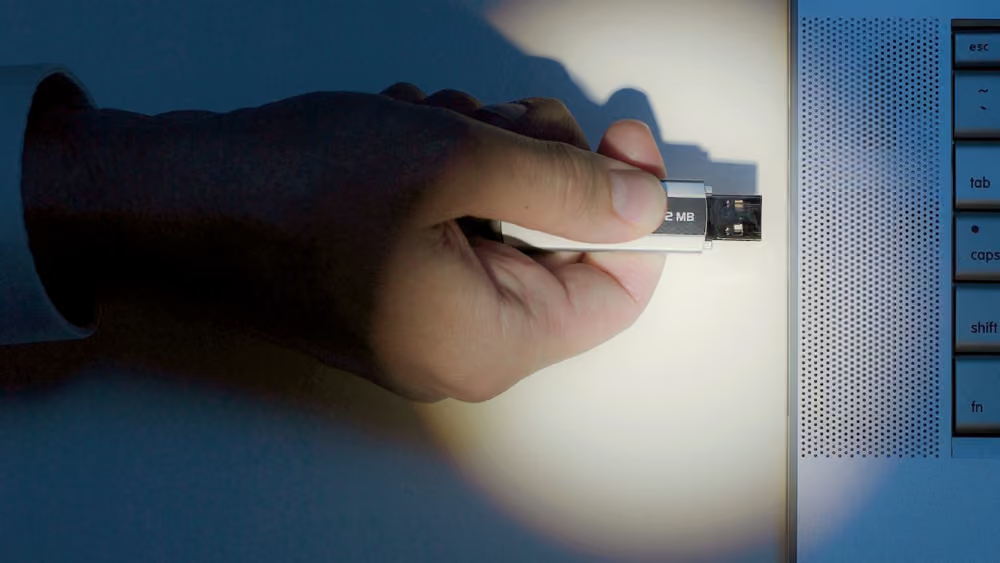
Yes, absolutely. North Korean people are already accessing uncensored information and media without the internet, notably through USB drives and MicroSD cards that are smuggled into the country and spread through sharing networks. These contain K-dramas, movies, music, and information that the North Korean regime tries so hard to keep out of the country.
The devices and hardware are already in use, the demand is there, and the sharing networks and behaviour exists. The need and opportunity is to leverage and build on this, providing new technologies that will help North Korean people access more uncensored information more safely.
2. Isn’t enabling North Koreans to access illegal foreign media putting them in danger?
Accessing uncensored information is risky in North Korea, especially with increased crackdowns and punishments in recent years. Our technologies and digital security tools equip North Koreans to access information more safely.
North Korean people will continue to take risks for information and media that most people in the world would take for granted.
User security is our highest priority in our development process, and this is guided by North Korean defectors who left the country recently, understand the environment, and can advise us on the best ways to protect and empower North Korean people who are trying to access uncensored information.
3. What is LiNK doing to increase North Korean people’s access to information?
LiNK’s IAP work can be broken down into four areas of focus.
We develop lightweight, secure programs help more North Koreans access more uncensored information; protect North Korean users with digital security and anti-surveillance measures; create and curate strategic content that meet North Korean people’s needs and build resilience to the regime’s propaganda; and work with distribution partners to deliver these technologies and content packages to North Koreans as reliably, effectively, and safely as we can.
4. Why did LiNK decide to do Information Access work?
In a 2024 HanVoice Woorion survey of 500 North Korean refugees, 86.2% agreed that “it is important to increase the flow of information to North Korean people.” This is the most effective way that we can support change inside North Korea.
As an organization, LiNK is uniquely positioned to do this work. With our long history of rescuing and supporting North Korean refugees, we have the networks and ability to work closely with a variety of North Koreans, including recent defectors and people who studied and worked in IT in North Korea, who inform and help test our products and strategies from start to finish.
Crucially, because of the support of people like you, we are able to make strategic investments in projects that governments or other funders may not support, which enables us to pursue the most effective long-term strategy possible to support North Korean people to achieve their freedom.
5. What kind of information can North Koreans access, both legally and illegally?
Legally, North Korean people have access to official media which is extremely centrally controlled and produced. There are no newspapers, TV stations or media channels with an alternative viewpoint from the government, and all official media serves to reinforce the regime’s ideologies and narratives about the outside world, their own country and the leadership. This official media includes, for instance, newspapers, North Korean films and dramas, carefully selected foreign (eg. Russian) films, partially censored sports broadcasts, radio, speeches by the ruling Kim family, government-approved books, and government-approved mobile apps.
Illegally accessed information or media could theoretically include anything, but most commonly would be movies and TV dramas from South Korea, China and elsewhere, music, some e-books, and foreign radio broadcasts including news and documentary programs. Close to the border with China, some North Korean people have a smuggled Chinese smartphone that can be used to connect to the Chinese network and communicate with or get information from the outside world.
→ Want to learn more about life inside North Korea? Sign up for North Korea 101, LiNK’s free online course!
6. How do we know increasing North Korean people’s access to information will help change North Korea?
Hundreds of interviews with North Korean refugees conducted by LiNK, and thousands more by other organizations, consistently show how access to outside information reshaped their understanding of the world, undermined regime propaganda, and often was key in their decision to risk their lives and seek freedom. We also see the North Korean regime’s crackdowns on this access to outside information, especially in recent years, as evidence that the regime understands the power of information to undermine their control and change their country as well.
Throughout history, we’ve seen similar dynamics in other authoritarian countries, where greater access to uncensored information has consistently increased aspirations for freedom, expanded people’s sense of what was possible, and played a key role in people overcoming dictatorships and achieving freedom across the world.
It is inherently difficult to capture and measure the long-term effects of information, particularly in a country like North Korea. But when history, logic, the testimony of countless North Koreans, and careful product and strategy validation processes all point in the same direction, investing in increasing North Korean people’s access to information is not a leap of faith. It is the strongest, most evidence-based opportunity to help North Koreans shape their future and ultimately achieve their liberty.
–
In the first half of 2026, our IAP team successfully deployed new information-access technologies across one of the world’s most tightly controlled borders, and reached people inside North Korea.
We believe North Koreans deserve the freedom to access information and make their own choices, and we’re committed to helping them break through the regime’s surveillance and censorship. Increasing information access is one of the most effective ways that we can have a direct impact on North Korean people’s lives right now.
Help drive change from inside North Korea by investing in LiNK’s Information Access Programs.










