A Day at Work with Ji Min and Hyun Kyung

Ji Min and Hyun Kyung recently started working at a food wrapping/delivery company that employs resettled North Koreans. The company buys organic potatoes, fruits, and vegetables from local farmers, and then wraps and delivers them to middle and high school cafeterias.
Ji Min and Hyun Kyung gave our resettlement coordinator Jihyun a tour of their workplace. Though it was their day off, they showed him how they would usually work so the photographer could take photos.

Jihyun: Thanks so much for showing us your workplace and demonstrating how you would usually work.
Ji Min: My pleasure. You know, I am usually not a big fan of getting my picture taken, especially since my family is still in North Korea. However, I am so happy to do this. If my story and pictures can help bring more attention to the North Korean issue so that LiNK will get more support and more North Korean people can achieve freedom through LiNK’s work, I feel like this is something I ought to do. You know, I always want to give back in return for what I have received. LiNK and LiNK’s supporters rescued me when I was in such a dangerous situation in China. I want more North Korean people to benefit from LiNK’s work.

Jihyun: What is the best thing that happened to you recently?
Ji Min: When it snowed for the first time this winter, I felt happy because snow reminds me of my hometown in North Korea. We get a lot of snow in North Korea compared to South Korea.
Recently, I got complimented by my boss for doing something well. You know, since I started working here, I have made some mistakes especially because I didn’t know some vegetables like parsley and broccoli. I had never seen them or heard of them until I started working here, so I got a bit discouraged during the first few weeks. And then, when no one else noticed that some expensive fruit was just sitting outside because someone forgot to put it onto a truck, I spotted the fruit on the ground and told my boss about it so we could save the fruit. If I hadn’t seen it, it would’ve been just thrown away or something. Yes, after all the mistakes I made, I did this so I got a compliment from my boss. It was so encouraging. You know what? No matter how old you are, getting a compliment is still very good (laughs).

Jihyun: What was your biggest challenge in North Korea?
Ji Min: Besides not having enough food and clothes, I really didn’t like that human rights and freedom of speech didn’t exist in North Korea. I could just get by with not having enough food and clothes, but I couldn’t stand my rights and freedom being taken away by the North Korean regime.
Hyun Kyung: I didn’t like the brutality of the North Korean regime. They cruelly punished people who said a single word against the regime. It was so scary.

Jihyun: What's your biggest challenge in South Korea?
Ji Min: I know that not every South Korean person is like this, but there are some South Korean people who have negative stereotypes and prejudices about people from North Korea like me. They sometimes treat me and other North Koreans like second-class citizens, looking down on us. I get very discouraged when that happens to me or other North Koreans.

Hyun Kyung: I am always concerned about my children left in North Korea. It is very difficult to call them, even through brokers, these days. I would never want to think anything about North Korea if my children were with me in South Korea. It is very painful not being with them and not being able to hear their voices on the phone. When I get so sad because of my children, I try to not think about them by working hard. Fortunately, I like what I do at my workplace, so it helps.
Ji Min: I miss my family too. After I came to South Korea, I realized how happy it was just to be with my family looking at their faces whether or not we had enough food or clothes back in North Korea.
Hyun Kyung: Whenever I am having a hard time in South Korea, I tell myself that I shouldn't give up for my children. I must successfully resettle in South Korea, so I can bring them here as soon as possible.

Jihyun: What is it like living in freedom in South Korea?
Hyun Kyung: I am just so thankful for many things. I love the work I do here because it perfectly complements my personality and the way I work (smiling). Among all kinds of new freedoms I have now, I really appreciate the freedom of movement. I like that the public transportation system in South Korea is so good that I can easily go wherever I want.
Ji Min: It is like going from an extreme to the other extreme. My life has radically changed since I came to South Korea. Now, I have freedom and rights I can enjoy.
A funny thing is that back in North Korea even the North Korean constitution states that the North Korean people have freedom and rights, but in real life there is no freedom and rights in the country.

Jihyun: What is something that you started to do in South Korea that you never did before?
Ji Min: I never even dreamed of driving a car in North Korea and after I came to South Korea I got a driver’s license. It feels so good whenever I get to drive a company truck. I always ask myself, “If I was still in North Korea, would I ever be able to drive?”

Jihyun: What should people do in order to remove the stereotypes/prejudices toward North Koreans?
Ji Min: There should be more proper education about North Korea in schools in South Korea. Especially younger South Korean people don’t know about North Korea and North Korean people. I think that is because students in South Korea don’t learn about North Korea and the people properly. Also the students need to know how to differentiate the North Korean regime and the people.
The lack of education on North Korea causes a lot of misunderstanding and indifference toward the North Korean issue and the people. I know that some South Koreans don’t even welcome resettled North Koreans here like me. This is very concerning. I think many South Koreans see reunification and the North Korean issue only as economic issues. They think that reunifying with North Korea and having more resettled North Korean refugees in South Korea won’t be beneficial for them.

Jihyun: What advice would you give to a friend who just arrived in South Korea?
Ji Min: You might get overwhelmed by so many new things and different kinds of jobs you can choose from in South Korea. Try to evaluate yourself (things like your experience, abilities and family situation) from an objective perspective and then choose what you want to do. If you start working, try to work at job as long as possible. Don’t quit your job too quickly.
Hyun Kyung: Yes, I agree! Don’t change jobs too often.

Jihyun: What are your hopes for the new year?
Hyun Kyung: Reunification! Or at least opening up of the North Korean society so I can see my children. I believe if the society opens up, the living conditions of the people in the country will get better.
Ji Min: Realistically, I hope I can work at my current company as long as possible without too much trouble. I hope both me and my company will do well next year.
And…yes, I hope I can see my children somehow. I really want to see them. I really do.
Help other North Korean refugees escape China and resettle successfully by donating to our life-changing programs. Donate today!
North Korean Defector Economist: How We Analyze North Korea Needs to Change
By: HyeGyeong Joo
HyeGyeong is a PhD student in the Department of Economics at Korea University, specializing in theoretical economics. Her research looks at developing theoretical models of the North Korean economy. Since 2022, HyeGyeong has also participated in LiNK’s English Language Program.
When I think about my past, I often feel a great sense of loss and sorrow for the people I left behind in North Korea. As a PhD student studying North Korean economics here in South Korea, I feel a strong desire to use my research to help improve the lives of North Korean people. In many ways, helping those I left behind also gives meaning to my own journey.
Whenever I watch the news or read academic papers on North Korea, I feel saddened by the way North Korean people are discussed and represented. Over time, I have come to believe that the way we analyze North Korea needs to change.
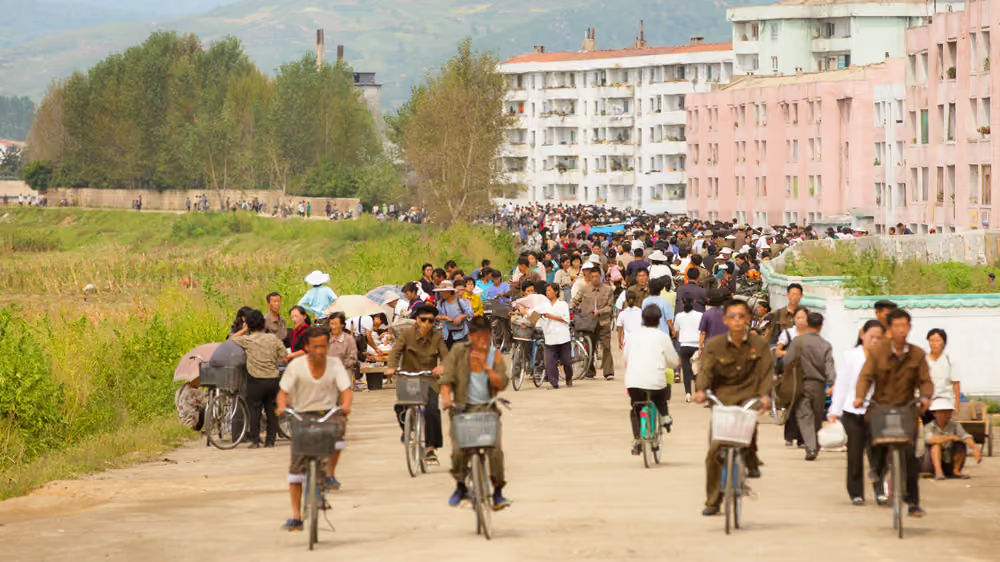
I believe there is a fundamental limitation in existing research on the North Korean economy, as much of it has traditional socialist planned economy analysis. Earlier studies have suggested that North Korea would either collapse or undergo a system transition as other socialist countries have done. However, after the breakdown of the Public Distribution System (PDS) in the mid-1990s and the emergence of the shadow economy (including through the Jangmadang—illegal markets), these approaches began to reveal their limitations.
As a result, the North Korean economy came to be understood not as a simple planned economy, but as a mixed economy in which state control and market activities coexist. However, these studies do not sufficiently explain why the North Korean regime allows marketization to persist at a certain level instead of completely suppressing it.
In order to explain the interaction between the government and ordinary North Korean citizens, who are the primary actors in Jangmadang activities, I divide the North Korean system into three groups: the regime, the elites, and ordinary citizens.
In particular, elites are important economic actors because they function as intermediaries between the regime and the people. My argument is that this phenomenon can be better understood by analyzing how these three groups strategically interact with one another.
These three groups pursue their interests in different ways, and their goals also differ significantly. The leadership wants to continue dynastic rule and ensure stable succession, the elite seek to secure their positions and avoid political risks such as purges, and ordinary citizens primarily seek survival and improved living conditions.
The interests of these three groups sometimes conflict with one another and sometimes align. In my opinion, these three groups in North Korea are currently remaining in a state of equilibrium.
This equilibrium means that these three groups can achieve their maximum interests under the current conditions in North Korea. Precisely because of this equilibrium, North Korea has been able to maintain both regime stability and limited marketization simultaneously.
That is why I believe we must identify what kind of shocks could cause this equilibrium to collapse. If such a change were to occur, it could become a new turning point for North Korea.
A new turning point for North Korea could lead the country toward a new political and economic order. The important thing is that we must identify what kinds of shocks could trigger such a transformation.
I hope for a North Korea that has changed—a place where its people can live freely. For me, North Korea is not just a state; it is my hometown, where I was born and raised, and where my family still lives. This is precisely why I am committed to a different approach to the North Korean issue—because my only goal is to see genuine change in North Korea, and I truly want to help bring about that change.
I want my article to inspire you to see something different the next time you watch the news or media coverage about North Korea. The next time you come across a piece of media about North Korea, I hope you take a moment to think about the real North Korean people. And perhaps you may also reflect on this article and consider what kinds of shocks could transform the current equilibrium of North Korea.
I hope you will join me on this journey.
–
HyeGyeong is a participant of the LiNK English Language Program (LELP), which serves to not only help North Korean defectors build confidence and skills in English, but develop their capacity as advocates for this issue. To that end, we partnered with select LELP “columnists” to write and polish personal essays through multiple rounds of external feedback and revision. Our goal is to have more North Koreans share their stories directly and lead efforts to change the narrative.
We believe the North Korean people can achieve their liberty in our lifetime.
Opportunities like LELP invest in the people building that future now. Help more North Koreans find their voice, reach their goals, and lead change on this issue.