
Disrupting the North Korean Regime’s Control: Increasing Information Access
North Korea is the most closed and isolated information environment in the world. The regime’s control hinges upon suppressing outside sources of information that could contradict or undermine their ideology. This makes their system of repression extremely effective; it also highlights a critical weakness, one that creates an opportunity for us to effect change inside the country.
Information is power. It enables people to scrutinize the world around them, hold governments accountable, and aspire towards a better life.
At Liberty in North Korea, we’re empowering people inside North Korea with tailor-made tools and technologies that increase their information access, and make that access safer and easier. But what does this actually look like? We asked our Chief Strategy Officer, Sokeel Park, to answer some frequently asked questions about our Information Access Programs (IAP).

1. Without the internet, is it really possible to increase information access inside North Korea?
Yes, absolutely. North Korean people are already accessing uncensored information and media without the internet, notably through USB drives and MicroSD cards that are smuggled into the country and spread through sharing networks. These contain K-dramas, movies, music, and information that the North Korean regime tries so hard to keep out of the country.
The devices and hardware are already in use, the demand is there, and the sharing networks and behaviour exists. The need and opportunity is to leverage and build on this, providing new technologies that will help North Korean people access more uncensored information more safely.
2. Isn’t enabling North Koreans to access illegal foreign media putting them in danger?
Accessing uncensored information is risky in North Korea, especially with increased crackdowns and punishments in recent years. Our technologies and digital security tools equip North Koreans to access information more safely.
North Korean people will continue to take risks for information and media that most people in the world would take for granted.
User security is our highest priority in our development process, and this is guided by North Korean defectors who left the country recently, understand the environment, and can advise us on the best ways to protect and empower North Korean people who are trying to access uncensored information.
3. What is LiNK doing to increase North Korean people’s access to information?
LiNK’s IAP work can be broken down into four areas of focus.
We develop lightweight, secure programs help more North Koreans access more uncensored information; protect North Korean users with digital security and anti-surveillance measures; create and curate strategic content that meet North Korean people’s needs and build resilience to the regime’s propaganda; and work with distribution partners to deliver these technologies and content packages to North Koreans as reliably, effectively, and safely as we can.

4. Why did LiNK decide to do Information Access work?
In a 2024 HanVoice Woorion survey of 500 North Korean refugees, 86.2% agreed that “it is important to increase the flow of information to North Korean people.” This is the most effective way that we can support change inside North Korea.
As an organization, LiNK is uniquely positioned to do this work. With our long history of rescuing and supporting North Korean refugees, we have the networks and ability to work closely with a variety of North Koreans, including recent defectors and people who studied and worked in IT in North Korea, who inform and help test our products and strategies from start to finish.
Crucially, because of the support of people like you, we are able to make strategic investments in projects that governments or other funders may not support, which enables us to pursue the most effective long-term strategy possible to support North Korean people to achieve their freedom.
5. What kind of information can North Koreans access, both legally and illegally?
Legally, North Korean people have access to official media which is extremely centrally controlled and produced. There are no newspapers, TV stations or media channels with an alternative viewpoint from the government, and all official media serves to reinforce the regime’s ideologies and narratives about the outside world, their own country and the leadership. This official media includes, for instance, newspapers, North Korean films and dramas, carefully selected foreign (eg. Russian) films, partially censored sports broadcasts, radio, speeches by the ruling Kim family, government-approved books, and government-approved mobile apps.
Illegally accessed information or media could theoretically include anything, but most commonly would be movies and TV dramas from South Korea, China and elsewhere, music, some e-books, and foreign radio broadcasts including news and documentary programs. Close to the border with China, some North Korean people have a smuggled Chinese smartphone that can be used to connect to the Chinese network and communicate with or get information from the outside world.
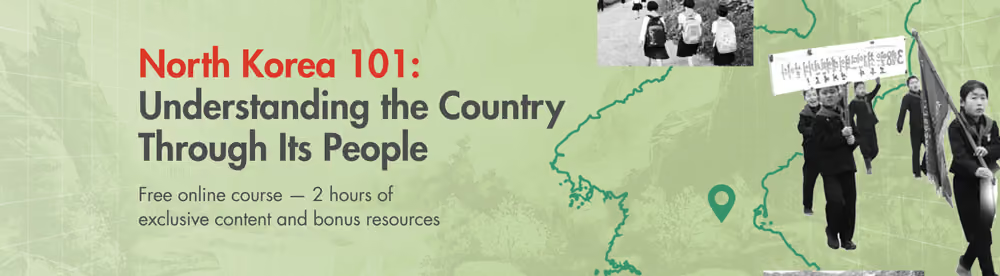
→ Want to learn more about life inside North Korea? Sign up for North Korea 101, LiNK’s free online course!
6. How do we know increasing North Korean people’s access to information will help change North Korea?
Hundreds of interviews with North Korean refugees conducted by LiNK, and thousands more by other organizations, consistently show how access to outside information reshaped their understanding of the world, undermined regime propaganda, and often was key in their decision to risk their lives and seek freedom. We also see the North Korean regime’s crackdowns on this access to outside information, especially in recent years, as evidence that the regime understands the power of information to undermine their control and change their country as well.
Throughout history, we’ve seen similar dynamics in other authoritarian countries, where greater access to uncensored information has consistently increased aspirations for freedom, expanded people’s sense of what was possible, and played a key role in people overcoming dictatorships and achieving freedom across the world.
It is inherently difficult to capture and measure the long-term effects of information, particularly in a country like North Korea. But when history, logic, the testimony of countless North Koreans, and careful product and strategy validation processes all point in the same direction, investing in increasing North Korean people’s access to information is not a leap of faith. It is the strongest, most evidence-based opportunity to help North Koreans shape their future and ultimately achieve their liberty.
–
In the first half of 2026, our IAP team successfully deployed new information-access technologies across one of the world’s most tightly controlled borders, and reached people inside North Korea.
We believe North Koreans deserve the freedom to access information and make their own choices, and we’re committed to helping them break through the regime’s surveillance and censorship. Increasing information access is one of the most effective ways that we can have a direct impact on North Korean people’s lives right now.
Help drive change from inside North Korea by investing in LiNK’s Information Access Programs.
Give Today
Crisis for North Korean Human Rights NGOs: Urgent Support Needed
The North Korean human rights movement is at a critical crossroads.
Unprecedented cuts to U.S. foreign aid under the Trump Administration have impacted projects around the world, including that of crucial South Korean NGOs working on the North Korea issue.
Until funding is fully resumed, these organizations face the prospect of downsizing or shutting down, threatening the entire ecosystem of groups working for the rights and freedom of North Korean people. Life-changing programs and decades of progress inside and outside North Korea are at risk of being undone.
Your immediate support is needed to help save the most critical projects of these organizations. LiNK has identified the core groups essential to preserving progress on this issue and has launched an emergency support fund—100% of donations will go directly to sustaining them through this crisis.
Historical Funding for North Korea-Focused NGOs
In the mid-1990s, reports of a devastating famine in North Korea and the first waves of refugees fleeing starvation caught the attention of South Korean activists. They travelled to the border of China to investigate and, realizing the severity of the situation, began campaigning in South Korea and internationally. For the first time, there was visibility on the humanitarian crisis and vast human rights violations happening in one of the most closed countries in the world.
In the wake of the Cold War, many politicians and governments had little interest in North Korea beyond seeing it as an emerging security problem. The widespread assumption was that the country would soon collapse, just as many other socialist countries had in the late 20th century.
To address the lack of action and attention, several groups focused on North Korean human rights emerged. Citizens Alliance for North Korean Human Rights was founded in 1996. NKnet was founded in 1998 and launched Daily NK in 2004. NKDB was established in 2003. Liberty in North Korea was founded in 2004.
From direct support for North Korean refugees, activism expanded to documenting human rights violations, raising public awareness, pressuring governments to take action, and getting outside information to people inside North Korea through broadcasts and USB smuggling. As the movement and North Korean defector population grew, new groups led by North Koreans themselves also emerged.
All organizations started with very few resources, and funding has often been an issue for groups in South Korea. Given the politicized nature of North Korea, support for activism has frequently fluctuated. When the political atmosphere aligned with this work, more funding would be available from the South Korean government. But when politics and administrations changed, grants dried up and public support would wane. In some cases, NGOs would even be subject to politically-motivated investigations, further hindering their vital work.
In late 2024, South Korean President Yoon’s martial law declaration and the subsequent impeachment proceedings once again left North Korean human rights organizations with a government unable to help, and a political environment not conducive to gaining support.
In these difficult circumstances, many groups in South Korea have come to rely on funding from international sources. As U.S. interest in the North Korea issue had grown in D.C., grants through the National Endowment for Democracy (NED) and the State Department (DRL) had become consistent and reliable sources of funding. Unlike those sometimes offered by the South Korean government, these grants covered not only the cost of activities, but also staff salaries, making it possible for these groups to operate sustainably.
U.S. government support had historically been immune to the kind of political winds that affected South Korean government funding. But recent US government disruption has left these NGOs on the brink.
U.S. Foreign Aid Freezes
The Trump administration started its second term with immediate cuts to U.S. foreign aid programs. State Department grants were frozen and the NED's funds were cut, suspending dozens of crucial grants to NGOs working on North Korea and leaving an uncertain picture of when or if funding might resume.
With the world’s largest economy, the U.S. was the biggest provider of foreign assistance by a significant margin. This loss of funding is unlikely to be replenished by other sources. Many European countries have also recently slashed their foreign assistance contributions to spend more on defense.
For South Korea-based NGOs, this funding disruption leaves a huge gap with very few options to fill it in South Korea or elsewhere. As a result, nearly all of these organizations are being forced to lay off staff, stop critical projects, and even consider the unthinkable: shutting down for good.
What This Means for LiNK & the Issue
LiNK is built on a funding model that is independent from government budgets, and is not directly affected by the recent aid freezes. But if the larger ecosystem of North Korean NGOs that we operate within diminishes or collapses, it will inevitably have an impact on the scope and efficacy of our work.
Even with an issue as big as North Korea, the community of organizations and individuals doing this work is relatively small. All our efforts are interconnected and mutually reinforcing. With many frontline NGOs now in danger, it jeopardizes progress on this issue as a whole.
LiNK relies on the research of these other groups to inform our programs. We join forces with them for international advocacy, share ideas, and consult each other on critical projects. With confidence in the vast array of work that these groups are doing, LiNK is able to be laser focused on a few select projects and maximize our impact.
Organizations like Human Rights Watch, UN agencies, global media outlets, and researchers also depend on these groups for their contacts, networks, research, and advocacy. Without their work and insights, globally we would be left in the dark about the current state of North Korea.
In South Korea, the individuals working on this issue are doing so with significant personal sacrifice. Given the unstable and politicized nature of the work, many activists have struggled to make a living wage, and face concern and criticism from their peers.
Funding through NED and DRL had just recently made it possible for some groups to pay staff a more sustainable salary. But even that relative stability is now gone. They have been left with no choice but to downsize and move out of offices. Staff have been laid off or put on unpaid leave. NGO leaders who have dedicated ten to twenty of their best years to this issue are now facing the prospect of leaving this field. Some feel that decades of work and effort may now abruptly end in failure.
At a time when North Korean people deserve more solidarity and support than ever, the community of activists working to mobilize and deliver that support is facing the worst crisis since the start of this movement in the 1990s.
Key NGOs in Crisis
Urgent Support is Needed
Our shared vision is bold. It not only deserves but will require a strong ecosystem of NGOs working together for the rights and freedoms of 26 million North Korean people.
You’ve stood with the North Korean people, and with us, and for that we’re deeply grateful. So we’re asking for your help. We have an opportunity to protect the progress we have made together on this issue, and to help save the most critical programs of these organizations.
Will you join us by making a donation today to ensure that this small community of dedicated organizations can continue their life-changing work?
Your donation could mean that a highly dedicated and skilled activist is not forced to look for other work. It could mean that a project inside North Korea, where the groundwork has already been laid, can be executed and finished. At this time of crisis, your donation will have an outsized impact. It is far more cost effective and efficient to preserve this work than to have to rebuild from scratch.
This campaign has concluded. Thank you for your support!










