
Foreign Media in North Korea - How Kpop is Challenging the Regime
Movies, TV shows, and music hold power. They’re a way for us to connect through common experiences, reckon with different sides of humanity, and revel in the beauty of being here at all. They transport us to another time and place- perhaps one of our imaginations- and most importantly, allow us to dream and imagine a limitless future.

In recent years, South Korean media and entertainment has gained international recognition. People like Hyun Bin and Son Yejin, the stars of popular Korean drama Crash Landing on You, have become household names, while Parasite swept the 2020 Academy Awards and music from K-pop groups like BTS are charting globally.
Meanwhile, just across the border, North Korea remains one of the most closed societies in the world. Yet even in the “hermit kingdom,” foreign media is accelerating empowerment of the people and change within the country!
Forced Isolation and the Regime’s Information Monopoly
The North Korean government has maintained power for decades through a system of imposed isolation, relentless indoctrination, and brutal repression. A complete monopoly on information and ideas within the country has been key- outside media threatens to challenge the legitimacy of their propaganda, and by extension, their control.
The 2014 United Nations Commission of Inquiry on Human Rights in North Korea reported an almost complete denial of the right to freedom of thought, conscience, and religion as well as of the rights to freedom of speech, opinion, expression, and association.
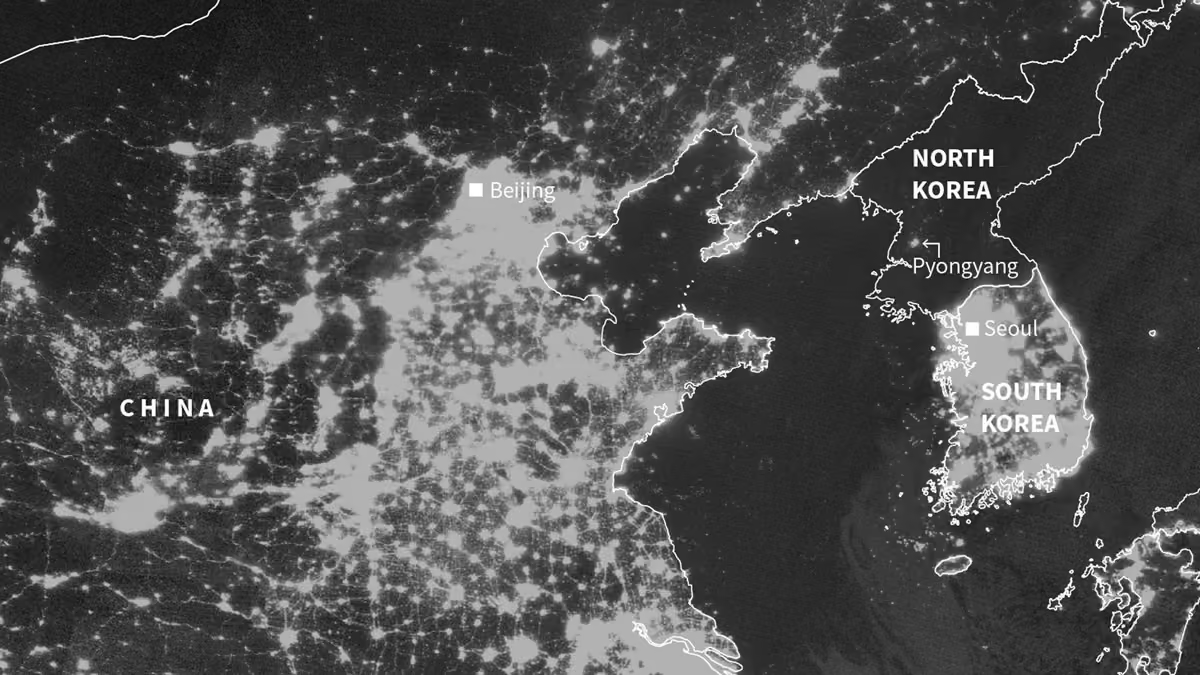
The regime employs a range of strategies to enforce information control:
- Restricting movement across borders and within the country
- Random house searches
- Severe punishment, including public executions, to deter foreign media consumption and sharing
- Sophisticated digital surveillance
- Jamming phone signals and locating users through signal triangulation
- Mobile OS file signature system that only permits government-approved apps and files
The Spread of Foreign Media
Despite this isolation and unparalleled internal restrictions, the North Korean people have been quietly changing their country from within, including through foreign media access. Through market activity and the movement of people and goods across the Chinese border, they have forced the gradual opening up of their society. Movies and music are smuggled into the country on USBs, SD and MicroSD cards, and small portable media players, offering illicit access to information from the outside world.
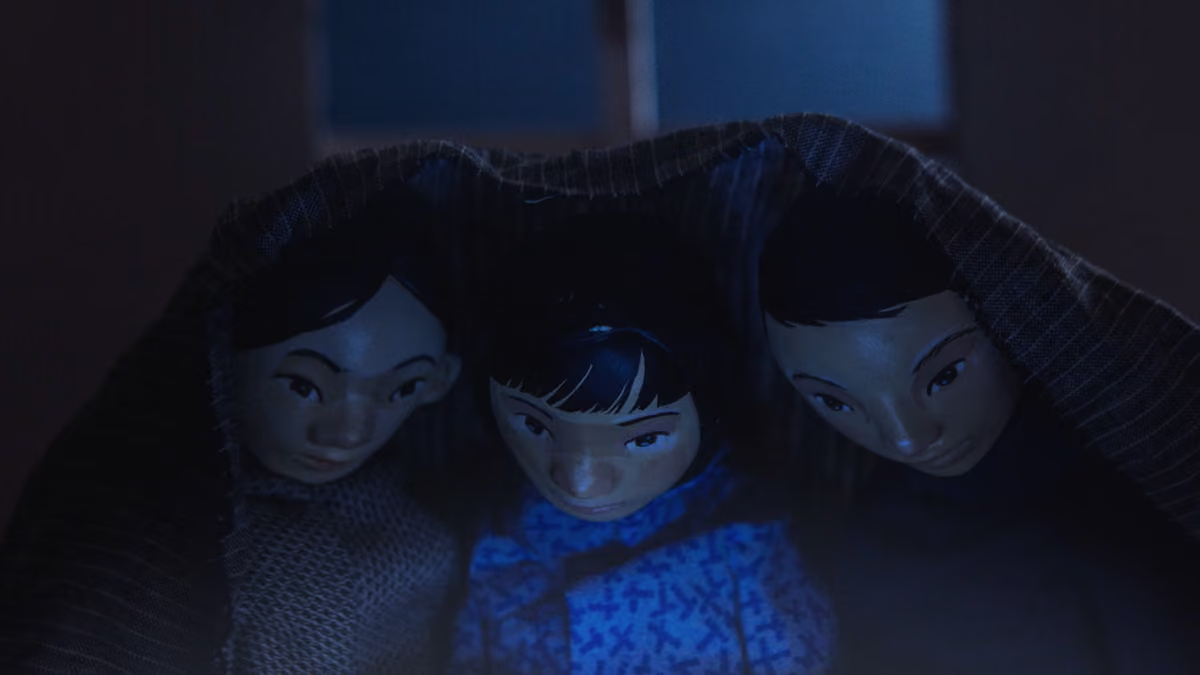
With lights off and windows shuttered, North Koreans will watch foreign media despite the risks. If all else fails, bribes are a way for people to reduce punishment if caught. Most North Korean police and government officials rely on bribes to survive, and some defectors complain that they are actually the biggest consumers of foreign media because they confiscate so much.
Information Technology in North Korea
Within North Korea, a broad range of information technologies are available, although they should be registered with authorities. Laptops and computers officially run on a government operating system, Red Star OS, while the North Korean intranet, Kwangmyong, is air-gapped from the internet and heavily surveilled. However, in practice, many North Koreans have non-networked devices used for games, editing software, watching videos, and to copy, delete and transfer media on removable devices.
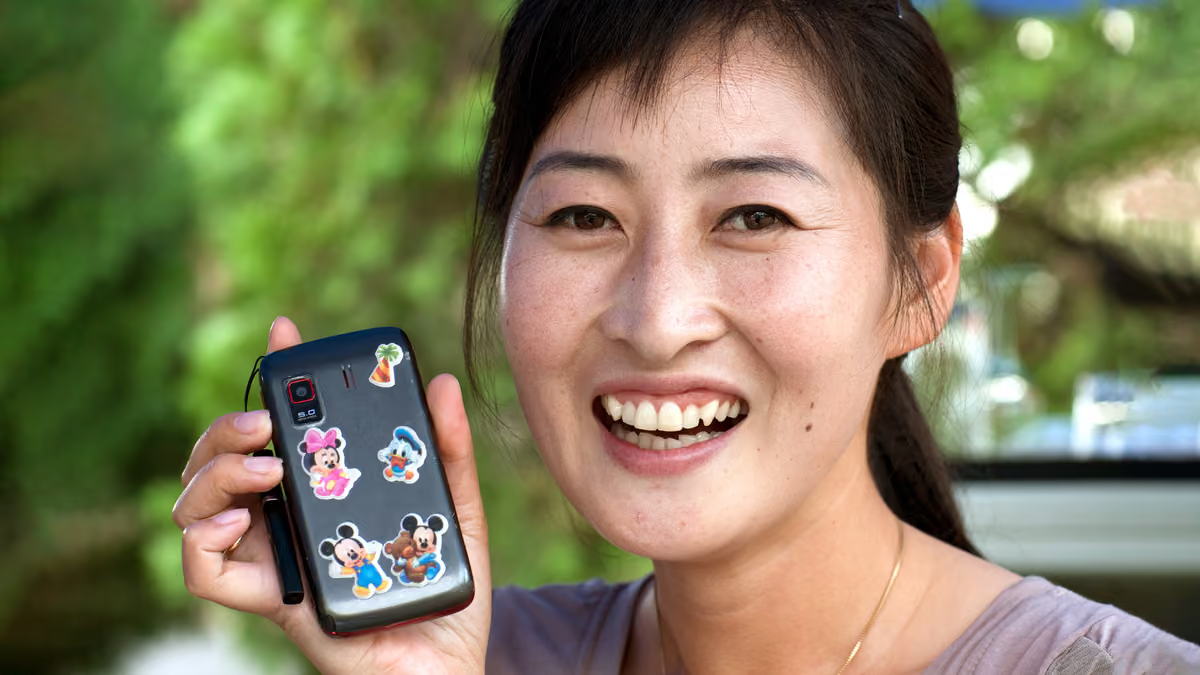
Mobile phones are also common with approximately 6 million on the North Korean network, meaning roughly 1 in 4 people have one. These North Korean phones generally cannot make international calls and the operating system limits users to approved state media (programs have been developed to bypass this security). On the other hand, smuggled Chinese phones can be used in border regions on the Chinese network. These have been crucial for staying in touch with relatives who have escaped or defected, who often send back money and information from the outside world.
Radios are the only channel of foreign media and news available real-time across the country. While they should officially be registered and fixed to North Korean stations, it is relatively easy to tamper with radio sets to pick up foreign broadcasts. In border regions, some TVs can also pick up live programming from South Korea and China. Traditionally, TVs were connected to DVD players, but newer LCD televisions also have direct USB input ports.
How Foreign Media Changes Perceptions
Among foreign media, entertainment from South Korea is particularly attractive, produced in the same base language by people with the same ancestry. They contain glimpses of rich and free realities just across the border. In comparison, domestic North Korean media seems old-fashioned and disingenuous, designed to reinforce the regime’s ideologies.
As North Koreans learn more about life, freedom and prosperity in the outside world, and their own relative poverty, the regime’s ideology and control are eroded.
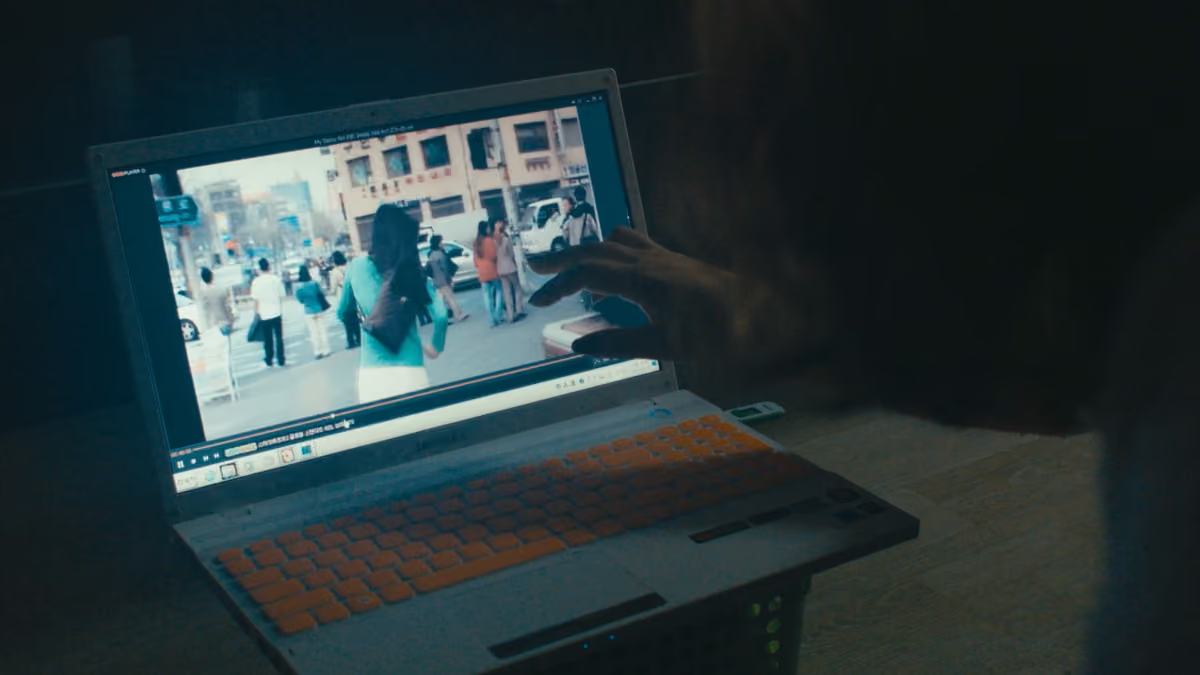
“At first you see the cars, apartment buildings, and markets and you think it must be a movie set. But the more you watch, there’s no way it can be just a set. If you watch one or two [movies] it always raises these doubts, and if you keep watching you know for sure. You realize how well South Koreans and other foreigners live.”
– Danbi, escaped North Korea in 2011
Empowered by foreign media, North Koreans are exploring their creativity and potential through everyday acts of resistance- using South Korean slang, copying fashion styles, and sharing pop culture references. In this culture war, Kim Jong-un has called for crackdowns on "unsavory, individualistic, anti-socialist behavior" among young people to restrict freedom of expression.
Foreign media also facilitates shared acts of resistance. People will swap USB devices with trusted friends and neighbors, increasing confidence in one another through a symmetrical transaction. Some people may also watch and discuss movies and shows together, increasing the media’s subversive influence and creating social networks.
The Regime’s Response
During the pandemic, we’ve seen unprecedented levels of isolation and restrictions, closing off the country more than ever before. To buttress control, Kim Jong Un has simultaneously increased crackdowns and punishments on foreign media consumption. In December 2020, the “anti-reactionary thought law” made watching foreign media punishable by 15 years in a political prison camp.
While the situation is harrowing, the government’s extreme response underscores the power of foreign media. The regime recognizes that social changes driven by North Korean people are a threat to their authority and control in the long term.
Accelerating Foreign Media Access and Change
Moving forward, increasing access to outside information is one of the most effective ways to help the North Korean people and bring forward change.
Information and technology support for North Korean people has historically been an under-utilized and under-invested strategy. LiNK Labs is our area of work focused on this opportunity- we’re developing technologies, networks, and content to empower North Korean people with access to information and ideas from the outside world.
The Bridge: The Role of North Korean Defectors in a Unified Korea in 2045
By: Eunsook Jang
Eunsook Jang holds a bachelor’s degree in Political Science from Korea University and a master’s degree in International Development from Brandeis University. A Fulbright Scholar and LiNK US Scholarship grantee, she is currently a research intern at the Hudson Institute, where her work focuses on post-conflict recovery, economic development, and human development. Her recent publications include “Slipping through the Cracks in South Korea: The Uncertain Futures for the Children of North Korean Defectors” with the Migration Policy Institute, and “Why Strengthening RFA Is a Strategic Imperative for US Policy on North Korea” in The Diplomat.
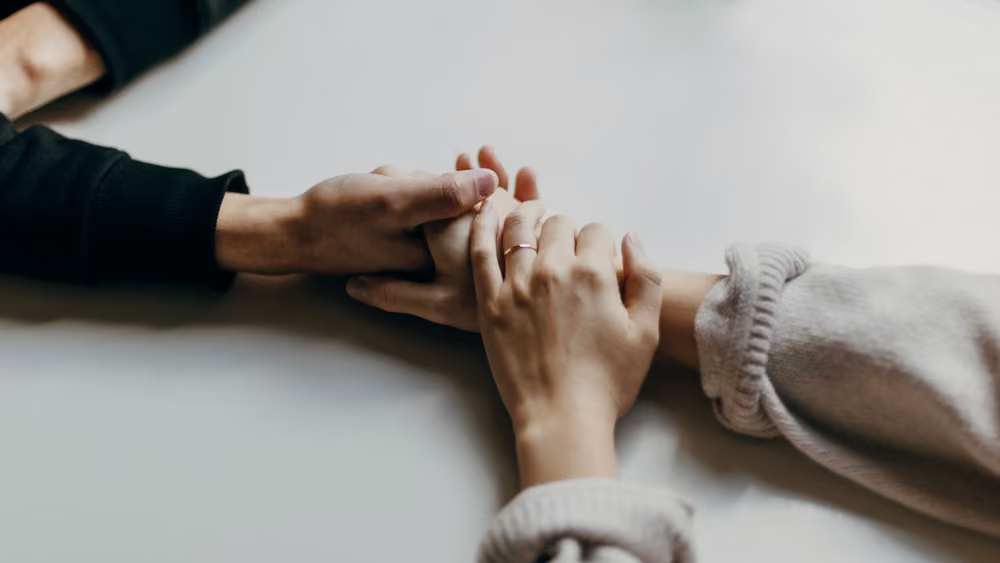
The door opens, and an elderly woman with white hair steps out. It is Emma's mother, Sun. Emma's voice fails her. She collapses into tears. Sun startles at the sound, turns toward Emma, and, in an instant, knows. It is her daughter.
"Euna!" her mother cries. The name no one had spoken aloud for thirty years. "Mom!" Emma answers, and they fall into each other’s arms.
Words fail them. They weep, touching each other's faces and hands as if to make sure the other is real. Emma feels with her palms the smaller body her mother now has, the sharp ridges of her shoulder blades, and cries harder.
"Look how you've grown," her mother manages through tears, cupping Emma's face in both hands. "You've become... a woman."
Emma pulls her closer. "Mom, I'm sorry. I left you alone." Her mother draws her in tighter, and murmurs into her hair: "You are here. You are alive. That is enough. I have missed you."
Sun had prayed to God every day for her daughter's new life, even without fully knowing religion itself.
For the first time since leaving, Emma cries in her mother's arms like a child.
And so for the next several hours, mother and daughter spend their time filling in thirty years of unshared life: how Emma met her husband Sam, how she spent each birthday without family, what it was like to settle into South Korean society.
After a while, Sun asks a kind of question Emma had not expected; a question filled with curiosity, hope, and all the images of South Korea she had imagined from afar.
“Is South Korea really like a K-drama?” Sun asks, her eyes sparkling.
"Yes, it often feels like it" Emma replies with quiet confidence. "I was able to study freely, for the life I wanted."
Sun shakes her head slowly, in something between disbelief and wonder. "To think, if you had stayed in North Korea, none of it would have been imaginable. Graduate school. A life like that. I suppose it really is a drama kind of place."
And yet not everything had felt like a drama. Settlement in South Korea had meant starting from zero: a political system unlike anything she knew, a language full of foreign words that made her feel dizzy just listening to it. She survived by studying fiercely and endured countless hours alone. It was the kind of loneliness that stayed at the back of the throat, the kind you feel when you fall ill and have no one to call, or when you achieve something and have no one to tell.
Emma takes her mother's hand. "Mom, everything will feel enormous and new at first. There will be moments when not knowing even small things makes you feel small too. But I will be there. So don't worry. We'll start this new life together."
As the words leave her mouth, she feels quietly grateful that she had gone through all of it first, knowing the path her mother is about to walk. And she finds herself already picturing it: the two of them sitting across from each other at her favorite pork belly restaurant Dwehyaji (돼야지), near Korea University, sharing a bottle of soju, talking until the night runs out. She smiles to herself at the thought.
The faces of the mentors and friends who had taught her culture and society drift through her mind, one by one, and she carries her gratitude for them again, as the sun goes down over Hyesan.
Emma falls asleep in the very spot where she slept as a child. It still feels like a dream. She closes her eyes, hoping she will not wake if it is.
Author’s note: I dedicate this piece to my father in South Korea, who has never once wavered in encouraging my studies, as if realizing through me the freedom to pursue the dreams that were taken from him. And to my mother, who remains in North Korea: This piece is my proof that your daughter has not turned away from your suffering, but is working, in her own small way, to fight against it. I hope to see you, even if only in my dreams tonight. I love and miss you beyond words.
–
Eunsook is a participant of the LiNK English Language Program (LELP), which serves to not only help North Korean defectors build confidence and skills in English, but develop their capacity as advocates for this issue. To that end, we partnered with select LELP “columnists” to write and polish personal essays through multiple rounds of external feedback and revision. Our goal is to have more North Koreans share their stories directly and lead efforts to change the narrative.
We believe the North Korean people can achieve their liberty in our lifetime.
Opportunities like LELP invest in the people building that future now. Help more North Koreans find their voice, reach their goals, and lead change on this issue.










