From North Korea to South Korea: Under the Big Dipper
By: Hyeyoung Woon
Hyeyoung Woon is a financial accounting professional who escaped North Korea in 2009. Through essays based on personal experience, Hyeyoung shares reflections on life in North Korea, the journey of defection, and adaptation to a new society.

There was a time when the night sky felt like the only place I could hold on to.
I grew up in a small city in the northern part of North Korea. As a child, my happiest moments were simple. Every night, my mother would tell me stories while I searched for the seven stars of the Big Dipper above us. Those stars felt constant and comforting, quietly watching over me as I fell asleep.
When I was seven years old, everything changed. As the economy in the North worsened, my parents had to leave, and I was sent to live with my grandparents. I did not know when they would return. They promised it would be soon, and that they would bring candy if I waited patiently. At first, I believed them. But days became months, and months became years. Waiting quietly became part of my life.
Years later, I was briefly reunited with my mother. But she was no longer the same person I remembered. Prison and hardship had changed her in a way I could not fully understand. We promised never to separate again, yet one morning she disappeared once more.
All she left behind was a letter, promising that one day she would take me to South Korea. That promise became my direction.
A few years later, a broker secretly contacted me in the middle of the night. Hidden in the mountains, through an illegal phone call, I heard my mother’s voice for the first time in years. From that moment, I decided to leave everything behind, I decided to follow her path out of North Korea.
The journey out of North Korea was filled with fear. When I reached Beijing airport, I was terrified as I boarded the plane to South Korea. But, for the first time in my life, I felt like I was finally moving toward something, instead of simply waiting.
And then, after years of waiting, I found her.
For a while, life felt almost normal. My mother taught me how to survive in a completely new world: how to study, how to adapt, and how to build a future in South Korea. Everything around me felt unfamiliar, but I was no longer alone.
Then life changed again.
While I was in university, my mother was diagnosed with liver cancer and given only one year to live. It felt unbearably cruel. And yet, that final year together became one of the most meaningful years of my life.
Before she passed away, my mother had one wish: to tell her own mother, “I love you.”
But in North Korean culture, those words are rarely spoken, and by then, it was already too late. All I could do was share my memories of my grandmother with her. As I spoke, I watched her eyes brighten with memories she could no longer return to.
Exactly one year later, she passed away.
Once again, I was left alone.
For a long time, I did not know how to continue living after my mother passed away. I had risked everything just to follow her, and suddenly the person who had been my destination was gone. I was alone again.
But slowly, I began to move forward.
Years later, when I traveled abroad, I often wished she could see those places too. In every new city, I quietly imagined her beside me.
Even now, when I look up at the night sky, I still search for the Big Dipper. Thinking about that time, my mother and I used to look at those seven stars together.
So much in my life has changed since then.
Countries have changed.
People have disappeared.
And time has carried us into completely different worlds.
But the Big Dipper remains. Quietly shining above us.
Sometimes, when I look at those stars, I still feel connected to her.
As if, even now, we are somehow looking at the same night sky from different worlds.
And, maybe, that is why the Big Dipper still comforts me.
It reminds me that some people never completely leave us.
–
Hyeyoung is a participant of the LiNK English Language Program (LELP), which serves to not only help North Korean defectors build confidence and skills in English, but develop their capacity as advocates for this issue. To that end, we partnered with select LELP “columnists” to write and polish personal essays through multiple rounds of external feedback and revision. Our goal is to have more North Koreans share their stories directly and lead efforts to change the narrative.
We believe the North Korean people can achieve their liberty in our lifetime.
Opportunities like LELP invest in the people building that future now. Help more North Koreans find their voice, reach their goals, and lead change on this issue.
Give Today
A North Korean Refugee’s Journey - Pursuit of the Freedom to Learn
By Yukyung Lim
Yukyung is a participant of LiNK’s Intensive English Program (LIEP), designed to build the capacity of North Korean English speakers at the intermediate level. In partnership with the British Council, LIEP aims to cultivate participants’ communication and critical thinking skills in English. LIEP is complementary to our broader LiNK English Language Program (LELP), which supports speakers of all proficiency levels.
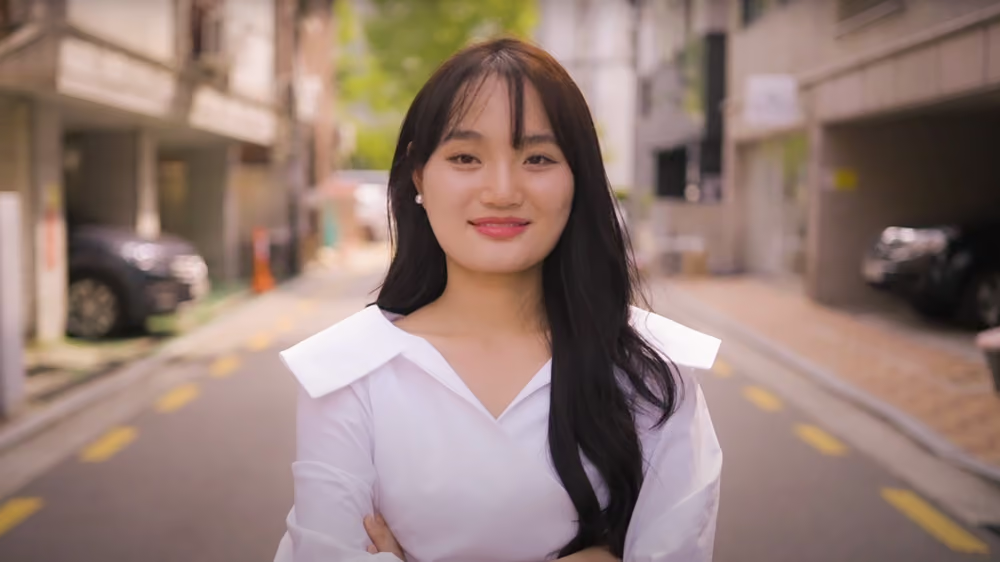
I was born in North Korea—a place where identities are imposed, voices are silenced, and dreams are tightly confined. There, schooling is not a pathway to opportunity but a means of indoctrination, designed to enforce obedience and suppress individuality. But thanks to my mother’s courage, I never had to undergo that system. She made the bold decision to keep me out of school in North Korea. At age eight, I escaped to China to reunite with her, beginning a journey that would define not only my identity but also my deep, lifelong yearning to learn.
In China, my mother obtained a false identity for me so I could enroll in school. That first day in a rural classroom marked the beginning of a different kind of life. I was behind, anxious, and constantly aware of our fragile situation.
For the first time, however, I was learning not to obey—but to think.
A year later, we moved to Beijing. There, I stepped into a world I had never imagined—one of academic rigor, intellectual freedom, and cultural diversity. It was in that environment that I first witnessed how learning can transform a person. Each lesson, each classroom conversation, opened doors not only to knowledge but also to self expression, confidence, and hope.
One winter afternoon in 2010, I was on my way to the bookstore, backpack heavy on my shoulders. Beijing was bleak and cold that year. Snowflakes fell softly, only to be crushed by cars and vanish into the grime of the streets. That scene reflected my life: I bore a name I couldn’t speak aloud, fears I couldn’t share, and a fragile existence that felt quietly lonely.
Inside the bookstore, warmth greeted me. I wandered through the aisles, searching for a quiet corner to rest. Then, I saw it—a book with a black-and-white cover, its portrait etched in solemn ink. The man’s composed expression exuded a power I longed for. I picked it up, almost unconsciously.
“I Have a Dream.”
“I have a dream that one day... people will not be judged by the color of their skin but by the content of their character.”
“This is the time to make real the promises of democracy.”
“We will not be satisfied until justice rolls down like waters and righteousness like a mighty stream.”
These weren’t just words. They were light, seeping through a crack I hadn’t known existed. In a world that had taught me to stay small and silent, they spoke to a part of me I had hidden away. For the first time, I felt truly seen—not for where I was from or what I looked like, but for my thoughts, my voice, and the quiet strength I carried within.
Later, after arriving in South Korea, I faced new challenges. Though I had returned to my cultural roots, I felt out of place. I was older than my classmates, unfamiliar with many social norms, and unsure of how to fit in. But with time, I began to build friendships and navigate this new society. Again, learning was central—it provided not just academic skills but also the social space to grow and belong.
During university, I studied abroad in Texas. It was my first experience in a Western classroom. I was struck by the openness, the individuality, and the value placed on diverse opinions. Being among students from different backgrounds showed me how perspectives can differ—and how that difference enriches everyone.
Wherever I was—in China, Korea, or the United States—the classroom was where I grew the most. It was where I stepped outside my comfort zone, gained confidence, and slowly came to understand who I was becoming.
Across all these countries, I’ve developed not just a global perspective but a deep appreciation for the transformative power of learning. In each setting, the classroom became both a battlefield and a sanctuary. I struggled, but I also discovered. I learned new languages, absorbed new worldviews, and came to realize that I was more than a refugee or survivor. I was a thinker, a student, and a human being with agency.
And then I understood something deeper: My story is rare—but it shouldn’t be. There are still millions of children in North Korea growing up without the right to question, to dream, or to imagine a world beyond their borders. They deserve more than silence or sympathy. They deserve the same chance I had—to envision a different future and be equipped to pursue it.
That’s why I’m sharing my story through Liberty in North Korea. Because stories hold power. They build bridges, shatter stereotypes, and create connections.
North Korean people are not just victims. They are potential scholars, leaders, creators, and changemakers—if only they are given the freedom to grow.
My dream is to one day build a global school for children who, like me, come from hardship but brim with promise. I want to help others discover the same sense of identity and possibility that learning gave me. Until then, I will continue to advocate, teach, and connect.
If you’re reading this, I hope you’ll join me. Learn more. Speak up. Share stories. Support organizations like LiNK that are fighting to empower North Korean people with freedom, dignity, and opportunity.
Because when you invest in a child’s education, you’re not only changing one life—you’re challenging an entire system and planting seeds for a freer world.
Opportunities like LiNK’s Intensive English Program (LIEP) are helping North Koreans succeed in resettlement, reach their goals, and lead change on this issue. Your support can help us continue to make an impact in the lives of North Korean refugees.