From North Korea to South Korea: Under the Big Dipper
By: Hyeyoung Woon
Hyeyoung Woon is a financial accounting professional who escaped North Korea in 2009. Through essays based on personal experience, Hyeyoung shares reflections on life in North Korea, the journey of defection, and adaptation to a new society.
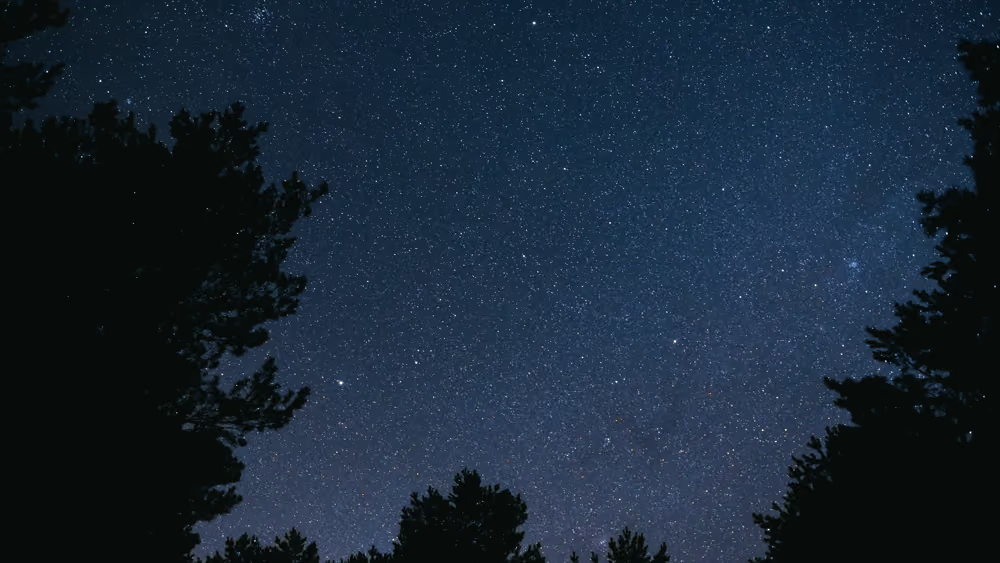
There was a time when the night sky felt like the only place I could hold on to.
I grew up in a small city in the northern part of North Korea. As a child, my happiest moments were simple. Every night, my mother would tell me stories while I searched for the seven stars of the Big Dipper above us. Those stars felt constant and comforting, quietly watching over me as I fell asleep.
When I was seven years old, everything changed. As the economy in the North worsened, my parents had to leave, and I was sent to live with my grandparents. I did not know when they would return. They promised it would be soon, and that they would bring candy if I waited patiently. At first, I believed them. But days became months, and months became years. Waiting quietly became part of my life.
Years later, I was briefly reunited with my mother. But she was no longer the same person I remembered. Prison and hardship had changed her in a way I could not fully understand. We promised never to separate again, yet one morning she disappeared once more.
All she left behind was a letter, promising that one day she would take me to South Korea. That promise became my direction.
A few years later, a broker secretly contacted me in the middle of the night. Hidden in the mountains, through an illegal phone call, I heard my mother’s voice for the first time in years. From that moment, I decided to leave everything behind, I decided to follow her path out of North Korea.
The journey out of North Korea was filled with fear. When I reached Beijing airport, I was terrified as I boarded the plane to South Korea. But, for the first time in my life, I felt like I was finally moving toward something, instead of simply waiting.
And then, after years of waiting, I found her.
For a while, life felt almost normal. My mother taught me how to survive in a completely new world: how to study, how to adapt, and how to build a future in South Korea. Everything around me felt unfamiliar, but I was no longer alone.
Then life changed again.
While I was in university, my mother was diagnosed with liver cancer and given only one year to live. It felt unbearably cruel. And yet, that final year together became one of the most meaningful years of my life.
Before she passed away, my mother had one wish: to tell her own mother, “I love you.”
But in North Korean culture, those words are rarely spoken, and by then, it was already too late. All I could do was share my memories of my grandmother with her. As I spoke, I watched her eyes brighten with memories she could no longer return to.
Exactly one year later, she passed away.
Once again, I was left alone.
For a long time, I did not know how to continue living after my mother passed away. I had risked everything just to follow her, and suddenly the person who had been my destination was gone. I was alone again.
But slowly, I began to move forward.
Years later, when I traveled abroad, I often wished she could see those places too. In every new city, I quietly imagined her beside me.
Even now, when I look up at the night sky, I still search for the Big Dipper. Thinking about that time, my mother and I used to look at those seven stars together.
So much in my life has changed since then.
Countries have changed.
People have disappeared.
And time has carried us into completely different worlds.
But the Big Dipper remains. Quietly shining above us.
Sometimes, when I look at those stars, I still feel connected to her.
As if, even now, we are somehow looking at the same night sky from different worlds.
And, maybe, that is why the Big Dipper still comforts me.
It reminds me that some people never completely leave us.
–
Hyeyoung is a participant of the LiNK English Language Program (LELP), which serves to not only help North Korean defectors build confidence and skills in English, but develop their capacity as advocates for this issue. To that end, we partnered with select LELP “columnists” to write and polish personal essays through multiple rounds of external feedback and revision. Our goal is to have more North Koreans share their stories directly and lead efforts to change the narrative.
We believe the North Korean people can achieve their liberty in our lifetime.
Opportunities like LELP invest in the people building that future now. Help more North Koreans find their voice, reach their goals, and lead change on this issue.
Give Today
Challenges of Freedom
Four North Korean defectors' experiences of resettling to South Korea.
It was the greatest country in the world. Sure, sometimes they saw people die from starvation and heard rumors of people disappearing into prison camps, but it was like that everywhere. At least that’s what they were told. But as foreign media started to spill into the country, they realized it wasn’t like that everywhere; they weren’t living in the greatest country in the world. A better life was out there and they knew they needed to leave to find it.
Every year, many North Koreans risk their lives to escape one of the world’s most oppressive regimes. They trek through jungles and over mountains, terrified of being caught and sent back. Once they finally reach freedom, they start over. New cultures, new opportunities, new challenges.
Here are four of their stories.

Ill Yong
Ill Yong opens Google Maps, trying to find a satellite image of his childhood house. This always makes him homesick. When he zooms in on his house, a blurry gray square surrounded by snow, he remembers the nearby waterfall and the summer days he spent playing there. But he also remembers how hard it was living in North Korea. His family listened to illegal South Korean radio every night but had to keep it hidden from friends and neighbors. If caught, they could have been sent to a political prison camp or even executed.
Ill Yong resettled to South Korea in 2009 and, even though his family was with him, starting over in a new country was challenging. The everyday moments took adjusting to. His first time at a buffet, Ill Yong was so overwhelmed by the massive amount of food that he just took a small bowl of rice. The first time he tried to use an escalator he was so confused about what to do that he jumped on at the bottom and then jumped off at the top. Ill Yong has now been in South Korea for nine years and is studying to become a Human Rights lawyer. A lot has changed since he first arrived (he now knows how to get on an escalator) but he still thinks about his old home in North Korea and hopes to see it again in person one day.

Noel
Noel came to South Korea in 2010 with a shy personality and a strong North Korean accent. She wanted to blend quietly into her new culture, but people constantly asked where she was from. School was also a struggle. In North Korea, she had dropped out after the first grade to stay home and help her mother. What she did learn at school was of little help in her new life. She was used to curriculum that focused on the Kim family. Determined to catch up, she began reading lots of books.
Noel is currently studying to become a writer and is no longer behind in school. Her new challenge is figuring out what to do with her freedom. Living in North Korea, she just followed the regime and did whatever she was told. It was the only option. Now, faced with endless choices, she knows that there is a responsibility that comes with freedom, and she wants to use it wisely.

Jessie
Jessie was overwhelmed. She was by herself in an unfamiliar country. So much was unknown: how to get around, where to study, how to make new friends, and even where to buy groceries. She wasn’t used to this new culture’s rules and norms. The first time she heard someone publicly criticize the South Korean president she was stunned. Freely expressing any negative thoughts about the regime was unheard of in North Korea.
Jessie now understands her new culture and loves her freedoms, especially being able to watch whatever dramas she wants without fear of punishment. South Korea has become her home, but she still longs for the day she can return to North Korea. Her parents have both passed away and she wants to go and pay her respects in person.

Geum Hyok
Geum Hyok stood by himself in an empty apartment wondering if he made a mistake. He had no friends and no family there to reassure him. Feeling lonely but determined to make a life for himself, he started classes at Korea University where he met people who were kind to him and checked on him regularly. Their friendship helped him not feel as lonely. Except for the couple times he was turned down for a job because they didn’t want to hire a North Korean, most people were welcoming to him. But what surprised him most was how many South Koreans didn’t know what was happening in North Korea. Geum Hyok didn’t blame them, he knew humans rights was complicated. But it was still disappointing.
Now, Geum Hyok is studying politics and diplomacy and enjoys having the freedom to do what he wants. He no longer questions his choice to escape but he does think about his loved ones still in North Korea. He especially misses his mother whom he hasn’t seen or spoken to in eight years. He is waiting for the day North Korea finally opens so they can be reunited.