From North Korea to South Korea: Under the Big Dipper
By: Hyeyoung Woon
Hyeyoung Woon is a financial accounting professional who escaped North Korea in 2009. Through essays based on personal experience, Hyeyoung shares reflections on life in North Korea, the journey of defection, and adaptation to a new society.
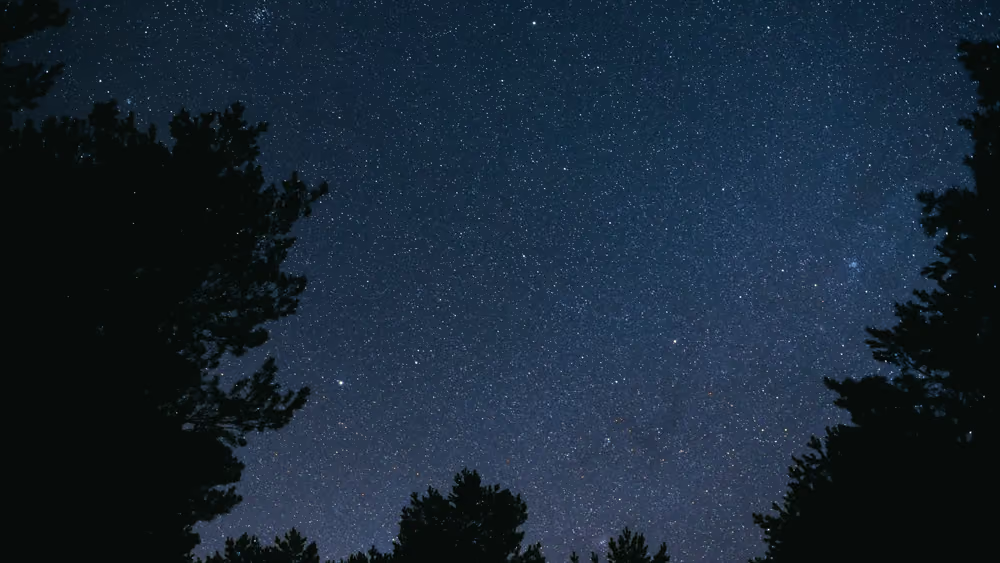
There was a time when the night sky felt like the only place I could hold on to.
I grew up in a small city in the northern part of North Korea. As a child, my happiest moments were simple. Every night, my mother would tell me stories while I searched for the seven stars of the Big Dipper above us. Those stars felt constant and comforting, quietly watching over me as I fell asleep.
When I was seven years old, everything changed. As the economy in the North worsened, my parents had to leave, and I was sent to live with my grandparents. I did not know when they would return. They promised it would be soon, and that they would bring candy if I waited patiently. At first, I believed them. But days became months, and months became years. Waiting quietly became part of my life.
Years later, I was briefly reunited with my mother. But she was no longer the same person I remembered. Prison and hardship had changed her in a way I could not fully understand. We promised never to separate again, yet one morning she disappeared once more.
All she left behind was a letter, promising that one day she would take me to South Korea. That promise became my direction.
A few years later, a broker secretly contacted me in the middle of the night. Hidden in the mountains, through an illegal phone call, I heard my mother’s voice for the first time in years. From that moment, I decided to leave everything behind, I decided to follow her path out of North Korea.
The journey out of North Korea was filled with fear. When I reached Beijing airport, I was terrified as I boarded the plane to South Korea. But, for the first time in my life, I felt like I was finally moving toward something, instead of simply waiting.
And then, after years of waiting, I found her.
For a while, life felt almost normal. My mother taught me how to survive in a completely new world: how to study, how to adapt, and how to build a future in South Korea. Everything around me felt unfamiliar, but I was no longer alone.
Then life changed again.
While I was in university, my mother was diagnosed with liver cancer and given only one year to live. It felt unbearably cruel. And yet, that final year together became one of the most meaningful years of my life.
Before she passed away, my mother had one wish: to tell her own mother, “I love you.”
But in North Korean culture, those words are rarely spoken, and by then, it was already too late. All I could do was share my memories of my grandmother with her. As I spoke, I watched her eyes brighten with memories she could no longer return to.
Exactly one year later, she passed away.
Once again, I was left alone.
For a long time, I did not know how to continue living after my mother passed away. I had risked everything just to follow her, and suddenly the person who had been my destination was gone. I was alone again.
But slowly, I began to move forward.
Years later, when I traveled abroad, I often wished she could see those places too. In every new city, I quietly imagined her beside me.
Even now, when I look up at the night sky, I still search for the Big Dipper. Thinking about that time, my mother and I used to look at those seven stars together.
So much in my life has changed since then.
Countries have changed.
People have disappeared.
And time has carried us into completely different worlds.
But the Big Dipper remains. Quietly shining above us.
Sometimes, when I look at those stars, I still feel connected to her.
As if, even now, we are somehow looking at the same night sky from different worlds.
And, maybe, that is why the Big Dipper still comforts me.
It reminds me that some people never completely leave us.
–
Hyeyoung is a participant of the LiNK English Language Program (LELP), which serves to not only help North Korean defectors build confidence and skills in English, but develop their capacity as advocates for this issue. To that end, we partnered with select LELP “columnists” to write and polish personal essays through multiple rounds of external feedback and revision. Our goal is to have more North Koreans share their stories directly and lead efforts to change the narrative.
We believe the North Korean people can achieve their liberty in our lifetime.
Opportunities like LELP invest in the people building that future now. Help more North Koreans find their voice, reach their goals, and lead change on this issue.
Give Today
The Making of 'I Am Sun Mu' – an Interview with Director Adam Sjoberg

Filmmaker and photographer Adam Sjoberg has been working for the last two and a half years on a new documentary about our friend and renowned resettled North Korean artist Sun Mu. The film, titled I Am Sun Mu, follows Sun Mu as he prepares a new exhibition. We have known Adam for a while—he directed Danny From North Korea—but he is also known for previous works such as Shake the Dust and many other internationally-recognized films.
Check out our interview below with Adam on his most recent documentary.

When did you begin working on I Am Sun Mu?
Justin Wheeler introduced me to Sun Mu in January of 2013. We had dinner and discussed the possibility of doing a documentary about his life and work. Because Sun Mu can’t show his face and has to go to great lengths to protect his identity, he was understandably careful about getting involved in a feature film about his life. However, because of the long-term relationship he’s built with LiNK, and my approach to filmmaking, he decided it was a good partnership. I’m super thankful that he said yes. A year after we initially met, he was invited to China to show his work in a solo exhibition. This was an unprecedented event for a North Korean artist—and a bold decision on the part of the curator. I decided this was a perfect opportunity to film him and use the exhibit as a narrative arc with which to tell the rest of his story.
What was your favorite part of the process?
The whole filming process has been a joy to work on. I loved some of the quieter moments of filming it when it would just be Sun Mu and me in his studio. He would be painting or working away on a piece, and I would just be a “fly on the wall” filming. That collaborative effort was really inspiring. I’ve also loved working with a team of creatives that are so talented. Mariana Blanco, our editor, has been crucial to getting the film completed. Ryan Wehner has been making some beautiful animations of Sun Mu’s work that really help bring Sun Mu’s back-story to life. And composer Joel P. West has been working on a unique and beautiful thematic score to round out the film. I love working as a team with people that inspire me.

What are some cool things you learned while you filmed?
There has been so many things that I’ve learned. I already had a basic knowledge of the history of the Korean peninsula, but I’ve learned even more about it—as well as the nuances of the Kim’s rule and influence on every portion of North Korean life. Hearing Sun Mu discuss his life in North Korea, as well as his process of “un-brainwashing” after he left was fascinating. But most importantly, developing a friendship with Sun Mu over the last two years has helped me see past the politics and stereotypes surrounding the issue. Part of the beauty of Sun Mu’s paintings is that they don’t sit in any particular political space. He misses his homeland and longs for a more idealized, free North Korea. His work reflects his torn heart: He is not North Korean or South Korean. He’s simply Korean, which is why so many of his paintings focus on the idea of reunification, which is often seen as an archaic solution to the future of the two Koreas. But I don’t think he’s painting about reunification because he’s sure it will happen, only that he hopes it will.
What was most challenging for you with creating the documentary?
I don’t want to give too much away, but things did not go as expected at Sun Mu’s exhibit. That created safety and security challenges. Beyond that, making a feature-length film is a tough job. There are so many parts of Sun Mu’s life that I wish I could tell. The more I filmed him, the more I wanted to include. But in the end, you have to decide what stories push the overall narrative forward and keep people interested. It was tough to lose some scenes, but there are always DVD extras!

Do you have a favorite scene?
Can I pick two? My favorite is probably a scene where Sun Mu describes the day he escaped. It’s mostly a compilation of his paintings brought to life with animation. Afterwards, Sun Mu sings a song while playing the guitar that he used to play back in North Korea. Another favorite scene is of Sun Mu painting with his daughters. He then describes a couple of paintings he made of them—one of which is of his oldest daughter holding a “letter that cannot be sent” to her grandmother. It’s powerful.
Why do you create documentaries? Why did you choose to do this one in particular?
I create documentaries because I have a passion for helping people tell their stories. I love the genre because of how it opens up people’s eyes to the world. Ever since getting involved with Liberty in North Korea back in 2010, I’ve been interested in this issue. The crisis in North Korea is often overlooked, thought of only in terms of its politics, and is considered by many to be a complicated “cause” in which to be involved. I’ve worked with commercial brands that haven’t wanted to align themselves with LiNK because their manufacturing is in China. But it’s one of the greatest ongoing tragedies in the world today—and I’m proud to be associated even a little bit with what LiNK is fearlessly doing.

Who is this documentary for?
Hopefully it’s for everyone. We tried to make a film that is not just about North Korea, but about a person—an artist. It has a little bit of everything in it: a few laughs, a story of family, a story of escape, and a story of an artist trying to make it. Sun Mu is a very poetic person, and so I think people will be drawn in by his narrative.
What are you most excited for people to see in the documentary?
The climax of the film is pretty exciting and emotional, but I’m most excited for people just to get to know Sun Mu.
Why should people watch this? Why is this important?
As I’ve mentioned above, this is an issue that is often only seen in the media regarding it’s politics, or else in comedies or shock-docs. I want people to see a more human side: to not walk away thinking of the Kims, but of the many people in North Korea who live under one of the most oppressive regime in the world. Not just of their plight, but of their potential.
Where/when can someone see the documentary?
There will be a website up soon with more information. It will take some time before we secure international and domestic distribution. Stay tuned to what LiNK is doing. We’ll try to keep everyone in the loop once it’s out for the world to see!
UPDATE: January 2017! We're excited to announce that I Am Sun Mu is now available on Netflix, iTunes, Amazon, YouTube, and other video on demand platforms! Watch it, rate it, and share!
Want some of Sun Mu's art for your home? Check out the Sun Mu canvas prints on the LiNK Shop!