From North Korea to South Korea: Under the Big Dipper
By: Hyeyoung Woon
Hyeyoung Woon is a financial accounting professional who escaped North Korea in 2009. Through essays based on personal experience, Hyeyoung shares reflections on life in North Korea, the journey of defection, and adaptation to a new society.

There was a time when the night sky felt like the only place I could hold on to.
I grew up in a small city in the northern part of North Korea. As a child, my happiest moments were simple. Every night, my mother would tell me stories while I searched for the seven stars of the Big Dipper above us. Those stars felt constant and comforting, quietly watching over me as I fell asleep.
When I was seven years old, everything changed. As the economy in the North worsened, my parents had to leave, and I was sent to live with my grandparents. I did not know when they would return. They promised it would be soon, and that they would bring candy if I waited patiently. At first, I believed them. But days became months, and months became years. Waiting quietly became part of my life.
Years later, I was briefly reunited with my mother. But she was no longer the same person I remembered. Prison and hardship had changed her in a way I could not fully understand. We promised never to separate again, yet one morning she disappeared once more.
All she left behind was a letter, promising that one day she would take me to South Korea. That promise became my direction.
A few years later, a broker secretly contacted me in the middle of the night. Hidden in the mountains, through an illegal phone call, I heard my mother’s voice for the first time in years. From that moment, I decided to leave everything behind, I decided to follow her path out of North Korea.
The journey out of North Korea was filled with fear. When I reached Beijing airport, I was terrified as I boarded the plane to South Korea. But, for the first time in my life, I felt like I was finally moving toward something, instead of simply waiting.
And then, after years of waiting, I found her.
For a while, life felt almost normal. My mother taught me how to survive in a completely new world: how to study, how to adapt, and how to build a future in South Korea. Everything around me felt unfamiliar, but I was no longer alone.
Then life changed again.
While I was in university, my mother was diagnosed with liver cancer and given only one year to live. It felt unbearably cruel. And yet, that final year together became one of the most meaningful years of my life.
Before she passed away, my mother had one wish: to tell her own mother, “I love you.”
But in North Korean culture, those words are rarely spoken, and by then, it was already too late. All I could do was share my memories of my grandmother with her. As I spoke, I watched her eyes brighten with memories she could no longer return to.
Exactly one year later, she passed away.
Once again, I was left alone.
For a long time, I did not know how to continue living after my mother passed away. I had risked everything just to follow her, and suddenly the person who had been my destination was gone. I was alone again.
But slowly, I began to move forward.
Years later, when I traveled abroad, I often wished she could see those places too. In every new city, I quietly imagined her beside me.
Even now, when I look up at the night sky, I still search for the Big Dipper. Thinking about that time, my mother and I used to look at those seven stars together.
So much in my life has changed since then.
Countries have changed.
People have disappeared.
And time has carried us into completely different worlds.
But the Big Dipper remains. Quietly shining above us.
Sometimes, when I look at those stars, I still feel connected to her.
As if, even now, we are somehow looking at the same night sky from different worlds.
And, maybe, that is why the Big Dipper still comforts me.
It reminds me that some people never completely leave us.
–
Hyeyoung is a participant of the LiNK English Language Program (LELP), which serves to not only help North Korean defectors build confidence and skills in English, but develop their capacity as advocates for this issue. To that end, we partnered with select LELP “columnists” to write and polish personal essays through multiple rounds of external feedback and revision. Our goal is to have more North Koreans share their stories directly and lead efforts to change the narrative.
We believe the North Korean people can achieve their liberty in our lifetime.
Opportunities like LELP invest in the people building that future now. Help more North Koreans find their voice, reach their goals, and lead change on this issue.
Give Today
Love and Dating ... in North Korea
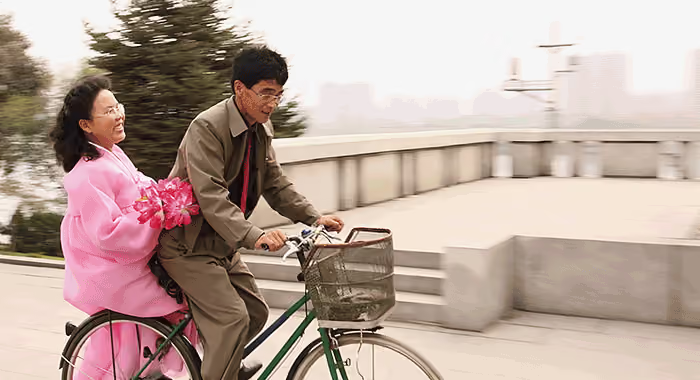
This updated version of Love & Sex in North Korea was originally written by LiNK for Koreaboo.
According to historians who are really good at remembering when things happened in the olden days, sex and love existed before the Internet was even invented. Before 56K dial-up, phones, and even Tinder, humans found ways to interact completely offline and engage in sexual activity. In fact, biologists believe that the human proclivity for sex is universal and plays a major role in producing baby humans, thereby maintaining the human race’s existence. (Go humans!)
So could it be that in North Korea too, people have sex and fall in love and do romantic things with each other?
According to North Korean refugees that I’ve worked with, the answer is: Yes. North Koreans have sex too.
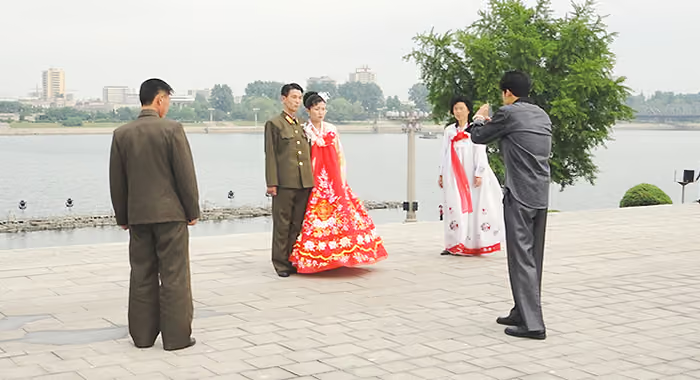
So, how do North Koreans do it?
First of all, the baseline to understand is that overall North Korean dating culture is pretty traditional and conservative. Think South Korea, but 50 years ago. One of the reasons for this is, well, North Korean society is quite conservative and patriarchal in general and North Korean media is super old-fashioned. In North Korean films you don’t see couples kissing or being physically affectionate with each other, so many North Koreans are just not used to PDA and wouldn’t dream of being too affectionate or kissing in public.
Nonetheless North Koreans do meet and date and fall in love like everywhere else. A lot of it starts in school (awww) and people also meet at dances or house parties. That’s right, when the parents are out of town young urban North Koreans will often invite a bunch of friends over and have a party. Once ‘the eyes have met’ the boy often has to do a lot of the pursuing. And guys, spare a thought for our brothers there: Only about 10% of North Koreans have a mobile phone. So for most, it has to be done the old fashioned way.
Either you have to pre-arrange to meet ‘10 trees away from the school gate at 7pm on Wednesday’ or you have to take the risk of going to their house. The danger, of course, is that you knock on the door and their mother answers, causing all that (traditional Asian) embarrassment. So a common trick is to knock and wait for someone to call out “Who is it?” If it’s the mother you say “I’ve come for Eun-kyung” (even though your girlfriend’s name is something else) and pretend you got the wrong house. If your girlfriend answers, then you can say, “It’s me! Come out!” Nicely done.
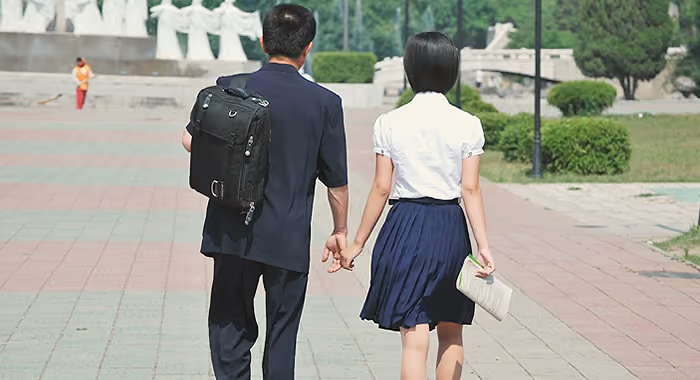
Finding a place to date isn’t so hard; people hang out in the park, or by the river, or around the market. But it’s when you need a bit more privacy that things get more difficult. The vast majority of young North Koreans live in their parents house until they get married (even more so than South Koreans) so there is no privacy at home. So when the relationship heats up, young couples will often go to the North Korean equivalent of a love motel, which is basically paying a middle-aged women to clear out of their own house for a few hours so the couple can get it on. A more risky space for a frisson might be a storage room with an unlocked door, or even a train toilet.
However, there’s a problem here...well, a few in fact. Sex education is almost non-existent in North Korea. And contraceptive pills and condoms can be hard to come by, too (you can’t just stop by the closest 24-hour convenience store). I have a friend who used to smuggle goods from China to sell in North Korea, and she says she saw a pregnancy test for the first time in 2007. She of course promptly smuggled some in to sell to North Korean women. This combination of factors unfortunately leads to a lot of unplanned pregnancies and risky abortions amongst unmarried women.
Like other aspects of North Korean culture, dating culture is not static. And as with other social changes, one of the major drivers is the influx of foreign media being smuggled in on DVDs and USB drives, and now even Micro-SD cards. In fact, one of the reasons South Korean dramas and films are so popular is because, in contrast to North Korean government-produced films, they show compelling human stories of love and relationships, and have addictive plotlines. If all you had access to was government propaganda your whole life and then suddenly you heard that your friends had access to this amazing new foreign stuff, you might risk watching it too.
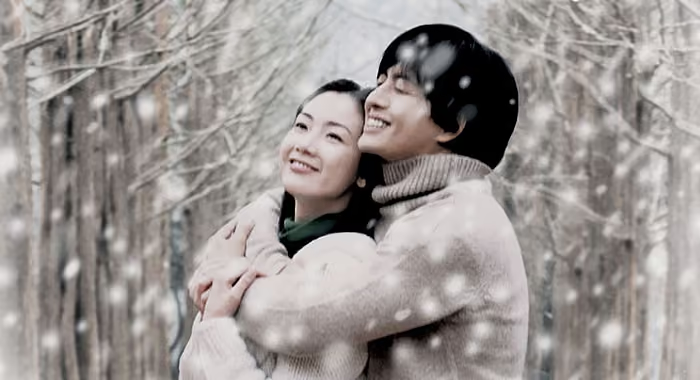
In the first few viewings, these simple South Korean soaps can be revelatory: The PDA, the attitudes of the female characters, even the way they talk and dress. The love story in the Korean drama Winter Sonata, which is credited with starting the Korean Wave across Asia, is still remembered fondly by many North Korean refugees.
Similarly when My Sassy Girl was smuggled in many young women who watched it were driven to imitate not just Jeon Ji-hyun’s fashion and hairstyle, but also the confident and cool way in which her character treats her boyfriend. (And of course in the background of these films and dramas, North Korean viewers can’t help but notice that South Korea looks way richer than North Korea). These information changes are confounding economic changes in their effects on gender relations, as bottom-up marketization has raised the status of women as they play a key role in illegal and semi-legal entrepreneurial business activities.
Humans being humans, porn is also being smuggled into North Korea. And without getting too PG-13, it would be fair to assume that this also opens up and accelerates changes in behaviour between the sheets as well.
It’s worth noting that despite a big growth in flows of foreign media over the last 10 years it is still limited, and especially in the countryside and in the interior of the country away from the border with China, people have much less access (if at all). So there is huge regional variation in North Korea and dating culture will still be very traditional and conservative in the countryside, whilst changing rather quickly in Pyongyang and other major cities and border towns. In addition, young Pyongyangites also mostly have mobile phones now, meaning fewer nervous knocks on doors.
Because of the government’s ongoing restrictions on culture and extreme paranoia over foreign media, North Korea was late to the sexual revolution. But it is now happening, and it is no trivial matter. The emulation of dating culture learned through South Korean and other foreign media, particularly among young urban North Koreans, is contributing to increased sensitivity to foreign trends and a liberalization and modernization of culture and society from the bottom up. And in the long run, it’s this kind of social change that will help usher in a wider transformation and opening of North Korean society, to the benefit of the North Korean people and humanity as a whole.
--SOKEEL PARK - director of research and strategy