How Has the Kim Family Held on to Power So Long?
The following content is adapted from North Korea 101, LiNK’s FREE online course that explains what's happening in North Korea beyond the headlines. Start learning today.
Sign up for NK 101
“This question is fundamental. To understand where we are and where we might be heading, we have to understand where we’ve come from.” – Sokeel Park, LiNK CSO
The North Korean regime is the world’s worst dictatorship, an extreme remnant of 20th century authoritarianism that has stretched across eight decades and three generations of the ruling Kim family. The regime’s all-encompassing system of control constrains the North Korean people’s agency and potential, resulting in an enforced poverty which includes physiological, material, social, informational, and cultural deprivations.
It is not easy for dictators to maintain power for long. During the Kim family’s rule, the world has seen the rise and fall of dozens of other dictatorships. Through many periods of global change and internal instability, they’ve managed to maintain power not by sheer force or luck, but through an array of adaptive strategies. But when the media portrays Kim Jong Un as crazy or irrational, it undermines our understanding and approaches to try to undermine that dictatorship.
There is a formula to their approach, and if we can understand it, then we can counteract it.
The Four Ways Dictators Lose Power
Historically, the fall of dictators can be attributed to four factors. By looking at each of them, we can see how the ruling Kim family has strategically avoided these fates.
1. Military Defeat/International Intervention
An external country or force intervening and overthrowing a dictator through military defeat.
2. Elite Challenges
An internal challenge emerging from within the country’s top political or military circles, forcibly removing the current dictator by assasination or a coup d'état,
3. Popular Uprising
An internal challenge from below, where a mass movement forces a change in leadership. In some cases, parts of the elite may join the side of the masses.
4. Death in Office
The death of the current leader, opening up an opportunity for someone else to assume control and end the dictatorship or make significant changes.
Threat #1: Preventing Military Overthrow
To prevent an external power from overthrowing their dictatorship, the Kim family first needs a strong deterrent against military force. The vast majority of mainstream news coverage of North Korea focuses on one thing: nuclear weapons. Having nuclear weapons and being seen as potentially willing and able to use them is arguably the most effective way to deter a military intervention from the outside.
Second, the Kim family has strategically managed their relations with countries like the Soviet Union / Russia, China, the United States, and South Korea. They go back and forth between periods of warmer and colder relations, effectively balancing opportunities and risks to gain support while preventing too much external influence. It’s unlikely that the Kim family has ever really trusted any of these external powers, even those that are sometimes labelled as “allies”.
Threat #2: Preventing Elite Challenges
Historically, the position of dictator can be very tempting to others within the leadership’s orbit, from competing family members to senior politicians or military leaders. To prevent anyone from building too much power and becoming a threat, the ruling Kim family carefully manages elite politics, alternating between demoting, promoting, and purging top officials.
On top of that, cross-layered surveillance between different institutions also keeps potential challengers under surveillance and in check, and prevents any one person or group of people from launching a challenge for power.
Threat #3: Preventing Popular Uprisings
The next scenario that the regime must prevent is a popular uprising.
A common conception of North Korea is that if the people wanted to rise up and revolt, they would have, and so they must be brainwashed or bought into the regime’s ideologies. While the latter may be true to some degree, it's difficult to fully grasp the extent to which the government’s system of control deprives people of their agency and potential and prevents them from challenging dictatorial rule.
North Korea is the most closed country in the world. The regime has forcibly cut off North Koreans from the rest of humanity, which serves as the baseline for their control. This centers everything—social structure, daily life, resources, information—around the regime, and eliminates sources that could undermine or threaten their authoritarian rule.
Laying the Foundation: Kim Il Sung’s Half-Century in Power
Kim Il Sung was 33 years old when he was installed into power by the Soviet Union—very young in global politics at the time, when most leaders were in their 50s and 60s. This historical happenstance has ended up being a key factor in the longevity of the Kim family’s control.
From his rise to power in 1945 to his death in 1994 at the age of 82, Kim Il Sung had 49 years to mold North Korea’s politics and systems in his image. During this time, he laid the foundation for hereditary succession by:
- Centralizing power around this dictatorship.
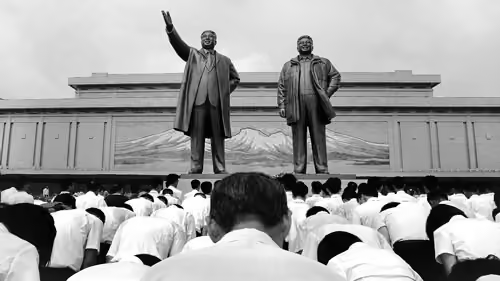
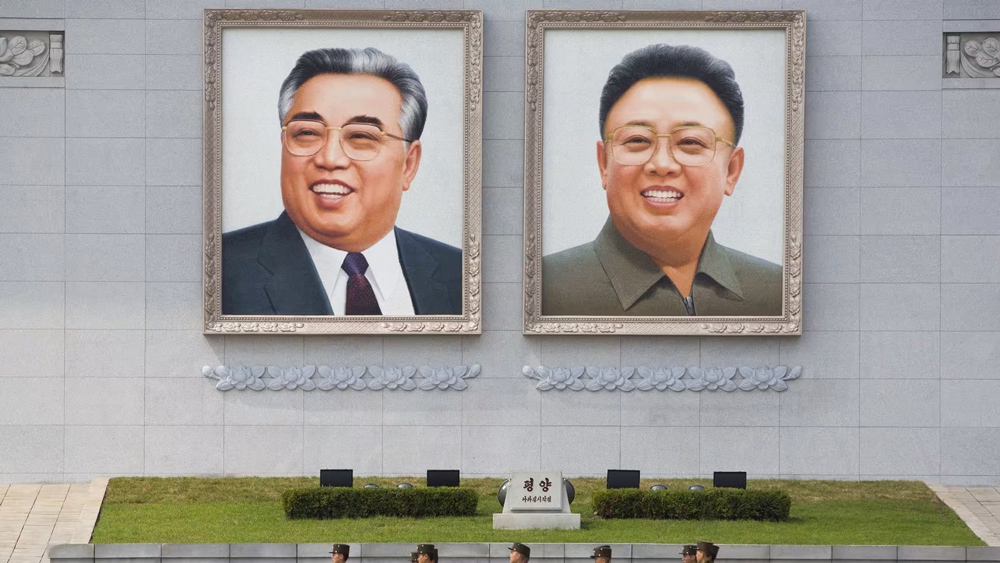
- Building a cult of personality around himself and his direct lineage: propaganda and myth-making that legitimized the Kim family as the only North Koreans worthy to lead the country.
- Purging anyone who could have been an alternative leader.
When it came time for Kim Jong Il to assume power, and the Kim Jong Un after that, decades of preparation smoothened the transition.
Now, after three generations of the Kim family, it would be very difficult for anyone else, even among the upper elite, to try and take power. Even if someone did manage to depose the current dictator, they would have to contend with not just managing the power vacuum, but the ideological void left by decades of propaganda and mythmaking that surrounded the Kim family.
Without the legitimacy that had been set up by the Kims, a new leader would likely find it difficult to maintain power for long. This is something that North Korean elites understand, which further discourages any rival officials from challenging the current regime.
Keep Learning with NK 101: Understanding the Country Through Its People
Through in-depth interviews with North Koreans who have escaped and insight from issue experts, this course will expand your understanding of the current state of North Korea. We’ll dive deeper into what’s happening in North Korea beyond the headlines, hone your ability to discern these key trends, and help you impress your friends with your expertise on the issue.
Access hours of exclusive, free content. Sign up for NK 101.
North Koreans Learning English | Interview with LELP Student & Volunteer
As North Korean refugees resettle in South Korea’s competitive society, conversational English ability has been identified as a top need for personal and professional growth.
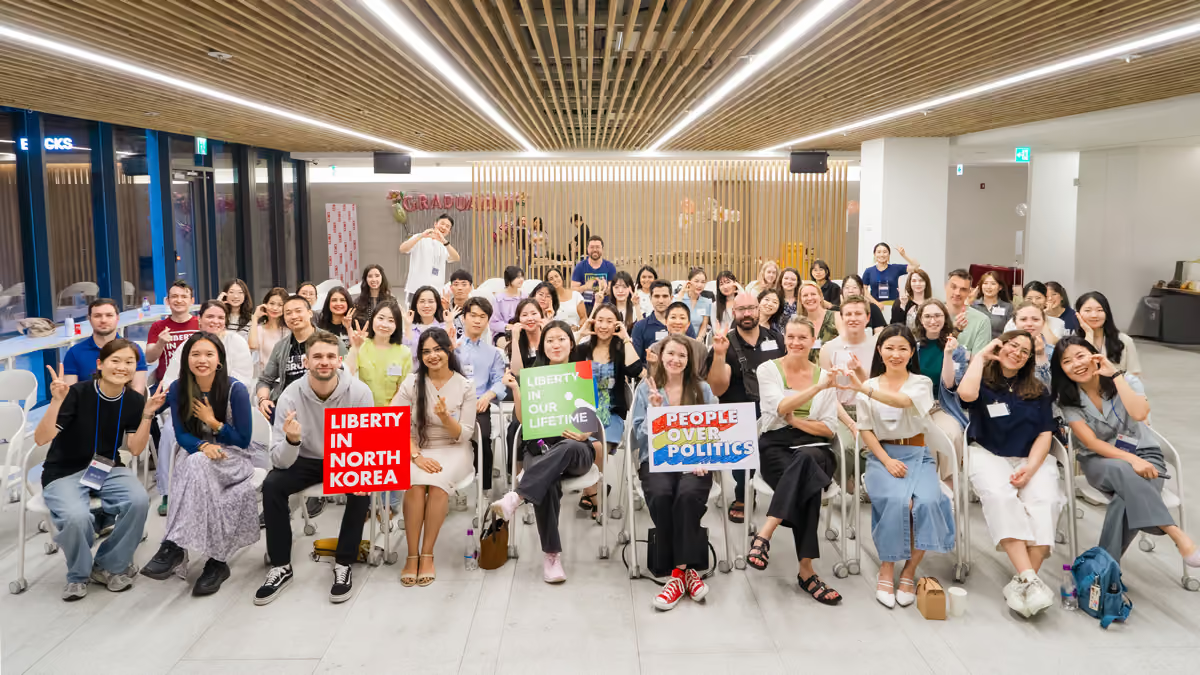
The LiNK English Language program (LELP) has become a mainstay in our efforts to help build the capacity of North Koreans as agents of change. Students are matched 1:1 with volunteer tutors from all around the world, leading to customized practice, conversations that break down barriers, and connections that will last a lifetime. In addition to weekly virtual study sessions, the program includes in-person bonding activities and a semesterly speech contest.
Spring 2024 has been the program’s biggest semester yet with 156 participants, including 78 North Korean students and 78 volunteers! Meet Stella, a North Korean student pursuing her PhD in Economics, and Cydney, a long-time LELP volunteer from the United States.
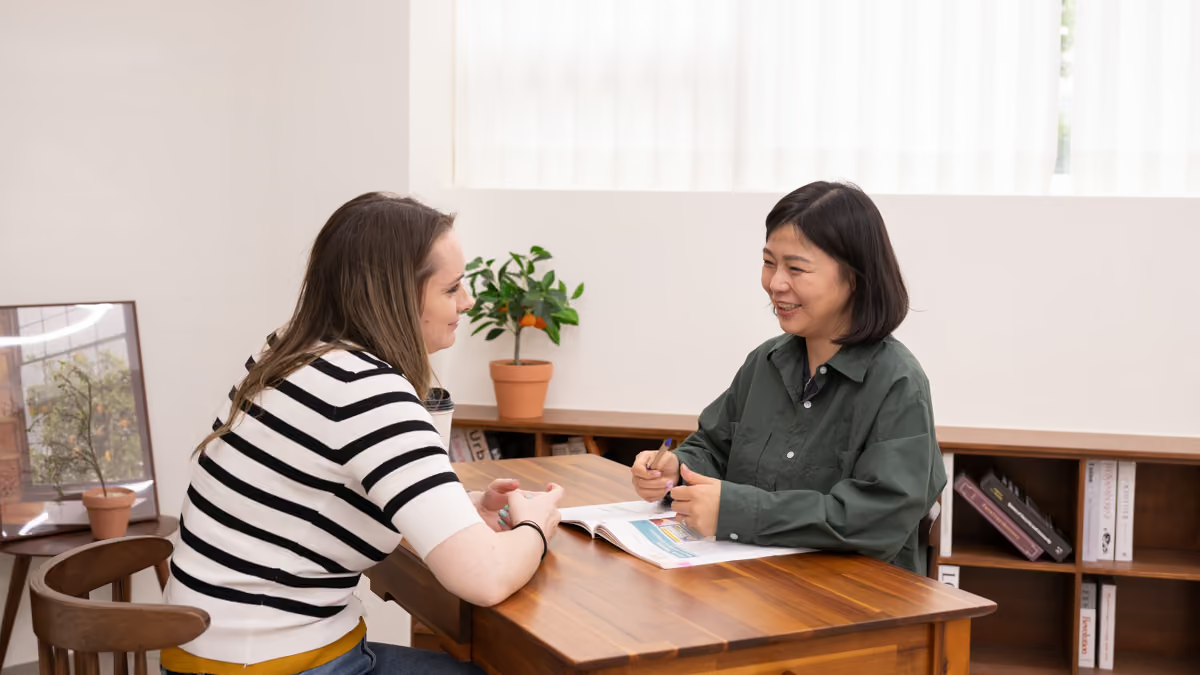
Please briefly introduce yourselves and share how you first met!
Stella - Hi, I’m Stella from North Korea. I’m currently living in South Korea and working towards getting my PhD in Economics.
Cydney - I’m Cydney, I’m from the US. I’ve been in South Korea for four years, teaching English at a hagwon. I’ve been a volunteer with LELP for two years now.
Stella - I don’t exactly remember when we met, it’s been so long!
Cydney - I think it was at the LELP hiking event! That was our first time meeting in-person.
Stella - Right, I was a little nervous then.
Cydney - Now we meet up all the time, going out for drinks and finding new places to check out in Seoul.
What has been your favorite activity during the program?
Stella - I really enjoy the speech contest. I can share my story and everyone is so attentive - the other North Korean students, volunteers, and LiNK staff. At other places, they’ll give you fixed questions that you have to answer. But LiNK gives you complete control over what you want to talk about.
People say North Koreans come from a prison, and sadness is the primary emotion. But in my experience, there is happiness even in the small things. I love to talk about those stories, my childhood memories.
First I’ll write my speech in Korean, and then I’ll write it again in English with Cydney’s help. I say what I want to express and she’ll help me.
Cydney - Sometimes I’ll write five different sentences and explain the nuances to Stella, and then she’ll go ‘okay that one, that’s how I want to say it.’
Stella - The days leading up to the speech content, I have so many feelings and emotions while I’m busy preparing. But afterwards, I feel a sense of relief. I love it because by sharing my story, I’m realizing new things about myself.
Cydney - I’m usually crying when she finishes delivering her speech. I’m just so happy and proud of all her hard work, and she’s so good at it. Hearing the speeches of the other students is also always so inspiring.
Is there a moment or everyday interaction where you felt LELP helped you?
Stella - Yes, there is. This semester I’m taking a microeconomics seminar and the class goes into English all the time. The professor asks us questions, and we have to answer in English. If I wasn’t part of LELP, then I would have never thought about raising my hand and talking with confidence. Even if my grammar isn’t perfect, I can still comfortably share my thoughts.
What are your dreams or goals?
Stella - I have a big dream. I want to be a professor someday, at the undergraduate or graduate level. More than just teaching a certain topic or subject, I hope to instill in my students a love of learning. That’s what my teacher back in my hometown did for me. I’ve been able to come this far because of her, and she continues to inspire me to this day.
In North Korea, education opportunities are limited. But my teacher always tried to help me. She told us that if we had big dreams, then we can grab the chance to make it happen. She taught me a lot of things, about life and to see more than our current circumstances. I think about her all the time, even now, and I want to be like her - a good teacher and a good person.
I consider this my third chance at life. First I just survived in North Korea, and second in China. Now in South Korea, I can finally live freely.
Cydney - I love this story. Since I know Stella wants to be a professor, I also asked why, and she shared her memories from growing up in North Korea. Knowing that she’s wanted to do this for so long, it just makes sense.
As for my future goals, I don’t have anything concrete like teaching, but I want to help people. I want to use all the things I learn and that I’m interested in to help people find themselves. LELP has given me a great opportunity to meet new friends from different backgrounds and be a part of this meaningful cause as a volunteer.
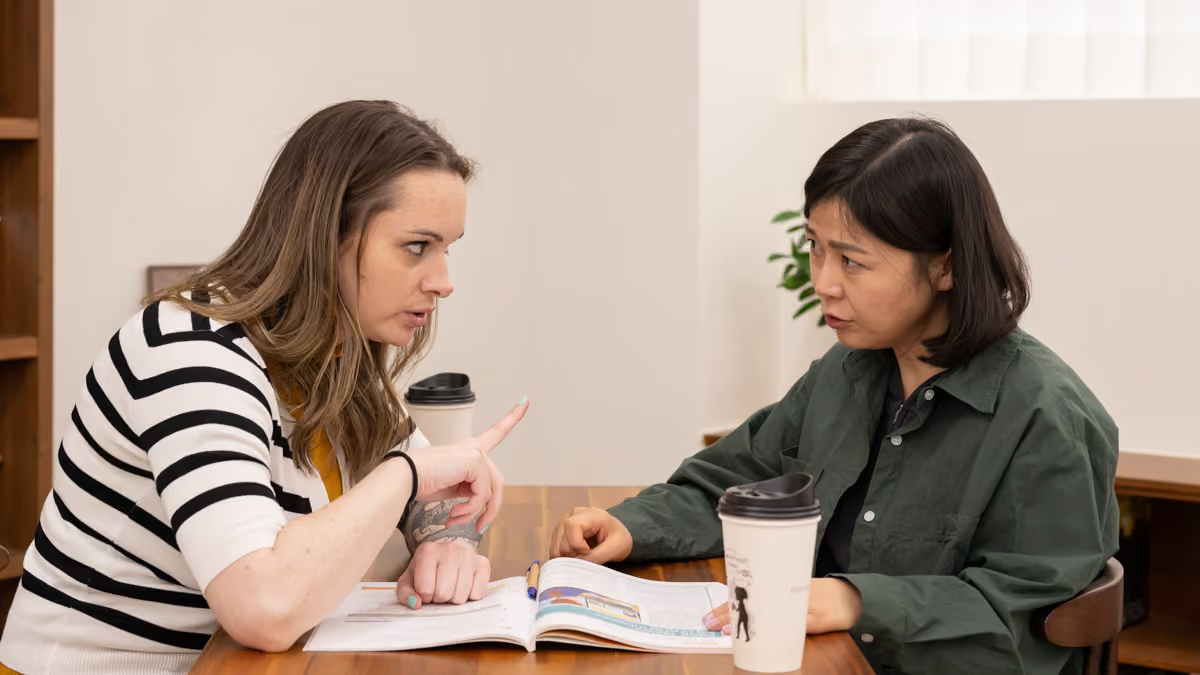
Has being part of this program changed your perspective on North Korea?
Cydney - Yes, definitely. Before LiNK, I had read a lot of books and biographies from North Koreans. With that kind of exposure, you hear a lot of the hard stuff. Very inspirational stories about incredible people, but tough to read. I wanted to get a bigger picture of the issue, and that naturally led me to LiNK. After volunteering with LELP for two years, my perspective has not just changed, but really expanded.
I’ve had a lot of conversations with Stella where the contexts of what we’re talking about could not be more different, but our experiences are very much the same. It’s brought this universal view of people doing their best to live their lives, and connecting over it.
Stella - A lot of times, people want to hear hard stories from North Koreans. If you talk about your happiness, they ask ‘Why are you here then? You can go back there.’ It always surprises me - how can they say something like that? People living anywhere, have both happy times and difficult situations. But they don’t want to hear positive things from North Korea, they just want to hear that you were living in hell.
But LiNK is different. I feel like I can just talk comfortably. It has made me want to continue this program. Other places have a political focus but LiNK doesn’t, just real human stories.
Cydney - It’s one of my favorite things about how LiNK shares stories of North Koreans. They don’t shy away from the hardship, but they’re showing happy, thriving people and smiling faces. It’s not, ‘come to our page to learn about our sadness,’ but ‘learn about these real people whose experiences we want to share.’
Did LiNK’s program further your interest in sharing North Korean stories and experiences?
Stella - Actually we planned it, we talked about her drawing pictures and me writing the stories.
Cydney - It’s still very much in the talking phase, but it’s been my dream to make a webtoon! We’ve thought about creating one together about a little North Korean girl and sharing Stella’s experiences through this format.
My undergraduate degree was in history, so I spent a long time studying situations similar to what happens in North Korea. It’s hard for me to know that I live in a time where people go through such things, especially people close to me, like Stella. I think what LiNK does is so important because it’s trying to change the narrative and what the history of North Korea will be. If I can have any part of it, I want to do what I can.
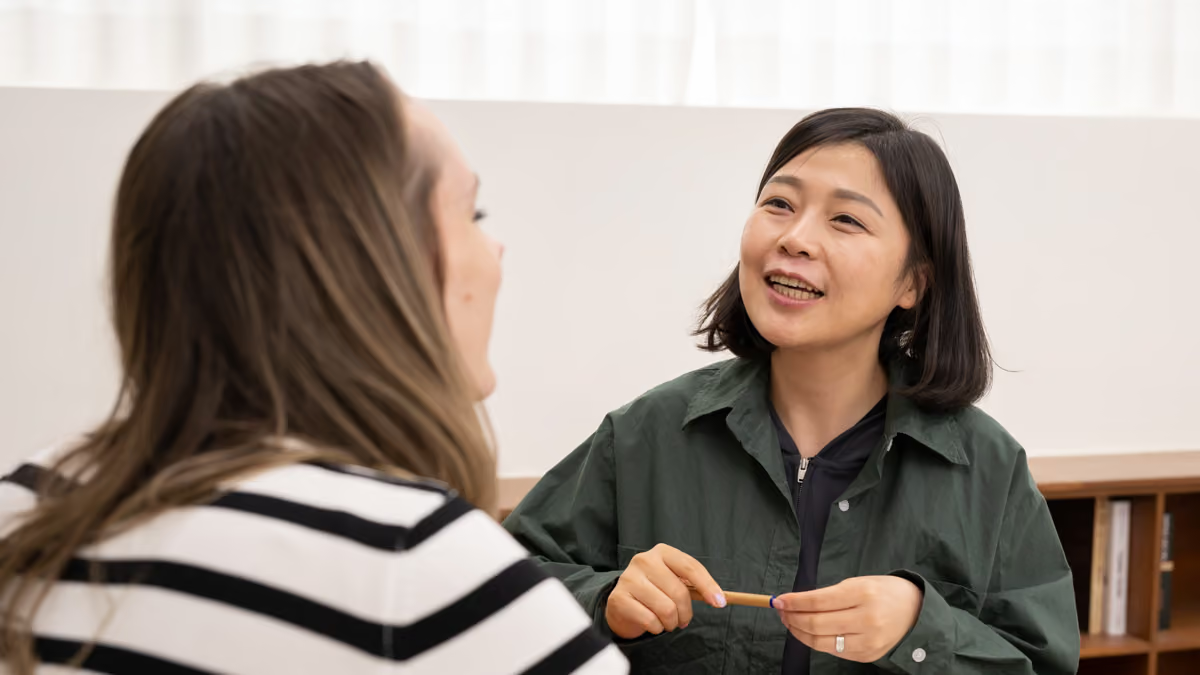
What is something that each of you learned from each other?
Stella - Cyndey is just such a strong person. Before I met her, I thought I was strong, but we shared our stories and I’m so amazed by her determination. She’s alone here in South Korea, with a different language and culture, but she never complains. She always tries to make the best of life and find happiness.
Cydney - I lived in the States, then I lived in China, and then in Korea. So there have been a lot of cultural challenges. The longer I’m here, I realize, ‘Oh, the things that I’m culturally used to are so different here that it’s starting to weigh on me.’ In those times, it’s been so great to talk to Stella.
That’s something we relate closely on, actually, both having to learn to live in South Korea.
She’s become one of my closest friends and we spend 90% of our time together just laughing. She’s so ambitious. I watch her do everything she can to reach her goals, and I think to myself, ‘I can do that too.’
Stella - I’m still reflecting on my experiences, so sometimes I try to find therapy but it hasn’t really helped me. But talking with Cydney has. She listens without judgment, and feels with me. So it’s become not just studying English together, but I feel healed with her.

Thank you for making programs like the LiNK English Language program possible. Every day, we see the impact that opportunities like this have in the lives of our North Korean friends, and members of this global movement.
Help us ensure that the LELP can continue, improve, and expand in the years to come.