
How Has the Kim Family Held on to Power So Long?
The following content is adapted from North Korea 101, LiNK’s FREE online course that explains what's happening in North Korea beyond the headlines. Start learning today.
Sign up for NK 101
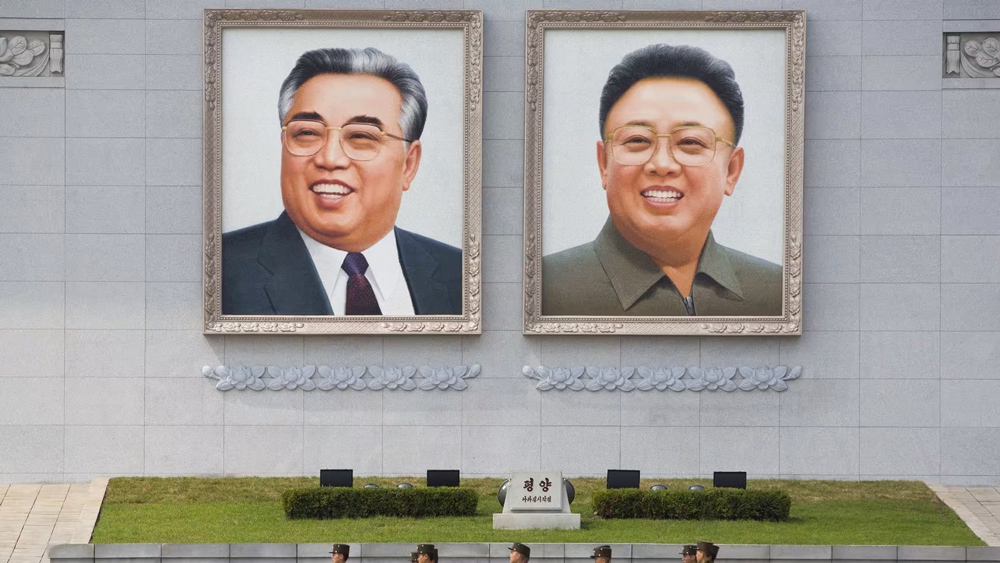
“This question is fundamental. To understand where we are and where we might be heading, we have to understand where we’ve come from.” – Sokeel Park, LiNK CSO
The North Korean regime is the world’s worst dictatorship, an extreme remnant of 20th century authoritarianism that has stretched across eight decades and three generations of the ruling Kim family. The regime’s all-encompassing system of control constrains the North Korean people’s agency and potential, resulting in an enforced poverty which includes physiological, material, social, informational, and cultural deprivations.
It is not easy for dictators to maintain power for long. During the Kim family’s rule, the world has seen the rise and fall of dozens of other dictatorships. Through many periods of global change and internal instability, they’ve managed to maintain power not by sheer force or luck, but through an array of adaptive strategies. But when the media portrays Kim Jong Un as crazy or irrational, it undermines our understanding and approaches to try to undermine that dictatorship.
There is a formula to their approach, and if we can understand it, then we can counteract it.
The Four Ways Dictators Lose Power
Historically, the fall of dictators can be attributed to four factors. By looking at each of them, we can see how the ruling Kim family has strategically avoided these fates.
1. Military Defeat/International Intervention
An external country or force intervening and overthrowing a dictator through military defeat.
2. Elite Challenges
An internal challenge emerging from within the country’s top political or military circles, forcibly removing the current dictator by assasination or a coup d'état,
3. Popular Uprising
An internal challenge from below, where a mass movement forces a change in leadership. In some cases, parts of the elite may join the side of the masses.
4. Death in Office
The death of the current leader, opening up an opportunity for someone else to assume control and end the dictatorship or make significant changes.
Threat #1: Preventing Military Overthrow
To prevent an external power from overthrowing their dictatorship, the Kim family first needs a strong deterrent against military force. The vast majority of mainstream news coverage of North Korea focuses on one thing: nuclear weapons. Having nuclear weapons and being seen as potentially willing and able to use them is arguably the most effective way to deter a military intervention from the outside.
Second, the Kim family has strategically managed their relations with countries like the Soviet Union / Russia, China, the United States, and South Korea. They go back and forth between periods of warmer and colder relations, effectively balancing opportunities and risks to gain support while preventing too much external influence. It’s unlikely that the Kim family has ever really trusted any of these external powers, even those that are sometimes labelled as “allies”.
Threat #2: Preventing Elite Challenges
Historically, the position of dictator can be very tempting to others within the leadership’s orbit, from competing family members to senior politicians or military leaders. To prevent anyone from building too much power and becoming a threat, the ruling Kim family carefully manages elite politics, alternating between demoting, promoting, and purging top officials.
On top of that, cross-layered surveillance between different institutions also keeps potential challengers under surveillance and in check, and prevents any one person or group of people from launching a challenge for power.
Threat #3: Preventing Popular Uprisings
The next scenario that the regime must prevent is a popular uprising.
A common conception of North Korea is that if the people wanted to rise up and revolt, they would have, and so they must be brainwashed or bought into the regime’s ideologies. While the latter may be true to some degree, it's difficult to fully grasp the extent to which the government’s system of control deprives people of their agency and potential and prevents them from challenging dictatorial rule.
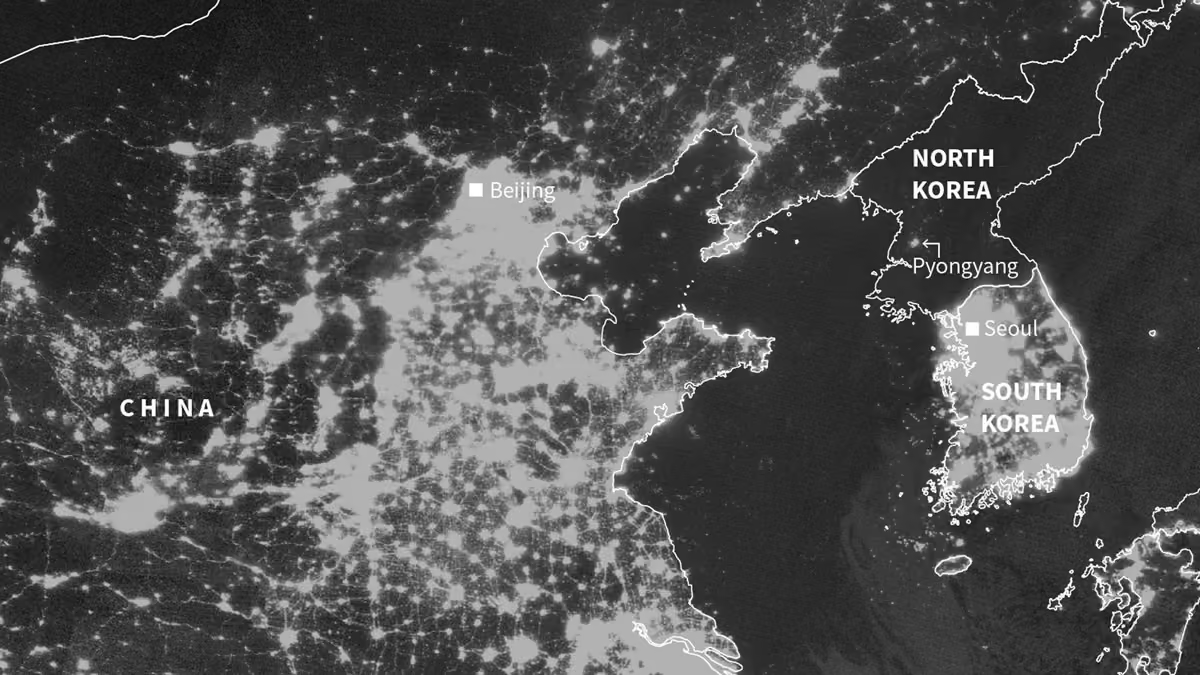
North Korea is the most closed country in the world. The regime has forcibly cut off North Koreans from the rest of humanity, which serves as the baseline for their control. This centers everything—social structure, daily life, resources, information—around the regime, and eliminates sources that could undermine or threaten their authoritarian rule.
Laying the Foundation: Kim Il Sung’s Half-Century in Power
Kim Il Sung was 33 years old when he was installed into power by the Soviet Union—very young in global politics at the time, when most leaders were in their 50s and 60s. This historical happenstance has ended up being a key factor in the longevity of the Kim family’s control.
From his rise to power in 1945 to his death in 1994 at the age of 82, Kim Il Sung had 49 years to mold North Korea’s politics and systems in his image. During this time, he laid the foundation for hereditary succession by:
- Centralizing power around this dictatorship.
- Building a cult of personality around himself and his direct lineage: propaganda and myth-making that legitimized the Kim family as the only North Koreans worthy to lead the country.
- Purging anyone who could have been an alternative leader.
When it came time for Kim Jong Il to assume power, and the Kim Jong Un after that, decades of preparation smoothened the transition.
Now, after three generations of the Kim family, it would be very difficult for anyone else, even among the upper elite, to try and take power. Even if someone did manage to depose the current dictator, they would have to contend with not just managing the power vacuum, but the ideological void left by decades of propaganda and mythmaking that surrounded the Kim family.
Without the legitimacy that had been set up by the Kims, a new leader would likely find it difficult to maintain power for long. This is something that North Korean elites understand, which further discourages any rival officials from challenging the current regime.
Keep Learning with NK 101: Understanding the Country Through Its People
Through in-depth interviews with North Koreans who have escaped and insight from issue experts, this course will expand your understanding of the current state of North Korea. We’ll dive deeper into what’s happening in North Korea beyond the headlines, hone your ability to discern these key trends, and help you impress your friends with your expertise on the issue.
Access hours of exclusive, free content. Sign up for NK 101.
Foreign Media in North Korea - How Kpop is Challenging the Regime
Movies, TV shows, and music hold power. They’re a way for us to connect through common experiences, reckon with different sides of humanity, and revel in the beauty of being here at all. They transport us to another time and place- perhaps one of our imaginations- and most importantly, allow us to dream and imagine a limitless future.

In recent years, South Korean media and entertainment has gained international recognition. People like Hyun Bin and Son Yejin, the stars of popular Korean drama Crash Landing on You, have become household names, while Parasite swept the 2020 Academy Awards and music from K-pop groups like BTS are charting globally.
Meanwhile, just across the border, North Korea remains one of the most closed societies in the world. Yet even in the “hermit kingdom,” foreign media is accelerating empowerment of the people and change within the country!
Forced Isolation and the Regime’s Information Monopoly
The North Korean government has maintained power for decades through a system of imposed isolation, relentless indoctrination, and brutal repression. A complete monopoly on information and ideas within the country has been key- outside media threatens to challenge the legitimacy of their propaganda, and by extension, their control.
The 2014 United Nations Commission of Inquiry on Human Rights in North Korea reported an almost complete denial of the right to freedom of thought, conscience, and religion as well as of the rights to freedom of speech, opinion, expression, and association.
The regime employs a range of strategies to enforce information control:
- Restricting movement across borders and within the country
- Random house searches
- Severe punishment, including public executions, to deter foreign media consumption and sharing
- Sophisticated digital surveillance
- Jamming phone signals and locating users through signal triangulation
- Mobile OS file signature system that only permits government-approved apps and files
The Spread of Foreign Media
Despite this isolation and unparalleled internal restrictions, the North Korean people have been quietly changing their country from within, including through foreign media access. Through market activity and the movement of people and goods across the Chinese border, they have forced the gradual opening up of their society. Movies and music are smuggled into the country on USBs, SD and MicroSD cards, and small portable media players, offering illicit access to information from the outside world.
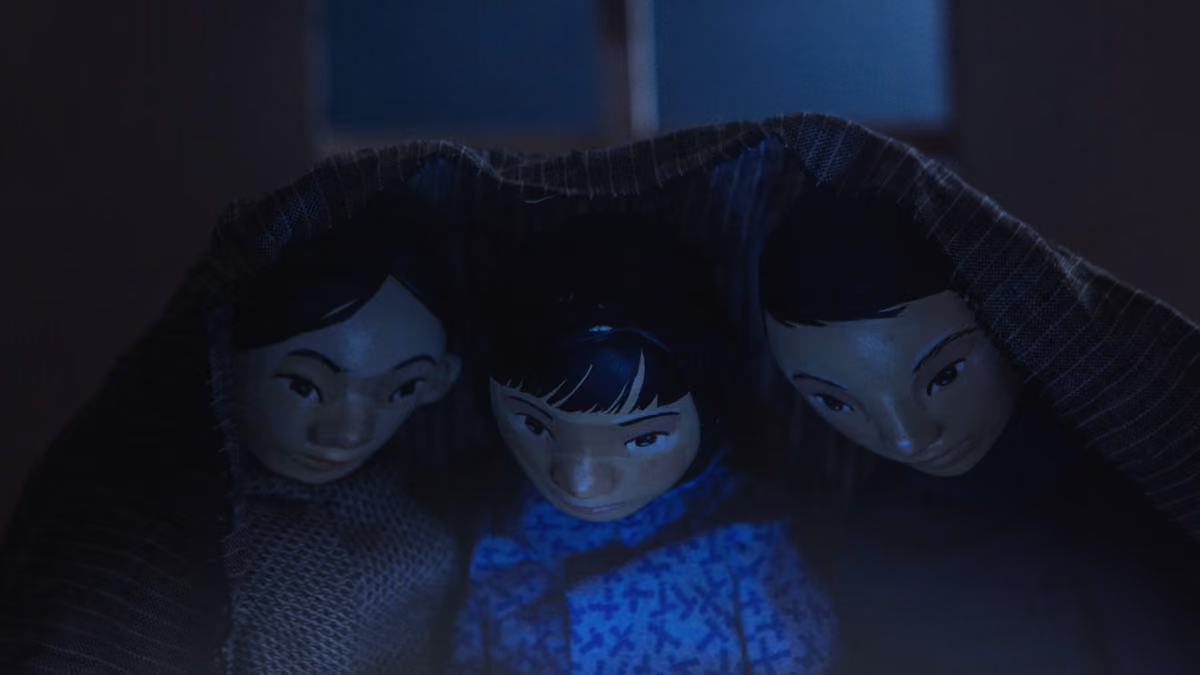
With lights off and windows shuttered, North Koreans will watch foreign media despite the risks. If all else fails, bribes are a way for people to reduce punishment if caught. Most North Korean police and government officials rely on bribes to survive, and some defectors complain that they are actually the biggest consumers of foreign media because they confiscate so much.
Information Technology in North Korea
Within North Korea, a broad range of information technologies are available, although they should be registered with authorities. Laptops and computers officially run on a government operating system, Red Star OS, while the North Korean intranet, Kwangmyong, is air-gapped from the internet and heavily surveilled. However, in practice, many North Koreans have non-networked devices used for games, editing software, watching videos, and to copy, delete and transfer media on removable devices.
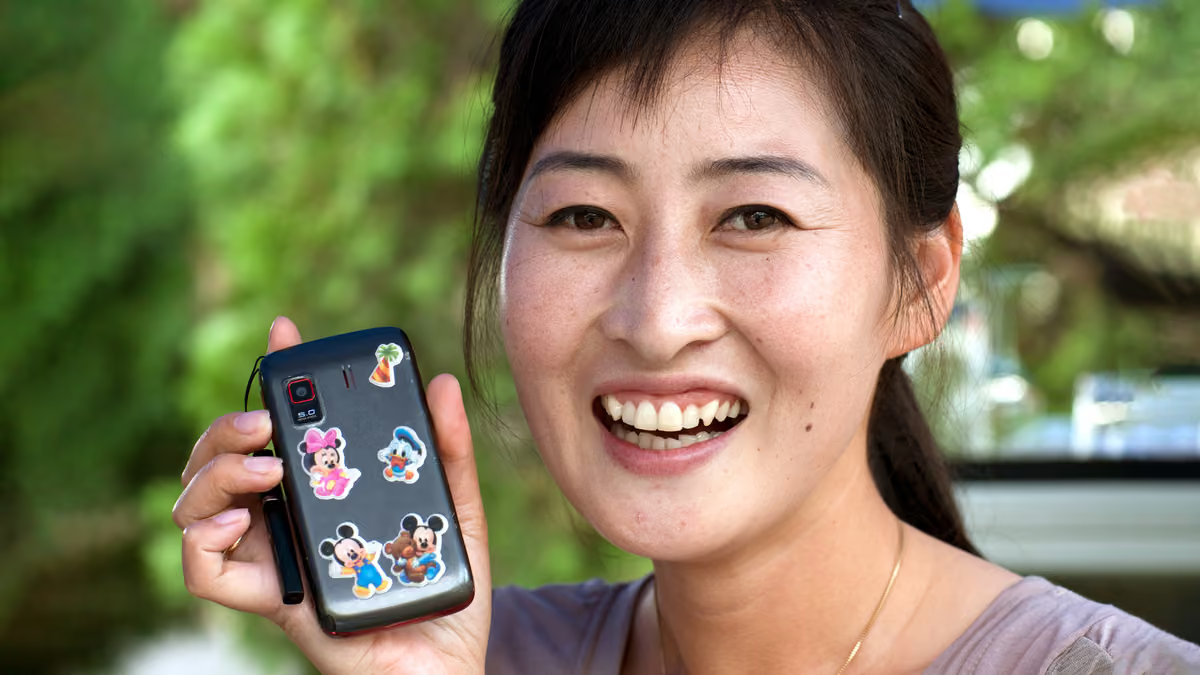
Mobile phones are also common with approximately 6 million on the North Korean network, meaning roughly 1 in 4 people have one. These North Korean phones generally cannot make international calls and the operating system limits users to approved state media (programs have been developed to bypass this security). On the other hand, smuggled Chinese phones can be used in border regions on the Chinese network. These have been crucial for staying in touch with relatives who have escaped or defected, who often send back money and information from the outside world.
Radios are the only channel of foreign media and news available real-time across the country. While they should officially be registered and fixed to North Korean stations, it is relatively easy to tamper with radio sets to pick up foreign broadcasts. In border regions, some TVs can also pick up live programming from South Korea and China. Traditionally, TVs were connected to DVD players, but newer LCD televisions also have direct USB input ports.
How Foreign Media Changes Perceptions
Among foreign media, entertainment from South Korea is particularly attractive, produced in the same base language by people with the same ancestry. They contain glimpses of rich and free realities just across the border. In comparison, domestic North Korean media seems old-fashioned and disingenuous, designed to reinforce the regime’s ideologies.
As North Koreans learn more about life, freedom and prosperity in the outside world, and their own relative poverty, the regime’s ideology and control are eroded.
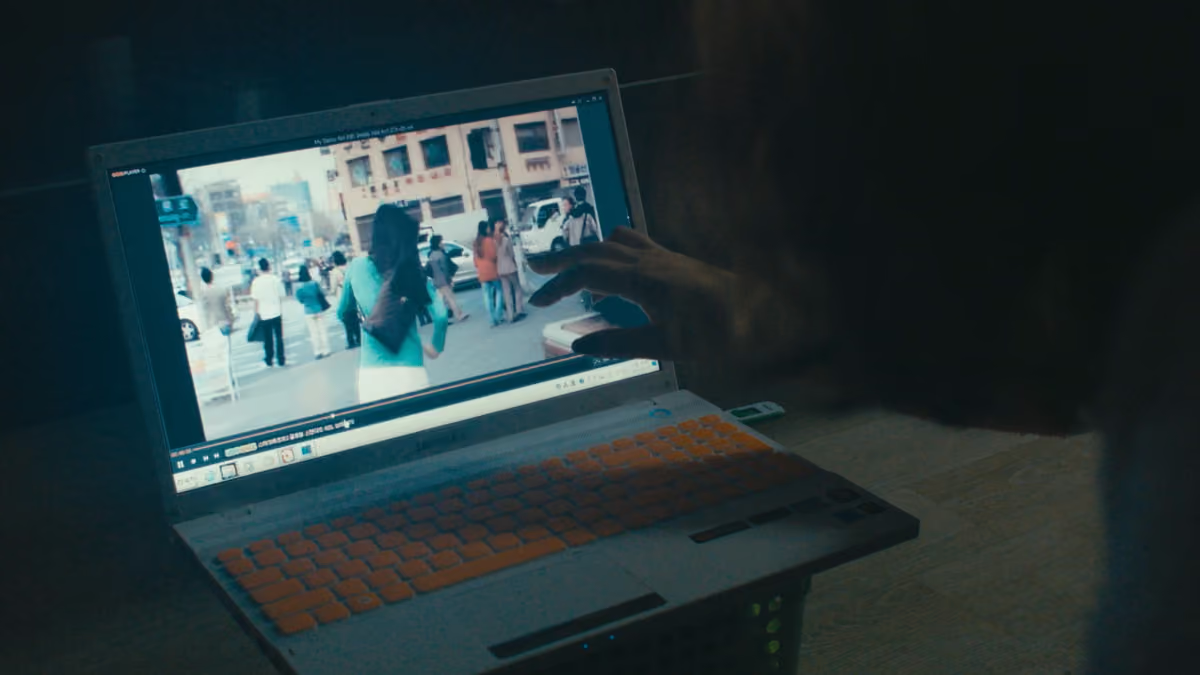
“At first you see the cars, apartment buildings, and markets and you think it must be a movie set. But the more you watch, there’s no way it can be just a set. If you watch one or two [movies] it always raises these doubts, and if you keep watching you know for sure. You realize how well South Koreans and other foreigners live.”
– Danbi, escaped North Korea in 2011
Empowered by foreign media, North Koreans are exploring their creativity and potential through everyday acts of resistance- using South Korean slang, copying fashion styles, and sharing pop culture references. In this culture war, Kim Jong-un has called for crackdowns on "unsavory, individualistic, anti-socialist behavior" among young people to restrict freedom of expression.
Foreign media also facilitates shared acts of resistance. People will swap USB devices with trusted friends and neighbors, increasing confidence in one another through a symmetrical transaction. Some people may also watch and discuss movies and shows together, increasing the media’s subversive influence and creating social networks.
The Regime’s Response
During the pandemic, we’ve seen unprecedented levels of isolation and restrictions, closing off the country more than ever before. To buttress control, Kim Jong Un has simultaneously increased crackdowns and punishments on foreign media consumption. In December 2020, the “anti-reactionary thought law” made watching foreign media punishable by 15 years in a political prison camp.
While the situation is harrowing, the government’s extreme response underscores the power of foreign media. The regime recognizes that social changes driven by North Korean people are a threat to their authority and control in the long term.
Accelerating Foreign Media Access and Change
Moving forward, increasing access to outside information is one of the most effective ways to help the North Korean people and bring forward change.
Information and technology support for North Korean people has historically been an under-utilized and under-invested strategy. LiNK Labs is our area of work focused on this opportunity- we’re developing technologies, networks, and content to empower North Korean people with access to information and ideas from the outside world.










