
How Has the Kim Family Held on to Power So Long?
The following content is adapted from North Korea 101, LiNK’s FREE online course that explains what's happening in North Korea beyond the headlines. Start learning today.
Sign up for NK 101
“This question is fundamental. To understand where we are and where we might be heading, we have to understand where we’ve come from.” – Sokeel Park, LiNK CSO
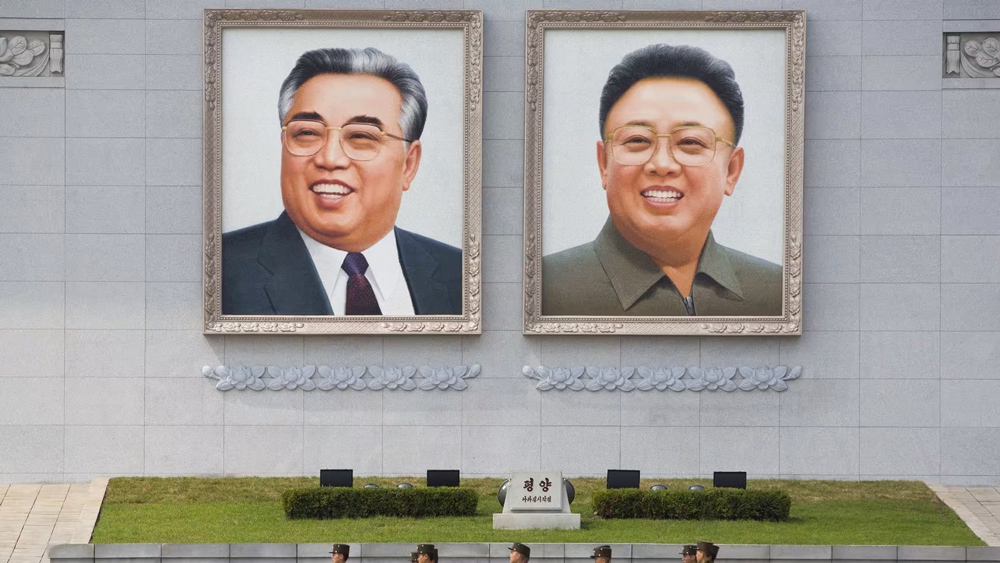
The North Korean regime is the world’s worst dictatorship, an extreme remnant of 20th century authoritarianism that has stretched across eight decades and three generations of the ruling Kim family. The regime’s all-encompassing system of control constrains the North Korean people’s agency and potential, resulting in an enforced poverty which includes physiological, material, social, informational, and cultural deprivations.
It is not easy for dictators to maintain power for long. During the Kim family’s rule, the world has seen the rise and fall of dozens of other dictatorships. Through many periods of global change and internal instability, they’ve managed to maintain power not by sheer force or luck, but through an array of adaptive strategies. But when the media portrays Kim Jong Un as crazy or irrational, it undermines our understanding and approaches to try to undermine that dictatorship.
There is a formula to their approach, and if we can understand it, then we can counteract it.
The Four Ways Dictators Lose Power
Historically, the fall of dictators can be attributed to four factors. By looking at each of them, we can see how the ruling Kim family has strategically avoided these fates.
1. Military Defeat/International Intervention
An external country or force intervening and overthrowing a dictator through military defeat.
2. Elite Challenges
An internal challenge emerging from within the country’s top political or military circles, forcibly removing the current dictator by assasination or a coup d'état,
3. Popular Uprising
An internal challenge from below, where a mass movement forces a change in leadership. In some cases, parts of the elite may join the side of the masses.
4. Death in Office
The death of the current leader, opening up an opportunity for someone else to assume control and end the dictatorship or make significant changes.
Threat #1: Preventing Military Overthrow
To prevent an external power from overthrowing their dictatorship, the Kim family first needs a strong deterrent against military force. The vast majority of mainstream news coverage of North Korea focuses on one thing: nuclear weapons. Having nuclear weapons and being seen as potentially willing and able to use them is arguably the most effective way to deter a military intervention from the outside.
Second, the Kim family has strategically managed their relations with countries like the Soviet Union / Russia, China, the United States, and South Korea. They go back and forth between periods of warmer and colder relations, effectively balancing opportunities and risks to gain support while preventing too much external influence. It’s unlikely that the Kim family has ever really trusted any of these external powers, even those that are sometimes labelled as “allies”.
Threat #2: Preventing Elite Challenges
Historically, the position of dictator can be very tempting to others within the leadership’s orbit, from competing family members to senior politicians or military leaders. To prevent anyone from building too much power and becoming a threat, the ruling Kim family carefully manages elite politics, alternating between demoting, promoting, and purging top officials.
On top of that, cross-layered surveillance between different institutions also keeps potential challengers under surveillance and in check, and prevents any one person or group of people from launching a challenge for power.
Threat #3: Preventing Popular Uprisings
The next scenario that the regime must prevent is a popular uprising.
A common conception of North Korea is that if the people wanted to rise up and revolt, they would have, and so they must be brainwashed or bought into the regime’s ideologies. While the latter may be true to some degree, it's difficult to fully grasp the extent to which the government’s system of control deprives people of their agency and potential and prevents them from challenging dictatorial rule.
North Korea is the most closed country in the world. The regime has forcibly cut off North Koreans from the rest of humanity, which serves as the baseline for their control. This centers everything—social structure, daily life, resources, information—around the regime, and eliminates sources that could undermine or threaten their authoritarian rule.
Laying the Foundation: Kim Il Sung’s Half-Century in Power
Kim Il Sung was 33 years old when he was installed into power by the Soviet Union—very young in global politics at the time, when most leaders were in their 50s and 60s. This historical happenstance has ended up being a key factor in the longevity of the Kim family’s control.
From his rise to power in 1945 to his death in 1994 at the age of 82, Kim Il Sung had 49 years to mold North Korea’s politics and systems in his image. During this time, he laid the foundation for hereditary succession by:
- Centralizing power around this dictatorship.
- Building a cult of personality around himself and his direct lineage: propaganda and myth-making that legitimized the Kim family as the only North Koreans worthy to lead the country.
- Purging anyone who could have been an alternative leader.
When it came time for Kim Jong Il to assume power, and the Kim Jong Un after that, decades of preparation smoothened the transition.
Now, after three generations of the Kim family, it would be very difficult for anyone else, even among the upper elite, to try and take power. Even if someone did manage to depose the current dictator, they would have to contend with not just managing the power vacuum, but the ideological void left by decades of propaganda and mythmaking that surrounded the Kim family.
Without the legitimacy that had been set up by the Kims, a new leader would likely find it difficult to maintain power for long. This is something that North Korean elites understand, which further discourages any rival officials from challenging the current regime.
Keep Learning with NK 101: Understanding the Country Through Its People
Through in-depth interviews with North Koreans who have escaped and insight from issue experts, this course will expand your understanding of the current state of North Korea. We’ll dive deeper into what’s happening in North Korea beyond the headlines, hone your ability to discern these key trends, and help you impress your friends with your expertise on the issue.
Access hours of exclusive, free content. Sign up for NK 101.
Spring in My Homeland, North Korea: A Glimpse of Reunification in 2045
By: Eunsook Jang
Eunsook Jang holds a bachelor’s degree in Political Science from Korea University and a master’s degree in International Development from Brandeis University. A Fulbright Scholar and LiNK US Scholarship grantee, she is currently a research intern at the Hudson Institute, where her work focuses on post-conflict recovery, economic development, and human development. Her recent publications include “Slipping through the Cracks in South Korea: The Uncertain Futures for the Children of North Korean Defectors” with the Migration Policy Institute, and “Why Strengthening RFA Is a Strategic Imperative for US Policy on North Korea” in The Diplomat.

In the spring of 2045, on a flight from Incheon to Pyongyang, Emma's hands tremble. Her husband Sam reaches over and, steadily, holds them without a word. She turns to the window and stares into the pale clouds below the wing.
“I’ve waited 30 years for this day,” she whispers. “But now that I’m here… it doesn’t feel real. I hope this isn’t a dream.”
“Maybe it’s both,” Sam replies. “The dream became real.”
She closes her eyes. In 2015, at just fifteen years old, she crossed the frozen Yalu River in a dark March morning, leaving without saying a proper goodbye to her mother. That guilt, its intensity, has never faded, not even after thirty years. It simply learns to live quietly beside her.
“Will Mom recognize me?” she asks. “We parted when I was fifteen. I’m forty-five now.”
“She will,” Sam answers. “How could a mother not recognize her daughter?”
Emma says nothing. Will I... be able to recognize her? She does not say it aloud this time.
An announcement comes through the cabin speakers: "This is the first return flight for North Korean defectors to their hometowns. We know how much you have endured. We will carry you safely home."
It is a rare moment of comfort from a South Korean voice. Moments later, the plane lifts into the sky.
An hour later, the plane lands in Pyongyang. Emma weeps quietly, overwhelmed by the thought that across so short a distance, lives in the South and the North had been so utterly, irreconcilably different. For thirty years, she had not been able to cross it, that gap, so small.
From Pyongyang, the journey to Hyesan continues by bus. As the skyline of Pyongyang passes past the window, its taller buildings, its broad avenues, Emma allows herself the fragile hope: perhaps Hyesan has developed too.
After five hours on the road, the bus arrives at Hyesan Station. The apartments and the lay of the land are almost entirely unchanged from when she had left thirty years earlier, as if time had refused to move, as if it had been waiting for her. Emma found herself hoping the same might be true of her mother.
A thirty minutes' walk from the station: that is where her mother's house is.
As if drawn by a magnet, her feet start moving on their own.
Sam asks if they are going the right way. Without hesitation, "Yes," Emma replies. "I used to walk this road every day as a child. It’s still in my body."
He points to a bus queue down the street. "There's a bus queue over there. Want to take it part of the way?" She shakes her head gently. "If you don't mind, I'd like to walk." "Then we’ll walk," he replies without hesitation. Emma feels another surge of gratitude, grips on his arm and follows her memory home.
Since Emma left her hometown in 2015, the North Korean regime has conducted ten more nuclear tests as of 2045. And yet the face of this neighborhood has not changed by a single detail. The freedom and human rights that should have been the people's return on those tests have been vaporized into the air.
They arrive at a fork in the road. To the left, an alley leads toward the house. A familiar-looking house comes into view, enclosed by a wooden fence. She stops and stands motionless. It is the house, it is her house.
Several minutes pass. Then the door opens. Emma feels her breath catch. For a second, she forgets how to move.
After thirty years, she is here.
This is what the micropolitics of reunification looks like. Grand narratives, speeches, and legal texts may provide its official language, but its lived realities lie in moments, in feelings, like this: a mother and daughter recognizing each other after thirty years apart.
Author’s note: I dedicate this piece to my father in South Korea, who has never once wavered in encouraging my studies, as if realizing through me the freedom to pursue the dreams that were taken from him. And to my mother, who remains in North Korea: This piece is my proof that your daughter has not turned away from your suffering, but is working, in her own small way, to fight against it. I hope to see you, even if only in my dreams tonight. I love and miss you beyond my expression.
–
Eunsook is a participant of the LiNK English Language Program (LELP), which serves to not only help North Korean defectors build confidence and skills in English, but develop their capacity as advocates for this issue. To that end, we partnered with select LELP “columnists” to write and polish personal essays through multiple rounds of external feedback and revision. Our goal is to have more North Koreans share their stories directly and lead efforts to change the narrative.
We believe the North Korean people can achieve their liberty in our lifetime.
Opportunities like LELP invest in the people building that future now. Help more North Koreans find their voice, reach their goals, and lead change on this issue.










