
How Has the Kim Family Held on to Power So Long?
The following content is adapted from North Korea 101, LiNK’s FREE online course that explains what's happening in North Korea beyond the headlines. Start learning today.
Sign up for NK 101
“This question is fundamental. To understand where we are and where we might be heading, we have to understand where we’ve come from.” – Sokeel Park, LiNK CSO
The North Korean regime is the world’s worst dictatorship, an extreme remnant of 20th century authoritarianism that has stretched across eight decades and three generations of the ruling Kim family. The regime’s all-encompassing system of control constrains the North Korean people’s agency and potential, resulting in an enforced poverty which includes physiological, material, social, informational, and cultural deprivations.
It is not easy for dictators to maintain power for long. During the Kim family’s rule, the world has seen the rise and fall of dozens of other dictatorships. Through many periods of global change and internal instability, they’ve managed to maintain power not by sheer force or luck, but through an array of adaptive strategies. But when the media portrays Kim Jong Un as crazy or irrational, it undermines our understanding and approaches to try to undermine that dictatorship.
There is a formula to their approach, and if we can understand it, then we can counteract it.
The Four Ways Dictators Lose Power
Historically, the fall of dictators can be attributed to four factors. By looking at each of them, we can see how the ruling Kim family has strategically avoided these fates.
1. Military Defeat/International Intervention
An external country or force intervening and overthrowing a dictator through military defeat.
2. Elite Challenges
An internal challenge emerging from within the country’s top political or military circles, forcibly removing the current dictator by assasination or a coup d'état,
3. Popular Uprising
An internal challenge from below, where a mass movement forces a change in leadership. In some cases, parts of the elite may join the side of the masses.
4. Death in Office
The death of the current leader, opening up an opportunity for someone else to assume control and end the dictatorship or make significant changes.
Threat #1: Preventing Military Overthrow
To prevent an external power from overthrowing their dictatorship, the Kim family first needs a strong deterrent against military force. The vast majority of mainstream news coverage of North Korea focuses on one thing: nuclear weapons. Having nuclear weapons and being seen as potentially willing and able to use them is arguably the most effective way to deter a military intervention from the outside.
Second, the Kim family has strategically managed their relations with countries like the Soviet Union / Russia, China, the United States, and South Korea. They go back and forth between periods of warmer and colder relations, effectively balancing opportunities and risks to gain support while preventing too much external influence. It’s unlikely that the Kim family has ever really trusted any of these external powers, even those that are sometimes labelled as “allies”.
Threat #2: Preventing Elite Challenges
Historically, the position of dictator can be very tempting to others within the leadership’s orbit, from competing family members to senior politicians or military leaders. To prevent anyone from building too much power and becoming a threat, the ruling Kim family carefully manages elite politics, alternating between demoting, promoting, and purging top officials.
On top of that, cross-layered surveillance between different institutions also keeps potential challengers under surveillance and in check, and prevents any one person or group of people from launching a challenge for power.
Threat #3: Preventing Popular Uprisings
The next scenario that the regime must prevent is a popular uprising.
A common conception of North Korea is that if the people wanted to rise up and revolt, they would have, and so they must be brainwashed or bought into the regime’s ideologies. While the latter may be true to some degree, it's difficult to fully grasp the extent to which the government’s system of control deprives people of their agency and potential and prevents them from challenging dictatorial rule.
North Korea is the most closed country in the world. The regime has forcibly cut off North Koreans from the rest of humanity, which serves as the baseline for their control. This centers everything—social structure, daily life, resources, information—around the regime, and eliminates sources that could undermine or threaten their authoritarian rule.
Laying the Foundation: Kim Il Sung’s Half-Century in Power
Kim Il Sung was 33 years old when he was installed into power by the Soviet Union—very young in global politics at the time, when most leaders were in their 50s and 60s. This historical happenstance has ended up being a key factor in the longevity of the Kim family’s control.
From his rise to power in 1945 to his death in 1994 at the age of 82, Kim Il Sung had 49 years to mold North Korea’s politics and systems in his image. During this time, he laid the foundation for hereditary succession by:
- Centralizing power around this dictatorship.
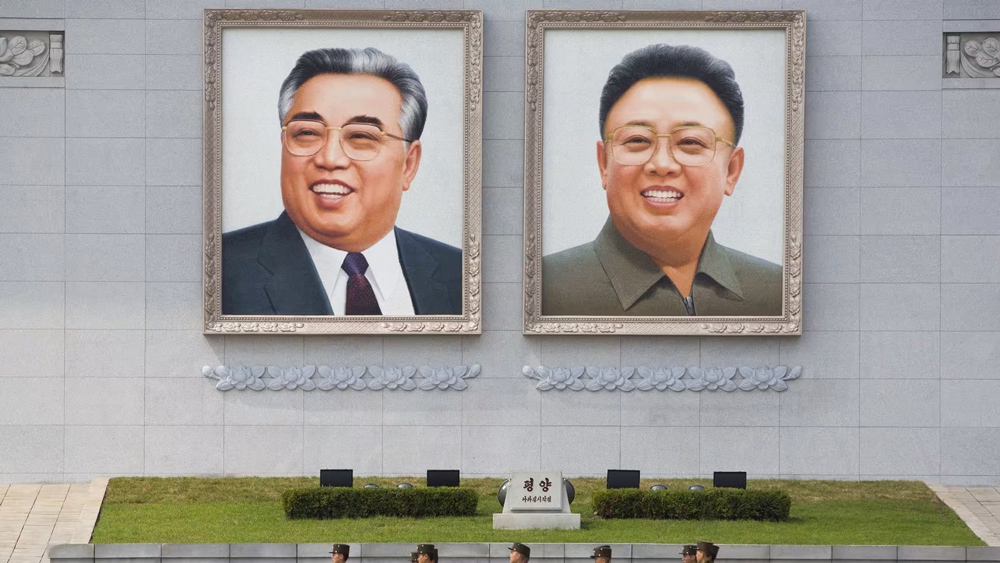
- Building a cult of personality around himself and his direct lineage: propaganda and myth-making that legitimized the Kim family as the only North Koreans worthy to lead the country.
- Purging anyone who could have been an alternative leader.
When it came time for Kim Jong Il to assume power, and the Kim Jong Un after that, decades of preparation smoothened the transition.
Now, after three generations of the Kim family, it would be very difficult for anyone else, even among the upper elite, to try and take power. Even if someone did manage to depose the current dictator, they would have to contend with not just managing the power vacuum, but the ideological void left by decades of propaganda and mythmaking that surrounded the Kim family.
Without the legitimacy that had been set up by the Kims, a new leader would likely find it difficult to maintain power for long. This is something that North Korean elites understand, which further discourages any rival officials from challenging the current regime.
Keep Learning with NK 101: Understanding the Country Through Its People
Through in-depth interviews with North Koreans who have escaped and insight from issue experts, this course will expand your understanding of the current state of North Korea. We’ll dive deeper into what’s happening in North Korea beyond the headlines, hone your ability to discern these key trends, and help you impress your friends with your expertise on the issue.
Access hours of exclusive, free content. Sign up for NK 101.
Yoon Ha's Story: Part 3 - Making it to South Korea

This is the third part of a three-part story. Read part one about the hardships Yoon Ha experienced growing up in North Korea, and part two about being trafficked in China.
After connecting with LiNK’s network, I had to hike up more mountains to get out of China. It was very difficult being eight-months pregnant. My legs hurt and began to swell up a lot. It was really dark and I fell a few times. It was so hard - I was completely exhausted.
There were other North Koreans escaping China with me and they were pulling me and helping me up. Whenever I wanted to give up, they encouraged me.
“We must go. We must go to South Korea to live. To live…”
I felt like it was my responsibility to keep going and to survive for myself and my daughter. The journey getting out of China was so tough. I was worried that my unborn baby might have died because I didn’t feel the baby moving in my stomach for a while.
After many months in government processing and after going through the Hanawon resettlement education center, I was finally able to live freely in South Korea. I was overjoyed.
Thankfully, my baby survived and I had a beautiful baby daughter right after I came to South Korea. More than a year later now, I am thankful that she is growing well and is in good health.

In North Korea, the police oppressed me, keeping me from doing what I needed to do to survive. And in China, the police were trying to find North Korean refugees who were living in hiding. They wanted to send us back to North Korea, even though they knew we would be brutally punished by the regime. Whenever the police came around, I locked all the doors and hid in fear until they left town. So at first, I was scared of the police in South Korea.
I got to know my assigned police officer and realized he is just a person like me and we are not that different. (Every resettled North Korean refugee in South Korea is assigned a police officer for their first five years. They check in on them on a regular basis, and provide basic legal advice and special protection if necessary.)
We talked openly and he shared about the challenges he had when he was younger. He calls me once a week to see how my daughter and I are doing. He has brought us fruit and diapers for my daughter. He is so sweet. He also helped me with paperwork, paying bills, and getting my phone fixed when it broke. I really appreciate him and now he feels like a friend to me.
Thanks to people like him, I can sleep well.

I have been surrounded by many good people from my church community, the Hana Center (the local South Korean government resettlement assistance center) and my designated police officer.
It felt so good to talk freely with many people in my first language--Korean. I had lived in China for many years and when I first went there, I knew no Chinese. I struggled so much with communicating and I couldn’t talk to people freely either because of the fear of getting caught.
Now I can talk to anyone without worrying about getting caught.
I am so glad I came to South Korea. My life here is much better than my life in North Korea or China. I feel very safe and free in South Korea.

I am still learning the meaning of freedom as I experience it in this new society. I can do what I want and go where I want to go. I can go somewhere just to have fun and no one stops me.
That is freedom to me, and I am living it right now.










