
I am Joy: I Escaped North Korea and Survived Human Trafficking
I was born and raised in a small North Korean village near the border with China. My family was very poor, and it made life extremely difficult for us. As a child I could not attend school and didn’t have any dreams for my future, because we were just trying to survive.
When I was seven, my mother quietly left us to go to China in order to make money. It took me months to realize that she was never coming back. As a teenager, my stepmother kept trying to marry me off so they would have one less mouth to feed. I didn’t want to be married off, so I finally decided to go to China to find a better life.
I felt so sorry to my father for not being a good daughter. I left a letter for him to explain why I was leaving, and how much I loved him. I told him that I hoped to see him again someday. Next to the letter I also left behind my nicest clothes, hoping he could sell them to buy food. I sewed a secret pocket into my jacket and hid a photo of my family there, and under my shirt collar I hid enough opium to kill myself in case I was caught. The morning I left I didn’t want to raise any suspicion, so I casually said goodbye to my father and walked out like it was any normal day. I couldn’t stop crying as I walked away. I knew that I may never see my family again, especially my father, who had sacrificed so much to raise me.
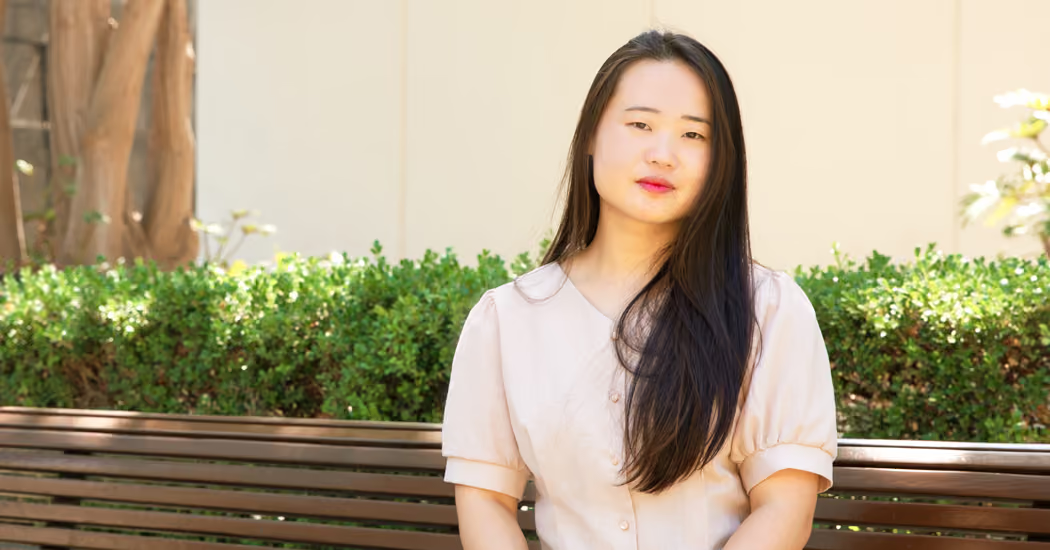
I will never forget how cold it was at the river. I could feel the snow through my torn shoes and the wind blew through my thin jacket. I was shivering as I stood in the knee-deep snow, waiting for the chance to make my escape. I slid down the riverbank onto the ice. I could hear the ice cracking as I crawled on my stomach across the frozen river. I expected that at any minute, North Korean guards would see me escaping and shoot me. After I finally made it to the Chinese side, it took me hours to find the broker I was supposed to meet.
By the time I found her, my toes were frozen white. The broker took me to her home to rest and recover . But I soon realized I was trapped. She told me I had to repay her and the other brokers a lot of money for helping me escape. And, because I had no money, the only option was to be sold as a bride. I was scared that if I refused, the brokers would sell me to a brothel or I would be forced to work in online sex chatrooms. I also knew that if I ran away, I’d be caught by the Chinese police and sent back to North Korea to face imprisonment and torture.
I had no choice but to be sold as a bride. For three days, a broker paraded me around villages in northern China and crowds of men would gather to bid on me.
In the final village, I sat cowering in the corner of a house. My cheeks were still red from the night I had crossed the river. There were many older Chinese men walking around me, and staring at me. I stared at the floor to avoid looking into their eyes. I did not understand what they were saying, but I could tell they were talking about me. I felt so humiliated. I was treated like an animal in a zoo. The North Korean broker finally found a man who was willing to pay enough for me. I was sold for three thousand dollars. In that moment, I was overcome with hopelessness, sorrow, and loss. I felt like I was losing everything, including my own body, to someone I had just met.
I was only 18.
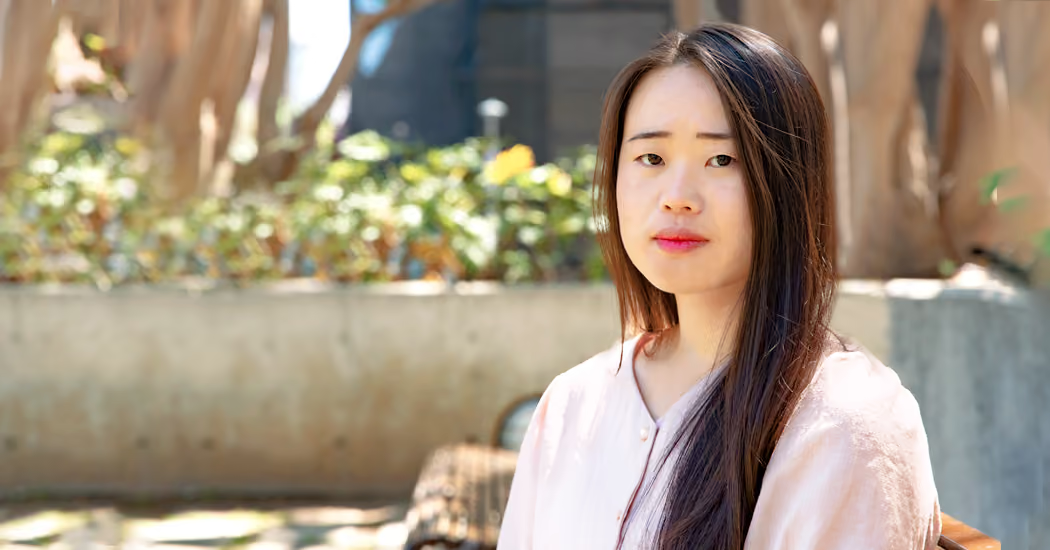
The man who bought me lived with his parents. They were afraid I would run away so they were always watching me. I was not even allowed to go to the bathroom without their permission. One morning, I started feeling sick so they took me to a local hospital.After some medical tests, the family brought me back to the house and everyone was smiling and talking. I was so confused. Someone called a North Korean woman who lived in my village and asked her to interpret the news for me. I was pregnant. As everyone celebrated, I felt even more hopeless.
This pregnancy would make my escape impossible. In North Korea, I had heard that if you jump off a high place or carry heavy things while you’re pregnant, you’ll have a miscarriage. So I tried to jump off the highest tree in the backyard, and carried around heavy buckets of water. But nine months later, I gave birth to a healthy baby daughter.
For the first few days after her birth, I didn’t even want to look at her. I was sorry and ashamed for feeling that way, but I couldn’t help resenting her. But as the days passed, my daughter began to recognize my face, and she would greet me with a big smile and open arms whenever I walked into the room. Her smile and joyful laughter began to melt away my troubles and hardships.
For the next two years, my daughter became my only reason to live.
Then one day, a North Korean woman who had also been sold into the same village introduced me to a South Korean man. He told me about South Korea, and the possibility of a free life, and said he offered to help me get there. But he warned me that the journey through China and Southeast Asia would be too dangerous for a young child. I was so torn. This was my chance to finally be free from this man and from the constant fear of being caught and sent back to North Korea. But how could I leave my child, the only joy in my life?
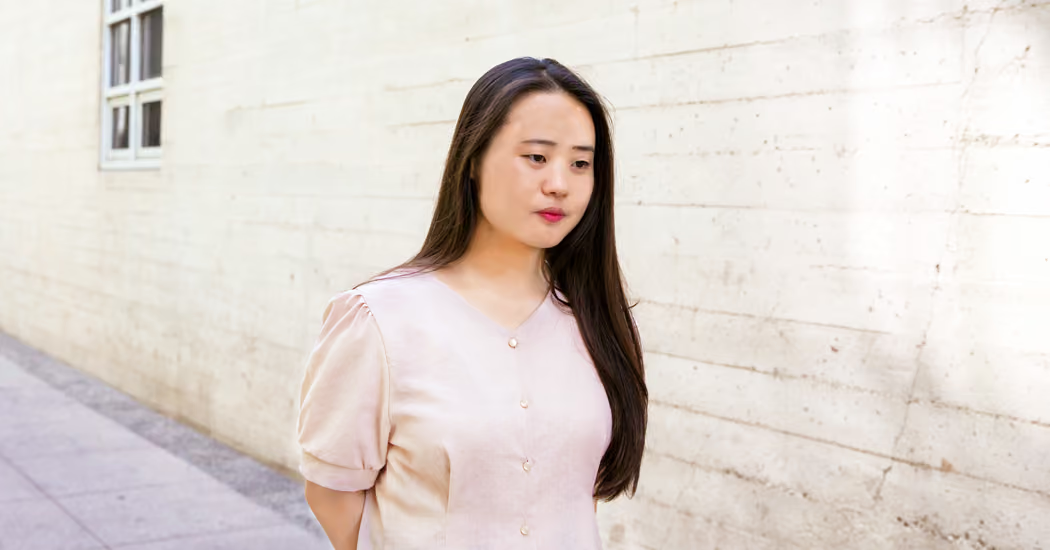
I was afraid I would never get an opportunity like this again , so I made the extremely difficult decision to go to South Korea, and I vowed to come back to China as soon as I could to get my daughter. In the early morning of my departure, I held my daughter in my arms as she slept and cried. I thought about the moment she would wake up and cry because I was not there. It reminded me of the day that my own mother had left me. I had felt so lonely and wondered for so long why she had abandoned me. I resented her for giving birth to me if she wasn’t interested in raising a child. And now I had to do the same thing to my own daughter.
I clenched my fists as hard as I could to hold back the tears, and I told the family I was making a trip to the market. I grabbed the bag of clothes I’d hid in the bush the day before, and headed to the bus station. I cried every day for the next three months thinking about my daughter. During my journey out of China, there were many nights when I woke up thinking I’d heard my daughter’s voice calling out “mommy.” One night, I didn’t want to wake everyone up so I went behind the curtain to cry, and I found another woman who was already there crying. She had also left her child behind to escape with my group. We sat behind that curtain in the safe house, weeping and hugging each other.
I finally made it to South Korea in 2013 with the help of Liberty in North Korea. I am currently in my last year of studying social work, and I want to devote my life to helping North Korean women who have endured the same trauma that I have. Although adjusting to a new society is difficult at times, I am determined to work hard so that one day I can bring my daughter to South Korea to be with me.
I should not be here today - I am one of the lucky ones.
At this very moment, women are being treated like a commodity and are being sold to older Chinese men. A recent report estimated that 60% of the North Korean female refugees in China are trafficked into the sex trade. 50% of those trafficked are forced into prostitution, 30% are in a forced marriage, and 15% are working in the cyber sex industry.
I am here as a survivor to share the darkest moments from my past so that I can help bring an end to the exploitation of other North Korean women refugees.
For North Korean women, escaping from North Korea is not the end of their journey but the beginning of their fight for freedom.
Please extend your love and give your support so that more North Korean people will find true freedom and safety. Thank you. I am grateful and hopeful. I am Joy.
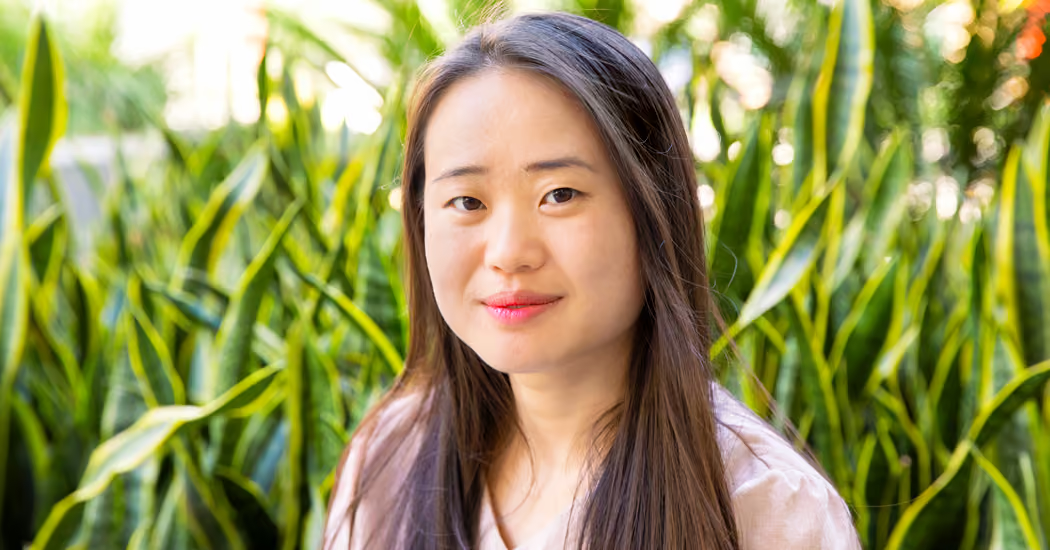
See what life is like for North Korean women who are sold in China in the short film "Sleep Well, My Baby". Based on true stories from women rescued through LiNK.
Read Joy’s full journey from escaping North Korea to being sold in China, and finally reaching freedom through LiNK’s rescue routes in our 3-part series here!
The North Korea I Remember: School, Family, and Home
By: HyeGyeong Joo
HyeGyeong is a PhD student in the Department of Economics at Korea University, specializing in theoretical economics. Her research looks at developing theoretical models of the North Korean economy. Since 2022, Hye-Gyeong has also participated in LiNK’s English Language Program.
Have you ever wanted to go home even while you were already at home? Because I have. It feels as though I am not longing for a physical house, but for something harder to name: a sense of belonging, of being whole, of belonging not anywhere but somewhere I would truly belong. Instead, I often feel emptiness, as if I do not fully belong. But I am not sure what these feelings mean or where they come from exactly.
I have been living in South Korea for around ten years, but I still miss North Korean food, school life, and above all, the time I spent with my family. There are restaurants in South Korea run by North Korean refugees, and sometimes their dishes bring back memories of home. Foods like injogogi-bap or nongma-guksu remind me not only of North Korean cuisine, but of birthdays, family, and everyday life.
The long strands of nongma-guksu always carry the wish for a long life, while the taste of injogogi-bap brings back the memory of a soybean dish made to resemble the meat we so rarely had.
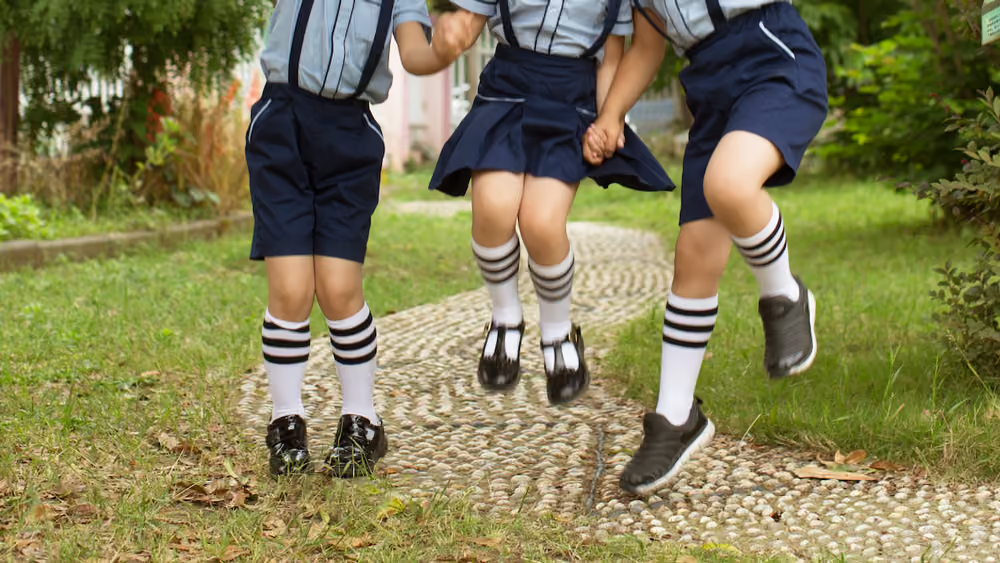
While these foods remind me of home, what I remember most vividly is my school life in North Korea. When I was in fourth grade, the girls in my school would often gather in the schoolyard to play jump rope. I was actually quite good at it. We would start with the rope at ankle height and gradually raise it higher and higher.
One day, when the rope had been raised to about head height, I tried to jump over it. Since I was quite short, I had to lift my leg as high as I could. Unfortunately, I ended up tearing my pants. I was so embarrassed that I almost cried. But what I remember most clearly is my teachers laughing so hard as they watched from the side. Even now, I can still picture that moment vividly.
I also remember winter lunchtime at school. We all brought packed lunches from home. In one corner of the classroom, there was a stove, and before lunch, students would place their lunch boxes on top of it to warm their food.
Sometimes, the lunch box closest to the stove would get burnt. During class, the smell of scorched rice would fill the room and make us so hungry that it was hard to focus. When lunchtime finally came, my friends and I would gather around the stove, sit in a circle, and eat together.
More than anything else, however, I miss the memories of winter. My friends and I would climb the hills near our town, sit on large sacks, and slide all the way down as if we were on sleds. We did it so often that the fabric on the back of our pants would wear thin and eventually tear. When that happened, I would go home only to be scolded by my mother.
Life was not easy in those days. We were often hungry and did not live comfortably. Sometimes we skipped breakfast, and sometimes a thin porridge was all we had for dinner. Yet, despite those hardships, I cannot forget the laughter we shared.
Looking back now, I realize that what I miss is not North Korea as a system. What I miss are the people with whom I laughed and cried, and the memories of my childhood that have stayed with me to this day.
For a long time, however, I could not talk about these feelings to anyone. I kept them to myself, unsure of how others would understand them. That began to change after I met people through Liberty in North Korea (LiNK). For the first time, I found a space where I felt I could speak more honestly about my memories and my life in North Korea.
Through the LiNK English program, I became close to a friend, and together we made a plan to create a book. I would write about real life in North Korea, and she would draw the illustrations for the book. I wanted people to see North Korea not only as a political system, but also as a place where ordinary people live, love, struggle, and create memories.
I shared this plan with someone I trusted deeply in South Korea. But she told me, “No, you can’t!” She said that if I spoke honestly about daily life in North Korea and about how much I miss certain parts of it, despite all the difficulties, people might ask, “Then why are you here? If you miss it so much, why don’t you go back?” Her response hurt me so deeply that I eventually closed my heart to others. After that, I stopped talking about these feelings with anyone. Only later did I finally find a place where I could tell my story freely and without hesitation.
When many people think about North Korea, they often think about politics, missiles, or the regime. But when I think about North Korea, I remember a girl whose pants tore while playing jump rope, students gathering around a stove to eat lunch together, and children laughing as they slid down snowy hills on sacks.
That is why I hope people can see North Korea not only as a political system, but also as a place where ordinary people live their lives. The people living there are not so different from people anywhere else. They laugh, dream, make friends, and create memories. Those are the stories I hope to share.
–
HyeGyeong is a participant of the LiNK English Language Program (LELP), which serves to not only help North Korean defectors build confidence and skills in English, but develop their capacity as advocates for this issue. To that end, we partnered with select LELP “columnists” to write and polish personal essays through multiple rounds of external feedback and revision. Our goal is to have more North Koreans share their stories directly and lead efforts to change the narrative.
We believe the North Korean people can achieve their liberty in our lifetime.
Opportunities like LELP invest in the people building that future now. Help more North Koreans find their voice, reach their goals, and lead change on this issue.










