I Left North Korea As a Child. My Life’s Work is to Return Home to a Free Country | Rose’s Story
As a child in North Korea, I loved quiet, warm mornings. At dawn, I’d wake to the sound of breakfast being made in the kitchen. When my feet grew cold, I’d burrow deeper into my grandfather's blanket. A day that began with the smell of a home-cooked meal was nothing special then—just an ordinary morning.
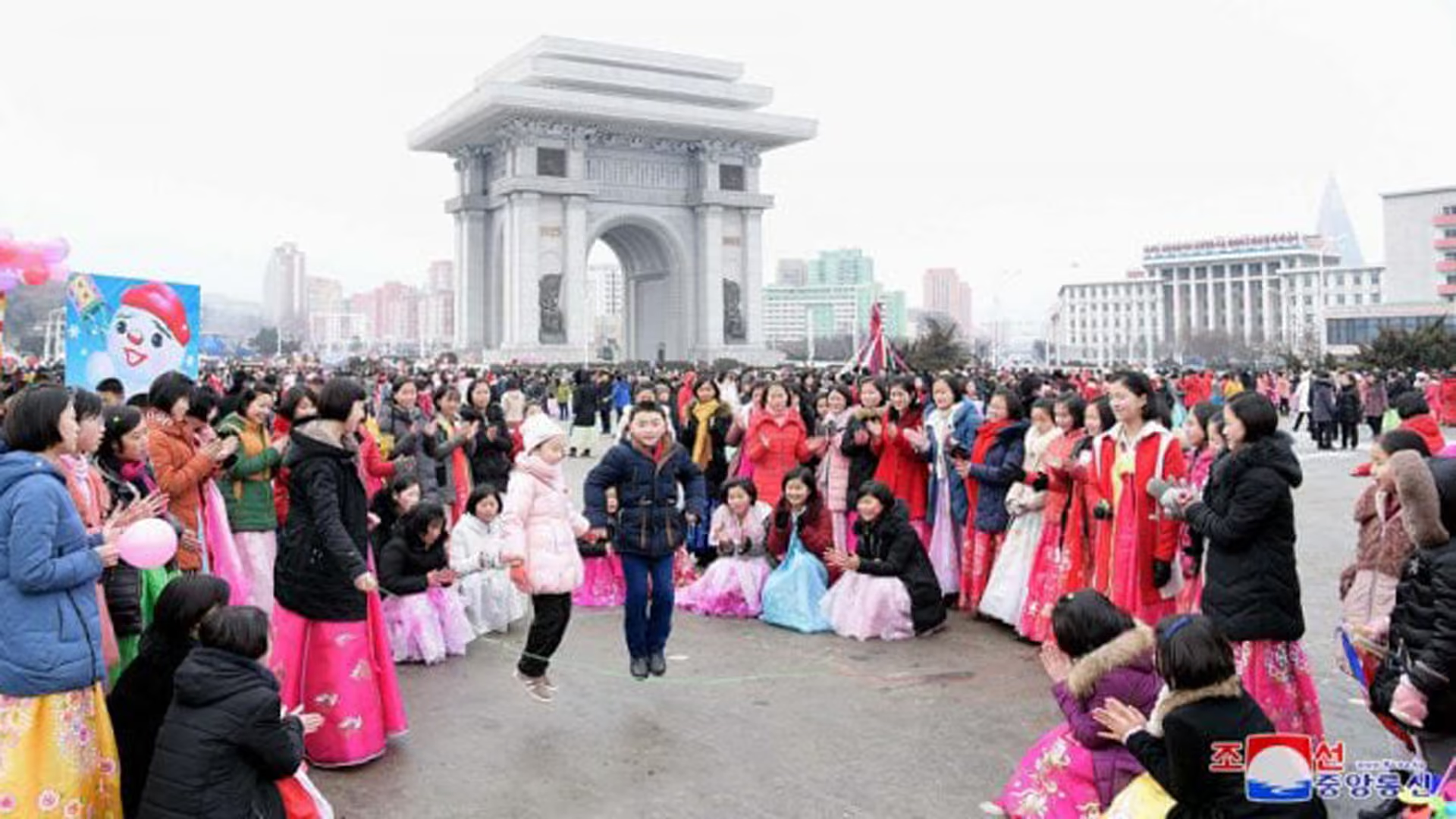
Growing up, I lived with my grandparents. We worked the fields together, swam in the Yalu River side by side, and grew tomatoes, eggplants, and cucumbers in a small garden. In the summers, my cousins and I played in the mountains and gathered wild strawberries. Every fall, I always looked forward to the corn harvest.
This was the world I knew, and I was quite happy with it.
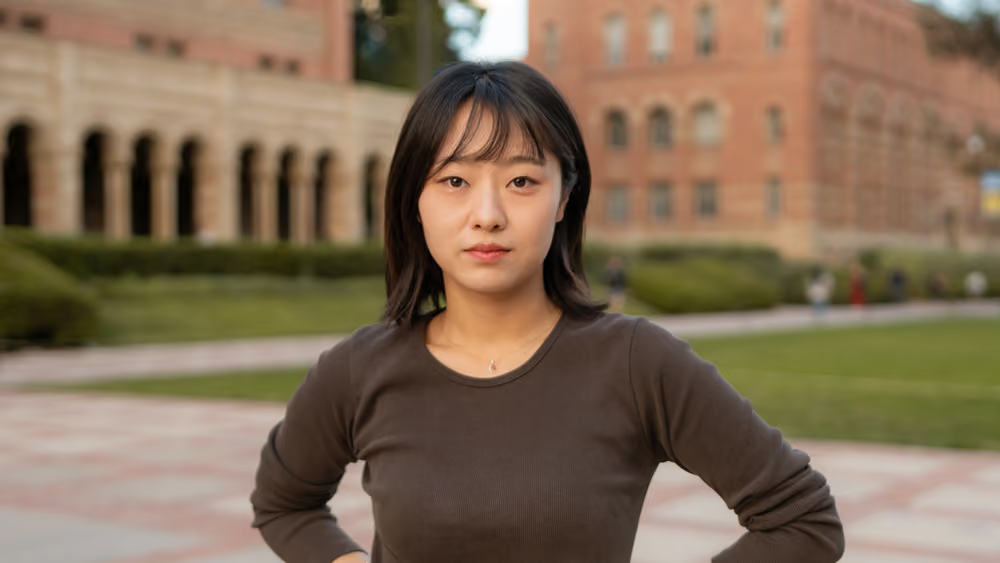
My mother's work as a broker—helping families separated by the border reunite or at least connect via phone—and her other job selling smuggled CDs containing Korean dramas eventually led to her arrest. She was released quickly but was placed under close surveillance. With no other way to support our family, she made the difficult decision to defect. It was a choice made easier, she later told me, by the countless South Korean dramas she had watched over the years that offered a glimpse into a life outside North Korea.
One winter vacation, my mother said, "Let’s go on a trip." I could barely contain my excitement. I had rarely ventured far from my hometown and thought I was finally traveling somewhere new. My grandmother gave me a warm boiled egg and told me to be safe. I didn’t know that would be the last time I would ever see her.
The journey never stopped. We left in winter and ended up in Southeast Asia, where summer never ends. Only then did I realize this trip was an escape. And it was only one-way.
When we finally arrived in South Korea, I couldn’t accept my new reality. I was only a child, but in my heart, I knew I’d never see my grandparents again. It felt like a cruel trick.
But life carried on, and I found myself adapting to South Korean society pretty quickly. I changed my accent and learned things by asking friends. Even at a young age, I instinctively felt the need to fit in. I was proud of myself for not looking or sounding like a North Korean.
Then one day in our elementary school classroom, the topic of North Korea came up. At that moment, I felt everyone’s eyes on me.
Although no words were spoken, the silence between me and my classmates felt like a wall.
As much as I tried to push it away, that feeling continued to follow me. In middle school, while watching a soccer game with friends and cheering for South Korea, someone said, “Shouldn’t you be rooting for North Korea?” I felt the color drain from my face. Once again, I felt the gap between me and them. And I wondered if I could ever close the distance.
Years later, in university, a professor mistakenly thought my South Korean friend was North Korean. She strongly denied it and took great offense, demanding a formal apology from the professor. Seeing her reaction, I wondered what it said about me. This incident left a deep scar on my heart.
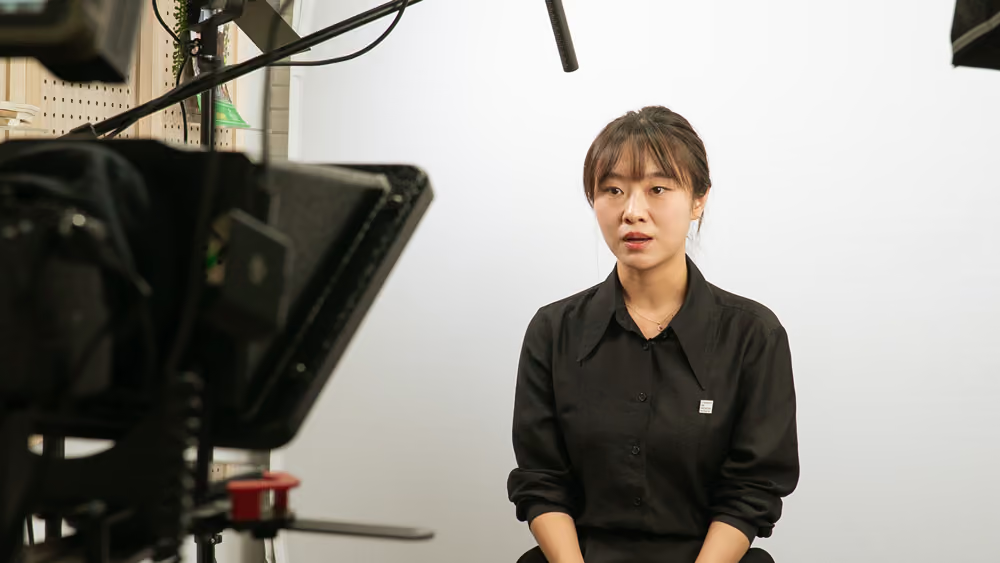
As time went on, I realized that I wasn’t as well-adapted as I thought. I had been living my life avoiding who I was. Whenever the topic of North Korea came up in conversation, I cringed and tried to change the subject. When my family in North Korea would secretly call us, I would hang up the phone after a brief greeting, afraid I’d burst into tears. I couldn’t face how much I missed them, because I didn’t want to accept that I may never see them again.
Amidst these complex emotions, I began my work on North Korean human rights. I wanted to change how North Koreans were portrayed as “pitiful,” or “dangerous.”
But doing this work scared me at first. If I shared my story, would people look at me again with those silent, disapproving eyes? Then I began to understand something important—those fears came from my own hidden prejudice. If I believed that North Koreans would only be seen in a certain way, didn’t that also mean it was how I saw them?
Confronting the deepest parts of myself allowed me to finally embrace who I was. I stopped hiding, and began to explore the thoughts and feelings I had suppressed for so long.
In 2022, I took part in Liberty in North Korea’s Co-Creators program. It’s a unique opportunity for North and South Korean students to work together on advocacy projects. Our team’s project was called “North Korea Travel.” We highlighted different regions of the country and shared facts about life there, leading naturally into conversations about human rights.
As I worked on this project, it occurred to me how much I actually didn’t know about my own country. Due to the regime’s strict restrictions on movement, I never traveled beyond my hometown until the day I left North Korea for good. When I explained this to participants, they listened attentively and said it was their first time learning about it.
Their sincerity caught me off guard. I realized that prejudice often does not come from malice, but simply from a lack of knowledge and understanding.
After that experience, I knew I wanted to continue creating moments of connection and understanding about North Korea. I figured the perfect way to reach people would be through the medium I know best: architecture.
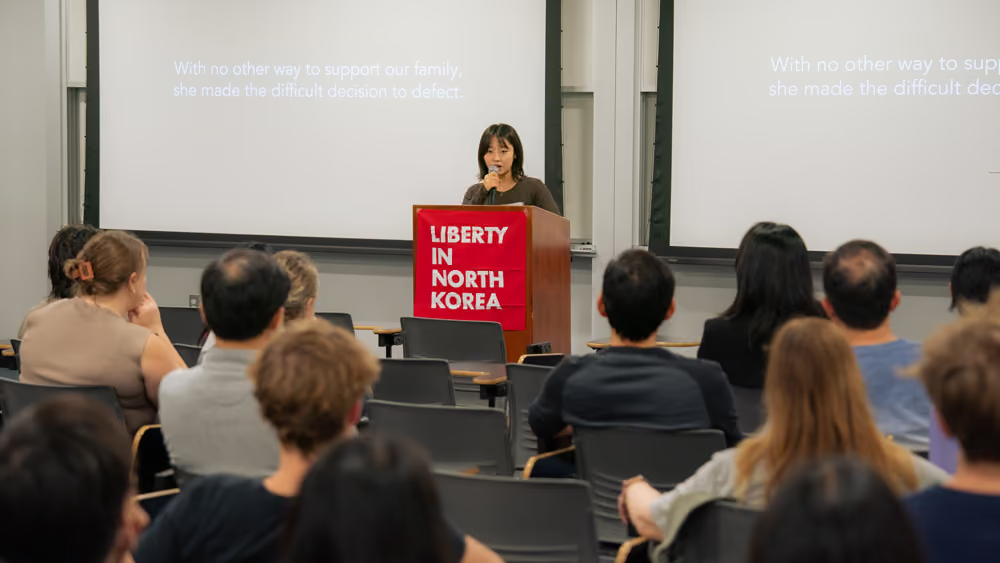
For my graduation project, I designed a North Korean Human Rights Memorial Hall. I chose Imjingak, near the DMZ, as the symbolic location. The space I conceptualized commemorates the sorrow of separation, and allows visitors to experience the "surveillance," "chaos," and "oppression" North Koreans face in their daily lives.
The Pantheon in Rome directs our gaze toward the sky. I turned that idea upside down. In my design, the ceiling collapses into the ground, trapping people beneath, like the crushing weight of the regime’s oppression.
On the opposite wall, the names of loved ones are carved into stone, representing those we miss dearly. Before politics, before ideology, these are mothers and fathers, grandparents and children. This is a space where people can freely miss and yearn for the people they left behind. And it is a reminder that North Korea is home to our families, friends and neighbors.
Last year, when I visited the Holocaust Memorial in Washington DC, I felt that it was more than just a commemorative site. It was a space that showcased how to confront humanity's darkest history to ensure that such things are never repeated again.
Standing there, I hoped that one day, the human rights abuses faced by North Koreans would also just be a memory for us to reflect on.
I no longer hide my identity. My story began in North Korea, in a beautiful city by the Yalu River. Even now, on quiet mornings, my thoughts drift back to my grandparents’ house. I want the world to see North Korea like I do—through the warmth of ordinary days and the humanity of its people.
I dream of returning home one day, when all North Koreans can live free and full lives. Until then, I will continue to speak through the language of space and the power of stories.
The Universal Declaration of Human Rights begins with this: "all human beings are born free and equal in dignity and rights." These aren’t just words on paper, but a reality that we can create together.
Please join me today to advance freedom and human rights for all North Koreans.
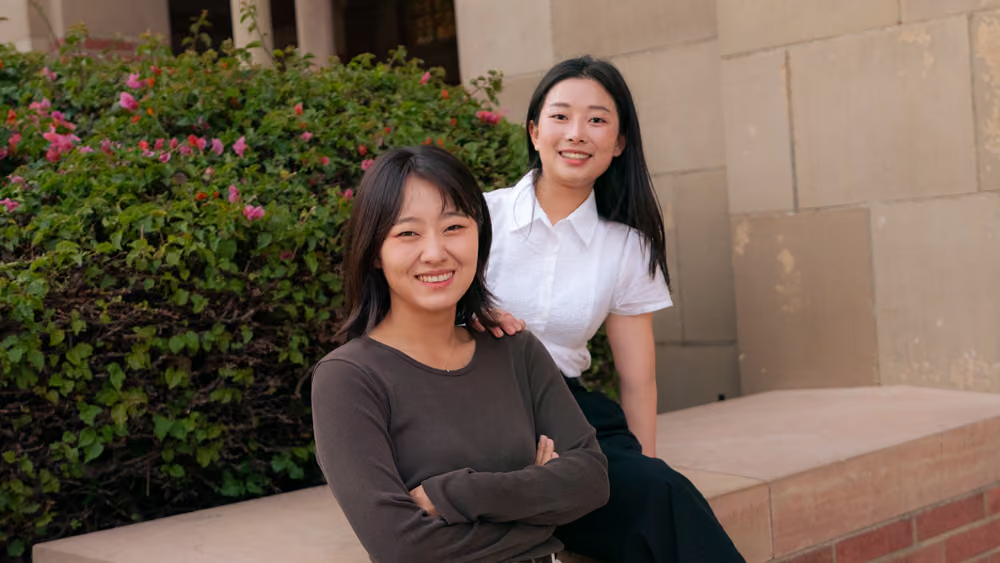
In 2025, Rose traveled across the US, sharing her story and advocating for the North Korean people as a LiNK Advocacy Fellow. Our capacity-building programs are cultivating the next generation of North Korean activists and leaders who are bringing change to their homeland.
Help empower more North Korean refugees with opportunities to grow, like Rose.
Give Today
North Korea 101: The History of North Korea
Watch The History of North Korea in Under 3 Minutes
If you want to go even further back, here's how North Korea came to be!
668 A.D: Ancient Korea
People have been living on the Korean peninsula since prehistoric times, slowly developing their own distinct culture and civilization. The Korean people were first united by the Silla Dynasty in 668 A.D. Since then, Korea has had to contend with the expansionist ambitions of its neighbors.
1910: Japan Colonizes Korea
In 1910, the Chosun Dynasty ended with Japan’s annexation and colonization of Korea. Koreans remember the Japanese colonial rule as a brutal experience. Resistance groups formed in Korea and China, mostly adopting leftist politics in reaction to the right-wing Japanese administration. Memories of the Japanese Imperial Administration’s oppression continue to haunt relations between the people of both Koreas and Japan today. Korea also began to modernize during this period, and the city of Pyongyang in particular became a vibrant center for Christianity and western culture.
1945: The Division of the Korean People
Following Japan’s defeat in 1945 the Soviet Union and United States agreed to split the post-war control of the Korean peninsula between themselves. On August 10, 1945 two young U.S. military officers drew up a line demarcating the U.S. and Soviet occupation zones at the 38th parallel. The divide should have been temporary, a mere footnote in Korea’s long history, but the emergence of the Cold War made this a seminal event. Seeking to ensure the maintenance of their respective influences in Korea, the U.S. and USSR installed leaders sympathetic to their own cause, while mistrust on both sides prevented cooperation on elections that were supposed to choose a leader for the entire peninsula. The United States handed control over the southern half of the peninsula to Syngman Rhee, while the Soviet Union gave Kim Il-sung power over the north. In 1948, both sides claimed to be the legitimate government and representative of the entire Korean people.
August 15, 1948
Syngman Rhee declares the formation of the Republic of Korea in Seoul, claiming jurisdiction over all of Korea..
September 8, 1948
Kim Il-sung declares the formation of the Democratic People’s Republic of Korea in Pyongyang, also claiming jurisdiction over all of Korea.
1950: The Korean War Begins
June 25, 1950
In 1950, Kim Il-sung attempted to unify Korea under his rule through military force, starting the Korean War. By far the most destructive and divisive event in Korean history, the war altered the life of almost every Korean person. Some historians claim that the U.S. military dropped more napalm on urban centers in Korea than Vietnam. The bombing campaigns reduced Pyongyang to rubble, and North Korea’s population was reduced by 10%.
July 27, 1953
Both sides eventually signed the armistice ending major hostilities in 1953. The DMZ (demilitarized zone) was established at almost the same position as the border before war broke out, separating millions of families caught on opposite sides of the border.
1953-1970s: Building a Stalinist State
From 1953 to the 1970s North Korea was considered by some outside observers to be a successful state. During this period, many North Koreans were actually better off than their southern brethren.
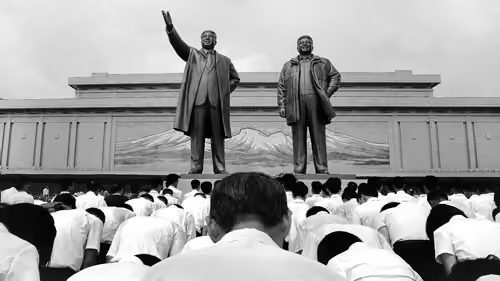
Kim Il-sung remodeled North Korean society along the lines of Juche—North Korea’s radically nationalistic ideology promoting Korean autonomy. The state-seized control of all private property and organizations. Officially, everything in the country, from businesses to the clothes on one’s back, belonged to the North Korean state. The regime rebuilt Pyongyang as a socialist capital and erected numerous monuments to Kim Il-sung, part of nationwide efforts to build a cult of personality to secure obedience by the people. The state took control of all media and restricted international travel. Kim Il-sung also worked constantly to centralize power under the Workers’ Party of Korea under his rule, and implemented a perpetual purge to rid the country of potential internal opponents to his rule.
Songbun
Massive inequalities began to emerge in North Korean society. The regime introduced the songbun system, which is still in place today. Under this system the entire population were sorted into different social classes according to one’s perceived loyalty to socialism and the regime. This classification determined the course of people’s lives. One’s songbun dictates the schools one can attend, the occupations one can be placed in, and even where one can live.At the time, the regime expelled around a quarter of the population of Pyongyang to the outer provinces for being of low songbun. For more on songbun, see this blog post.
The regime silenced anyone who opposed the system with extreme prejudice. Free speech became an offense punishable by imprisonment or even death. Worse, when one was arrested, up to three generations of their family would be sent to political prison camps. The regime instructed children to inform on their parents, and neighbors to inform on each other. Under these conditions, the North Korean people became fearful and distrusting of each other.
Stagnation
By the 1970s, the initial gains of postwar reconstruction and modernization had dissipated, and Kim Il-sung’s ideologically driven governance failed to produce prosperity. North Korea was also highly dependent on trade and aid from the Soviet Union and the Eastern bloc, so when the economies of those countries began to decline it greatly affected North Korea’s economy. The people’s quality of life stagnated in the 1980s and began to decline until the collapse of the USSR in 1991, at which point the North Korean socialist command economy stopped functioning. Poor agricultural policies and environmental mismanagement increased vulnerability to extreme weather conditions and brought increasingly meager crop yields. To make matters worse, the regime had lost allies to fall back on when the economy failed. North Korea’s reserves were quickly running out. These were the circumstances the country found itself in when Kim Il-sung died in 1994.
Economic Collapse
Kim Jong-il took power in the post-Cold War era when North Korea was on the brink of disaster. Realizing the need to handle both external and internal threats, Kim Jong-il instituted a “military first” policy that prioritized the military and elites over the general population to an even greater extent than before. This policy made the coming crisis even worse for the average North Korean. Many North Koreans blame Kim Jong-il’s leadership for the famine. In reality, Kim Jong-il’s policies exacerbated a crisis that was long in the making.
The economic collapse and subsequent famine in North Korea had its peak in the mid-to-late 1990s. It is estimated that up to one million people died—roughly 5% of the population. Even many of those that survived suffered immensely. Starvation in childhood has stunted the growth of an entire generation of North Koreans. The North Korean government had to lower the minimum required height for soldiers because 145 cm (4 feet 9 inches) was too tall for most 16-17 year olds.
In Barbara Demick’s book “Nothing to Envy”, a North Korean doctor tells of how even she became desperately hungry. After fleeing to China, she discovered a bowl of food left out for a dog. Upon examining the white rice and generous chunks of meat, she concluded that “dogs in China ate better than doctors in North Korea.”
July 8, 1994
Kim Il-sung dies and his son Kim Jong-il takes over as leader.
Social Changes
The collapse of the command economy led to widespread social changes. The need for food drove the North Korean people away from the regime’s control, as when the government stopped providing food, the survivors found other ways to feed themselves. People foraged and sold anything they could to buy food at small, illegal markets that began to spring up, creating a process of bottom-up marketization. Some fled to China, leading to a wave of refugees from North Korea, while information about the outside world slowly began to flow back into the country. Some resorted to prostitution or crime. What was once a highly ordered and controlled society gave way to a disorganized and fluid society, with new independent paths to wealth and power for those who defied the regime and pursued the markets. These social effects would continue even after the worst of the famine had passed.
2000s: The People & Markets Prove Their Resilience
By the early 2000s, the people began to recover. The markets, which initially emerged as a survival mechanism, gradually grew to encompass a broader range of goods and services and became better established. The markets today are the major source of food for ordinary North Koreans. South Korea also adopted the “Sunshine Policy”, in which it gave unconditional aid to North Korea, and increased economic cooperation between the Koreas. Established in 2003, the Kaesong Industrial Complex just north of the DMZ was part of this policy and now allows South Korean companies to hire over 50,000 North Korean workers. China also gradually strengthened its economic relationship with North Korea, and today is by far North Korea’s most important economic and political partner. Nevertheless, ordinary North Koreans continue to face the severe challenges of chronic food shortages and grinding poverty, while their basic freedoms are curtailed by a repressive regime whose number one concern is staying in power.
Always uneasy about the growth of the markets, in late 2009 the regime made their most drastic attempt to restrain the markets to date: a currency reform aimed at wiping out private wealth. The resultant market disruption and rapid inflation reversed the people’s hard-won progress, and even regime projects were derailed. North Korean refugees have described this as a watershed moment in their diminishing belief in the regime, with anti-regime sentiment so strong that it even rose to the surface in some communities. It is now absolutely clear to the regime that the markets are a fact of life they must learn to live with.
December, 2011
Kim Jong-il dies and his son Kim Jong-un takes over as leader.
Now: The Third Kim Era
In December 2011, Kim Jong-il died and his son Kim Jong-un inherited control of the nation. Thought to be just 27 or 28 years old at the time of his succession, Kim Jong-un was largely unknown to the North Korean people as well as to the outside world. North Koreans that escaped the country in 2011 told us that there had not been a lot of propaganda about Kim Jong-un during that year. By contrast, Kim Jong-il was much better known to the North Korean people when he came to power in 1994.
In his first years in power, Kim Jong-un has implemented a new PR style that has portrayed him as a modern version of his grandfather, while purging, demoting and promoting regime officials to secure his power base. The new leadership also moved to crack down on illegal cross-border movement and the inflow of foreign media, increasing repression in the border regions and reducing the number of defectors who managed to make it to South Korea by almost half. Meanwhile, there have been signs of cautious experimentation with economic liberalization in order to adapt to the reality of the entrenched de facto market economy inside the country.
North Korea’s history is far from over. In fact, it may be entering its most interesting phase. The people are becoming increasingly empowered and the grassroots changes spreading across North Korean society are steadily increasing the people’s physical and psychological independence from the regime, making the system as it is currently structured unsustainable. We cannot know the pathway that North Korea’s change and opening will take, but change and opening will happen, and the future of North Korea will be increasingly driven by the North Korean people themselves.