
I Watched K-Dramas Inside North Korea. They Gave Me the Courage to Escape | Hannah’s Story
How many times have you checked your phone today? Fifty? A hundred? Every time we look at the screen we are connected to the world around us and an endless stream of information—news, research, entertainment.
Now imagine waking up tomorrow in a place without the internet. A place where people are executed for sharing foreign media, and where families risk their lives just to stay in touch across borders.
For 26 million people in North Korea, this is their reality. And 7 years ago, I was one of them.
I was born in Hoeryong, a city in the northernmost part of North Korea near the Tumen River. Winters were brutal and there were frequent shortages of fuel and electricity.
My father was a high school physics teacher. He was quiet, loyal and diligent. His days started at 7am in the classroom and went late into the night, even on weekends. But despite his dedication, the monthly rations he received were not enough for our family.
So in order to survive, my mother began selling goods at the market. She wanted a better life for us, and that led her to do the unthinkable—escape North Korea. Three times she tried. Three times she was caught. Each time she was imprisoned and sent to a labor camp.
The prison camp was a living hell. My mother saw women waste away from hunger and die from simple illnesses. She was one of the lucky ones; her family brought her food and medicine, an act that made her a witness to the suffering of others.
I was just 13 when I first visited her, carrying a bowl of rice. In North Korea, it falls to families to provide for their imprisoned relatives.
Seeing my mother stand there like a criminal, her head bowed before the guard, I knew this wasn't right. I should have been in school, but instead, I was sneaking food to her, hiding from the stares of strangers.
We were being punished, but I didn't understand why. I felt wronged, and in my anger, I blamed her.
My mother had made a choice to save her family, but North Korean society saw her as a criminal. My father, who had led a quiet life as a teacher, was denied opportunities at work. Our family was labeled as traitors.
In 2013, on her fourth attempt, my mother finally escaped and made it to South Korea. She worked tirelessly to send money back to North Korea to help our family. She also slowly opened a window into another world.
Using a smuggled Chinese cell phone I was able to speak to my mother from time to time. And on our secret calls she shared with me new South Korean expressions and words she was learning. As she settled into a new society, despite numerous differences, she also recognized similarities between North and South Korea and its people, and reminded me that despite decades of division, we are still one people.
I secretly began watching South Korean sitcoms. I’ll never forget one called “High Kick 3.” In one episode, there was a story about a man who fell into debt and was being chased by collectors. But what shocked me was that his family wasn’t punished for it. In North Korea, if one person “sins” the entire family is condemned. But this showed me that in South Korea, life could be different. That even within a family, you were free to make your own choices.
This realization changed me and offered a glimpse of the vast world beyond North Korea. Information, even in the form of a sitcom, was hope. And it was worth risking everything for.
Meanwhile, I continued to face obstacles in my day to day life. I had learned how to code and use software like photoshop, and I dreamed of going to university after graduation. But because my mother had defected, I was rejected. So I used my computer skills to find work as a photographer and photo editor.
Hoping to advance my career, I volunteered for the "shock brigade," a group sent to do manual labor at dangerous construction sites. While others prayed they wouldn't get picked for this kind of work, I went willingly, thinking it could be my way to a promotion.
I was sent to the Samjiyon district, a place known for its harsh winters. For over a month, I demolished buildings in minus 40-degree weather without protective gear. Dust filled my lungs, and sweat froze my clothes solid. My only relief was being able to sleep in a crumbling basement.
When I returned, expecting the promotion I had been promised, my supervisor simply said, "Let's wait a little longer."
That was the moment I understood my mother. She had risked her life to escape because she was after something more fundamental than a better life. She wanted to live like a human being.
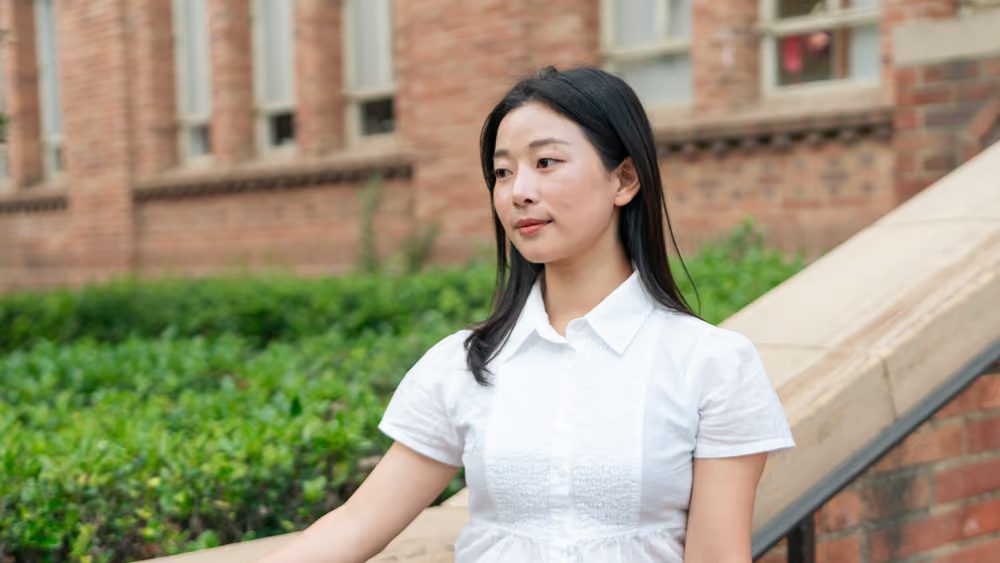
In 2019, I made the same choice and escaped. With the help of Liberty in North Korea, I made it safely to South Korea and reunited with my mom.
Freedom wasn’t as easy as I thought it would be. In North Korea, my tech and computer skills had helped me survive. I had always thought that “no matter where I go, as long as I have a computer, I’ll be fine.” But in South Korea, I struggled with something as simple as a new keyboard layout. In school, subjects like social studies felt foreign because I had grown up in a completely different education system with distorted versions of history and philosophy. My dream of going to college suddenly felt impossible.
Eventually I found my place in science. The formulas and equations in math, chemistry, and physics were the constant, unchanging truths I could always count on.
I decided to major in electrical engineering. It was rare for North Korean defectors to pursue this field. But I was determined to stay ahead and not fall behind in our rapidly changing world. Now my goal is to become an engineer who can help bridge North and South Korea’s science and technology industries when the two countries are one again.
More than ever, I see that information isn’t just about knowledge and convenience—it’s a lifeline. Without access to information, you can’t see a way forward, let alone build a future.
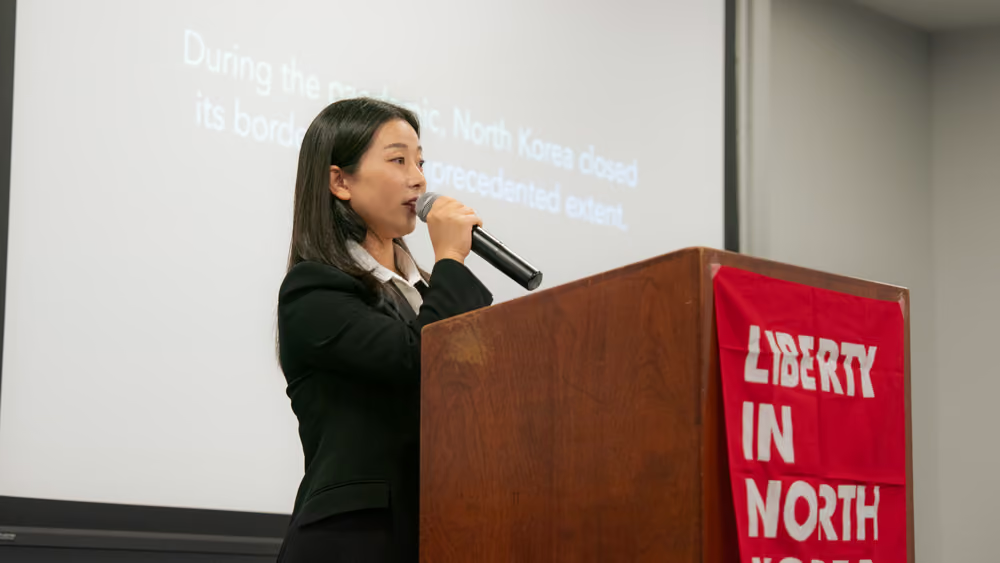
And right now, the people I left behind are more cut off than ever before. During the pandemic, North Korea closed its borders to an unprecedented extent. Soldiers along the border had shoot-to-kill orders for anyone trying to escape. Around 90% of the markets were forced to shut down, leaving families with barely enough to eat. The UN reported that nearly half the population—12 million people—faced food insecurity, while the World Health Organization rated North Korea’s access to medical care as the lowest in the world.
A few years ago, when my father became very sick, I was able to send him money for medicine and hospital care. But most North Koreans don’t have that chance. Without someone on the outside, they are not only cut off from resources and information, but from hope itself. For many, their future depends on a lifeline from the outside world.
Supporting North Korean people and protecting human rights cannot be put off.
We have an opportunity to be a lifeline for people inside North Korea today. To remind them that they have not been forgotten. With your support, we can rescue and support more North Korean refugees, and get more outside information and technology to people inside the country. And that information can empower North Koreans to not only see a way forward, but to ultimately determine their own future.
Despite the risks, North Koreans are quietly accessing foreign media and learning about life in the outside world. Increasing their access to uncensored information is one of the most effective ways to increase change inside the country.
Liberty in North Korea partners with North Korean defectors and engineers, like Hannah, to develop technology, content, and tools tailor-made for the North Korea context. Our goal is to empower North Koreans with information about the outside world, increasing their aspirations for social and economic progress, and building pressure for change and opening.
Empower North Koreans with information access.
Give Today
Love and Dating ... in North Korea
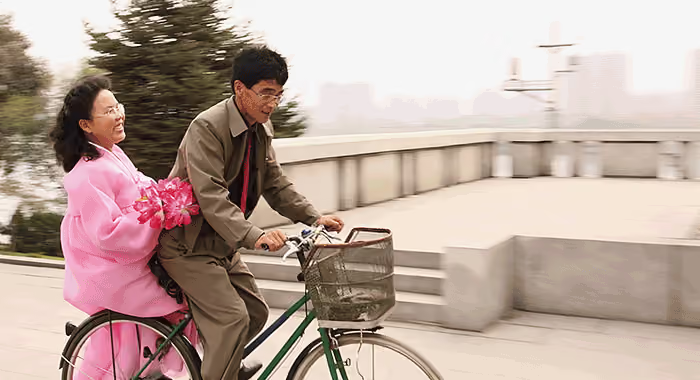
This updated version of Love & Sex in North Korea was originally written by LiNK for Koreaboo.
According to historians who are really good at remembering when things happened in the olden days, sex and love existed before the Internet was even invented. Before 56K dial-up, phones, and even Tinder, humans found ways to interact completely offline and engage in sexual activity. In fact, biologists believe that the human proclivity for sex is universal and plays a major role in producing baby humans, thereby maintaining the human race’s existence. (Go humans!)
So could it be that in North Korea too, people have sex and fall in love and do romantic things with each other?
According to North Korean refugees that I’ve worked with, the answer is: Yes. North Koreans have sex too.
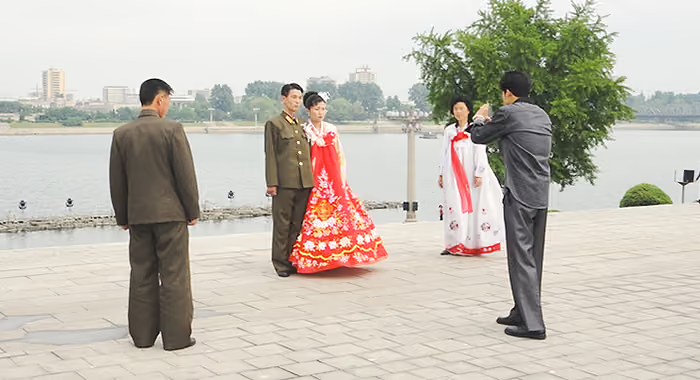
So, how do North Koreans do it?
First of all, the baseline to understand is that overall North Korean dating culture is pretty traditional and conservative. Think South Korea, but 50 years ago. One of the reasons for this is, well, North Korean society is quite conservative and patriarchal in general and North Korean media is super old-fashioned. In North Korean films you don’t see couples kissing or being physically affectionate with each other, so many North Koreans are just not used to PDA and wouldn’t dream of being too affectionate or kissing in public.
Nonetheless North Koreans do meet and date and fall in love like everywhere else. A lot of it starts in school (awww) and people also meet at dances or house parties. That’s right, when the parents are out of town young urban North Koreans will often invite a bunch of friends over and have a party. Once ‘the eyes have met’ the boy often has to do a lot of the pursuing. And guys, spare a thought for our brothers there: Only about 10% of North Koreans have a mobile phone. So for most, it has to be done the old fashioned way.
Either you have to pre-arrange to meet ‘10 trees away from the school gate at 7pm on Wednesday’ or you have to take the risk of going to their house. The danger, of course, is that you knock on the door and their mother answers, causing all that (traditional Asian) embarrassment. So a common trick is to knock and wait for someone to call out “Who is it?” If it’s the mother you say “I’ve come for Eun-kyung” (even though your girlfriend’s name is something else) and pretend you got the wrong house. If your girlfriend answers, then you can say, “It’s me! Come out!” Nicely done.
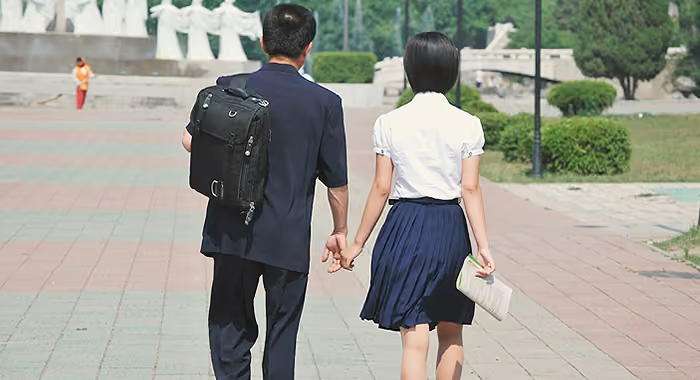
Finding a place to date isn’t so hard; people hang out in the park, or by the river, or around the market. But it’s when you need a bit more privacy that things get more difficult. The vast majority of young North Koreans live in their parents house until they get married (even more so than South Koreans) so there is no privacy at home. So when the relationship heats up, young couples will often go to the North Korean equivalent of a love motel, which is basically paying a middle-aged women to clear out of their own house for a few hours so the couple can get it on. A more risky space for a frisson might be a storage room with an unlocked door, or even a train toilet.
However, there’s a problem here...well, a few in fact. Sex education is almost non-existent in North Korea. And contraceptive pills and condoms can be hard to come by, too (you can’t just stop by the closest 24-hour convenience store). I have a friend who used to smuggle goods from China to sell in North Korea, and she says she saw a pregnancy test for the first time in 2007. She of course promptly smuggled some in to sell to North Korean women. This combination of factors unfortunately leads to a lot of unplanned pregnancies and risky abortions amongst unmarried women.
Like other aspects of North Korean culture, dating culture is not static. And as with other social changes, one of the major drivers is the influx of foreign media being smuggled in on DVDs and USB drives, and now even Micro-SD cards. In fact, one of the reasons South Korean dramas and films are so popular is because, in contrast to North Korean government-produced films, they show compelling human stories of love and relationships, and have addictive plotlines. If all you had access to was government propaganda your whole life and then suddenly you heard that your friends had access to this amazing new foreign stuff, you might risk watching it too.
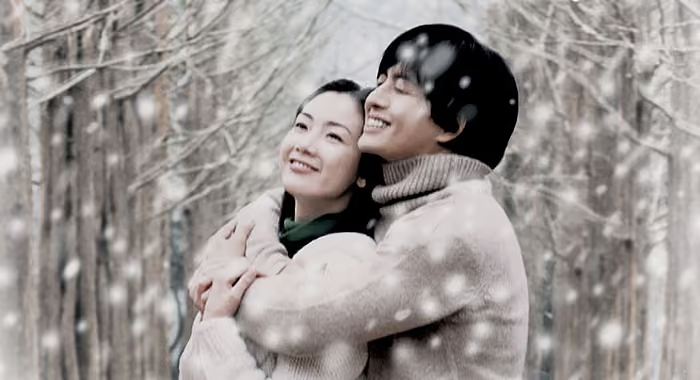
In the first few viewings, these simple South Korean soaps can be revelatory: The PDA, the attitudes of the female characters, even the way they talk and dress. The love story in the Korean drama Winter Sonata, which is credited with starting the Korean Wave across Asia, is still remembered fondly by many North Korean refugees.
Similarly when My Sassy Girl was smuggled in many young women who watched it were driven to imitate not just Jeon Ji-hyun’s fashion and hairstyle, but also the confident and cool way in which her character treats her boyfriend. (And of course in the background of these films and dramas, North Korean viewers can’t help but notice that South Korea looks way richer than North Korea). These information changes are confounding economic changes in their effects on gender relations, as bottom-up marketization has raised the status of women as they play a key role in illegal and semi-legal entrepreneurial business activities.
Humans being humans, porn is also being smuggled into North Korea. And without getting too PG-13, it would be fair to assume that this also opens up and accelerates changes in behaviour between the sheets as well.
It’s worth noting that despite a big growth in flows of foreign media over the last 10 years it is still limited, and especially in the countryside and in the interior of the country away from the border with China, people have much less access (if at all). So there is huge regional variation in North Korea and dating culture will still be very traditional and conservative in the countryside, whilst changing rather quickly in Pyongyang and other major cities and border towns. In addition, young Pyongyangites also mostly have mobile phones now, meaning fewer nervous knocks on doors.
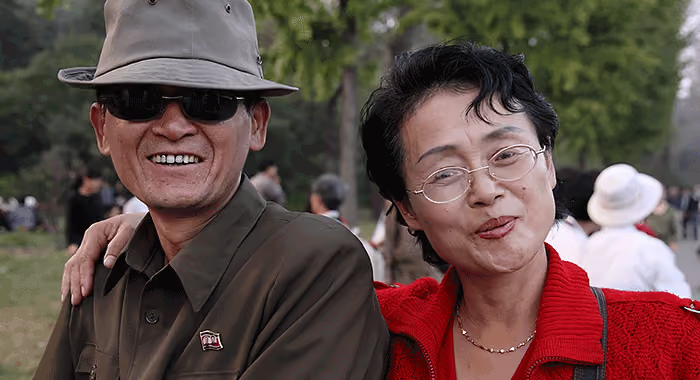
Because of the government’s ongoing restrictions on culture and extreme paranoia over foreign media, North Korea was late to the sexual revolution. But it is now happening, and it is no trivial matter. The emulation of dating culture learned through South Korean and other foreign media, particularly among young urban North Koreans, is contributing to increased sensitivity to foreign trends and a liberalization and modernization of culture and society from the bottom up. And in the long run, it’s this kind of social change that will help usher in a wider transformation and opening of North Korean society, to the benefit of the North Korean people and humanity as a whole.
--SOKEEL PARK - director of research and strategy










