
I Watched K-Dramas Inside North Korea. They Gave Me the Courage to Escape | Hannah’s Story
How many times have you checked your phone today? Fifty? A hundred? Every time we look at the screen we are connected to the world around us and an endless stream of information—news, research, entertainment.
Now imagine waking up tomorrow in a place without the internet. A place where people are executed for sharing foreign media, and where families risk their lives just to stay in touch across borders.
For 26 million people in North Korea, this is their reality. And 7 years ago, I was one of them.
I was born in Hoeryong, a city in the northernmost part of North Korea near the Tumen River. Winters were brutal and there were frequent shortages of fuel and electricity.
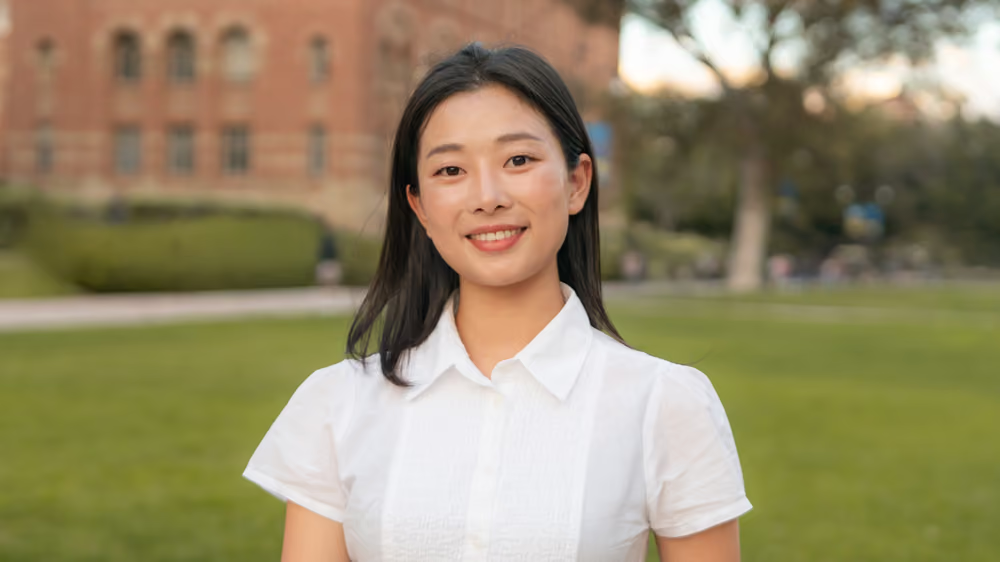
My father was a high school physics teacher. He was quiet, loyal and diligent. His days started at 7am in the classroom and went late into the night, even on weekends. But despite his dedication, the monthly rations he received were not enough for our family.
So in order to survive, my mother began selling goods at the market. She wanted a better life for us, and that led her to do the unthinkable—escape North Korea. Three times she tried. Three times she was caught. Each time she was imprisoned and sent to a labor camp.
The prison camp was a living hell. My mother saw women waste away from hunger and die from simple illnesses. She was one of the lucky ones; her family brought her food and medicine, an act that made her a witness to the suffering of others.
I was just 13 when I first visited her, carrying a bowl of rice. In North Korea, it falls to families to provide for their imprisoned relatives.
Seeing my mother stand there like a criminal, her head bowed before the guard, I knew this wasn't right. I should have been in school, but instead, I was sneaking food to her, hiding from the stares of strangers.
We were being punished, but I didn't understand why. I felt wronged, and in my anger, I blamed her.
My mother had made a choice to save her family, but North Korean society saw her as a criminal. My father, who had led a quiet life as a teacher, was denied opportunities at work. Our family was labeled as traitors.
In 2013, on her fourth attempt, my mother finally escaped and made it to South Korea. She worked tirelessly to send money back to North Korea to help our family. She also slowly opened a window into another world.
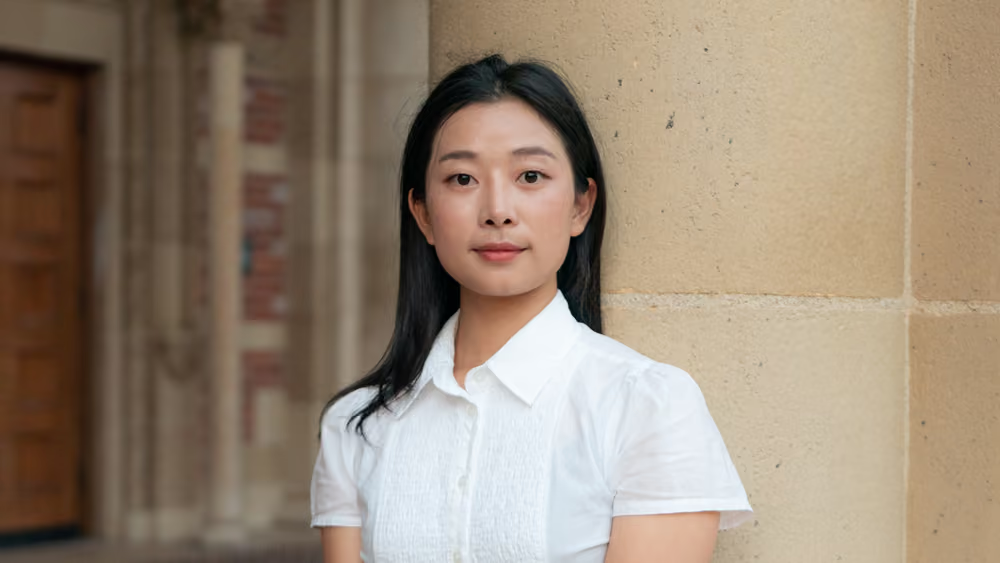
Using a smuggled Chinese cell phone I was able to speak to my mother from time to time. And on our secret calls she shared with me new South Korean expressions and words she was learning. As she settled into a new society, despite numerous differences, she also recognized similarities between North and South Korea and its people, and reminded me that despite decades of division, we are still one people.
I secretly began watching South Korean sitcoms. I’ll never forget one called “High Kick 3.” In one episode, there was a story about a man who fell into debt and was being chased by collectors. But what shocked me was that his family wasn’t punished for it. In North Korea, if one person “sins” the entire family is condemned. But this showed me that in South Korea, life could be different. That even within a family, you were free to make your own choices.
This realization changed me and offered a glimpse of the vast world beyond North Korea. Information, even in the form of a sitcom, was hope. And it was worth risking everything for.
Meanwhile, I continued to face obstacles in my day to day life. I had learned how to code and use software like photoshop, and I dreamed of going to university after graduation. But because my mother had defected, I was rejected. So I used my computer skills to find work as a photographer and photo editor.
Hoping to advance my career, I volunteered for the "shock brigade," a group sent to do manual labor at dangerous construction sites. While others prayed they wouldn't get picked for this kind of work, I went willingly, thinking it could be my way to a promotion.
I was sent to the Samjiyon district, a place known for its harsh winters. For over a month, I demolished buildings in minus 40-degree weather without protective gear. Dust filled my lungs, and sweat froze my clothes solid. My only relief was being able to sleep in a crumbling basement.
When I returned, expecting the promotion I had been promised, my supervisor simply said, "Let's wait a little longer."
That was the moment I understood my mother. She had risked her life to escape because she was after something more fundamental than a better life. She wanted to live like a human being.
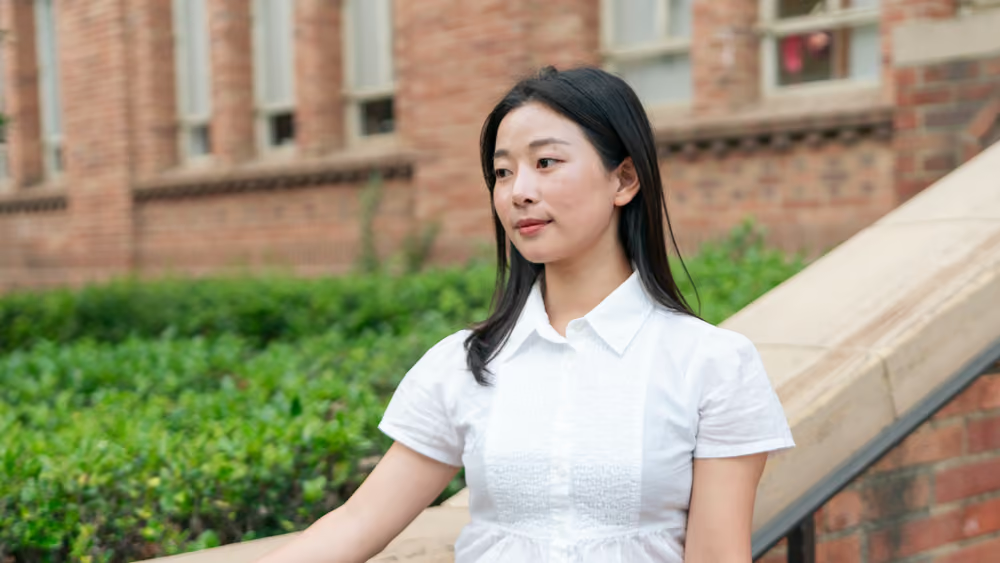
In 2019, I made the same choice and escaped. With the help of Liberty in North Korea, I made it safely to South Korea and reunited with my mom.
Freedom wasn’t as easy as I thought it would be. In North Korea, my tech and computer skills had helped me survive. I had always thought that “no matter where I go, as long as I have a computer, I’ll be fine.” But in South Korea, I struggled with something as simple as a new keyboard layout. In school, subjects like social studies felt foreign because I had grown up in a completely different education system with distorted versions of history and philosophy. My dream of going to college suddenly felt impossible.
Eventually I found my place in science. The formulas and equations in math, chemistry, and physics were the constant, unchanging truths I could always count on.
I decided to major in electrical engineering. It was rare for North Korean defectors to pursue this field. But I was determined to stay ahead and not fall behind in our rapidly changing world. Now my goal is to become an engineer who can help bridge North and South Korea’s science and technology industries when the two countries are one again.
More than ever, I see that information isn’t just about knowledge and convenience—it’s a lifeline. Without access to information, you can’t see a way forward, let alone build a future.
And right now, the people I left behind are more cut off than ever before. During the pandemic, North Korea closed its borders to an unprecedented extent. Soldiers along the border had shoot-to-kill orders for anyone trying to escape. Around 90% of the markets were forced to shut down, leaving families with barely enough to eat. The UN reported that nearly half the population—12 million people—faced food insecurity, while the World Health Organization rated North Korea’s access to medical care as the lowest in the world.
A few years ago, when my father became very sick, I was able to send him money for medicine and hospital care. But most North Koreans don’t have that chance. Without someone on the outside, they are not only cut off from resources and information, but from hope itself. For many, their future depends on a lifeline from the outside world.
Supporting North Korean people and protecting human rights cannot be put off.
We have an opportunity to be a lifeline for people inside North Korea today. To remind them that they have not been forgotten. With your support, we can rescue and support more North Korean refugees, and get more outside information and technology to people inside the country. And that information can empower North Koreans to not only see a way forward, but to ultimately determine their own future.
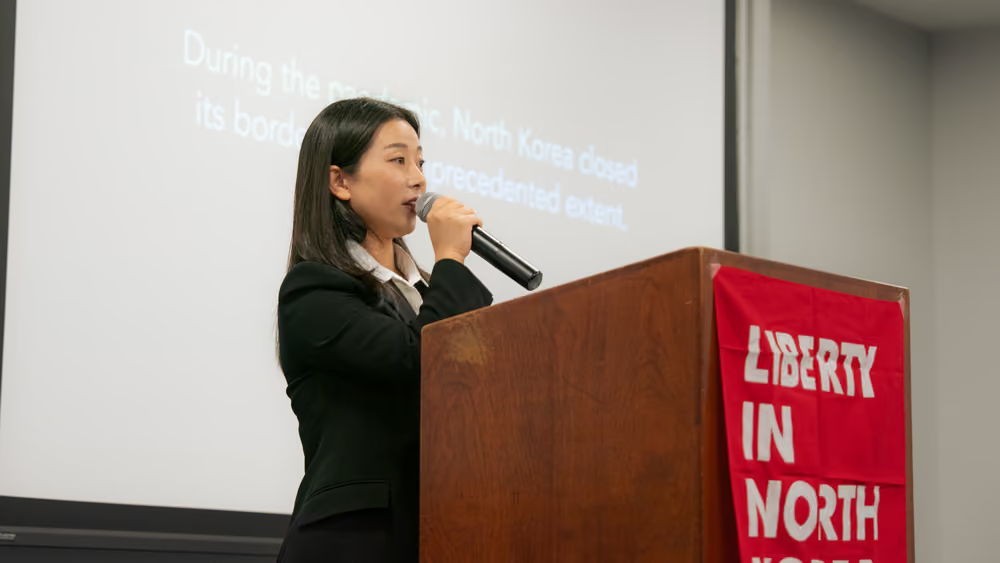
Despite the risks, North Koreans are quietly accessing foreign media and learning about life in the outside world. Increasing their access to uncensored information is one of the most effective ways to increase change inside the country.
Liberty in North Korea partners with North Korean defectors and engineers, like Hannah, to develop technology, content, and tools tailor-made for the North Korea context. Our goal is to empower North Koreans with information about the outside world, increasing their aspirations for social and economic progress, and building pressure for change and opening.
Empower North Koreans with information access.
Give Today
Crisis for North Korean Human Rights NGOs: Urgent Support Needed
The North Korean human rights movement is at a critical crossroads.
Unprecedented cuts to U.S. foreign aid under the Trump Administration have impacted projects around the world, including that of crucial South Korean NGOs working on the North Korea issue.
Until funding is fully resumed, these organizations face the prospect of downsizing or shutting down, threatening the entire ecosystem of groups working for the rights and freedom of North Korean people. Life-changing programs and decades of progress inside and outside North Korea are at risk of being undone.
Your immediate support is needed to help save the most critical projects of these organizations. LiNK has identified the core groups essential to preserving progress on this issue and has launched an emergency support fund—100% of donations will go directly to sustaining them through this crisis.
Historical Funding for North Korea-Focused NGOs
In the mid-1990s, reports of a devastating famine in North Korea and the first waves of refugees fleeing starvation caught the attention of South Korean activists. They travelled to the border of China to investigate and, realizing the severity of the situation, began campaigning in South Korea and internationally. For the first time, there was visibility on the humanitarian crisis and vast human rights violations happening in one of the most closed countries in the world.
In the wake of the Cold War, many politicians and governments had little interest in North Korea beyond seeing it as an emerging security problem. The widespread assumption was that the country would soon collapse, just as many other socialist countries had in the late 20th century.
To address the lack of action and attention, several groups focused on North Korean human rights emerged. Citizens Alliance for North Korean Human Rights was founded in 1996. NKnet was founded in 1998 and launched Daily NK in 2004. NKDB was established in 2003. Liberty in North Korea was founded in 2004.
From direct support for North Korean refugees, activism expanded to documenting human rights violations, raising public awareness, pressuring governments to take action, and getting outside information to people inside North Korea through broadcasts and USB smuggling. As the movement and North Korean defector population grew, new groups led by North Koreans themselves also emerged.
All organizations started with very few resources, and funding has often been an issue for groups in South Korea. Given the politicized nature of North Korea, support for activism has frequently fluctuated. When the political atmosphere aligned with this work, more funding would be available from the South Korean government. But when politics and administrations changed, grants dried up and public support would wane. In some cases, NGOs would even be subject to politically-motivated investigations, further hindering their vital work.
In late 2024, South Korean President Yoon’s martial law declaration and the subsequent impeachment proceedings once again left North Korean human rights organizations with a government unable to help, and a political environment not conducive to gaining support.
In these difficult circumstances, many groups in South Korea have come to rely on funding from international sources. As U.S. interest in the North Korea issue had grown in D.C., grants through the National Endowment for Democracy (NED) and the State Department (DRL) had become consistent and reliable sources of funding. Unlike those sometimes offered by the South Korean government, these grants covered not only the cost of activities, but also staff salaries, making it possible for these groups to operate sustainably.
U.S. government support had historically been immune to the kind of political winds that affected South Korean government funding. But recent US government disruption has left these NGOs on the brink.
U.S. Foreign Aid Freezes
The Trump administration started its second term with immediate cuts to U.S. foreign aid programs. State Department grants were frozen and the NED's funds were cut, suspending dozens of crucial grants to NGOs working on North Korea and leaving an uncertain picture of when or if funding might resume.
With the world’s largest economy, the U.S. was the biggest provider of foreign assistance by a significant margin. This loss of funding is unlikely to be replenished by other sources. Many European countries have also recently slashed their foreign assistance contributions to spend more on defense.
For South Korea-based NGOs, this funding disruption leaves a huge gap with very few options to fill it in South Korea or elsewhere. As a result, nearly all of these organizations are being forced to lay off staff, stop critical projects, and even consider the unthinkable: shutting down for good.
What This Means for LiNK & the Issue
LiNK is built on a funding model that is independent from government budgets, and is not directly affected by the recent aid freezes. But if the larger ecosystem of North Korean NGOs that we operate within diminishes or collapses, it will inevitably have an impact on the scope and efficacy of our work.
Even with an issue as big as North Korea, the community of organizations and individuals doing this work is relatively small. All our efforts are interconnected and mutually reinforcing. With many frontline NGOs now in danger, it jeopardizes progress on this issue as a whole.
LiNK relies on the research of these other groups to inform our programs. We join forces with them for international advocacy, share ideas, and consult each other on critical projects. With confidence in the vast array of work that these groups are doing, LiNK is able to be laser focused on a few select projects and maximize our impact.
Organizations like Human Rights Watch, UN agencies, global media outlets, and researchers also depend on these groups for their contacts, networks, research, and advocacy. Without their work and insights, globally we would be left in the dark about the current state of North Korea.
In South Korea, the individuals working on this issue are doing so with significant personal sacrifice. Given the unstable and politicized nature of the work, many activists have struggled to make a living wage, and face concern and criticism from their peers.
Funding through NED and DRL had just recently made it possible for some groups to pay staff a more sustainable salary. But even that relative stability is now gone. They have been left with no choice but to downsize and move out of offices. Staff have been laid off or put on unpaid leave. NGO leaders who have dedicated ten to twenty of their best years to this issue are now facing the prospect of leaving this field. Some feel that decades of work and effort may now abruptly end in failure.
At a time when North Korean people deserve more solidarity and support than ever, the community of activists working to mobilize and deliver that support is facing the worst crisis since the start of this movement in the 1990s.
Key NGOs in Crisis
Urgent Support is Needed
Our shared vision is bold. It not only deserves but will require a strong ecosystem of NGOs working together for the rights and freedoms of 26 million North Korean people.
You’ve stood with the North Korean people, and with us, and for that we’re deeply grateful. So we’re asking for your help. We have an opportunity to protect the progress we have made together on this issue, and to help save the most critical programs of these organizations.
Will you join us by making a donation today to ensure that this small community of dedicated organizations can continue their life-changing work?
Your donation could mean that a highly dedicated and skilled activist is not forced to look for other work. It could mean that a project inside North Korea, where the groundwork has already been laid, can be executed and finished. At this time of crisis, your donation will have an outsized impact. It is far more cost effective and efficient to preserve this work than to have to rebuild from scratch.
This campaign has concluded. Thank you for your support!










