
I Watched K-Dramas Inside North Korea. They Gave Me the Courage to Escape | Hannah’s Story
How many times have you checked your phone today? Fifty? A hundred? Every time we look at the screen we are connected to the world around us and an endless stream of information—news, research, entertainment.
Now imagine waking up tomorrow in a place without the internet. A place where people are executed for sharing foreign media, and where families risk their lives just to stay in touch across borders.
For 26 million people in North Korea, this is their reality. And 7 years ago, I was one of them.
I was born in Hoeryong, a city in the northernmost part of North Korea near the Tumen River. Winters were brutal and there were frequent shortages of fuel and electricity.
My father was a high school physics teacher. He was quiet, loyal and diligent. His days started at 7am in the classroom and went late into the night, even on weekends. But despite his dedication, the monthly rations he received were not enough for our family.
So in order to survive, my mother began selling goods at the market. She wanted a better life for us, and that led her to do the unthinkable—escape North Korea. Three times she tried. Three times she was caught. Each time she was imprisoned and sent to a labor camp.
The prison camp was a living hell. My mother saw women waste away from hunger and die from simple illnesses. She was one of the lucky ones; her family brought her food and medicine, an act that made her a witness to the suffering of others.
I was just 13 when I first visited her, carrying a bowl of rice. In North Korea, it falls to families to provide for their imprisoned relatives.
Seeing my mother stand there like a criminal, her head bowed before the guard, I knew this wasn't right. I should have been in school, but instead, I was sneaking food to her, hiding from the stares of strangers.
We were being punished, but I didn't understand why. I felt wronged, and in my anger, I blamed her.
My mother had made a choice to save her family, but North Korean society saw her as a criminal. My father, who had led a quiet life as a teacher, was denied opportunities at work. Our family was labeled as traitors.
In 2013, on her fourth attempt, my mother finally escaped and made it to South Korea. She worked tirelessly to send money back to North Korea to help our family. She also slowly opened a window into another world.
Using a smuggled Chinese cell phone I was able to speak to my mother from time to time. And on our secret calls she shared with me new South Korean expressions and words she was learning. As she settled into a new society, despite numerous differences, she also recognized similarities between North and South Korea and its people, and reminded me that despite decades of division, we are still one people.
I secretly began watching South Korean sitcoms. I’ll never forget one called “High Kick 3.” In one episode, there was a story about a man who fell into debt and was being chased by collectors. But what shocked me was that his family wasn’t punished for it. In North Korea, if one person “sins” the entire family is condemned. But this showed me that in South Korea, life could be different. That even within a family, you were free to make your own choices.
This realization changed me and offered a glimpse of the vast world beyond North Korea. Information, even in the form of a sitcom, was hope. And it was worth risking everything for.
Meanwhile, I continued to face obstacles in my day to day life. I had learned how to code and use software like photoshop, and I dreamed of going to university after graduation. But because my mother had defected, I was rejected. So I used my computer skills to find work as a photographer and photo editor.
Hoping to advance my career, I volunteered for the "shock brigade," a group sent to do manual labor at dangerous construction sites. While others prayed they wouldn't get picked for this kind of work, I went willingly, thinking it could be my way to a promotion.
I was sent to the Samjiyon district, a place known for its harsh winters. For over a month, I demolished buildings in minus 40-degree weather without protective gear. Dust filled my lungs, and sweat froze my clothes solid. My only relief was being able to sleep in a crumbling basement.
When I returned, expecting the promotion I had been promised, my supervisor simply said, "Let's wait a little longer."
That was the moment I understood my mother. She had risked her life to escape because she was after something more fundamental than a better life. She wanted to live like a human being.
In 2019, I made the same choice and escaped. With the help of Liberty in North Korea, I made it safely to South Korea and reunited with my mom.
Freedom wasn’t as easy as I thought it would be. In North Korea, my tech and computer skills had helped me survive. I had always thought that “no matter where I go, as long as I have a computer, I’ll be fine.” But in South Korea, I struggled with something as simple as a new keyboard layout. In school, subjects like social studies felt foreign because I had grown up in a completely different education system with distorted versions of history and philosophy. My dream of going to college suddenly felt impossible.
Eventually I found my place in science. The formulas and equations in math, chemistry, and physics were the constant, unchanging truths I could always count on.
I decided to major in electrical engineering. It was rare for North Korean defectors to pursue this field. But I was determined to stay ahead and not fall behind in our rapidly changing world. Now my goal is to become an engineer who can help bridge North and South Korea’s science and technology industries when the two countries are one again.
More than ever, I see that information isn’t just about knowledge and convenience—it’s a lifeline. Without access to information, you can’t see a way forward, let alone build a future.
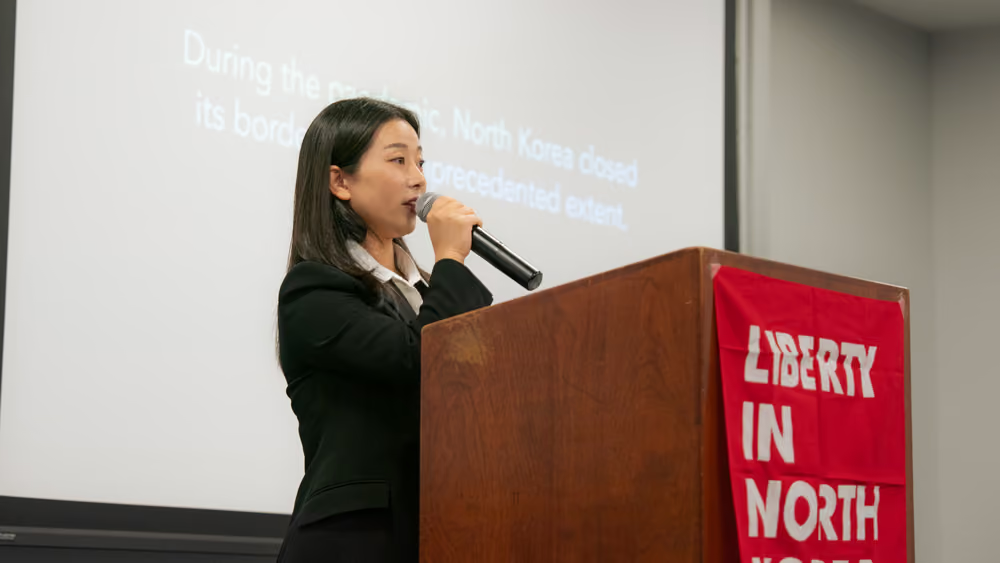
And right now, the people I left behind are more cut off than ever before. During the pandemic, North Korea closed its borders to an unprecedented extent. Soldiers along the border had shoot-to-kill orders for anyone trying to escape. Around 90% of the markets were forced to shut down, leaving families with barely enough to eat. The UN reported that nearly half the population—12 million people—faced food insecurity, while the World Health Organization rated North Korea’s access to medical care as the lowest in the world.
A few years ago, when my father became very sick, I was able to send him money for medicine and hospital care. But most North Koreans don’t have that chance. Without someone on the outside, they are not only cut off from resources and information, but from hope itself. For many, their future depends on a lifeline from the outside world.
Supporting North Korean people and protecting human rights cannot be put off.
We have an opportunity to be a lifeline for people inside North Korea today. To remind them that they have not been forgotten. With your support, we can rescue and support more North Korean refugees, and get more outside information and technology to people inside the country. And that information can empower North Koreans to not only see a way forward, but to ultimately determine their own future.
Despite the risks, North Koreans are quietly accessing foreign media and learning about life in the outside world. Increasing their access to uncensored information is one of the most effective ways to increase change inside the country.
Liberty in North Korea partners with North Korean defectors and engineers, like Hannah, to develop technology, content, and tools tailor-made for the North Korea context. Our goal is to empower North Koreans with information about the outside world, increasing their aspirations for social and economic progress, and building pressure for change and opening.
Empower North Koreans with information access.
Give Today
North Korean Agents of Change | Seohyun’s Story
It was an ordinary taxi ride. The driver struck up a casual conversation, commenting about the weather, asking what I do. At some point I shared that I was from North Korea- after two years studying abroad in China, I was used to the curiosity that typically followed.
But instead, the driver pointed to a picture of Deng Xiaoping on his rear view mirror. He explained how China was able to open up, reform, and get out of poverty. Then he asked, very pointedly, “why hasn’t your leader done the same thing, and left the people to starve?”
That was the moment when over two decades of brainwashing finally began to unravel.
My name is Seohyun Lee and I’m an advocate for the North Korean people. I was born and raised in Pyongyang, North Korea’s capital. This is my story.
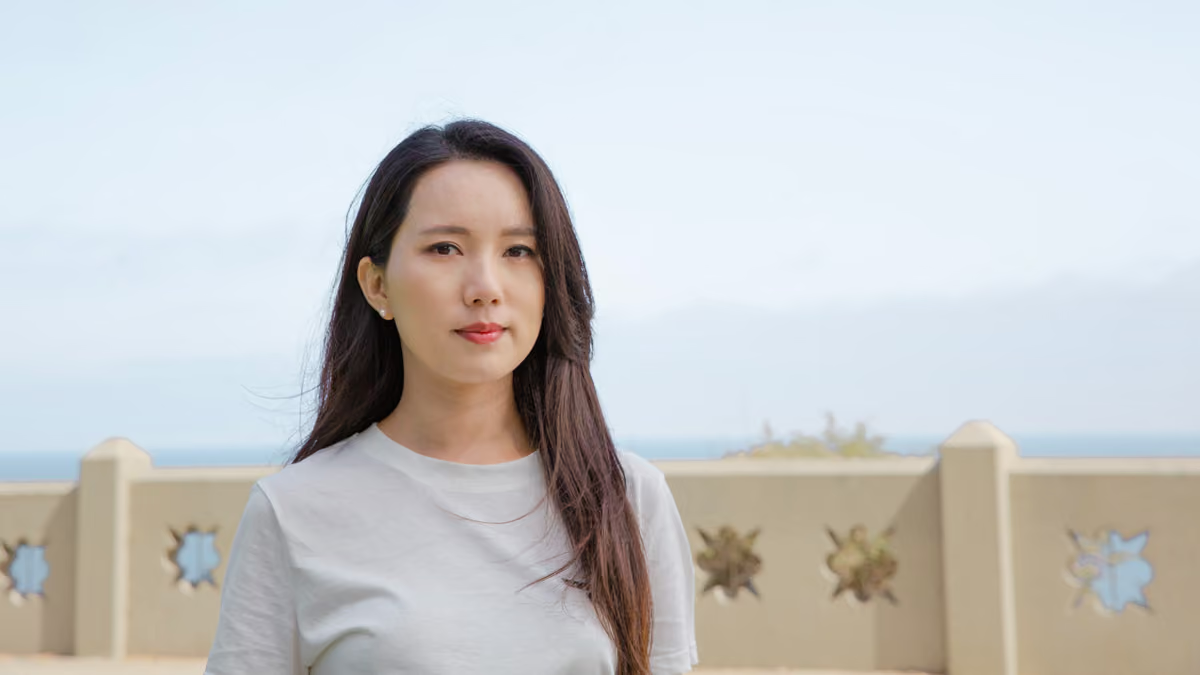
I had the unique opportunity to study in China because of my father’s position and commitment to the regime. He was a high-ranking overseas economic officer, and was allowed to bring his children if he could afford all living expenses and tuition. At first, my brother and I alternated our time in China- one member of the family always had to stay behind as a hostage. But in 2010, the regime adopted a more open policy that allowed entire families to be together, so we were all finally reunited.
Growing up in Pyongyang, the circle of elites was very small. Every so often, you’d hear about a family that was sent to a political prison camp because someone’s son or daughter acted out of line. I restrained myself from an early age because I knew my actions and words could threaten the safety of my loved ones.
So even after learning the truth about North Korea, there was not much I could do. I hoped that because Kim Jong Un was a younger guy who had also studied abroad in Switzerland, our generation could change North Korea with more open-minded leadership. But it turned out to be even worse than before.
My fondest memories in China are with my roommate, another North Korean exchange student. She was my best friend and like a big sister to me. We traveled, shopped, and shared many delicious meals together. When I was sick with the flu, she took me to the hospital and stayed by my side until my IV was finished. During those years, she was like another part of me.
I’ll never forget the last time I saw her. I watched helplessly as she was forcefully taken from our dorm room by North Korean officers. Her father was executed for being associated with Kim Jong Un’s uncle, and she was sent to a political prison camp with the rest of her family.
That day, my eyes were opened to the brutality of the regime. To them, we were just like batteries to be thrown away when used up. Our lives never mattered.
I miss her so much. I really want to believe that she’s still alive, and one day I can meet her again.
What happened to my roommate was not an isolated incident. Starting in 2013, there were countless executions and purges happening in North Korea under the Kim Jong Un regime. My family and I lost many friends, neighbors, and respected colleagues. While dealing with great loss, we also knew that at any moment, we could be next.
It was a crisp fall evening. My family and I drove to a park and left our phones in the car. We walked until we were out of earshot, and finally talked openly about what we should do.
My father worked hard because he had hope that improving the economy would better the lives of the people. But we realized that under the current system, what he desired was not possible. So in order to save ourselves and also bring change to the country, we decided to leave in October 2014.
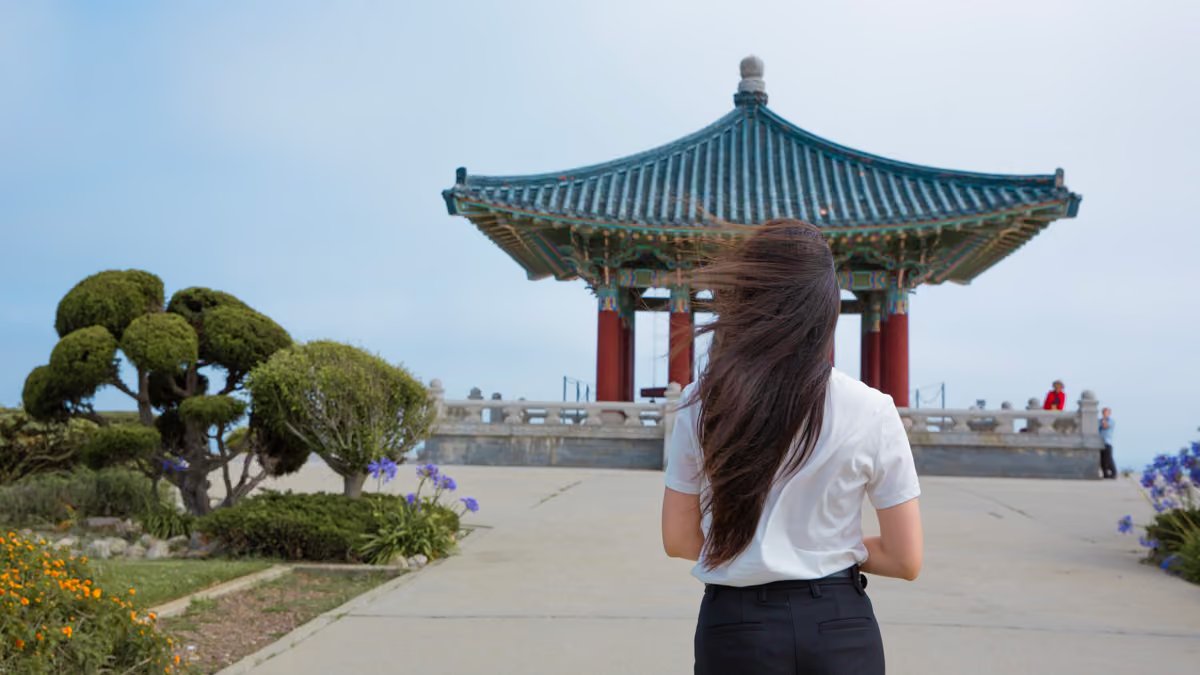
My dad still has a huge heart for North Korea. But I want to make sure that his love for the country is separated from being loyal to the regime. Back in North Korea, he worked tirelessly for a better future for the people. Today, he’s working towards the day where every North Korean has guaranteed human rights and three meals a day.
Like a lot of Asian parents, my father is not good at outwardly expressing affection. The way it manifests is through constant nagging. I didn't get it when I was young, but as I’ve gotten older, I now understand that's how he shows his love and care for us.
There have been moments when I’ve wished I was born in a different country. But when I think about my family, I never regret it.
My dad has been our foundation, my mom is the most thoughtful and perfect woman I know, and my brother has always looked out for me. We all love and support each other, especially after going through so much together.
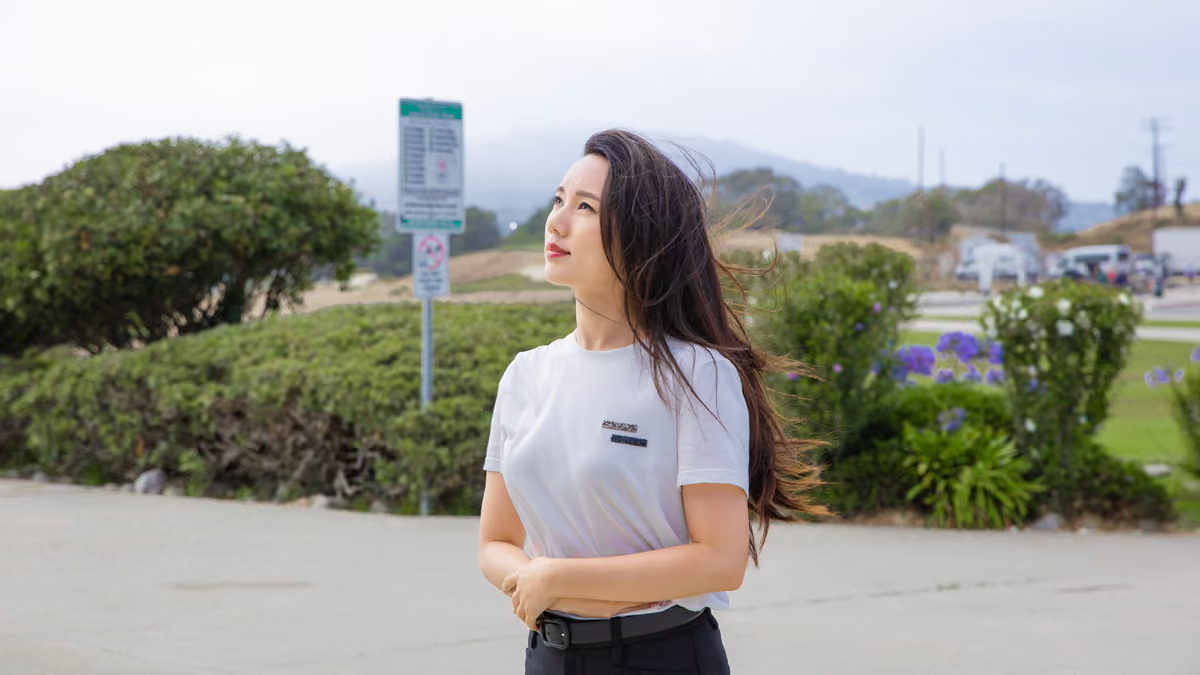
This fall, I started my graduate studies at Columbia University. I never imagined that I would be chasing my dreams here in America. I hope to use everything I learn to bring a better future for the North Korean people, even after they become free from the current regime.
When my family and I left China, we came here not only to save ourselves, but with ambitions to change the system and bring freedom. Many people have not been as lucky as I have, so I feel it is my privilege and obligation to be a voice for my fellow North Koreans. I believe many of them are already opening their minds to the outside world.
We need to let them know that there’s a global movement of people who have their backs, and we can’t wait for them to be free.
It’s #GivingTuesday, the year’s biggest day of generosity! As we work towards creating the best version of our world, we’re making sure it’s one where every North Korean is free.
Your support will allow us to continue investing in North Korean agents of change - people like Seohyun - who are leading this movement and transforming one of the most repressive countries in the world.
Through access to English language programs, mentorship, scholarships, and more, you can help us support more North Korean refugees as they pursue their dreams and impact this issue.
Give Today










