
I Watched K-Dramas Inside North Korea. They Gave Me the Courage to Escape | Hannah’s Story
How many times have you checked your phone today? Fifty? A hundred? Every time we look at the screen we are connected to the world around us and an endless stream of information—news, research, entertainment.
Now imagine waking up tomorrow in a place without the internet. A place where people are executed for sharing foreign media, and where families risk their lives just to stay in touch across borders.
For 26 million people in North Korea, this is their reality. And 7 years ago, I was one of them.
I was born in Hoeryong, a city in the northernmost part of North Korea near the Tumen River. Winters were brutal and there were frequent shortages of fuel and electricity.
My father was a high school physics teacher. He was quiet, loyal and diligent. His days started at 7am in the classroom and went late into the night, even on weekends. But despite his dedication, the monthly rations he received were not enough for our family.
So in order to survive, my mother began selling goods at the market. She wanted a better life for us, and that led her to do the unthinkable—escape North Korea. Three times she tried. Three times she was caught. Each time she was imprisoned and sent to a labor camp.
The prison camp was a living hell. My mother saw women waste away from hunger and die from simple illnesses. She was one of the lucky ones; her family brought her food and medicine, an act that made her a witness to the suffering of others.
I was just 13 when I first visited her, carrying a bowl of rice. In North Korea, it falls to families to provide for their imprisoned relatives.
Seeing my mother stand there like a criminal, her head bowed before the guard, I knew this wasn't right. I should have been in school, but instead, I was sneaking food to her, hiding from the stares of strangers.
We were being punished, but I didn't understand why. I felt wronged, and in my anger, I blamed her.
My mother had made a choice to save her family, but North Korean society saw her as a criminal. My father, who had led a quiet life as a teacher, was denied opportunities at work. Our family was labeled as traitors.
In 2013, on her fourth attempt, my mother finally escaped and made it to South Korea. She worked tirelessly to send money back to North Korea to help our family. She also slowly opened a window into another world.
Using a smuggled Chinese cell phone I was able to speak to my mother from time to time. And on our secret calls she shared with me new South Korean expressions and words she was learning. As she settled into a new society, despite numerous differences, she also recognized similarities between North and South Korea and its people, and reminded me that despite decades of division, we are still one people.
I secretly began watching South Korean sitcoms. I’ll never forget one called “High Kick 3.” In one episode, there was a story about a man who fell into debt and was being chased by collectors. But what shocked me was that his family wasn’t punished for it. In North Korea, if one person “sins” the entire family is condemned. But this showed me that in South Korea, life could be different. That even within a family, you were free to make your own choices.
This realization changed me and offered a glimpse of the vast world beyond North Korea. Information, even in the form of a sitcom, was hope. And it was worth risking everything for.
Meanwhile, I continued to face obstacles in my day to day life. I had learned how to code and use software like photoshop, and I dreamed of going to university after graduation. But because my mother had defected, I was rejected. So I used my computer skills to find work as a photographer and photo editor.
Hoping to advance my career, I volunteered for the "shock brigade," a group sent to do manual labor at dangerous construction sites. While others prayed they wouldn't get picked for this kind of work, I went willingly, thinking it could be my way to a promotion.
I was sent to the Samjiyon district, a place known for its harsh winters. For over a month, I demolished buildings in minus 40-degree weather without protective gear. Dust filled my lungs, and sweat froze my clothes solid. My only relief was being able to sleep in a crumbling basement.
When I returned, expecting the promotion I had been promised, my supervisor simply said, "Let's wait a little longer."
That was the moment I understood my mother. She had risked her life to escape because she was after something more fundamental than a better life. She wanted to live like a human being.
In 2019, I made the same choice and escaped. With the help of Liberty in North Korea, I made it safely to South Korea and reunited with my mom.
Freedom wasn’t as easy as I thought it would be. In North Korea, my tech and computer skills had helped me survive. I had always thought that “no matter where I go, as long as I have a computer, I’ll be fine.” But in South Korea, I struggled with something as simple as a new keyboard layout. In school, subjects like social studies felt foreign because I had grown up in a completely different education system with distorted versions of history and philosophy. My dream of going to college suddenly felt impossible.
Eventually I found my place in science. The formulas and equations in math, chemistry, and physics were the constant, unchanging truths I could always count on.
I decided to major in electrical engineering. It was rare for North Korean defectors to pursue this field. But I was determined to stay ahead and not fall behind in our rapidly changing world. Now my goal is to become an engineer who can help bridge North and South Korea’s science and technology industries when the two countries are one again.
More than ever, I see that information isn’t just about knowledge and convenience—it’s a lifeline. Without access to information, you can’t see a way forward, let alone build a future.
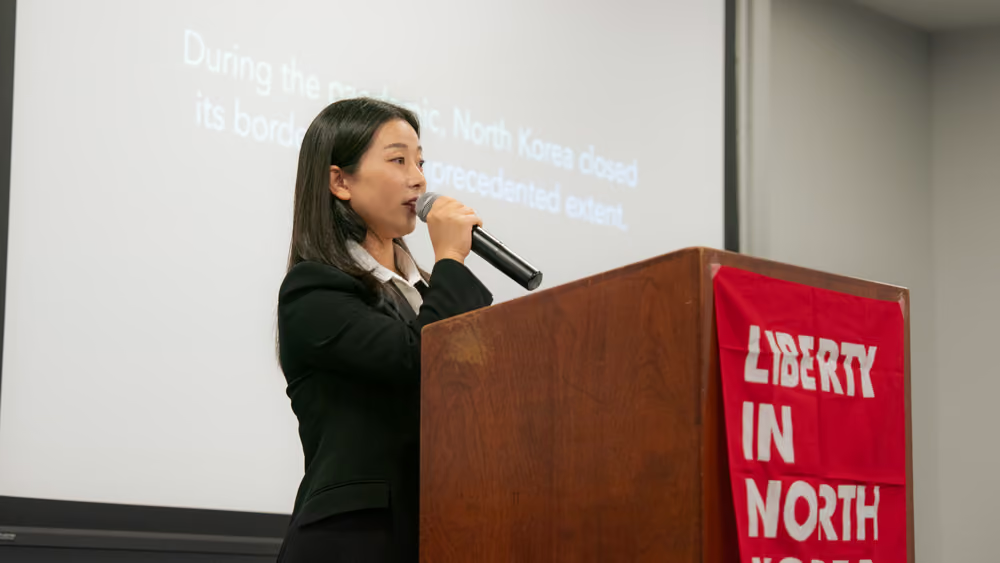
And right now, the people I left behind are more cut off than ever before. During the pandemic, North Korea closed its borders to an unprecedented extent. Soldiers along the border had shoot-to-kill orders for anyone trying to escape. Around 90% of the markets were forced to shut down, leaving families with barely enough to eat. The UN reported that nearly half the population—12 million people—faced food insecurity, while the World Health Organization rated North Korea’s access to medical care as the lowest in the world.
A few years ago, when my father became very sick, I was able to send him money for medicine and hospital care. But most North Koreans don’t have that chance. Without someone on the outside, they are not only cut off from resources and information, but from hope itself. For many, their future depends on a lifeline from the outside world.
Supporting North Korean people and protecting human rights cannot be put off.
We have an opportunity to be a lifeline for people inside North Korea today. To remind them that they have not been forgotten. With your support, we can rescue and support more North Korean refugees, and get more outside information and technology to people inside the country. And that information can empower North Koreans to not only see a way forward, but to ultimately determine their own future.
Despite the risks, North Koreans are quietly accessing foreign media and learning about life in the outside world. Increasing their access to uncensored information is one of the most effective ways to increase change inside the country.
Liberty in North Korea partners with North Korean defectors and engineers, like Hannah, to develop technology, content, and tools tailor-made for the North Korea context. Our goal is to empower North Koreans with information about the outside world, increasing their aspirations for social and economic progress, and building pressure for change and opening.
Empower North Koreans with information access.
Give Today
The Red Box: Misunderstandings and Stereotypes about North Koreans
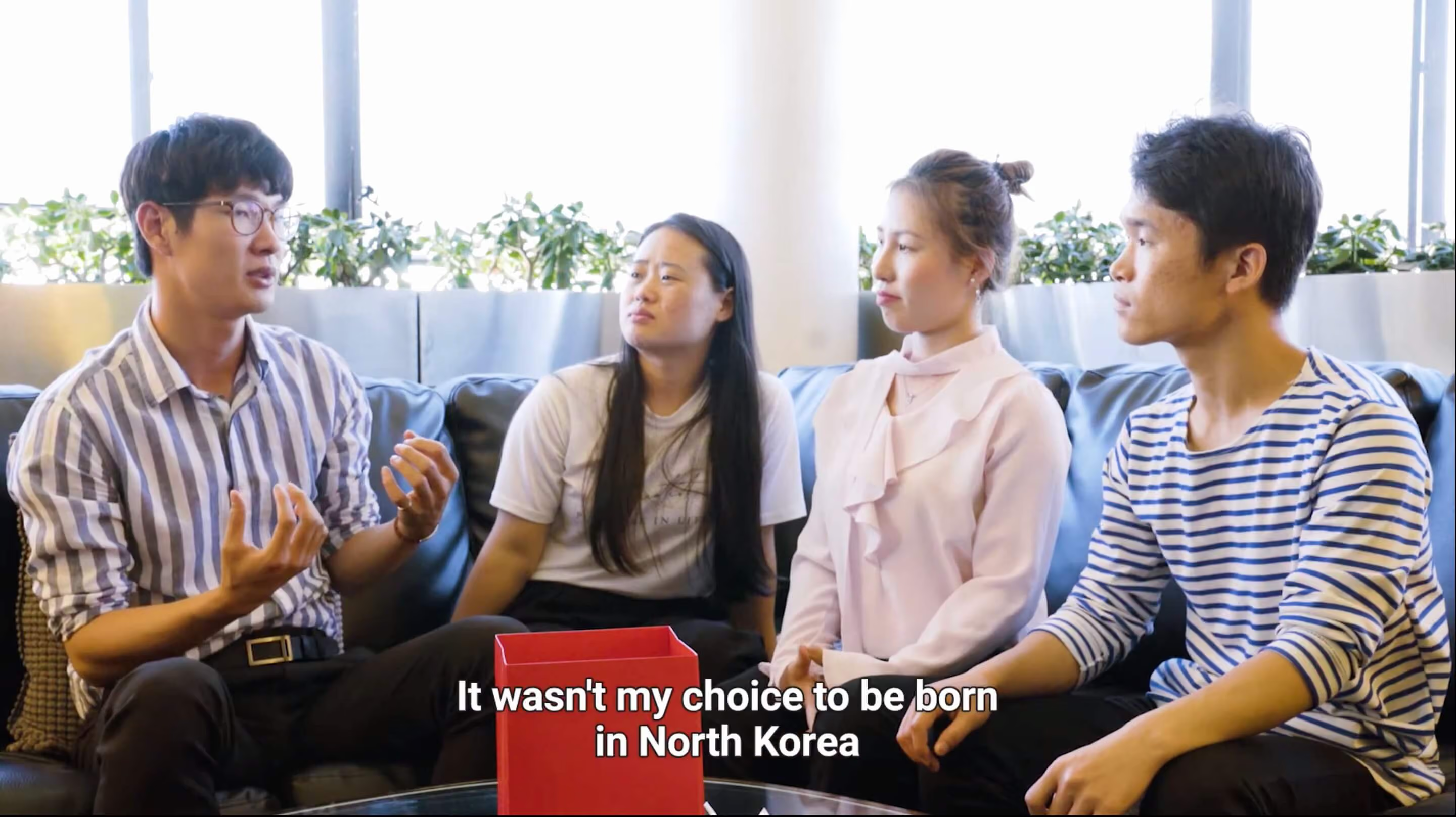
For North Korean refugees, resettling in a new society comes with many challenges. One of these challenges is overcoming the stereotypes about North Korea and the North Korean people.
In the latest episode of The Red Box, our North Korean friends and 2019 LiNK Advocacy Fellows talk about the struggle of of facing stereotypes after resettling in South Korea.
Watch as Jeongyol, Joy, Dasom, and Ilhyeok answer your questions in The Red Box Series!
Read the transcript of this episode below!
All: Welcome to the Red Box!
Jeongyol:
Are there any misunderstandings about the North Korean people that make you feel uncomfortable?
Ilhyeok: Misunderstandings?
Joy: When I first came to South Korea, was working part-time at a convenience store. I was still very young and had a very heavy North Korean accent.
In South Korea, when a customer enters the part-time employees don't really greet them. But I used to greet the customers standing and say "Welcome!" so people would ask me where I'm from.
I'd tell them that I'm from North Korea. They'd say "oh really?" After they get their stuff and put them on the counter, they'd asked me if I ever had jjajangmyun or pork in North Korea? They'd ask me these types of questions. Some people ask because they don't know but sometimes they ask questions that insinuate that we were all so poor in North Korea. Not everyone in North Korea is like that. There's people who live well too
Jeongyol: If someone asked me that, I’d tell them I might've lived a wealthier life there [in North Korea].
Joy: So those types of questions made me feel a little uncomfortable.
Jeongyol: A lot of people think like that.
Dasom: People think that all North Koreans are poor, ignorant, and uneducated. People have told me that even though I must have starved and lived poorly in North Korea, I don't look the part.
Maybe some people did or didn't have enough food to eat. There are poor people and there are rich people too. Every country is the same — it’s the same in South Korea too. There are rich, poor, and homeless people in South Korea too. I don't think it's right to judge someone like that. It made me feel very uncomfortable
Jeongyol: When I was in high school, there was a soccer match between North Korea and South Korea. But all of a sudden they asked me which team I'm cheering for. So I was startled by the question.
Should I say I'm cheering for North Korea or South Korea? What's my identity?
Even though I'm living in South Korea as a South Korean citizen, they didn't recognize the fact that I'm also South Korean. That we were the same people.
So at the time I answered, "I'm not cheering for either team. I don't care who wins. I’m just watching the game for fun.” It went over smoothly but afterward I kept thinking about it. But now that I think about it…It wasn't my choice to be born in North Korea.
Dasom: Right
Jeongyol: I could've been born in the U.S. but somehow I was born in North Korea.
Anyone could've been born in North Korea.
It's not anyone's fault. So from that moment on, I became confident. I am just who I am.
Ilhyeok: I have this older friend from China. During holidays like in January, he'd always ask me if I am visiting my hometown. Whenever he asks me that question, I want to be able to tell him that I'm am going [home] but I can't because I can't go back so I just don’t answer him. When he asked me if I'm going home, I just wished that I could return home one day.
It's heartbreaking not being able to go home.
During Chuseok and New Year's Day, those two holidays are when I miss home the most.
Joy: One uncomfortable question for me was when I was in school or met people was when they asked me why there's no riot or uprising in North Korea. Sometimes people ask because they really don't know but sometimes they insinuate that we're cowards.
And with that viewpoint, they ask why we won't revolt against the government. I try to explain but they still insist and say, ”But you guys still should have done something.” That makes me a little sad.
In North Korea, there's a system of monitoring each other. So if one person says something bad, they'd get reported right away and taken.
Jeongyol: In South Korea there were a lot of civil riots so they ask why we didn't do anything in North Korea.
Joy: But it's a very different situation.
Jeongyol: The system doesn't allow it.
Dasom:
What also made me uncomfortable was if I did something wrong, people would blame it because I'm North Korean.
They say things like, “It's because she's North Korean.” That made me upset. Other people say bad things and make mistakes too. But because of one mistake they say all North Koreans are like that and that I wouldn't know things or be able to do things because I'm from North Korea.
I hated hearing that so I wouldn't tell anyone that I was from North Korea.










