
Joy's Story: Part 2 - Trafficked in China

In the first part of her story, Joy shared the details of her life in North Korea and how she made her daring escape. Read "Part 1 - Growing Up in North Korea".
After I finally got picked up by the broker, we got onto a bus. The bus got stopped by Chinese police twice and every time the police came aboard I pretended to be asleep.
I was ready to take the opium pill I had stashed in the collar of my shirt and end my life if I got caught, but thankfully I didn’t have to.
I got some rest for a couple of hours after I arrived at the house and then I was connected with the second broker. The second broker was a North Korean defector. I told her that I wanted to live with an old Chinese couple as their foster granddaughter. She shook her head and told me my only option was to be sold into marriage to a Chinese man so all the brokers who helped me escape could take my bridal cost as payment.

I couldn't even think of refusing because I was afraid the brokers would do something bad to me or drop me off somewhere alone to get caught by the Chinese police and sent back to North Korea. I had also heard that if North Korean women refused to get married in China, then they could be sold to brothels or sex websites so that the brokers could receive payment. At that point, I realized that I was trapped and I didn’t have any other choice but to be trafficked. The second broker told me that I could escape after living with my Chinese husband for at least six months. If I escape in less than 6 months, the brokers that sold me would return my bridal money to the Chinese husband.

The second broker took me to different small towns to sell me. Every time I went to a town, many old Chinese men gathered around me to bargain my bridal cost. I felt so ashamed. I was being treated as an animal and not as a human being.
The North Korean broker finally found a man who was willing to pay the amount the broker wanted for me as a bride. I couldn’t even communicate with him because I didn’t speak the language. I remembered looking at the broker’s face. She seemed to pity me. My whole being at the moment was filled with so much bitterness, hopelessness, and sorrow toward everything in the world.
I felt like I was losing everything including my own body to someone I didn’t even know. I was only 18.
Continue reading Part 3 of Joy's story where she shares about her escape from the Chinese man and her rescue journey through LiNK's networks.
You can support North Korean refugees like Joy each month by becoming a Liberty Monthly Donor.
Freedom Walk & Run 2026, Seoul
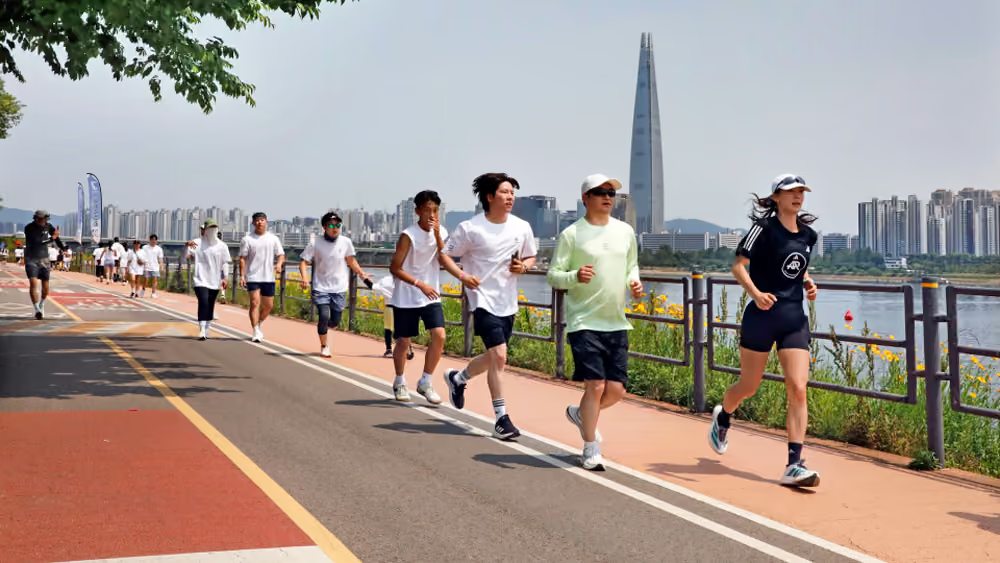
What Does Freedom Mean to You?
This fall, 200 people will gather along the Han River in Seoul to honor the 26 million people living in North Korea by answering one question: What does freedom mean to you?
Before setting out, every participant in Liberty in North Korea’s Freedom Walk & Run will write their own answers on the race bib they’ll wear for the 6 kilometer race.
The course is divided into three sections, each representing a different freedom: the freedom to leave, the freedom to lead, and the freedom to learn.
Each represents a different part of LiNK’s work and a different way North Korean people are pursuing greater freedom and choice in their own lives.
0-2km: Freedom to Leave
The first two kilometers represent the freedom to leave.
For North Koreans who decide to leave their country, reaching safety can mean a long and dangerous journey through multiple countries.
LiNK helps North Korean refugees navigate a secret route to safety. To date, over 1,400 North Korean refugees have reached freedom through LiNK’s networks. Every person who makes that journey has their own reason for leaving, their own hopes for what comes next, and their own idea of what freedom means to them.
Reaching safety opens the door to the next part of their journey.
2km-4km: Freedom to Lead
The next two kilometers represent the freedom to lead.
Starting over in a new country comes with countless possibilities, but just as many challenges. North Korean people resettling in South Korea or the US are learning a new system, while pursuing education, beginning careers, building relationships, or deciding what they want their future to look like.
LiNK’s programs support resettled North Koreans as they pursue education, language learning, and career development, providing mentorship, scholarships, and so much more.
And then comes the final stretch.
4-6km: Freedom to Learn
The last two kilometers represent the freedom to learn.
For people living inside North Korea, access to information from outside of the country is heavily restricted. Official media is centrally controlled, while foreign films, television, music, news, and other outside information are accessed illegally and often at significant personal risk.
Despite the government’s efforts to control information, curiosity about what freedom looks like proves impossible to suppress.
“No matter how much you try to control it, you can’t get rid of curiosity.”
Information gives someone a new point of reference. It introduces possibilities they had never encountered before. It gives them the chance to imagine a future beyond the North Korean regime.
North Korean people are finding ways to access outside media, through USB drives and microSD cards. LiNK’s Information Access Programs build on these existing channels by working with North Korean defectors and engineers to develop tailor-made technology and content that help people inside the country access more information more safely.
This is a growing part of our work, and one we believe has enormous potential to contribute to long-term change.
Get Involved: Support information access in North Korea
This fall, we’re giving supporters a closer look at this work through an upcoming documentary about information access in North Korea.
Make a gift of $30 or more to LiNK’s Information Access Programs by October 24 and you’ll receive an exclusive preview of the documentary this fall.
Your support helps LiNK enable more North Koreans to access more outside information more safely. This builds people’s resilience against regime disinformation, increases their aspirations for social and economic progress, and builds pressure for change and opening.
Donate today & get the documentary preview
Join us in Seoul
If you’re in Seoul, join us along the Han River on Saturday, October 24, for the Freedom Walk & Run. Participation is limited to 200 people, so reserve your spot today.










