New Realizations: An Interview with Hae Ri

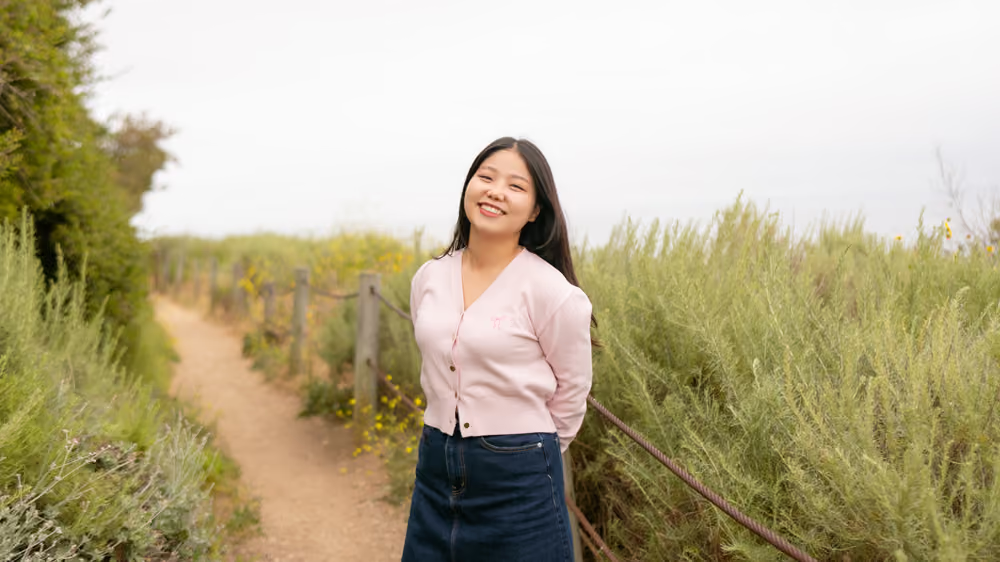
Hae Ri escaped from North Korea out of fear that she would be sent to a political prison camp for watching South Korean TV shows after it happened to her friend's family. After arriving in China, she connected with our networks and made the journey to safety in South Korea. Today she is successfully resettled and has been working toward her goals. She is currently studying to be a nurse and took part in our English Teaching & Cultural Exchange Program.
Anna, one of our resettlement assistance coordinators, recently met up with Hae Ri to learn more about her life in North Korea and how she is doing now. Read the interview below:

Anna: Did you want to move to South Korea?
Hae Ri: After graduating from high school, I learned a lot of things about South Korea through CDs and DVDs and the stories from my mom and dad after their trips to China.
The crackdown on CDs and DVDs were not that harsh until I entered 4th grade. It wasn’t a sudden change, but a gradual one. When more people have access to CDs, you notice the change in their awareness.
When I saw the world outside of North Korea in those CDs and DVDs, I was amazed and I hoped I could see it before I died.
I couldn’t believe I was actually in South Korea when I got here because it felt like a dream. I often wished to go to South Korea during middle school whenever I watched foreign films at my friend’s house.
Funny thing is, officers and the elite are the ones who have easy access to these things. My friend's father’s job was security related, so I was able to watch many dramas at her house. One day her house was searched and her parents were sent away, so she stayed at our other friend's house. She could not keep herself from watching “Stairway to Heaven” though, so me, my friend, and my friend’s aunt all watched it too. She was eventually caught.
In a political prison camp, you are not treated as a human being and are beaten over and over. People were called in one by one, and this made me worried. If you come from a powerful family or have connections, you may be able to get yourself out of there, but that did not apply to me. If I went there, there was no way out and I would be blamed for everything. That made me determined to leave North Korea as soon as I could.

Anna: What would you like to tell to your friends who watched films together in North Korea?
Hae Ri: We shared everything when we were at school because we were the closest friends, but now I am the only one who is living in this place we all dreamed of going to. It is frustrating that I don’t know how they are doing while I am living my dream.

Anna: Do you think about your hometown a lot?
Hae Ri: I imagine what it is like there now. When I talk to my uncle over the phone, it hurts me to hear that people are having a hard time finding food every day. I also miss my friends. It would be great to reunite with them.

Anna: What is the first thing you want to do with your friends?
Hae Ri: I want to travel. I was told that Jeju Island is beautiful, and I would like to visit with my friends. That is what motivates me to do well until they can join me. I am sorry that I couldn’t even say goodbye to my best friend. It would be wonderful to see my friends again and enjoy this freedom together.

Anna: What is the biggest difference between North and South Korea?
Hae Ri: There are just too many to list and more differences than commonalities. Because there was no freedom in North Korea, after I finished school there, I didn't work. Even though I learned skills, there was no place to use them. I didn’t have any specific plans for what I should do or hopes for the future. I felt powerless, thinking that there was going to be nothing to receive in return for my hard work.

Anna: What have you achieved since your resettlement in South Korea?
Hae Ri: Being a nurse was one of the best jobs for women in North Korea. There was a school for that, but it's usually for people who have enough money for the tuition, which I couldn’t afford. Even if you went there, studying might not be your priority because people just need their degree and just need to know how to use a needle to work. Of course, I wanted to go there.
It was still hard for me to decide to study once I came to South Korea, but then a friend from church suggested that I should begin studying since I am still very young. I thought I really would achieve nothing if I continue to live like this. So now I am preparing for college, and I already passed the test to become a nursing assistant.

Anna: What was it like to hear that you were accepted?
Hae Ri: Well, I did feel a sense of accomplishment, but at the same time, it felt like a beginning for something new. I wasn’t satisfied to have the story end there. But you know, they say a journey of thousand miles begins with the first step. I just made my first step, and I need to continue moving forward. It’s also important that I don’t rush things too fast and work on one thing at a time, since I am new to a lot of things and there is a lot left to learn.

Anna: What was the first thing you tried after your resettlement?
Hae Ri: The first thing I wanted to eat was samgyeopsal (grilled pork). Back when I was in North Korea, I couldn’t afford to eat this so I would just eat fried vegetables. I only saw this through Korean dramas. In South Korea, you have a variety of foods to choose from, like pizza and hamburgers. My grandmother, who worked at Kaesong Industrial Complex, came back with a Coke one day. There was a picture on the bottle that looked like some kind of bread I didn't recognize—it was actually a picture of a hamburger! I didn’t like the taste of hamburger at first, but now I love it!

Anna: Did you visit your grandmother? Wasn’t Kaesong Industrial Complex far from where you lived?
Hae Ri: It took me two days to get to Kaesong. It was an arduous journey. I would go there once every three to four years by train. There is no express line to Kaesong, so the train would stop at several stations, and I had to wait for several hours at the station just standing or lying on the ground because there weren’t enough seats.
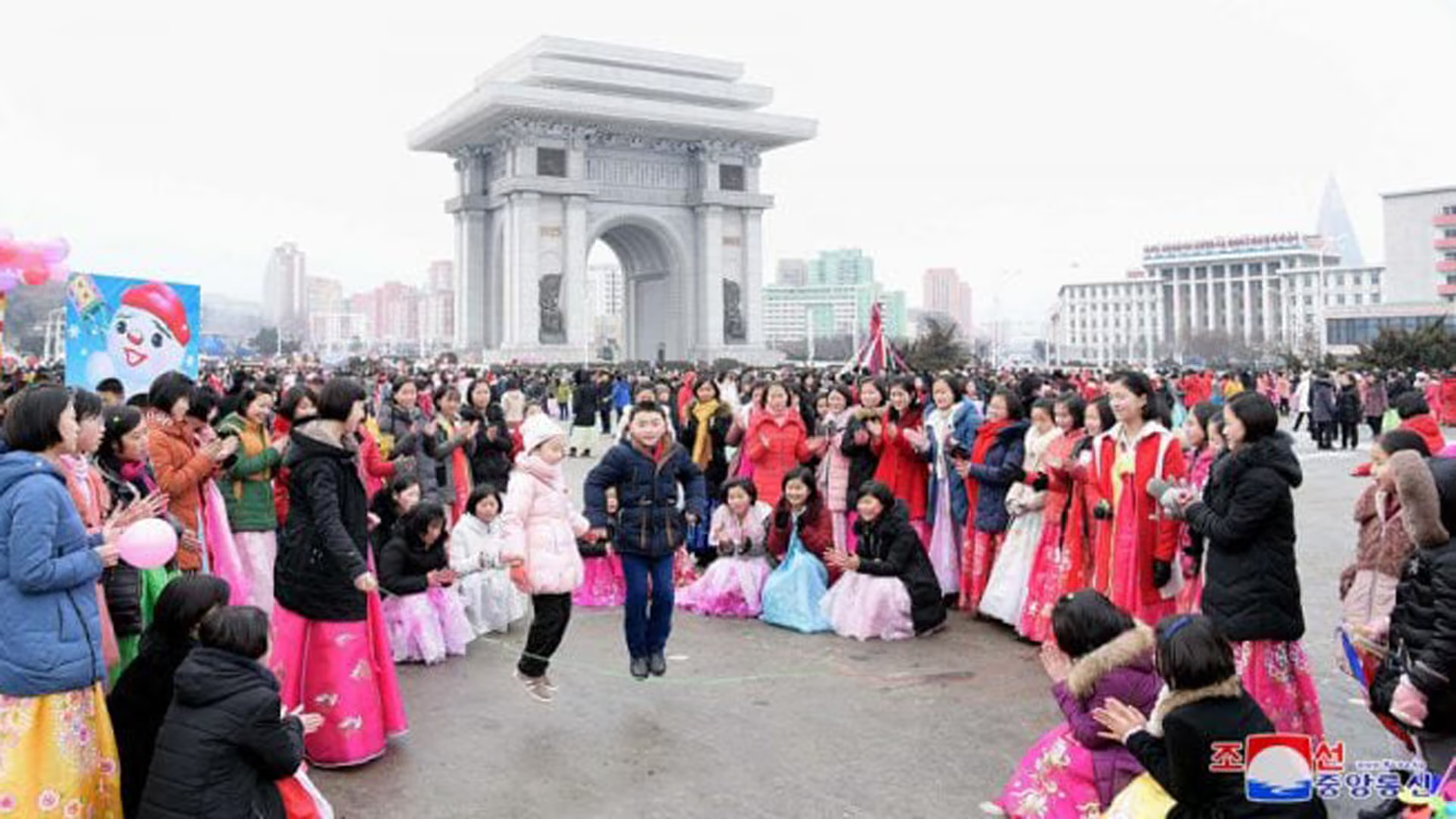
In North Korea, you need a certificate to move to different places, which is especially difficult for Kaesong because there is a lot of exchange going on there with South Korea. So one day, I walked for a full day to Kaesong. While I was climbing a mountain to get there, I came across the military. The military personnel asked where I was going and why I was going to Kaesong. Then you have to give all the food and everything you have in your bag so they will let you go. When I first came to South Korea, I wondered if South Korea is a lot smaller than North Korea because it only takes three hours to get almost anywhere here. It would take two days in North Korea to get to a place you can go within three hours in South Korea. Not only the transportation is bad, but there is always the risk of getting caught while you are on the move.

Anna: What was difficult when you got to South Korea?
Hae Ri: My accent. I hated to hear that no one would take me for a part-time worker because I am from North Korea. I hated myself for being born in North Korea, and I thought people were staring at me because I was weird. This made me think more about the reasons for others to keep a distance from me. Changing my accent was difficult.Studying was a big challenge as well. Back in North Korea, I didn’t have much hope for achieving anything because of my family background. My accent is a challenge for daily living, but learning how to study was the most difficult challenge for fulfilling my dream.

Anna: What were your first experiences with the outside world?
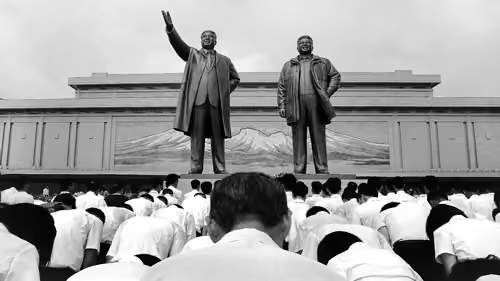
Hae Ri: At home, no one really had sincere respect for Kim Jong-il or Kim Jong-un. Watching the things about Kim Jong-un, I thought it was ridiculous that people actually cried for the leader. However, I was shocked to realize the truth about the Kim family. I thought Kim Jong-un lived a very modest life until I was in Hanawon and learned that he spends so much on living a luxurious life, which could instead be spent saving so many people who are starving. I watched the Korean film called, “When the Azalea Blooms” when I was in China. The film was about Kim Jong-il, and that film also opened my eyes and made me realize what was actually going on.

Anna: What did you think when you first watched the film?
Hae Ri: I didn’t believe it at first, but when I watched it again, things became clear. There is a huge difference between knowing the truth and not knowing it. I want more people to hear the message and share what I realized. People get lost in their daily lives without thinking about their dreams.

Anna: Is there any message you want to give to your friends?
Hae Ri: I believe unification will take place in the future, so I have to resettle here successfully so I can be an example for my friends later on and lead them. That keeps me working hard even when things are tough. That’s what my mom thinks too. I need to prove that my decision was right and that I can do well here. I always wish the best for my friends in North Korea. When I think about my future, I am always thinking of ways to help North Koreans, and ways to return the help I received from LiNK to society.
It is just a dream for now, but I would like to do something meaningful, like sending aid materials to support North Korea.

We are only able to provide crucial support for North Koreans like Hae Ri with your help!
Spring in My Homeland, North Korea: A Glimpse of Reunification in 2045
By: Eunsook Jang
Eunsook Jang holds a bachelor’s degree in Political Science from Korea University and a master’s degree in International Development from Brandeis University. A Fulbright Scholar and LiNK US Scholarship grantee, she is currently a research intern at the Hudson Institute, where her work focuses on post-conflict recovery, economic development, and human development. Her recent publications include “Slipping through the Cracks in South Korea: The Uncertain Futures for the Children of North Korean Defectors” with the Migration Policy Institute, and “Why Strengthening RFA Is a Strategic Imperative for US Policy on North Korea” in The Diplomat.

In the spring of 2045, on a flight from Incheon to Pyongyang, Emma's hands tremble. Her husband Sam reaches over and, steadily, holds them without a word. She turns to the window and stares into the pale clouds below the wing.
“I’ve waited 30 years for this day,” she whispers. “But now that I’m here… it doesn’t feel real. I hope this isn’t a dream.”
“Maybe it’s both,” Sam replies. “The dream became real.”
She closes her eyes. In 2015, at just fifteen years old, she crossed the frozen Yalu River in a dark March morning, leaving without saying a proper goodbye to her mother. That guilt, its intensity, has never faded, not even after thirty years. It simply learns to live quietly beside her.
“Will Mom recognize me?” she asks. “We parted when I was fifteen. I’m forty-five now.”
“She will,” Sam answers. “How could a mother not recognize her daughter?”
Emma says nothing. Will I... be able to recognize her? She does not say it aloud this time.
An announcement comes through the cabin speakers: "This is the first return flight for North Korean defectors to their hometowns. We know how much you have endured. We will carry you safely home."
It is a rare moment of comfort from a South Korean voice. Moments later, the plane lifts into the sky.
An hour later, the plane lands in Pyongyang. Emma weeps quietly, overwhelmed by the thought that across so short a distance, lives in the South and the North had been so utterly, irreconcilably different. For thirty years, she had not been able to cross it, that gap, so small.
From Pyongyang, the journey to Hyesan continues by bus. As the skyline of Pyongyang passes past the window, its taller buildings, its broad avenues, Emma allows herself the fragile hope: perhaps Hyesan has developed too.
After five hours on the road, the bus arrives at Hyesan Station. The apartments and the lay of the land are almost entirely unchanged from when she had left thirty years earlier, as if time had refused to move, as if it had been waiting for her. Emma found herself hoping the same might be true of her mother.
A thirty minutes' walk from the station: that is where her mother's house is.
As if drawn by a magnet, her feet start moving on their own.
Sam asks if they are going the right way. Without hesitation, "Yes," Emma replies. "I used to walk this road every day as a child. It’s still in my body."
He points to a bus queue down the street. "There's a bus queue over there. Want to take it part of the way?" She shakes her head gently. "If you don't mind, I'd like to walk." "Then we’ll walk," he replies without hesitation. Emma feels another surge of gratitude, grips on his arm and follows her memory home.
Since Emma left her hometown in 2015, the North Korean regime has conducted ten more nuclear tests as of 2045. And yet the face of this neighborhood has not changed by a single detail. The freedom and human rights that should have been the people's return on those tests have been vaporized into the air.
They arrive at a fork in the road. To the left, an alley leads toward the house. A familiar-looking house comes into view, enclosed by a wooden fence. She stops and stands motionless. It is the house, it is her house.
Several minutes pass. Then the door opens. Emma feels her breath catch. For a second, she forgets how to move.
After thirty years, she is here.
This is what the micropolitics of reunification looks like. Grand narratives, speeches, and legal texts may provide its official language, but its lived realities lie in moments, in feelings, like this: a mother and daughter recognizing each other after thirty years apart.
Author’s note: I dedicate this piece to my father in South Korea, who has never once wavered in encouraging my studies, as if realizing through me the freedom to pursue the dreams that were taken from him. And to my mother, who remains in North Korea: This piece is my proof that your daughter has not turned away from your suffering, but is working, in her own small way, to fight against it. I hope to see you, even if only in my dreams tonight. I love and miss you beyond my expression.
–
Eunsook is a participant of the LiNK English Language Program (LELP), which serves to not only help North Korean defectors build confidence and skills in English, but develop their capacity as advocates for this issue. To that end, we partnered with select LELP “columnists” to write and polish personal essays through multiple rounds of external feedback and revision. Our goal is to have more North Koreans share their stories directly and lead efforts to change the narrative.
We believe the North Korean people can achieve their liberty in our lifetime.
Opportunities like LELP invest in the people building that future now. Help more North Koreans find their voice, reach their goals, and lead change on this issue.