
North Korean Defector Economist: How We Analyze North Korea Needs to Change
By: HyeGyeong Joo
HyeGyeong is a PhD student in the Department of Economics at Korea University, specializing in theoretical economics. Her research looks at developing theoretical models of the North Korean economy. Since 2022, HyeGyeong has also participated in LiNK’s English Language Program.
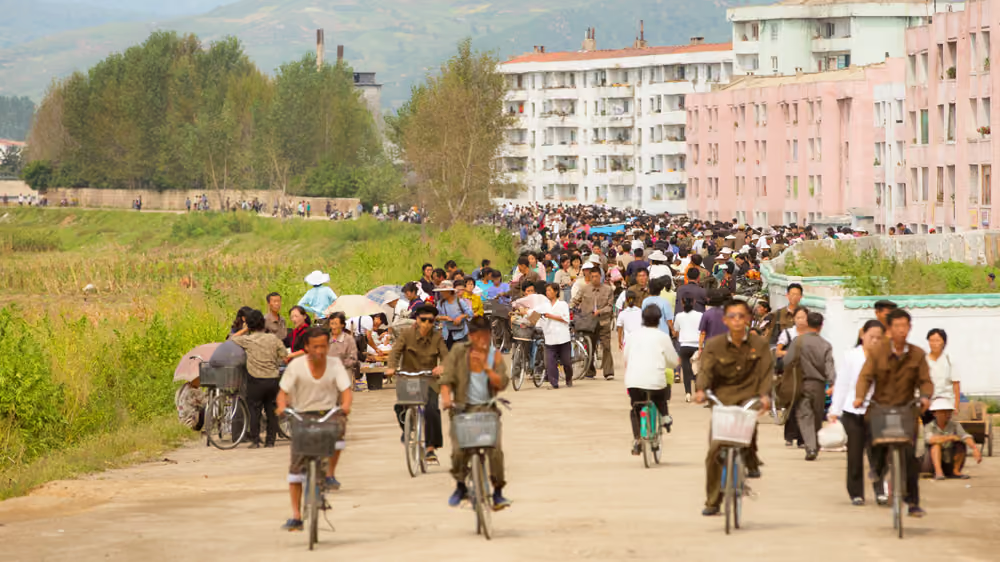
When I think about my past, I often feel a great sense of loss and sorrow for the people I left behind in North Korea. As a PhD student studying North Korean economics here in South Korea, I feel a strong desire to use my research to help improve the lives of North Korean people. In many ways, helping those I left behind also gives meaning to my own journey.
Whenever I watch the news or read academic papers on North Korea, I feel saddened by the way North Korean people are discussed and represented. Over time, I have come to believe that the way we analyze North Korea needs to change.
I believe there is a fundamental limitation in existing research on the North Korean economy, as much of it has traditional socialist planned economy analysis. Earlier studies have suggested that North Korea would either collapse or undergo a system transition as other socialist countries have done. However, after the breakdown of the Public Distribution System (PDS) in the mid-1990s and the emergence of the shadow economy (including through the Jangmadang—illegal markets), these approaches began to reveal their limitations.
As a result, the North Korean economy came to be understood not as a simple planned economy, but as a mixed economy in which state control and market activities coexist. However, these studies do not sufficiently explain why the North Korean regime allows marketization to persist at a certain level instead of completely suppressing it.
In order to explain the interaction between the government and ordinary North Korean citizens, who are the primary actors in Jangmadang activities, I divide the North Korean system into three groups: the regime, the elites, and ordinary citizens.
In particular, elites are important economic actors because they function as intermediaries between the regime and the people. My argument is that this phenomenon can be better understood by analyzing how these three groups strategically interact with one another.
These three groups pursue their interests in different ways, and their goals also differ significantly. The leadership wants to continue dynastic rule and ensure stable succession, the elite seek to secure their positions and avoid political risks such as purges, and ordinary citizens primarily seek survival and improved living conditions.
The interests of these three groups sometimes conflict with one another and sometimes align. In my opinion, these three groups in North Korea are currently remaining in a state of equilibrium.
This equilibrium means that these three groups can achieve their maximum interests under the current conditions in North Korea. Precisely because of this equilibrium, North Korea has been able to maintain both regime stability and limited marketization simultaneously.
That is why I believe we must identify what kind of shocks could cause this equilibrium to collapse. If such a change were to occur, it could become a new turning point for North Korea.
A new turning point for North Korea could lead the country toward a new political and economic order. The important thing is that we must identify what kinds of shocks could trigger such a transformation.
I hope for a North Korea that has changed—a place where its people can live freely. For me, North Korea is not just a state; it is my hometown, where I was born and raised, and where my family still lives. This is precisely why I am committed to a different approach to the North Korean issue—because my only goal is to see genuine change in North Korea, and I truly want to help bring about that change.
I want my article to inspire you to see something different the next time you watch the news or media coverage about North Korea. The next time you come across a piece of media about North Korea, I hope you take a moment to think about the real North Korean people. And perhaps you may also reflect on this article and consider what kinds of shocks could transform the current equilibrium of North Korea.
I hope you will join me on this journey.
–
HyeGyeong is a participant of the LiNK English Language Program (LELP), which serves to not only help North Korean defectors build confidence and skills in English, but develop their capacity as advocates for this issue. To that end, we partnered with select LELP “columnists” to write and polish personal essays through multiple rounds of external feedback and revision. Our goal is to have more North Koreans share their stories directly and lead efforts to change the narrative.
We believe the North Korean people can achieve their liberty in our lifetime.
Opportunities like LELP invest in the people building that future now. Help more North Koreans find their voice, reach their goals, and lead change on this issue.
Give Today
Liberty In North Korea’s 2025 Annual Report
Helping North Korean People Win Their Freedom
We’re excited to share LiNK’s 2025 Annual Report—a celebration of the work we accomplished together alongside a global movement of support for the North Korean people.
2025 Impact Highlights
- 17 rescued
- 22 resettled
- 122 supported in resettlement
- 144 empowered through LiNK programs
- $4,214,232 raised
- 11,833,136 reached ONLINE
- 2,746+ reached IN-PERSON
- 7 information access projects
Read the full 2025 Annual Report here
Our Work Towards Liberty in North Korea
- Refugee Rescues & Resettlement Support: Helping North Koreans refugees reach safety and supporting them as they rebuild their lives in freedom.
- Empowering Resettled North Koreans: Investing in the capacity of North Koreans to succeed and work towards changing the future of their country.
- Increasing Information Access for North Koreans: Developing and distributing tailored technology and content to help North Koreans access more uncensored information more safely.
- Global Awareness & Advocacy: Amplifying North Korean refugee voices to reshape how the world sees this issue and mobilize a global movement of support.
Note From Our CEO
It's been 20 years since my first visit to the border of North Korea and China.
To this day, I vividly remember Stitch—a 6-year-old boy I met on that trip, just days after his parents were caught and repatriated to North Korea. I still remember the silly faces he made at us as we were leaving the shelter that night. Perhaps it was a way to hide a grief he couldn't yet understand, or maybe he was just being a little boy. Later on, I thought about his mother. I couldn't begin to imagine how she must have felt being forced back across the border to a fate unknown, wondering if she would ever see her son again. That night changed everything for me. And for the last two decades, it has never let me go.
This past year, as I reflected on stories like Stitch’s that have stayed with me over the years, I was reminded that the urgency on this issue has not diminished.
Life inside North Korea remains profoundly difficult. Last year, in a follow-up to a landmark UN human rights report on North Korea from 11 years ago, it was found that “since 2014, control by the Government over its citizens has tightened increasingly. Under laws introduced since 2015, citizens have been subjected to increased surveillance and control in all parts of life. No other population is under such restrictions in today’s world.”
The regime continues to maintain near-total control through pervasive surveillance, arbitrary detention, torture, forced labor, and the increased use of public executions. All of this is happening while our attention is understandably pulled toward other crises at home and abroad. But just because it isn't in our daily newsfeed doesn't mean it isn't happening in North Korea every single day.
In 2025, the North Korean human rights movement faced its greatest crisis in decades. NGOs vital to the movement and on the frontlines—rescuing refugees, sending information into the country, and documenting abuses—were forced to downsize or potentially shut down due to a sudden collapse in funding and dramatic shifts in policy. According to reports, the North Korean government was watching all of this closely. They saw the weakening of these NGOs as a strategic advantage.
And yet, in the face of these challenges, your support made it possible for us to launch an emergency campaign to raise funds for four frontline organizations fighting to survive, while continuing our own work in these areas.
Together, we brought 17 North Korean refugees to freedom, and celebrated the milestone of our 1,400th rescue. Each one required navigating a landscape that has grown more difficult every year with China’s rapid expansion of biometric security systems and AI-enabled surveillance. On the other side of that journey, 22 people were newly resettled and began rebuilding their lives, while our team continued supporting 122 individuals in their resettlement.
We invested in 144 North Korean storytellers, advocates and leaders through our programs, equipping them with scholarships, language skills, leadership and advocacy training, and a community that believes in them. Two Advocacy Fellows traveled across the country, speaking at universities and Fortune 500 companies and meeting with congressional offices on Capitol Hill. Scholarship recipients completed graduate programs and are going on to shape policy: one recently received a fully-funded PhD offer; another will begin teaching international relations in Tokyo this spring. These are not just personal victories but the emergence of leaders who are working to change the future of their country.
We also made a significant bet on something we believe could irreversibly change the course of this issue: technology designed specifically for the North Korean context. We advanced seven information access projects last year, with the support of 68 North Korean defector collaborators helping us develop and test tools that give citizens safer access to far more uncensored information than a single thumb drive could ever carry, alongside digital security tools to protect them from the regime's surveillance. These are significant advances. But they are only the beginning.
We are so grateful for the ways you have shown up and supported the North Korean people year after year. This work belongs to all of us—and none of it would be possible without you.
As a North Korean friend reminded us last year, “Freedom is not given, but it is something we can achieve.”
Thank you for your shared belief in this vision. Together, we can see it happen in our lifetime.
With unwavering hope,
Hannah Song
CEO, Liberty in North Korea

Refugee Rescues & Resettlement Support
While escape from inside North Korea remains almost impossible, there is an urgent need to help North Korean refugees hiding in China, many who have been living in uncertainty for years. Liberty in North Korea ensures a safe and dignified pathway, without cost or condition, for North Korean refugees who make the brave decision to seek freedom.
In 2025, we’re grateful to have welcomed 17 North Korean refugees and their children to freedom, and celebrated the milestone of our 1,400th rescue.
On the other side of the rescue journey, LiNK helps North Koreans rebuild their lives with a strong foundation. Based on need, our team connects them to resources and services, conducts home visits, and provides financial assistance.
- 17 rescued
- 22 newly resettled
- 122 supported
“Up until the very last moment before leaving home [in China], I was terrified and hesitant. I was afraid of being arrested and worried about my family back in China. Now that I'm in South Korea, I realize I would have regretted it if I hadn't left. Living in freedom with ID feels like a dream. I'm excited to get vocational training, find a job, and adapt to South Korea well!”
– Won-mi, rescued in February 2025

Empowering Resettled North Koreans
North Korean refugees have unlimited potential, but they do not face an even playing field after arriving in South Korea or the US. We identify current challenges faced by resettled North Koreans and invest in their success through education, skill-building, and leadership opportunities.
With the right support, North Koreans consistently prove their potential and become key players in driving change. They’re reaching their academic and career goals, sending money and information back into North Korea, and building global understanding and support for this issue. This next generation of North Korean leaders, entrepreneurs, storytellers, and advocates will be the ones to determine the future of their country; LiNK’s programs grow their capacity and partner with them as agents of change.
- 144 empowered through our programs
“LiNK’s program has helped me organize my thoughts and see my story as valuable. Seeing how others gain comfort or courage through my story, I feel that my difficult experiences have become meaningful points of connection. The storytelling and presentation training I received has allowed me to speak with responsibility rather than fear.”
– Ree Ha Kim, LESP participant

Increasing Information Access for North Koreans
North Koreans live in one of the most closed and limited information environments in the world. To protect the effectiveness of their propaganda, the regime tries to maintain a complete monopoly on information and ideas inside the country. Their narratives emphasize the outside world as being dangerous and the threat of war as imminent, justifying the dictatorship and its draconian restrictions.
Increasing the North Korean people’s access to uncensored outside information is therefore one of the most effective levers for change in the country.
Liberty in North Korea works with North Korean defectors and engineers to develop tailor-made technology and content to help people inside the country access more information more safely. Empowered with the truth, North Koreans gain resilience against the regime’s propaganda and are emboldened to scrutinize the government, imagine a different future, and build pressure for change and opening.
- 7 technology projects
- 68 North Korean defector collaborators
- 80,000+ lines of code written
“This will have a major impact on the people of North Korea… Right now, because of the new law punishing so-called ‘non-socialist behavior,’ morale is very low. But if this program spreads inside North Korea, it will help people regain confidence.”
– Anonymous North Korean user tester
*In order to protect end users, partners, and our projects, we are limited in what we can share publicly.

Global Advocacy and Awareness
For decades, North Korea has been reduced to a caricature—part threat, part joke. Dictators and geopolitics dominate headlines, making the country seem hopeless and unchanging. The global community’s inattention and inaction has only helped the regime to maintain the worst dictatorship on earth.
Liberty in North Korea partners with North Koreans to build an alternative narrative focused on their perspectives, resilience, and potential. Our objective is to reshape how the world sees and responds to North Korea, increasing pressure on governments to act and mobilizing the support that the North Korean people deserve.
Participants from LiNK’s programs have gone on to contribute to South Korea’s policy towards North Korea and engage at the highest levels of international politics, including at the United Nations Security Council and in the Oval Office.
- 11,833,136 reached online
- 2,764+ reached in-person
“As an Advocacy Fellow, I discovered new parts of myself, built confidence, and learned lessons that changed the way I see the world and my own story… With these lessons as my guide, I plan to stay dedicated to the cause of North Korean human rights and remain closely connected with the people I’ve met, building a lasting bridge of solidarity together.”
– Hannah Oh, 2025 LiNK Advocacy Fellow










