
North Korean Defector Economist: How We Analyze North Korea Needs to Change
By: HyeGyeong Joo
HyeGyeong is a PhD student in the Department of Economics at Korea University, specializing in theoretical economics. Her research looks at developing theoretical models of the North Korean economy. Since 2022, HyeGyeong has also participated in LiNK’s English Language Program.
When I think about my past, I often feel a great sense of loss and sorrow for the people I left behind in North Korea. As a PhD student studying North Korean economics here in South Korea, I feel a strong desire to use my research to help improve the lives of North Korean people. In many ways, helping those I left behind also gives meaning to my own journey.
Whenever I watch the news or read academic papers on North Korea, I feel saddened by the way North Korean people are discussed and represented. Over time, I have come to believe that the way we analyze North Korea needs to change.
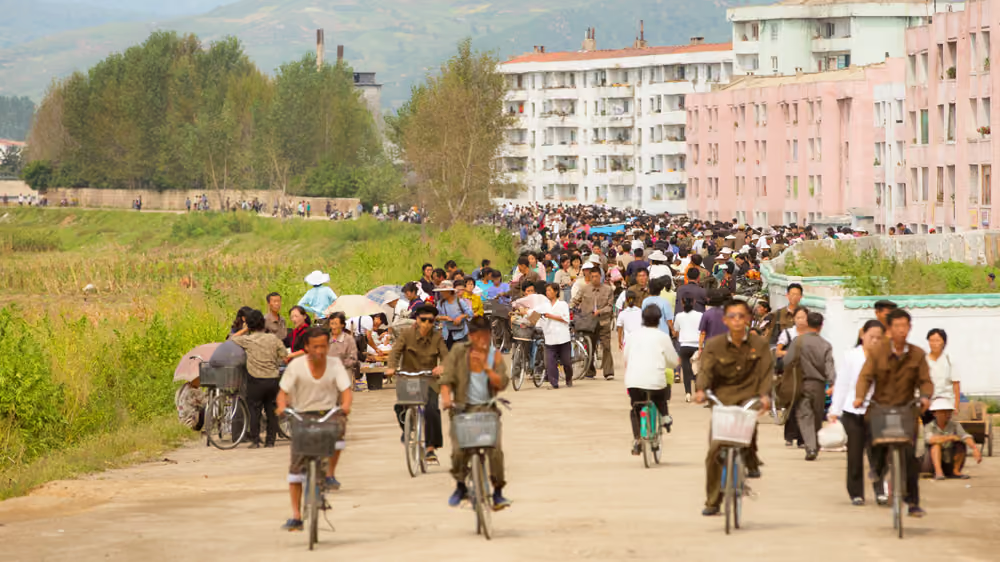
I believe there is a fundamental limitation in existing research on the North Korean economy, as much of it has traditional socialist planned economy analysis. Earlier studies have suggested that North Korea would either collapse or undergo a system transition as other socialist countries have done. However, after the breakdown of the Public Distribution System (PDS) in the mid-1990s and the emergence of the shadow economy (including through the Jangmadang—illegal markets), these approaches began to reveal their limitations.
As a result, the North Korean economy came to be understood not as a simple planned economy, but as a mixed economy in which state control and market activities coexist. However, these studies do not sufficiently explain why the North Korean regime allows marketization to persist at a certain level instead of completely suppressing it.
In order to explain the interaction between the government and ordinary North Korean citizens, who are the primary actors in Jangmadang activities, I divide the North Korean system into three groups: the regime, the elites, and ordinary citizens.
In particular, elites are important economic actors because they function as intermediaries between the regime and the people. My argument is that this phenomenon can be better understood by analyzing how these three groups strategically interact with one another.
These three groups pursue their interests in different ways, and their goals also differ significantly. The leadership wants to continue dynastic rule and ensure stable succession, the elite seek to secure their positions and avoid political risks such as purges, and ordinary citizens primarily seek survival and improved living conditions.
The interests of these three groups sometimes conflict with one another and sometimes align. In my opinion, these three groups in North Korea are currently remaining in a state of equilibrium.
This equilibrium means that these three groups can achieve their maximum interests under the current conditions in North Korea. Precisely because of this equilibrium, North Korea has been able to maintain both regime stability and limited marketization simultaneously.
That is why I believe we must identify what kind of shocks could cause this equilibrium to collapse. If such a change were to occur, it could become a new turning point for North Korea.
A new turning point for North Korea could lead the country toward a new political and economic order. The important thing is that we must identify what kinds of shocks could trigger such a transformation.
I hope for a North Korea that has changed—a place where its people can live freely. For me, North Korea is not just a state; it is my hometown, where I was born and raised, and where my family still lives. This is precisely why I am committed to a different approach to the North Korean issue—because my only goal is to see genuine change in North Korea, and I truly want to help bring about that change.
I want my article to inspire you to see something different the next time you watch the news or media coverage about North Korea. The next time you come across a piece of media about North Korea, I hope you take a moment to think about the real North Korean people. And perhaps you may also reflect on this article and consider what kinds of shocks could transform the current equilibrium of North Korea.
I hope you will join me on this journey.
–
HyeGyeong is a participant of the LiNK English Language Program (LELP), which serves to not only help North Korean defectors build confidence and skills in English, but develop their capacity as advocates for this issue. To that end, we partnered with select LELP “columnists” to write and polish personal essays through multiple rounds of external feedback and revision. Our goal is to have more North Koreans share their stories directly and lead efforts to change the narrative.
We believe the North Korean people can achieve their liberty in our lifetime.
Opportunities like LELP invest in the people building that future now. Help more North Koreans find their voice, reach their goals, and lead change on this issue.
Give Today
Holly & Mia: North Korean mother and daughter

"When I was young, my mom took me to go see a fortune teller. The fortune teller stared quite forcefully into my eyes, then said that she couldn't see me—that my future was a mystery because she couldn't see me in this world. My mother started crying, asking if I was going to die. The fortune teller told her not to worry, that although I would leave this world, I was going to find success in a world away. That was the moment I understood. I knew I had to leave."
To not know a day’s rest, to never feel a moment's peace — these were common themes in Holly’s life. Since graduating high school, she worked tooth and nail just to stay afloat. Growing into adulthood in the midst of a changing North Korea, she knew that money would be the only thing that could keep her and her family safe. Her family was able to find security by doing business in the Jangmadang (North Korean Market), but it was not enough. Holly left her home to travel to the southern part of North Korea to try to run her own business. Instead of steady business, she found love. Holly’s newfound romantic bliss did not last long. Due to a series of unfortunate business transactions, her husband lost everything. Feeling helpless, she decided to give up everything she had and make for the border. After two attempts and two jail sentences for attempted escape, she finally made it out. But even in China, she could feel a target on her back. Shortly after crossing the border, with no options, Holly was sold into a marriage.
Holly had a daughter with this man, and stayed in a loveless “marriage” because she did not want to deprive her daughter a father. She wanted to be able to give the new light in her life everything — every chance and opportunity any other child is offered by birth in the free world. Seeing that her husband could not care or provide for her, let alone her child, she knew she was not yet free. With the dream of an opportunity-rich future for her baby, Holly was able to make the arduous journey to freedom through our rescue networks. Traveling thousands of miles with her baby, not yet two years old, she could feel her dream come true the further she got from her old life.Now, Holly and her daughter Mia are safely resettled in the United States. Holly is excited to be able to learn anything and everything. "I want to learn a skill, any skill, that allows me to gain a good career and provide for my baby."
On a recent visit with Holly and Mia, we learned something new about her. Mia had beautiful hats, scarves, mittens and sweaters that were all knit by her mother. Holly learned to knit from her own mother and was using her skills to dress her daughter. With limited resources, she was even knitting with two chopsticks! Holly is working diligently to learn English and is excited and motivated by all of the new information she has access to. When she is not studying English or playing with Mia, she is knitting. To support Holly and Mia in their resettlement, we worked together to provide a place for Holly to sell her beautiful, handmade hats. 100% of the proceeds will go directly to Holly and Mia. Thank you for your support!










