
North Korean Defector Economist: How We Analyze North Korea Needs to Change
By: HyeGyeong Joo
HyeGyeong is a PhD student in the Department of Economics at Korea University, specializing in theoretical economics. Her research looks at developing theoretical models of the North Korean economy. Since 2022, HyeGyeong has also participated in LiNK’s English Language Program.
When I think about my past, I often feel a great sense of loss and sorrow for the people I left behind in North Korea. As a PhD student studying North Korean economics here in South Korea, I feel a strong desire to use my research to help improve the lives of North Korean people. In many ways, helping those I left behind also gives meaning to my own journey.
Whenever I watch the news or read academic papers on North Korea, I feel saddened by the way North Korean people are discussed and represented. Over time, I have come to believe that the way we analyze North Korea needs to change.
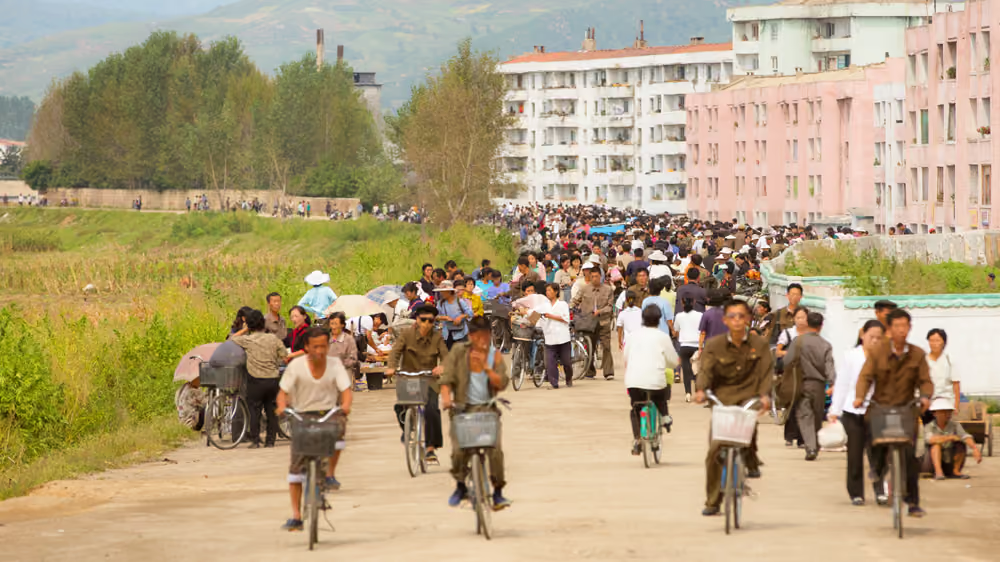
I believe there is a fundamental limitation in existing research on the North Korean economy, as much of it has traditional socialist planned economy analysis. Earlier studies have suggested that North Korea would either collapse or undergo a system transition as other socialist countries have done. However, after the breakdown of the Public Distribution System (PDS) in the mid-1990s and the emergence of the shadow economy (including through the Jangmadang—illegal markets), these approaches began to reveal their limitations.
As a result, the North Korean economy came to be understood not as a simple planned economy, but as a mixed economy in which state control and market activities coexist. However, these studies do not sufficiently explain why the North Korean regime allows marketization to persist at a certain level instead of completely suppressing it.
In order to explain the interaction between the government and ordinary North Korean citizens, who are the primary actors in Jangmadang activities, I divide the North Korean system into three groups: the regime, the elites, and ordinary citizens.
In particular, elites are important economic actors because they function as intermediaries between the regime and the people. My argument is that this phenomenon can be better understood by analyzing how these three groups strategically interact with one another.
These three groups pursue their interests in different ways, and their goals also differ significantly. The leadership wants to continue dynastic rule and ensure stable succession, the elite seek to secure their positions and avoid political risks such as purges, and ordinary citizens primarily seek survival and improved living conditions.
The interests of these three groups sometimes conflict with one another and sometimes align. In my opinion, these three groups in North Korea are currently remaining in a state of equilibrium.
This equilibrium means that these three groups can achieve their maximum interests under the current conditions in North Korea. Precisely because of this equilibrium, North Korea has been able to maintain both regime stability and limited marketization simultaneously.
That is why I believe we must identify what kind of shocks could cause this equilibrium to collapse. If such a change were to occur, it could become a new turning point for North Korea.
A new turning point for North Korea could lead the country toward a new political and economic order. The important thing is that we must identify what kinds of shocks could trigger such a transformation.
I hope for a North Korea that has changed—a place where its people can live freely. For me, North Korea is not just a state; it is my hometown, where I was born and raised, and where my family still lives. This is precisely why I am committed to a different approach to the North Korean issue—because my only goal is to see genuine change in North Korea, and I truly want to help bring about that change.
I want my article to inspire you to see something different the next time you watch the news or media coverage about North Korea. The next time you come across a piece of media about North Korea, I hope you take a moment to think about the real North Korean people. And perhaps you may also reflect on this article and consider what kinds of shocks could transform the current equilibrium of North Korea.
I hope you will join me on this journey.
–
HyeGyeong is a participant of the LiNK English Language Program (LELP), which serves to not only help North Korean defectors build confidence and skills in English, but develop their capacity as advocates for this issue. To that end, we partnered with select LELP “columnists” to write and polish personal essays through multiple rounds of external feedback and revision. Our goal is to have more North Koreans share their stories directly and lead efforts to change the narrative.
We believe the North Korean people can achieve their liberty in our lifetime.
Opportunities like LELP invest in the people building that future now. Help more North Koreans find their voice, reach their goals, and lead change on this issue.
Give Today
Most North Korean Refugees Are Women. Here’s Why.

Over 33,000 North Korean refugees have made it safely to South Korea. 70% of them are female.
Why?
Firstly, North Korea is both politically and culturally very patriarchal, so women traditionally have a lower status than men, and are actually less tightly controlled by the North Korean system. Starting from the famine of the 1990s, North Korean women had to exploit their official status as “housewives” to engage in private market activities and become the breadwinners to ensure their family’s survival.
This combination of a new found economic role, relatively more mobility, and increased independence led more North Korean women to seek further economic opportunities in China (sometimes with an intention to stay temporarily and return, and sometimes as a more permanent move).
There was also a perception among North Koreans that women would have a better chance of being able to stay under the radar and work informally in China, for instance in restaurants or textile factories. This has in fact been borne out in reality, and there is another more tragic factor pulling North Korean women into China—a demand for North Korean brides among unmarried Chinese men, and a broader demand for North Korean women in the Chinese sex industry (including brothels and online sex chat rooms). This demand is driven by a lack of marriage-aged women particularly in rural Northeast China, a result of China’s ‘one child policy’ and the migration of young Chinese women to the cities.
Regardless of the reason behind their initial escape into China, a higher proportion of women getting out of the country translates to a female majority making it all the way to South Korea.
Another reason that might be thought to hold North Korean men back is that they are tied up in military service for much of their 20s, which is a prime age for defection. Not only do men have less freedom when they are in the military, but they are also often relocated to the interior of the country away from the border with China, decreasing their chances of escape. However this does not exactly play out in the demographic data for arrivals of North Korean refugees in South Korea, which shows no spike in the female to male ratio of refugees in their 20s, so it is hard to say how big of a factor this is.
Finally, anecdotally, it seems that some North Korean women may be more likely to be motivated to make the journey to South Korea after watching dramas and films that are smuggled into North Korea on USBs and Micro-SD cards. North Korean women have told us that visions of life in South Korea where women have much greater freedom in self expression and fashion, and are granted higher status and respect—especially by the romantic heartthrobs of your typical K-drama—fueled their fantasies of life beyond North Korea’s borders and were a significant factor in their decision to escape.

Among the more than twenty thousand female North Koreans who have made it all the way to safe resettlement in South Korea have emerged some of the most effective advocates for the North Korean people. Several North Korea-born women have written books, and are increasingly giving the issue a human face on South Korean television and to audiences around the world.

These advocates, and hundreds of other North Korean women who have quietly strived to successfully resettle and bring their children and other family members to South Korea, are among the people that we’ve been able to support and work with because of your commitment to stand alongside the North Korean people.
So on International Women’s Day, we salute the North Korean women who have been able to emerge as a force of progress despite being born in the most repressive country in the world, and we salute our sisters and brothers around the world who continue to believe in and support them.
- Sokeel Park, Director of Research & Strategy










