
How a North Korean Defector Achieves His Dreams after Resettlement

Sang Hoon never had a place to call his own in North Korea, often spending his nights in the homes of his friends and relatives. His thoughts regularly drifted to faraway places and he imagined visiting the outside world. Sang Hoon had always been interested in other countries and hoped to work as a diplomat, but he was never able to follow his dream in North Korea.
His desire to leave his home country grew day by day until he could take it no more. After searching, he found someone to help him escape. Once in China, he connected with our network and made the journey to safety and freedom in South Korea.
Now, Sang Hoon is one of the most passionate, ambitious people we have the privilege to work with. As soon as he resettled, he began taking classes to learn how to use the computer. Most people take one class at a time, but Sang Hoon doubled up on classes and was able to get four computer certificates in very little time. He got a job at a research institute and continues to learn and strives to achieve his goals every day.Our resettlement coordinator Jihyun recently interviewed Sang Hoon. Read it below:

Jihyun What was the best thing that happened to you recently?
Sang Hoon: I bought a car after I saved up some money from working. My job requires a lot of traveling across South Korea, so I needed a car.
In North Korea, I could never even imagine having my own car because it is almost impossible for someone to own one unless they are a high-ranking government official. Even driving a car was something I could only dream about. It still feels surreal to be driving around with my own car in Seoul. I am very happy.

Jihyun You are one of the most positive people that I know. What makes you so positive?
Sang Hoon: I lived more than 40 years in North Korea and I lived for a quite short time in South Korea. The one thing I can say is this: compared to my life in North Korea, my life here is like heaven because I can make money and do my best to achieve my dreams and goals. I can even go travel abroad if I want.
In North Korea, even if the people try really hard, it is almost impossible for them to achieve their dreams and goals because of the way North Korean society is set up. So compared to North Korea, South Korea is a great society. I am thankful for it all the time because my dreams can come true if I try my best here.
I just wish I had come here earlier. If I had come in my 20s, I would’ve experienced more things and worked harder. However, I try to think of it as motivation.
I keep telling myself to study and work more than other people to make up for coming here in my late age. It is never too late.

Jihyun What were some challenges you had when you first resettled to South Korea?
Sang Hoon: When I first resettled to South Korea, I couldn’t get used to seeing young couples kissing each other and almost making out in public. (Laughs)
Seriously, when I first resettled in South Korea most necessities were covered by the government’s benefits for North Korean defectors, but still I felt a little overwhelmed by the reality that I would have to find a job on my own and make a lot of new decisions for the first time in my life. I learned about some job opportunities and how to get a job from Hanawon (the South Korean governmental resettlement facility) and Hana Center (the local resettlement assistance center run by the South Korean government).
However, I still felt like I didn’t have enough information to make informed decisions about my job and other things about my new life.
I didn’t know a lot of things about South Korean society or the words they used so even when I went on the Internet to find more information on my own, I didn’t know what words I should type in to find out the information I wanted to know. I didn’t know what to look up and look for.

Jihyun How did you try to overcome the challenges?
Sang Hoon: I came to South Korea by myself and I don’t have any family members who came before me, so I didn’t have anyone to ask questions about different jobs. So I humbled myself. I decided to learn from people working at Hanawon, Hana Center, and other organizations. I would ask a lot of questions to them regardless of whether they were younger or older than me. I also carefully listened to advice from other North Korean defectors who resettled before me. Through learning from other people, I became eager and positive. I went wherever I could learn.
Jihyun What were some of the new things you learned and got to do after you resettled to South Korea?
Sang Hoon: Using the Internet! On the Internet, I can get all information I want. It is so convenient.
I love the freedom of getting knowledge...being able to learn and study what I want. When I'm on the Internet, I feel connected with the world.

Jihyun What would you like say to other North Koreans defectors?
Sang Hoon: I want to encourage other North Koreans in the new society to not only enjoy their freedom, abundance, and new life, but to also be responsible for things in their lives. I know some North Korean defectors who only enjoy things, but don’t invest in themselves by studying or working hard. I think we should focus on resettling well in the new society through education or work first before we start enjoying things.
I also like traveling around and having fun, but I am waiting to do more of the fun stuff after I get more settled in my new job and new life. Also having gratitude! I want us to remember when things were so hard back in North Korea. That helps us stay positive and grateful for our new lives and freedom. Let’s not focus on only negative things so much.

Jihyun What would you like to say specifically to other resettled North Koreans who came to South Korea in their late age like you and who think it’s too late for them to start learning and trying new things here?
Sang Hoon: I want to tell them “do you remember when we were risking our lives to escape from North Korea and coming out of China? (I even brought a knife to kill myself just in case I got caught because I knew I would get horribly punished for a long time, maybe the rest of my life for escaping North Korea.) We risked our lives to come here. What are you afraid of? What can you not do in the new society where you don’t have to risk your life anymore?
Nothing can stop us pursuing our dreams and goals in the new society—not even our age!”
Jihyun What do you think of North Korea?
Sang Hoon: North Korea is still my home country where my family still lives and my ancestors are buried. However, because of all the human rights abuses, I don’t really want to think of it.

Jihyun What is your dream or goal in South Korea?
Sang Hoon: After I save up more money, I want to go to grad school. I know it won’t be easy to study in grad school at my age, but I want to challenge myself to try. Also I want to contribute to reunification of North Korea and South Korea with my background, experience, education, and work.
Jihyun What is the most important value in your life?
Sang Hoon: Education. I want to keep learning new things. This is one of the reasons why I want to go to grad school. I just want to continue learning from other people and books so I can keep improving myself. I really love the freedom of being able to learn what I want to learn.

Jihyun What is freedom to you?
Sang Hoon: Freedom is life because we need freedom to live.
Jihyun Lastly, what would you like to say to South Koreans?
Sang Hoon: I want to ask South Korean people to see North Korean people not as second-class citizens, but just people of the same ethnic group—Koreans. Please don’t treat us with stereotypes or stigma. We need more support from you and more people who can understand us. We want to be in harmony with you.
You can help other North Korean refugees escape China and resettle successfully by donating to our work.
Donate today.
Remembering North Korea: Today, I’m Happy Because I Can Have Ice Cream
By: Hyeyoung Woon
Hyeyong escaped from North Korea in 2009. She currently works as a financial accountant, and strives to grow her ability as a storyteller and writer to share her personal experiences as a North Korean defector.
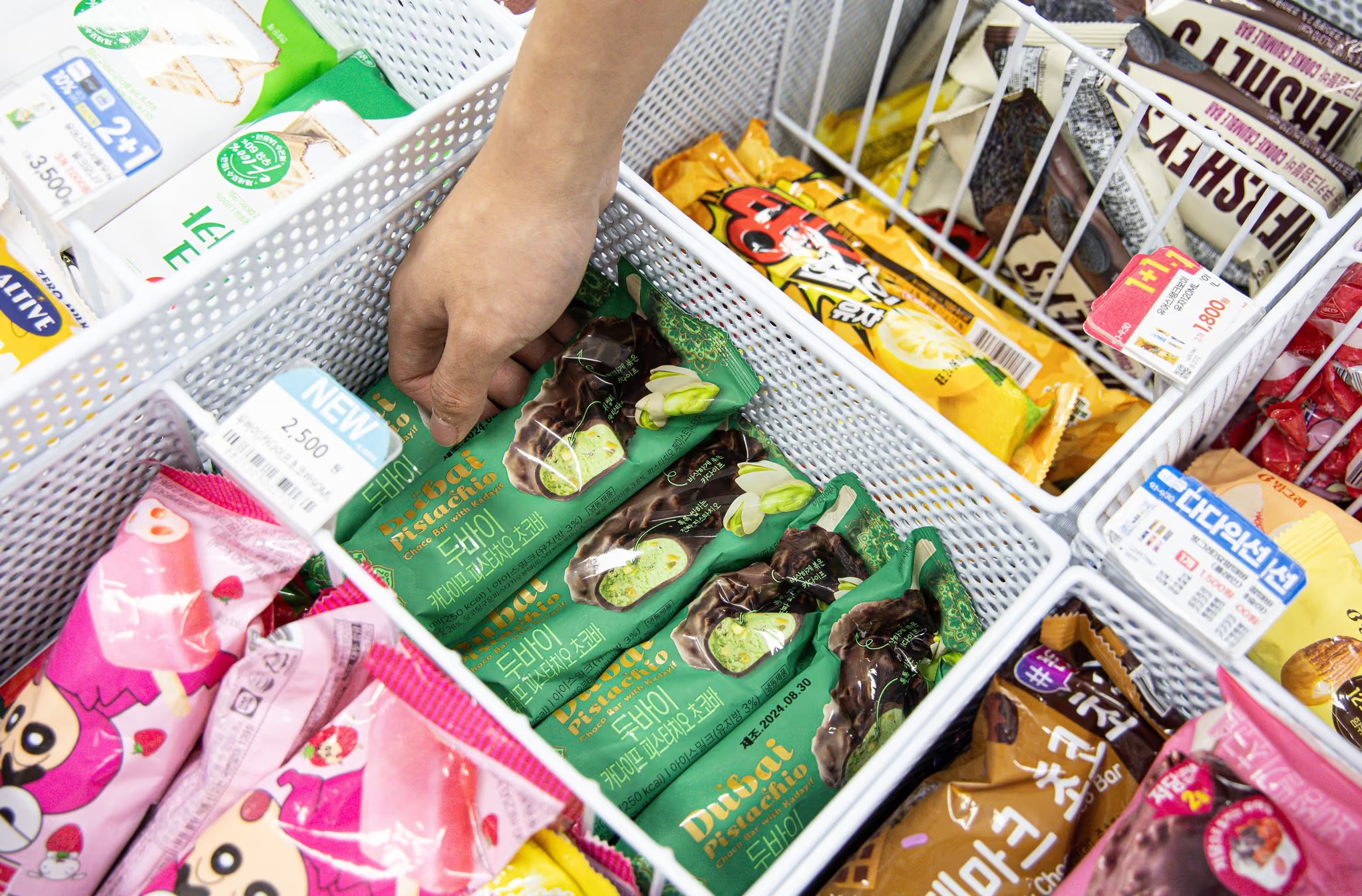
There are days when happiness feels complicated.
And then there are days when it feels very simple.
For me, sometimes, it is just ice cream.
When I was young in North Korea, ice cream was very different.
We had “eoreum bosunge” which is sweet pink water frozen in a small metal can with a stick inside. It was icy and rough, and the taste was so strong. That was all I knew.
But everything changed on my first day in South Korea.
I went to a small neighborhood store with my mom and that was where I first saw an ice cream called “Pure Milk”.
At that time, I had just started becoming interested in the English language, so maybe that is why the name caught my eyes.
I picked it up and took a bite.
And honestly, it felt like a different world.
It was soft, smooth, and full of real milk flavor.
Until then, ice cream had only meant frozen sweet water to me. I did not know something so simple could taste so real.
After that day, I kept choosing the same ice cream again and again.
Of course, now I know there are more expensive and famous ice creams in the world and, just like that, my life has changed too.
But maybe that is why I still choose Pure Milk.
Not because it is the best,
But because it reminds me of who I used to be.
When I first came to South Korea, everything felt new and exciting.
And little by little, this new world made me forget the old one.
Maybe that is part of growing up.
Or maybe it is part of learning how to survive in a new society.
But sometimes, I become afraid that my old memories are slowly fading away too.
That is why small things like this ice cream still matter to me.
They remind me of where I started.
They help me keep a part of myself that I do not want to lose.
And I still want to remember the girl who once believed pink frozen water was enough to be called ice cream.
–
Hyeyoung is a participant of the LiNK English Language Program (LELP), which serves to not only help North Korean defectors build confidence and skills in English, but develop their capacity as advocates for this issue. To that end, we partnered with select LELP “columnists” to write and polish personal essays through multiple rounds of external feedback and revision. Our goal is to have more North Koreans share their stories directly and lead efforts to change the narrative.
We believe the North Korean people can achieve their liberty in our lifetime.
Opportunities like LELP invest in the people building that future now. Help more North Koreans find their voice, reach their goals, and lead change on this issue.










