
SONGBUN | Social Class in a Socialist Paradise

The history of all hitherto existing society is the history of class struggles.
Freeman and slave, patrician and plebeian, lord and serf, guild-master and journeyman, in a word, oppressor and oppressed, stood in constant opposition to one another, carried on an uninterrupted, now hidden, now open fight, a fight that each time ended, either in a revolutionary reconstitution of society at large, or in the common ruin of the contending classes...
The modern bourgeois society that has sprouted from the ruins of feudal society has not done away with class antagonisms. It has but established new classes, new conditions of oppression, new forms of struggle in place of the old ones.
So begins Chapter 1 of The Communist Manifesto, written by Marx and Engels and published in 1848. If we take the last paragraph, and change a couple of labels, it perfectly describes North Korea today:
The North Korean society that has sprouted from the ruins of the division of Korea and the Korean War has not done away with class antagonisms. It has but established new classes, new conditions of oppression, new forms of struggle in place of the old ones.
In fact, the North Korean regime has established 3 new classes divided into 51 categories, and has created what is widely recognized as the most oppressive society in the world. Maybe Marx rests easier now that his portrait no longer adorns Kim Il-sung Square in Pyongyang; it was taken down before Kim Il-sung’s centenary celebrations in April. The North Korean regime has been extremely intentional at creating and enforcing social classes based on political loyalty and this system, known as songbun (성분), is key to understanding North Korean society as a whole and specifically and the system of oppression which the ruling elite uses to maintain political control. So a new report on Songbun by our colleagues at HRNK, Marked for Life, is a great addition to the literature on NK.
The report describes songbun as a state-directed system of discrimination based on hereditary classes determined by perceived loyalty to the regime. It decides your prospects in almost every area of life, including education, occupation, military service, Party membership, treatment by the criminal justice system, housing, medical treatment, marriage, and even food supply. The individual has no control over this system, their songbun being decided by their family line, making it analogous to discrimination along racial lines. The whole system can be described as a political apartheid, reminiscent of the racial apartheid in South Africa that attracted such international criticism until it ended with the election of Nelson Mandela.
CREATION OF SONGBUN
The songbun system was devised in the early years after the formation of North Korea out of a motivation to protect the Kim regime by isolating and controlling perceived internal political threats. It did this by categorizing every single North Korean resident according to how politically safe or risky they might be. The key factors considered were your ancestors’ socioeconomic background at the time of liberation (1945), their activities during the Korean War (1950-1953), and whether you had relatives in South Korea or China (being connected to the outside world is bad for your songbun).
North Koreans were split into three broad classes:
- Core (핵심), 28% of the population. Includes professional revolutionaries, descendants of ‘war heroes’ who died working or fighting for the North, peasants or those from peasant families.
- Wavering (동요), 45%. Includes people who had previously lived in South Korea or China, those with relatives who went to the South, families of small-scale merchants, intellectuals, practitioners of superstition, etc.
- Hostile (적대), 27%. Includes descendants of landlords, capitalists, religious people, political prisoners, those who had assisted South Korean forces during the Korean War, or were otherwise judged anti-Party or associated with external powers.
The regime keeps a file on every single person above the age of 17 (before that age your details were registered on your parent’s file), and an incredible amount of work goes into creating and regularly updating these records. The data is now managed using the software system “Faithful Servant 2.0.” This digitization makes it easier for authorities to access any citizen’s songbun file from any Ministry of Public Security computer terminal from provincial to county levels.
EFFECTS OF SONGBUN
Songbun is deeply entrenched in North Korean society and affects nearly all aspects of a North Korean’s life, including (see HRNK’s full report for further details):
Occupation:
In NK, you do not choose your job. The regime chooses it for you, and it is heavily influenced by your songbun. Simply put, if you have low songbun, you will be put into gruelling manual work, whereas if you have high songbun, you might expect a relatively cushy Party cadre position. There is no element of meritocracy here and ability does not factor in much, meaning that it is quite possible that more able workers are placed in less important roles while less able workers are given positions of responsibility. This failure to efficiently utilize their national talent-pool is yet another reason why North Korea’s state-controlled economy struggles so much.
Education:
Again, this is not meritocratic. If your parents have good songbun, then you are allowed to progress. Otherwise, no matter how hard you study, you will not advance academically. As you can imagine, this can cause resentment (although that resentment is sometimes aimed at the parents, not the regime). This system also ensures that “elites play together.” Those with good songbun go through the same schools and the same colleges, and they network within this pool for their future mutual benefit. Those with bad songbun are of course denied such opportunities. The importance of personal connections in North Korean society compounds the importance of songbun.
Family:
Knowing the importance of keeping a clean record in NK society, parents impress on their children the importance of not doing anything to step outside the Party line, as it would affect the whole family. The importance of songbun also means it is one of the most important factors to consider when finding a spouse. If you marry someone of lower songbun you and your children will lose out, so people tend to marry within their songbun level, as indicated by the occupation and status of their partner’s family. (Note that these phenomena are not unique to North Korea, as people tend to marry within their own social class in other countries too. What is unique in North Korea is how this is being played out within a class system which has been systematically created according to the interests of the ruling elite.)
Internal Exile:
For decades, the regime has systematically exiled tens to hundreds of thousands of low-songbun political undesirables to isolated and unfavourable mountainous areas in the northeast of North Korea. Here they have been forced into hard labour, subject to tighter controls, excluded from population centres, and effectively removed as a potential political threat. It could be argued that the regime has not only tried to cut off the outside world but is now increasingly cutting off Pyongyang from its outer provinces, leaving those who are judged as potential political threats isolated and with no way to demonstrate their frustration without risk of complete elimination.
Food:
Songbun has a huge effect on a North Korean citizen’s food supply. Particularly at times of scarcity, the distribution of food and resources has been concentrated to the higher songbun levels - Pyongyang and central regime institutions (Party, government and military). This was particularly noticeable during the famine of the 1990s and the chronic food shortages that have blighted the people ever since. When the state-economy collapsed and there were not enough provisions to go round, the regime stopped providing food to the politically undesirable northeast regions, so the famine hit those regions the hardest. It has been reported that as many as 30% of the population died in the worst affected regions, particularly North Hamgyeong Province. It should come as no surprise then that around 60% of North Korean refugees who have made it to South Korea are also from that province. An issue for another post is how this demonstrates the inextricable linkage between human rights and humanitarian / economic issues in North Korea. Understanding songbun should call us to question the wisdom of distinguishing between “economic migrants” and “political refugees” when it comes to this population.
Medical Care:
The public health system all but collapsed in the 1990s, but special treatment is still available for elites in Pyongyang. People of lower songbun cannot access these facilities, even if they have independent wealth, and the best they can hope for is to buy medicine on the black market.
In short, songbun institutionalizes the dominance of the ruling elite and their descendants over all other groups in society, and as this system has been implemented over several decades, the privileges of the core class have grown while the others suffered.The operation of this system is not at all transparent but people are generally aware of it, although they may not know details, including of their own songbun. Quite a few of the North Korean refugees that I have interviewed about their songbun have not been very sure about their own level. People of higher songbun are better aware of the system, and one gentleman that I interviewed jokingly half-boasted to me that his family was “totally red, the core of the core.” To him it was clear that he had good songbun because so many of his relatives held positions of responsibility within regime institutions, and some members of his family had also been granted considerable educational opportunities.
It is worth noting that while it is extremely difficult to improve your songbun, you can easily drop levels if you get in trouble through committing criminal or political offenses, or fail to cooperate with regime officials, or if a family member gets into such trouble. The implementation of songbun therefore creates considerable fear and forces people to obey the regime, and in reality it is an effective tool used by the regime to maintain control and power.
As we might expect, the changes inside North Korea over the last 15 years have affected the implementation of this system, albeit without being able to overturn it. The interaction between marketization and songbun (both mitigating and exacerbating effects), songbun’s effect on anti-regime sentiment, and the extent to which the songbun system can constrain change in North Korea will be covered in the next blog post…

SOKEEL J. PARK | Research & Policy Analyst
Disrupting the North Korean Regime’s Control: Increasing Information Access
North Korea is the most closed and isolated information environment in the world. The regime’s control hinges upon suppressing outside sources of information that could contradict or undermine their ideology. This makes their system of repression extremely effective; it also highlights a critical weakness, one that creates an opportunity for us to effect change inside the country.
Information is power. It enables people to scrutinize the world around them, hold governments accountable, and aspire towards a better life.
At Liberty in North Korea, we’re empowering people inside North Korea with tailor-made tools and technologies that increase their information access, and make that access safer and easier. But what does this actually look like? We asked our Chief Strategy Officer, Sokeel Park, to answer some frequently asked questions about our Information Access Programs (IAP).

1. Without the internet, is it really possible to increase information access inside North Korea?
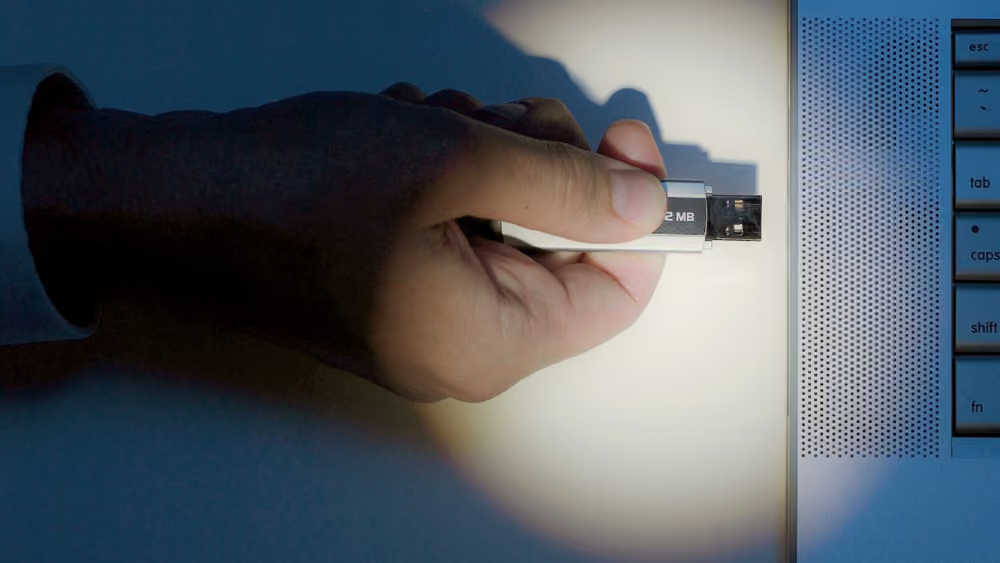
Yes, absolutely. North Korean people are already accessing uncensored information and media without the internet, notably through USB drives and MicroSD cards that are smuggled into the country and spread through sharing networks. These contain K-dramas, movies, music, and information that the North Korean regime tries so hard to keep out of the country.
The devices and hardware are already in use, the demand is there, and the sharing networks and behaviour exists. The need and opportunity is to leverage and build on this, providing new technologies that will help North Korean people access more uncensored information more safely.
2. Isn’t enabling North Koreans to access illegal foreign media putting them in danger?
Accessing uncensored information is risky in North Korea, especially with increased crackdowns and punishments in recent years. Our technologies and digital security tools equip North Koreans to access information more safely.
North Korean people will continue to take risks for information and media that most people in the world would take for granted.
User security is our highest priority in our development process, and this is guided by North Korean defectors who left the country recently, understand the environment, and can advise us on the best ways to protect and empower North Korean people who are trying to access uncensored information.
3. What is LiNK doing to increase North Korean people’s access to information?
LiNK’s IAP work can be broken down into four areas of focus.
We develop lightweight, secure programs help more North Koreans access more uncensored information; protect North Korean users with digital security and anti-surveillance measures; create and curate strategic content that meet North Korean people’s needs and build resilience to the regime’s propaganda; and work with distribution partners to deliver these technologies and content packages to North Koreans as reliably, effectively, and safely as we can.
4. Why did LiNK decide to do Information Access work?
In a 2024 HanVoice Woorion survey of 500 North Korean refugees, 86.2% agreed that “it is important to increase the flow of information to North Korean people.” This is the most effective way that we can support change inside North Korea.
As an organization, LiNK is uniquely positioned to do this work. With our long history of rescuing and supporting North Korean refugees, we have the networks and ability to work closely with a variety of North Koreans, including recent defectors and people who studied and worked in IT in North Korea, who inform and help test our products and strategies from start to finish.
Crucially, because of the support of people like you, we are able to make strategic investments in projects that governments or other funders may not support, which enables us to pursue the most effective long-term strategy possible to support North Korean people to achieve their freedom.
5. What kind of information can North Koreans access, both legally and illegally?
Legally, North Korean people have access to official media which is extremely centrally controlled and produced. There are no newspapers, TV stations or media channels with an alternative viewpoint from the government, and all official media serves to reinforce the regime’s ideologies and narratives about the outside world, their own country and the leadership. This official media includes, for instance, newspapers, North Korean films and dramas, carefully selected foreign (eg. Russian) films, partially censored sports broadcasts, radio, speeches by the ruling Kim family, government-approved books, and government-approved mobile apps.
Illegally accessed information or media could theoretically include anything, but most commonly would be movies and TV dramas from South Korea, China and elsewhere, music, some e-books, and foreign radio broadcasts including news and documentary programs. Close to the border with China, some North Korean people have a smuggled Chinese smartphone that can be used to connect to the Chinese network and communicate with or get information from the outside world.
→ Want to learn more about life inside North Korea? Sign up for North Korea 101, LiNK’s free online course!
6. How do we know increasing North Korean people’s access to information will help change North Korea?
Hundreds of interviews with North Korean refugees conducted by LiNK, and thousands more by other organizations, consistently show how access to outside information reshaped their understanding of the world, undermined regime propaganda, and often was key in their decision to risk their lives and seek freedom. We also see the North Korean regime’s crackdowns on this access to outside information, especially in recent years, as evidence that the regime understands the power of information to undermine their control and change their country as well.
Throughout history, we’ve seen similar dynamics in other authoritarian countries, where greater access to uncensored information has consistently increased aspirations for freedom, expanded people’s sense of what was possible, and played a key role in people overcoming dictatorships and achieving freedom across the world.
It is inherently difficult to capture and measure the long-term effects of information, particularly in a country like North Korea. But when history, logic, the testimony of countless North Koreans, and careful product and strategy validation processes all point in the same direction, investing in increasing North Korean people’s access to information is not a leap of faith. It is the strongest, most evidence-based opportunity to help North Koreans shape their future and ultimately achieve their liberty.
–
In the first half of 2026, our IAP team successfully deployed new information-access technologies across one of the world’s most tightly controlled borders, and reached people inside North Korea.
We believe North Koreans deserve the freedom to access information and make their own choices, and we’re committed to helping them break through the regime’s surveillance and censorship. Increasing information access is one of the most effective ways that we can have a direct impact on North Korean people’s lives right now.
Help drive change from inside North Korea by investing in LiNK’s Information Access Programs.










