
NK Perspectives: 5 North Koreans weigh in on the second Kim-Trump Summit
We asked 5 North Koreans what they thought of the 2nd Kim-Trump summit, their perception of the U.S while growing up, and what they wish the world knew about North Korea.

What went through your mind when you saw Kim Jong Un and President Trump shaking hands last year?

Jessie Kim
27 years old, from Hyesan, escaped in 2011
Jessie: When I saw Trump and Kim Jong Un shaking hands during the first North Korea-U.S. summit, two things came into my mind.
1. With the help of the United States, maybe South and North Korea will actually reunify. And especially when I saw them shaking hands, I couldn’t stop crying thinking how one day I might meet my family again.
2. At the same time, I was worried that the world might forget about the North Korean people who are suffering behind Kim Jong Un’s political showmanship.

Jung Jin
35 years old, from Yanggang Province, escaped in 2014
Jung Jin: In North Korea, everyone is taught to be hostile towards America from an early age. We’re taught that the American imperialists are our mortal enemy with whom we cannot live together under the same sky.
So when I saw Kim Jong Un smiling and shaking hands with the president of the U.S., I really wondered what was going on in his head. For Trump, it’s about nuclear weapons, and for Kim Jong Un, it’s about maintaining his regime. I was worried about who on earth would help the tens of millions of North Korean people who are suffering because of that regime.

Geumhyok Kim
27 years old, from Pyongyang, escaped in 2012
Geumhyok: It didn’t leave me with any particular feeling. Watching the heads of the two countries, which have been enemies for so long, shaking hands and strolling down a garden path together can itself be an emotional and meaningful thing.
However, I feel that the Singapore Summit had far too many shortcomings to solve the nuclear problems of the Korean Peninsula when one considers the highly complex underlying issues and interests involved. In the final analysis, although it may have looked as if the North Korean issue might even be solved immediately after the summit, nothing has changed in reality and it has only served to highlight the difference in the basic positions of the two sides.

Joseph Park
37 years old, from North Hamkyung Province, escaped in 1999
Joseph: To be honest, I was expecting the Trump-Kim moment to be more emotional because the previous summit between president Moon and Kim Jong Un was such a powerful moment, but it didn’t live up to my expectation. Unlike the inter-Korean summit, the U.S-North Korea summit hasn’t produced any tangible results, which is disappointing.

Jinho Kim*
24 years old, from Chongjin, escaped in 2008
Jinho: I felt that many people would fall for the propaganda. Kim Jong Un shook hands with the president of the United States for the first time in history, so the thought that many people expected peace to come and might see Kim Jong Un as a normal leader worried me. The more Kim Jong Un develops his image as a normal leader, the quieter the voices calling for human rights for the North Korean people will become.
*Name changed for privacy reasons
When you were in North Korea, what was your perception of the United States?
Jessie: When I was growing up in North Korea, I really wanted to visit America during my lifetime. When I was young, my grandma used to tell me stories about American soldiers [that she met during the Korean War], and after my mother died I used a lot of American dollars while running my private business. The North Korean government teaches us that America is very bad, but in the jangmadang (markets) the U.S. dollar is valued very highly. These social contradictions made me doubt the state, and ultimately led to my escape.
Jung Jin: Since I received so much anti-American education when I was young, I thought that Americans were all scary looking vicious murderers. But my thinking started to change as I got older and I watched American movies that were smuggled across the border from China. I was able to feel at least a bit like Americans are just human and many of them are good people.
Geumhyok: When I was in North Korea, I received two kinds of education about the U.S. The first was the general anti-American education and the second was a more in-depth strategic analysis of the U.S. when I was enrolled at the Pyongyang Foreign Languages School and Kim Il Sung University as a student of English Literature. I personally felt the power of the U.S, and was afraid of it. I never once thought that North Korea could defeat the U.S. in a war as claimed by the North Korean government. In fact, I dreaded the opposite outcome.
Joseph: We were taught that the United States is our mortal enemy who made the Korean people suffer, and is an invader occupying South Korea. However, when I came to South Korea the people that influenced me the most were Americans. Despite the sanctions imposed on North Korea by the U.S. and the international community, the people doing humanitarian work in the North are Americans. I think the North Korean government demonizes the U.S. for political gain in much the same way American politicians demonize Islam or South Korean right-wing politicians and the Abe administration of Japan demonize North Korea for political gain.
Jinho: I was faithful to what I was taught so I believed the U.S. was our mortal enemy. When I played with my friends, the kids playing the role of ‘bad guys’ always pretended to be Americans. When the U.S. and North Korea made a gesture of peace, I thought that the U.S. was surrendering to North Korea. I only thought of the U.S. as an imperialist power that was oppressing our people.
What are your personal hopes for this summit?
Jessie: Honestly, I don’t have high hopes for the second North Korea-U.S. summit. After the first NK-U.S. summit that seemed would lead to huge change, and after three North-South summits, I think the world has just helped Kim Jong Un to get what he wants. Especially when we consider that the second NK-U.S. summit is being held in Hanoi, Vietnam, we can see more clearly what Kim Jong Un’s objective is. If we really want to achieve peace between North Korea and South Korea, then we need to throw away any hopes of North Korea giving up their nuclear weapons and direct our policy effort at making North Korea reform, open, and develop the economy for the people, not just for Kim Jong Un.
Jung Jin: I know it seems like a really futile hope, but I wish that the North Korean people are in Kim Jong Un’s mind even a little bit when he is doing this summit. I hope rather than only obsessing about how he can maintain his regime, he spares a second’s thought for the people."The one thing I want to tell the world about North Korea is that the people living there are ordinary people just like us."
Geumhyok: To be honest, I am skeptical about the upcoming meeting. A summit is no more than a show. I would say that the series of working-level talks leading up to the summit are more important. There have been many negotiations but denuclearization is becoming less likely by the day, and in fact it seems we might be heading for just a nuclear freeze. It’s hard to see a negotiation that deviates from one’s original goal and gradually finds a point of compromise as a victorious one. That’s why I don’t have high hopes for this summit.
Joseph: I hope North Korea and the U.S. end the armistice and declare an end to the war, sign a peace treaty, and establish diplomatic relations. And I sincerely hope that North Korea dismantles its nuclear weapons and the Korean peninsula turns into a land of peace so that there is no more pain for separated families.
Jinho: I hope the U.S. will take the initiative in the talks and force Kim Jong Un to give up his nuclear weapons and open up the country. I hope that there will be no declaration ending the Korean War or the signing of a peace agreement. Since North Korea still has the ambition of unifying the whole peninsula, if there is a declaration ending the war or peace treaty, the Korean Peninsula could fall into the hands of North Korea, just like what happened in Vietnam which is where Kim Jong Un chose as the venue for the talks.
If North Korea were to sign a peace treaty and improve relations with the United States, a country they have long propagandized as their eternal enemy, how would this influence North Korean society and culture?
Jessie: Personally, I think it’s difficult to expect that signing a peace treaty and ending hostilities will change the perceptions of ordinary citizens who are struggling to make a living, because a peace treaty signed by Kim Jong Un would be for the benefit of the regime, not for the people. A true peace treaty is one that facilitates economic reforms and actually improves the lives of the people.
Jung Jin: North Korean people live with not just their freedom, but even their human instincts repressed. If North Korea ends their hostile relationship with America, the symbol of capitalism, then socially and culturally the winds of capitalism will blow strongly in North Korea. I think there will be a lot of change in people’s fashion particularly. And if people’s fashion changes, then of course people’s consciousness changes too.
Geumhyok: A peace treaty between the U.S. and North Korea has many meanings. I, too, want to see the hostilities between the two countries end and an improvement of bilateral relations. However, to realize this there are many hurdles to be overcome. Realistically, it’s near impossible. First, the situation in South Korea doesn’t allow it. The two Koreas have starkly different systems and their respective constitutions both state that the other side should be reunified under their system. A peace treaty between the U.S. and North Korea will undermine the basis for the deployment of U.S. troops in South Korea and, in turn, destabilize the North-South power balance. This can catalyze new security concerns and affect the Northeast Asian order in an unpredictable way. Without any meaningful change to the authoritarian dictatorship of North Korea, the socio-cultural impact of a peace treaty will not be felt by the people. In fact, it can work towards bolstering North Korea’s dictatorship."...a peace treaty signed by Kim Jong Un would be for the benefit of the regime, not for the people. A true peace treaty is one that facilitates economic reforms and actually improves the lives of the people."
Joseph: People really dislike Japan, but no North Koreans dislike goods made in Japan. It’s the same with the U.S.: people hate the U.S. but there is no one that would say no to Hollywood movies or Apple products. Even Kim Jong Un uses an iMac and an iPad. After the North Korea-U.S. summit last year, the North Korean government has been promising its people a peaceful future with the U.S., ending the hostility between the two countries. I think a new future awaits the North Koreans. But I hope only good things will go into that pure and untouched land.
Jinho: To my knowledge, North Korea will advertise it as the U.S. surrendering to North Korea. Then North Koreans will once again gain hope for the regime and abandon their ideas about human rights. Just because a peace agreement is signed does not mean that Kim Jong Un will give freedom to his people. I think this will only change Kim Jong Un's political position and have no positive impact on the real human rights and lives of the North Korean people.
What do you wish people around the world who will be watching this summit knew about North Korea?
Jessie: As humans born on this earth we all have basic rights. But North Korean people live without even knowing the meaning of such a word. Media portrayals of Kim Jong Un, [his wife] Ri Sol Ju carrying an expensive handbag, and the parts of Pyongyang shown to the world are not the true North Korea. North Korean people are hidden behind the veils of skyscrapers and luxury handbags. The one thing I want to tell the world about North Korea is that the people living there are ordinary people just like us. I hope we don’t forget about the North Korean people who can’t even claim their right to life.\"The more Kim Jong Un develops his image as a normal leader through these summits, the more the international community will lose interest in the oppression and control he has on the people."
Jung Jin: It seems that people think Kim Jong Un represents North Korea, and I guess people around the world can think that. But I wish people knew the fact that behind Kim Jong Un, who is abnormally obese, even in his mid-30s, there are many North Korean children and adults who are skinny and have stunted growth because of food shortages. I can tell you for certain that North Koreans are generally shorter than South Koreans. We’re the same ethnicity and we have the same blood, so I can only conclude that this difference in our physiques must come from the differences in nutrition.
Geumhyok: The North Korea-U.S. summit is a show; a show of a grand scale. What’s important is the series of working-level negotiations happening below that. We need to closely watch what is being negotiated. These shows are dazzling, and when fireworks are too bright people cover their eyes and ears. But when the show finishes and darkness returns, everything will go back to the way it was before. The Singapore Summit was like that. We can’t let people have fantasies about Kim Jong Un’s dictatorship, because such fantasies only strengthen the power of the dictatorship.
Joseph: I hope people remember the 25 million North Koreans when they watch the summit between North Korea and the U.S. Those who’ve had to suffer the most due to the hostile relationship with North Korea are the North Korean people, not the regime. Peace will improve people’s lives. Peace will solve the issue of separated families. Peace will solve people’s hunger. Peace will solve the problems of people in pain. I think this is the most fundamental way of restoring people’s human rights."We can’t let people have fantasies about Kim Jong Un’s dictatorship, because such fantasies only strengthen the power of the dictatorship."
Jinho: Just because the leaders talk, it does not mean that the lives of North Koreans will change. Kim Jong Un is no different from his father Kim Jong Il and his grandfather Kim Il Sung in the sense that they are all dictators. He executed his relatives using anti-aircraft guns in order to maintain his regime, and cleared away homeless orphans and neglected them. North Koreans are still oppressed and are being sent to prison camps to be killed. The only reason the number of starving people is reducing is not because of Kim Jong Un, but because of the jangmadang (markets) developed by the North Korean people themselves. The more Kim Jong Un develops his image as a normal leader through these summits, the more the international community will lose interest in the oppression and control he has on the people. Citizens in the international community must be aware of this, and avoid only watching the political aspects shown through these summits.
How Has the Kim Family Held on to Power So Long?
The following content is adapted from North Korea 101, LiNK’s FREE online course that explains what's happening in North Korea beyond the headlines. Start learning today.
Sign up for NK 101
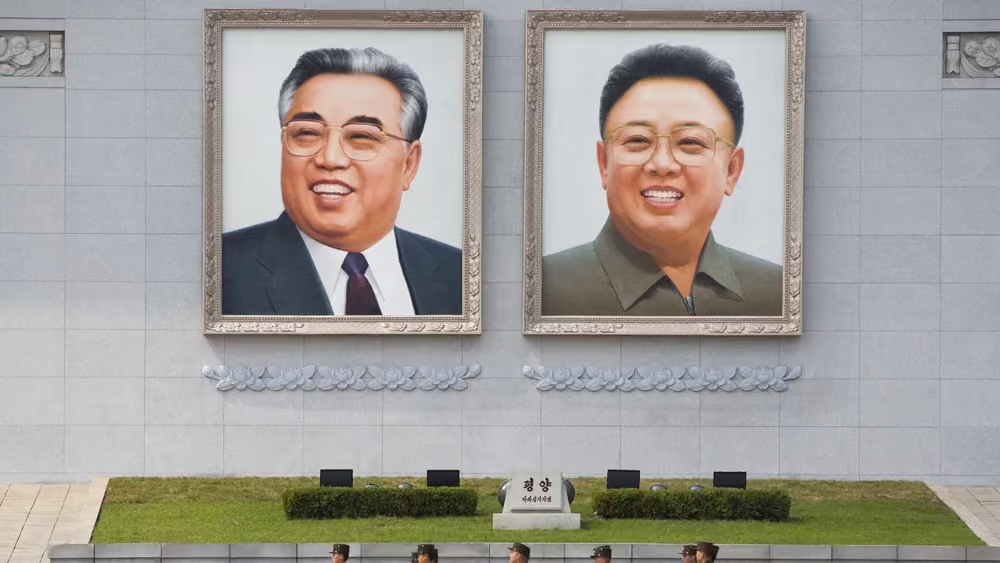
“This question is fundamental. To understand where we are and where we might be heading, we have to understand where we’ve come from.” – Sokeel Park, LiNK CSO
The North Korean regime is the world’s worst dictatorship, an extreme remnant of 20th century authoritarianism that has stretched across eight decades and three generations of the ruling Kim family. The regime’s all-encompassing system of control constrains the North Korean people’s agency and potential, resulting in an enforced poverty which includes physiological, material, social, informational, and cultural deprivations.
It is not easy for dictators to maintain power for long. During the Kim family’s rule, the world has seen the rise and fall of dozens of other dictatorships. Through many periods of global change and internal instability, they’ve managed to maintain power not by sheer force or luck, but through an array of adaptive strategies. But when the media portrays Kim Jong Un as crazy or irrational, it undermines our understanding and approaches to try to undermine that dictatorship.
There is a formula to their approach, and if we can understand it, then we can counteract it.
The Four Ways Dictators Lose Power
Historically, the fall of dictators can be attributed to four factors. By looking at each of them, we can see how the ruling Kim family has strategically avoided these fates.
1. Military Defeat/International Intervention
An external country or force intervening and overthrowing a dictator through military defeat.
2. Elite Challenges
An internal challenge emerging from within the country’s top political or military circles, forcibly removing the current dictator by assasination or a coup d'état,
3. Popular Uprising
An internal challenge from below, where a mass movement forces a change in leadership. In some cases, parts of the elite may join the side of the masses.
4. Death in Office
The death of the current leader, opening up an opportunity for someone else to assume control and end the dictatorship or make significant changes.
Threat #1: Preventing Military Overthrow
To prevent an external power from overthrowing their dictatorship, the Kim family first needs a strong deterrent against military force. The vast majority of mainstream news coverage of North Korea focuses on one thing: nuclear weapons. Having nuclear weapons and being seen as potentially willing and able to use them is arguably the most effective way to deter a military intervention from the outside.
Second, the Kim family has strategically managed their relations with countries like the Soviet Union / Russia, China, the United States, and South Korea. They go back and forth between periods of warmer and colder relations, effectively balancing opportunities and risks to gain support while preventing too much external influence. It’s unlikely that the Kim family has ever really trusted any of these external powers, even those that are sometimes labelled as “allies”.
Threat #2: Preventing Elite Challenges
Historically, the position of dictator can be very tempting to others within the leadership’s orbit, from competing family members to senior politicians or military leaders. To prevent anyone from building too much power and becoming a threat, the ruling Kim family carefully manages elite politics, alternating between demoting, promoting, and purging top officials.
On top of that, cross-layered surveillance between different institutions also keeps potential challengers under surveillance and in check, and prevents any one person or group of people from launching a challenge for power.
Threat #3: Preventing Popular Uprisings
The next scenario that the regime must prevent is a popular uprising.
A common conception of North Korea is that if the people wanted to rise up and revolt, they would have, and so they must be brainwashed or bought into the regime’s ideologies. While the latter may be true to some degree, it's difficult to fully grasp the extent to which the government’s system of control deprives people of their agency and potential and prevents them from challenging dictatorial rule.
North Korea is the most closed country in the world. The regime has forcibly cut off North Koreans from the rest of humanity, which serves as the baseline for their control. This centers everything—social structure, daily life, resources, information—around the regime, and eliminates sources that could undermine or threaten their authoritarian rule.
Laying the Foundation: Kim Il Sung’s Half-Century in Power
Kim Il Sung was 33 years old when he was installed into power by the Soviet Union—very young in global politics at the time, when most leaders were in their 50s and 60s. This historical happenstance has ended up being a key factor in the longevity of the Kim family’s control.
From his rise to power in 1945 to his death in 1994 at the age of 82, Kim Il Sung had 49 years to mold North Korea’s politics and systems in his image. During this time, he laid the foundation for hereditary succession by:
- Centralizing power around this dictatorship.
- Building a cult of personality around himself and his direct lineage: propaganda and myth-making that legitimized the Kim family as the only North Koreans worthy to lead the country.
- Purging anyone who could have been an alternative leader.
When it came time for Kim Jong Il to assume power, and the Kim Jong Un after that, decades of preparation smoothened the transition.
Now, after three generations of the Kim family, it would be very difficult for anyone else, even among the upper elite, to try and take power. Even if someone did manage to depose the current dictator, they would have to contend with not just managing the power vacuum, but the ideological void left by decades of propaganda and mythmaking that surrounded the Kim family.
Without the legitimacy that had been set up by the Kims, a new leader would likely find it difficult to maintain power for long. This is something that North Korean elites understand, which further discourages any rival officials from challenging the current regime.
Keep Learning with NK 101: Understanding the Country Through Its People
Through in-depth interviews with North Koreans who have escaped and insight from issue experts, this course will expand your understanding of the current state of North Korea. We’ll dive deeper into what’s happening in North Korea beyond the headlines, hone your ability to discern these key trends, and help you impress your friends with your expertise on the issue.










