The Bridge: The Role of North Korean Defectors in a Unified Korea in 2045
By: Eunsook Jang
Eunsook Jang holds a bachelor’s degree in Political Science from Korea University and a master’s degree in International Development from Brandeis University. A Fulbright Scholar and LiNK US Scholarship grantee, she is currently a research intern at the Hudson Institute, where her work focuses on post-conflict recovery, economic development, and human development. Her recent publications include “Slipping through the Cracks in South Korea: The Uncertain Futures for the Children of North Korean Defectors” with the Migration Policy Institute, and “Why Strengthening RFA Is a Strategic Imperative for US Policy on North Korea” in The Diplomat.
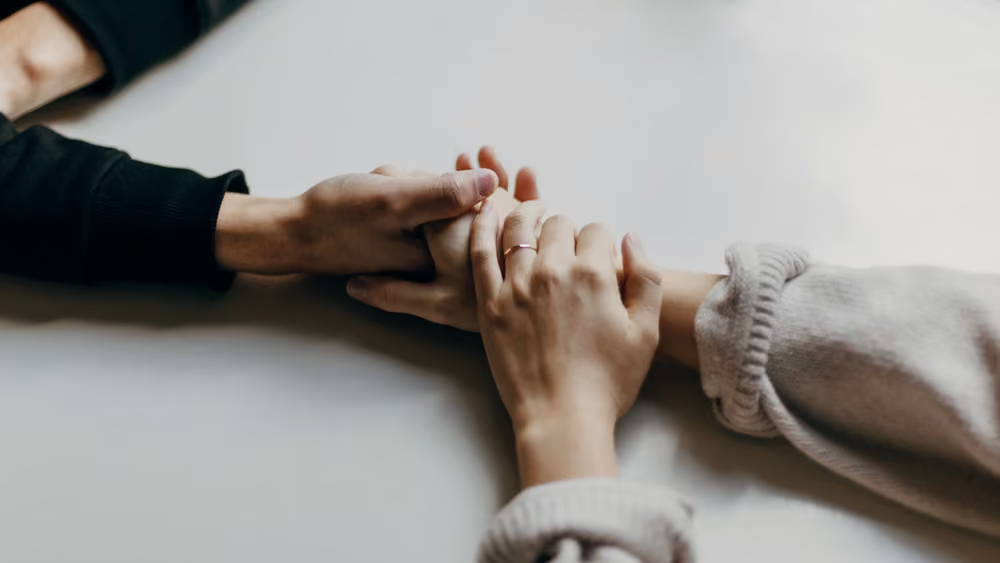
The door opens, and an elderly woman with white hair steps out. It is Emma's mother, Sun. Emma's voice fails her. She collapses into tears. Sun startles at the sound, turns toward Emma, and, in an instant, knows. It is her daughter.
"Euna!" her mother cries. The name no one had spoken aloud for thirty years. "Mom!" Emma answers, and they fall into each other’s arms.
Words fail them. They weep, touching each other's faces and hands as if to make sure the other is real. Emma feels with her palms the smaller body her mother now has, the sharp ridges of her shoulder blades, and cries harder.
"Look how you've grown," her mother manages through tears, cupping Emma's face in both hands. "You've become... a woman."
Emma pulls her closer. "Mom, I'm sorry. I left you alone." Her mother draws her in tighter, and murmurs into her hair: "You are here. You are alive. That is enough. I have missed you."
Sun had prayed to God every day for her daughter's new life, even without fully knowing religion itself.
For the first time since leaving, Emma cries in her mother's arms like a child.
And so for the next several hours, mother and daughter spend their time filling in thirty years of unshared life: how Emma met her husband Sam, how she spent each birthday without family, what it was like to settle into South Korean society.
After a while, Sun asks a kind of question Emma had not expected; a question filled with curiosity, hope, and all the images of South Korea she had imagined from afar.
“Is South Korea really like a K-drama?” Sun asks, her eyes sparkling.
"Yes, it often feels like it" Emma replies with quiet confidence. "I was able to study freely, for the life I wanted."
Sun shakes her head slowly, in something between disbelief and wonder. "To think, if you had stayed in North Korea, none of it would have been imaginable. Graduate school. A life like that. I suppose it really is a drama kind of place."
And yet not everything had felt like a drama. Settlement in South Korea had meant starting from zero: a political system unlike anything she knew, a language full of foreign words that made her feel dizzy just listening to it. She survived by studying fiercely and endured countless hours alone. It was the kind of loneliness that stayed at the back of the throat, the kind you feel when you fall ill and have no one to call, or when you achieve something and have no one to tell.
Emma takes her mother's hand. "Mom, everything will feel enormous and new at first. There will be moments when not knowing even small things makes you feel small too. But I will be there. So don't worry. We'll start this new life together."
As the words leave her mouth, she feels quietly grateful that she had gone through all of it first, knowing the path her mother is about to walk. And she finds herself already picturing it: the two of them sitting across from each other at her favorite pork belly restaurant Dwehyaji (돼야지), near Korea University, sharing a bottle of soju, talking until the night runs out. She smiles to herself at the thought.
The faces of the mentors and friends who had taught her culture and society drift through her mind, one by one, and she carries her gratitude for them again, as the sun goes down over Hyesan.
Emma falls asleep in the very spot where she slept as a child. It still feels like a dream. She closes her eyes, hoping she will not wake if it is.
Author’s note: I dedicate this piece to my father in South Korea, who has never once wavered in encouraging my studies, as if realizing through me the freedom to pursue the dreams that were taken from him. And to my mother, who remains in North Korea: This piece is my proof that your daughter has not turned away from your suffering, but is working, in her own small way, to fight against it. I hope to see you, even if only in my dreams tonight. I love and miss you beyond words.
–
Eunsook is a participant of the LiNK English Language Program (LELP), which serves to not only help North Korean defectors build confidence and skills in English, but develop their capacity as advocates for this issue. To that end, we partnered with select LELP “columnists” to write and polish personal essays through multiple rounds of external feedback and revision. Our goal is to have more North Koreans share their stories directly and lead efforts to change the narrative.
We believe the North Korean people can achieve their liberty in our lifetime.
Opportunities like LELP invest in the people building that future now. Help more North Koreans find their voice, reach their goals, and lead change on this issue.
Give Today
I Watched K-Dramas Inside North Korea. They Gave Me the Courage to Escape | Hannah’s Story
How many times have you checked your phone today? Fifty? A hundred? Every time we look at the screen we are connected to the world around us and an endless stream of information—news, research, entertainment.
Now imagine waking up tomorrow in a place without the internet. A place where people are executed for sharing foreign media, and where families risk their lives just to stay in touch across borders.
For 26 million people in North Korea, this is their reality. And 7 years ago, I was one of them.
I was born in Hoeryong, a city in the northernmost part of North Korea near the Tumen River. Winters were brutal and there were frequent shortages of fuel and electricity.
My father was a high school physics teacher. He was quiet, loyal and diligent. His days started at 7am in the classroom and went late into the night, even on weekends. But despite his dedication, the monthly rations he received were not enough for our family.
So in order to survive, my mother began selling goods at the market. She wanted a better life for us, and that led her to do the unthinkable—escape North Korea. Three times she tried. Three times she was caught. Each time she was imprisoned and sent to a labor camp.
The prison camp was a living hell. My mother saw women waste away from hunger and die from simple illnesses. She was one of the lucky ones; her family brought her food and medicine, an act that made her a witness to the suffering of others.
I was just 13 when I first visited her, carrying a bowl of rice. In North Korea, it falls to families to provide for their imprisoned relatives.
Seeing my mother stand there like a criminal, her head bowed before the guard, I knew this wasn't right. I should have been in school, but instead, I was sneaking food to her, hiding from the stares of strangers.
We were being punished, but I didn't understand why. I felt wronged, and in my anger, I blamed her.
My mother had made a choice to save her family, but North Korean society saw her as a criminal. My father, who had led a quiet life as a teacher, was denied opportunities at work. Our family was labeled as traitors.
In 2013, on her fourth attempt, my mother finally escaped and made it to South Korea. She worked tirelessly to send money back to North Korea to help our family. She also slowly opened a window into another world.
Using a smuggled Chinese cell phone I was able to speak to my mother from time to time. And on our secret calls she shared with me new South Korean expressions and words she was learning. As she settled into a new society, despite numerous differences, she also recognized similarities between North and South Korea and its people, and reminded me that despite decades of division, we are still one people.
I secretly began watching South Korean sitcoms. I’ll never forget one called “High Kick 3.” In one episode, there was a story about a man who fell into debt and was being chased by collectors. But what shocked me was that his family wasn’t punished for it. In North Korea, if one person “sins” the entire family is condemned. But this showed me that in South Korea, life could be different. That even within a family, you were free to make your own choices.
This realization changed me and offered a glimpse of the vast world beyond North Korea. Information, even in the form of a sitcom, was hope. And it was worth risking everything for.
Meanwhile, I continued to face obstacles in my day to day life. I had learned how to code and use software like photoshop, and I dreamed of going to university after graduation. But because my mother had defected, I was rejected. So I used my computer skills to find work as a photographer and photo editor.
Hoping to advance my career, I volunteered for the "shock brigade," a group sent to do manual labor at dangerous construction sites. While others prayed they wouldn't get picked for this kind of work, I went willingly, thinking it could be my way to a promotion.
I was sent to the Samjiyon district, a place known for its harsh winters. For over a month, I demolished buildings in minus 40-degree weather without protective gear. Dust filled my lungs, and sweat froze my clothes solid. My only relief was being able to sleep in a crumbling basement.
When I returned, expecting the promotion I had been promised, my supervisor simply said, "Let's wait a little longer."
That was the moment I understood my mother. She had risked her life to escape because she was after something more fundamental than a better life. She wanted to live like a human being.
In 2019, I made the same choice and escaped. With the help of Liberty in North Korea, I made it safely to South Korea and reunited with my mom.
Freedom wasn’t as easy as I thought it would be. In North Korea, my tech and computer skills had helped me survive. I had always thought that “no matter where I go, as long as I have a computer, I’ll be fine.” But in South Korea, I struggled with something as simple as a new keyboard layout. In school, subjects like social studies felt foreign because I had grown up in a completely different education system with distorted versions of history and philosophy. My dream of going to college suddenly felt impossible.
Eventually I found my place in science. The formulas and equations in math, chemistry, and physics were the constant, unchanging truths I could always count on.
I decided to major in electrical engineering. It was rare for North Korean defectors to pursue this field. But I was determined to stay ahead and not fall behind in our rapidly changing world. Now my goal is to become an engineer who can help bridge North and South Korea’s science and technology industries when the two countries are one again.
More than ever, I see that information isn’t just about knowledge and convenience—it’s a lifeline. Without access to information, you can’t see a way forward, let alone build a future.
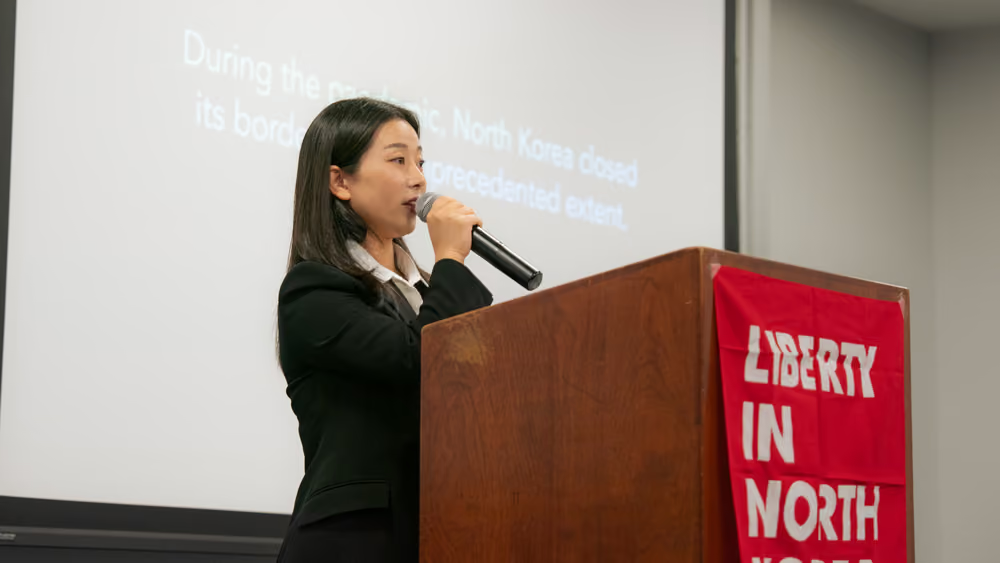
And right now, the people I left behind are more cut off than ever before. During the pandemic, North Korea closed its borders to an unprecedented extent. Soldiers along the border had shoot-to-kill orders for anyone trying to escape. Around 90% of the markets were forced to shut down, leaving families with barely enough to eat. The UN reported that nearly half the population—12 million people—faced food insecurity, while the World Health Organization rated North Korea’s access to medical care as the lowest in the world.
A few years ago, when my father became very sick, I was able to send him money for medicine and hospital care. But most North Koreans don’t have that chance. Without someone on the outside, they are not only cut off from resources and information, but from hope itself. For many, their future depends on a lifeline from the outside world.
Supporting North Korean people and protecting human rights cannot be put off.
We have an opportunity to be a lifeline for people inside North Korea today. To remind them that they have not been forgotten. With your support, we can rescue and support more North Korean refugees, and get more outside information and technology to people inside the country. And that information can empower North Koreans to not only see a way forward, but to ultimately determine their own future.
Despite the risks, North Koreans are quietly accessing foreign media and learning about life in the outside world. Increasing their access to uncensored information is one of the most effective ways to increase change inside the country.
Liberty in North Korea partners with North Korean defectors and engineers, like Hannah, to develop technology, content, and tools tailor-made for the North Korea context. Our goal is to empower North Koreans with information about the outside world, increasing their aspirations for social and economic progress, and building pressure for change and opening.