The Bridge: The Role of North Korean Defectors in a Unified Korea in 2045
By: Eunsook Jang
Eunsook Jang holds a bachelor’s degree in Political Science from Korea University and a master’s degree in International Development from Brandeis University. A Fulbright Scholar and LiNK US Scholarship grantee, she is currently a research intern at the Hudson Institute, where her work focuses on post-conflict recovery, economic development, and human development. Her recent publications include “Slipping through the Cracks in South Korea: The Uncertain Futures for the Children of North Korean Defectors” with the Migration Policy Institute, and “Why Strengthening RFA Is a Strategic Imperative for US Policy on North Korea” in The Diplomat.
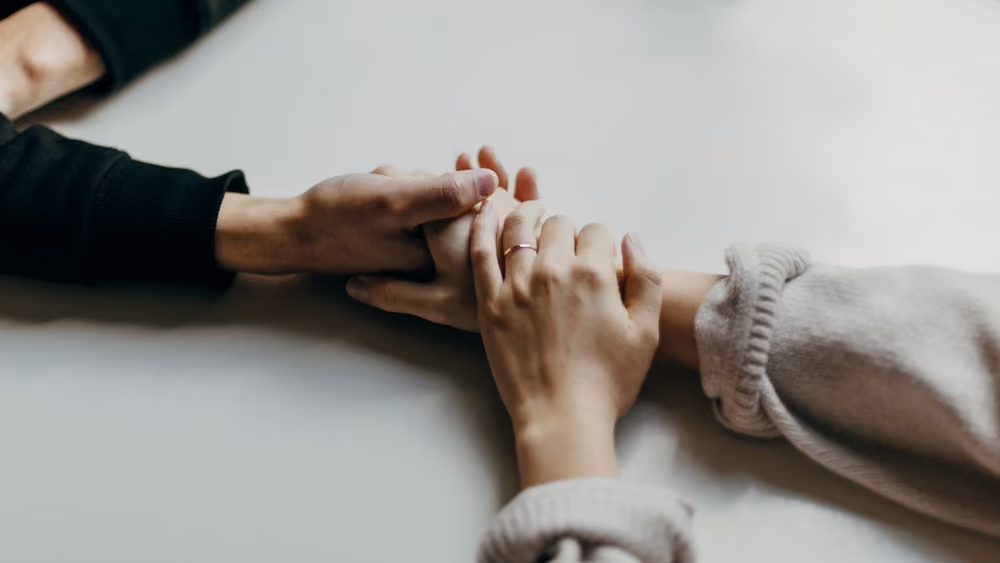
The door opens, and an elderly woman with white hair steps out. It is Emma's mother, Sun. Emma's voice fails her. She collapses into tears. Sun startles at the sound, turns toward Emma, and, in an instant, knows. It is her daughter.
"Euna!" her mother cries. The name no one had spoken aloud for thirty years. "Mom!" Emma answers, and they fall into each other’s arms.
Words fail them. They weep, touching each other's faces and hands as if to make sure the other is real. Emma feels with her palms the smaller body her mother now has, the sharp ridges of her shoulder blades, and cries harder.
"Look how you've grown," her mother manages through tears, cupping Emma's face in both hands. "You've become... a woman."
Emma pulls her closer. "Mom, I'm sorry. I left you alone." Her mother draws her in tighter, and murmurs into her hair: "You are here. You are alive. That is enough. I have missed you."
Sun had prayed to God every day for her daughter's new life, even without fully knowing religion itself.
For the first time since leaving, Emma cries in her mother's arms like a child.
And so for the next several hours, mother and daughter spend their time filling in thirty years of unshared life: how Emma met her husband Sam, how she spent each birthday without family, what it was like to settle into South Korean society.
After a while, Sun asks a kind of question Emma had not expected; a question filled with curiosity, hope, and all the images of South Korea she had imagined from afar.
“Is South Korea really like a K-drama?” Sun asks, her eyes sparkling.
"Yes, it often feels like it" Emma replies with quiet confidence. "I was able to study freely, for the life I wanted."
Sun shakes her head slowly, in something between disbelief and wonder. "To think, if you had stayed in North Korea, none of it would have been imaginable. Graduate school. A life like that. I suppose it really is a drama kind of place."
And yet not everything had felt like a drama. Settlement in South Korea had meant starting from zero: a political system unlike anything she knew, a language full of foreign words that made her feel dizzy just listening to it. She survived by studying fiercely and endured countless hours alone. It was the kind of loneliness that stayed at the back of the throat, the kind you feel when you fall ill and have no one to call, or when you achieve something and have no one to tell.
Emma takes her mother's hand. "Mom, everything will feel enormous and new at first. There will be moments when not knowing even small things makes you feel small too. But I will be there. So don't worry. We'll start this new life together."
As the words leave her mouth, she feels quietly grateful that she had gone through all of it first, knowing the path her mother is about to walk. And she finds herself already picturing it: the two of them sitting across from each other at her favorite pork belly restaurant Dwehyaji (돼야지), near Korea University, sharing a bottle of soju, talking until the night runs out. She smiles to herself at the thought.
The faces of the mentors and friends who had taught her culture and society drift through her mind, one by one, and she carries her gratitude for them again, as the sun goes down over Hyesan.
Emma falls asleep in the very spot where she slept as a child. It still feels like a dream. She closes her eyes, hoping she will not wake if it is.
Author’s note: I dedicate this piece to my father in South Korea, who has never once wavered in encouraging my studies, as if realizing through me the freedom to pursue the dreams that were taken from him. And to my mother, who remains in North Korea: This piece is my proof that your daughter has not turned away from your suffering, but is working, in her own small way, to fight against it. I hope to see you, even if only in my dreams tonight. I love and miss you beyond words.
–
Eunsook is a participant of the LiNK English Language Program (LELP), which serves to not only help North Korean defectors build confidence and skills in English, but develop their capacity as advocates for this issue. To that end, we partnered with select LELP “columnists” to write and polish personal essays through multiple rounds of external feedback and revision. Our goal is to have more North Koreans share their stories directly and lead efforts to change the narrative.
We believe the North Korean people can achieve their liberty in our lifetime.
Opportunities like LELP invest in the people building that future now. Help more North Koreans find their voice, reach their goals, and lead change on this issue.
Give Today
North Korean Fellows in the United States: Meet the Class of 2025
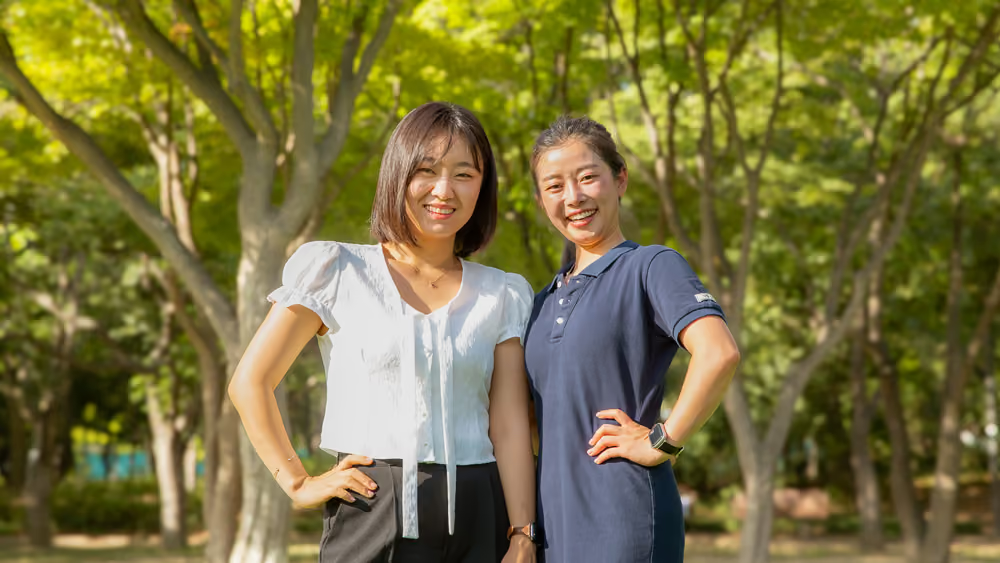
Please join us in welcoming Hannah and Rose, LiNK’s 2025 Advocacy Fellows!
The Advocacy Fellows program partners with young North Korean defectors to build their skills as effective leaders, storytellers, and agents of change for this issue. Hannah and Rose spent the last month training and preparing with our team in South Korea, and will now be traveling across the US to share their stories!
Join us at a Fellows speaking event near you!
Dallas, TX
September 9th, 6pm
Southern Methodist University | Dallas Hall Room 306 (McCord Auditorium)
3225 University Blvd, Dallas TX 75205
RSVP Here
Guest parking information here
Waco, TX
September 11th, 6pm
Baylor University, Foster Campus | Room 240
1621 S 3rd St, Waco, TX 76706
RSVP Here
Parking: 1521 S Fourth St. Waco,TX 76706 (Google maps or Apple Maps)
Madison, WI
September 16th, 12pm
UW-Madison | Lubar Commons (Room 7200)
975 Bascom Mall, Madison, WI 53706
RSVP here
Evanston, IL
September 20th, 5pm
Northwestern University | Harris Hall 107
1881 Sheridan Rd, Evanston, IL 60201
RSVP Here
Palo Alto, CA
September 28th, 1:20pm
True North Church
655 Arastradero Road, Palo Alto, CA 94306
RSVP Here
Berkeley, CA
September 29th, 6pm
UC Berkeley | Stephens Lounge at the MLK Student Union
2495 Bancroft Way, Berkeley, CA 94720
Parking: Lower Sproul Garage
RSVP Here
Washington, D.C.
October 8th, 1pm ET
The Stimson Center
1211 Connecticut Avenue Northwest Washington, DC 20036
RSVP Here
*Online livestream also available: RSVP Here
Washington, D.C
October 9th, 10:30am
ET Hudson Institute
1201 Pennsylvania Ave N.W. Suite 400 Washington, DC 20004
RSVP Here
Philadelphia, PA
October 13th, 5:30pm
University of Pennsylvania
3401 Walnut Street, Philadelphia, PA 19104
RSVP Here
New York, NY
October 16th, 2025, 12 PM
The Korea Society
350 Madison Avenue, 24th Floor
New York, NY 10017
RSVP here
Los Angeles, CA
October 21st, 7:30pm
UCLA
Haines Hall Room A2 Portola Plaza, Los Angeles, CA 90095
Parking available in UCLA Parking Structure 2
RSVP here
Additional details and timely updates will be sent to RSVP’ed guests via email.
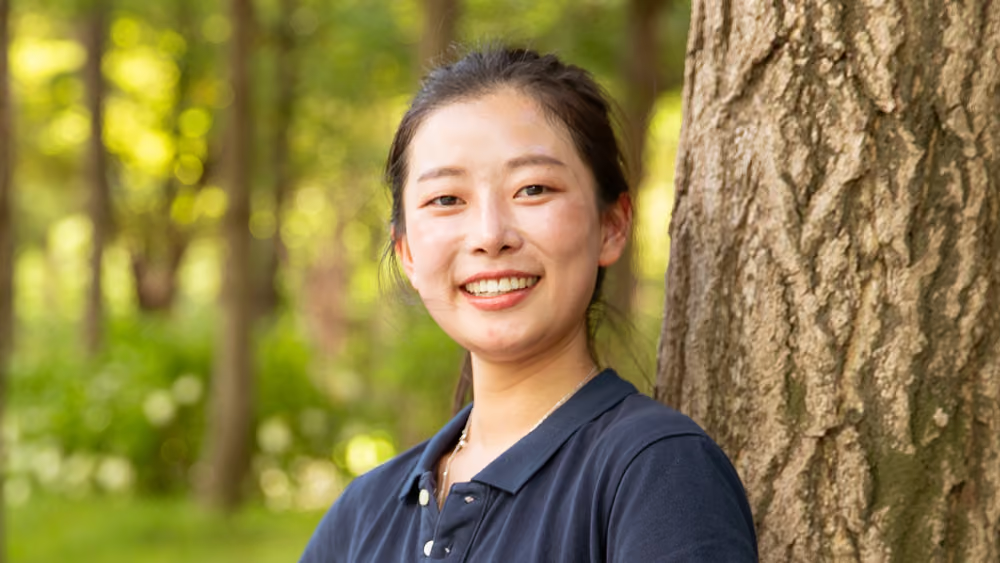
Hannah is a 4th year student at Hongik University studying Electrical and Electronic Engineering. While participating in LiNK’s Changemaker Scholarship Program, she worked on developing devices and strategies that increase information access for people inside North Korea. Her goal as an Advocacy Fellow is to grow as a leader and communicator, and facilitate more collaborative work on this issue.
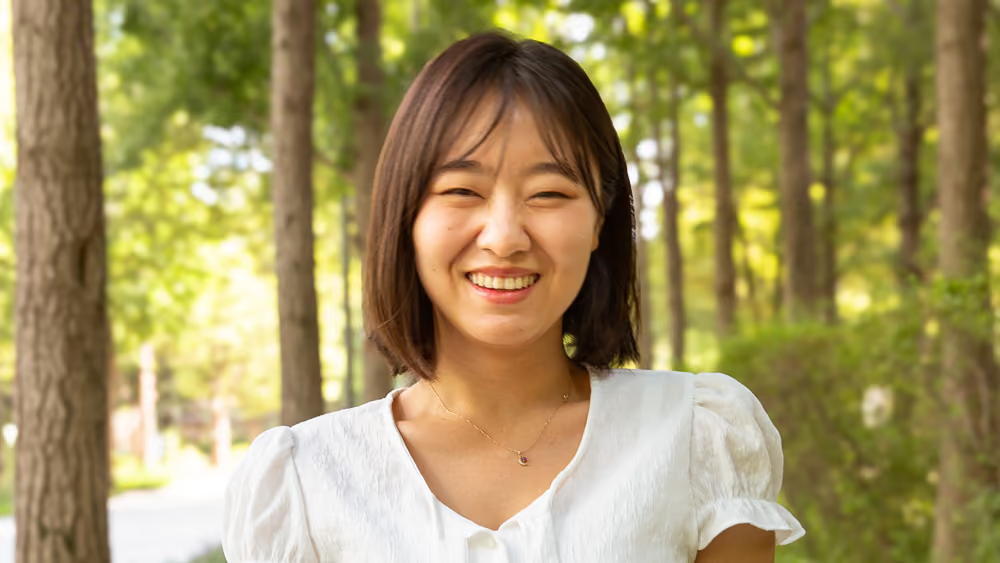
Rose graduated from Hongik University’s Department of Architecture. For her final project, she designed a memorial to honor North Korean human rights and provide comfort to defectors who had to leave their homeland. She drew inspiration from the Holocaust and 9/11 Memorials in the US, and was deeply moved by how such spaces contribute to healing and progress. As an Advocacy Fellow, Rose hopes to continue finding her identity and increase interest in this issue.