The Bridge: The Role of North Korean Defectors in a Unified Korea in 2045
By: Eunsook Jang
Eunsook Jang holds a bachelor’s degree in Political Science from Korea University and a master’s degree in International Development from Brandeis University. A Fulbright Scholar and LiNK US Scholarship grantee, she is currently a research intern at the Hudson Institute, where her work focuses on post-conflict recovery, economic development, and human development. Her recent publications include “Slipping through the Cracks in South Korea: The Uncertain Futures for the Children of North Korean Defectors” with the Migration Policy Institute, and “Why Strengthening RFA Is a Strategic Imperative for US Policy on North Korea” in The Diplomat.
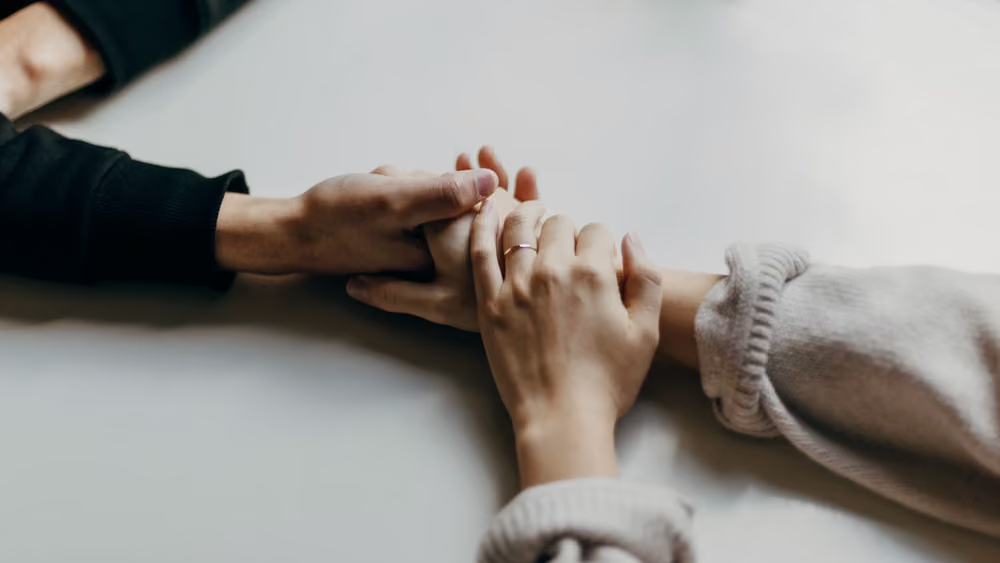
The door opens, and an elderly woman with white hair steps out. It is Emma's mother, Sun. Emma's voice fails her. She collapses into tears. Sun startles at the sound, turns toward Emma, and, in an instant, knows. It is her daughter.
"Euna!" her mother cries. The name no one had spoken aloud for thirty years. "Mom!" Emma answers, and they fall into each other’s arms.
Words fail them. They weep, touching each other's faces and hands as if to make sure the other is real. Emma feels with her palms the smaller body her mother now has, the sharp ridges of her shoulder blades, and cries harder.
"Look how you've grown," her mother manages through tears, cupping Emma's face in both hands. "You've become... a woman."
Emma pulls her closer. "Mom, I'm sorry. I left you alone." Her mother draws her in tighter, and murmurs into her hair: "You are here. You are alive. That is enough. I have missed you."
Sun had prayed to God every day for her daughter's new life, even without fully knowing religion itself.
For the first time since leaving, Emma cries in her mother's arms like a child.
And so for the next several hours, mother and daughter spend their time filling in thirty years of unshared life: how Emma met her husband Sam, how she spent each birthday without family, what it was like to settle into South Korean society.
After a while, Sun asks a kind of question Emma had not expected; a question filled with curiosity, hope, and all the images of South Korea she had imagined from afar.
“Is South Korea really like a K-drama?” Sun asks, her eyes sparkling.
"Yes, it often feels like it" Emma replies with quiet confidence. "I was able to study freely, for the life I wanted."
Sun shakes her head slowly, in something between disbelief and wonder. "To think, if you had stayed in North Korea, none of it would have been imaginable. Graduate school. A life like that. I suppose it really is a drama kind of place."
And yet not everything had felt like a drama. Settlement in South Korea had meant starting from zero: a political system unlike anything she knew, a language full of foreign words that made her feel dizzy just listening to it. She survived by studying fiercely and endured countless hours alone. It was the kind of loneliness that stayed at the back of the throat, the kind you feel when you fall ill and have no one to call, or when you achieve something and have no one to tell.
Emma takes her mother's hand. "Mom, everything will feel enormous and new at first. There will be moments when not knowing even small things makes you feel small too. But I will be there. So don't worry. We'll start this new life together."
As the words leave her mouth, she feels quietly grateful that she had gone through all of it first, knowing the path her mother is about to walk. And she finds herself already picturing it: the two of them sitting across from each other at her favorite pork belly restaurant Dwehyaji (돼야지), near Korea University, sharing a bottle of soju, talking until the night runs out. She smiles to herself at the thought.
The faces of the mentors and friends who had taught her culture and society drift through her mind, one by one, and she carries her gratitude for them again, as the sun goes down over Hyesan.
Emma falls asleep in the very spot where she slept as a child. It still feels like a dream. She closes her eyes, hoping she will not wake if it is.
Author’s note: I dedicate this piece to my father in South Korea, who has never once wavered in encouraging my studies, as if realizing through me the freedom to pursue the dreams that were taken from him. And to my mother, who remains in North Korea: This piece is my proof that your daughter has not turned away from your suffering, but is working, in her own small way, to fight against it. I hope to see you, even if only in my dreams tonight. I love and miss you beyond words.
–
Eunsook is a participant of the LiNK English Language Program (LELP), which serves to not only help North Korean defectors build confidence and skills in English, but develop their capacity as advocates for this issue. To that end, we partnered with select LELP “columnists” to write and polish personal essays through multiple rounds of external feedback and revision. Our goal is to have more North Koreans share their stories directly and lead efforts to change the narrative.
We believe the North Korean people can achieve their liberty in our lifetime.
Opportunities like LELP invest in the people building that future now. Help more North Koreans find their voice, reach their goals, and lead change on this issue.
Give Today
Women’s History Month | Korean Freedom Fighter Yu Gwan-sun
March 1st marks the beginning of Women’s History Month, an opportunity to celebrate the contributions women have made to culture and society through the ages.
For Koreans, it’s also the anniversary of the March 1st Movement, or Sam-il (3-1) Undong. On this day in 1919, Koreans across the peninsula took a stand against Japanese colonial occupation. As peaceful protesters called for independence, an unlikely leader and activist emerged in 16 year old Yu Gwan-sun. As we honor her bravery as a symbol of Korea’s collective fight for freedom, we’re reminded of the North Korean women who are still fighting for free and full lives today.

The Korean Independence Movement
The Sam-il movement began with a declaration of independence issued by thirty-three Korean cultural and religious leaders - many of whom were young adults. In the face of great risk, they laid out a Korean vision of equality, internationalism, human happiness and world peace that is still relevant today. These daring words galvanized the nation, and peaceful protests erupted across the country over the coming weeks, with peasants, tradespeople, housewives, and scholars marching alongside one another. An estimated 2 million Koreans participated in these first public displays of resistance, fostering a sense of national unity; an awareness that each individual was not alone in their desire for freedom.
Ordinary Korean women played a crucial role in the grassroots movement. While traditional Confucian culture and Japanese education policy relegated women to the domestic sphere, they emerged as leaders in the demonstrations following March 1st. Along with freedom for their country, they sought social awakening and an improvement in the status of women.

Canadian journalist Frederick Arthur Mckenzie, who was working as a correspondent in Korea at the time, witnessed the historic culture shift. In his book, Korea’s Fight for Freedom, he recalls how “Female students were most active in Seoul. For instance, most of the people arrested in the morning of the 5th of March were girl students.”
Freedom Fighter Yu Gwan-sun
Yu Gwan-sun was one such student, a brilliant 16-year-old girl who attended Ewha Hakdang. There, she witnessed the beginnings of the Sam-il Movement and took part in the initial protests in Seoul. Yu and her classmates were detained by Japanese authorities, but missionaries from their school were able to negotiate their release.

Following March 1st, schools were shut down in an attempt to stop students and activists from coordinating further protests. Yu returned to her hometown of Cheonan, but her conviction for a free Korea did not waver. She smuggled a copy of the declaration of independence and went from village to village, spreading word about the Sam-il Movement. On March 31st, Yu climbed to the top of Mount Maebong and lit a beacon fire, signaling to protestors that the time had come to make their stand.
The next day, 3,000 people gathered at Aunae marketplace in Cheonan shouting “Mansei!” and “Long live Korean independence!” Yu distributed homemade taegukgi, or Korean national flags, while rallying the villagers. When Japanese military police arrived to shut down the protest, they fired into the crowd and killed 19 people, including Yu’s parents.

The Sam-il Movement was eventually suppressed by Japanese authorities in mid-April. According to The Bloody History of the Korean Independence Movement by Park Eun-sik, there were an estimated 7,500 deaths, 16,000 injuries, and 46,000 arrests.
Yu Gwan-sun was arrested and convicted of sedition. She was sent to Seodaemun Prison but even then, she did not give up the fight for freedom. While incarcerated, she famously wrote:
“Even if my fingernails are torn out, my nose and ears are ripped apart, and my legs and arms are crushed, this physical pain does not compare to the pain of losing my nation. My only remorse is not being able to do more than dedicating my life to my country.”
On the one year anniversary of the Sam-il Movement, Yu organized a large-scale protest with her fellow inmates. They were brutally beaten and tortured for their defiance, and she was
transferred to an isolated underground cell. On September 28th, 1920, at the age of 17, Yu died from the injuries she suffered.

Yu never experienced a free Korea, yet she audaciously fought to see a different future in her lifetime. Twenty-five years after her passing, in August of 1945, Korea finally gained its independence from colonialism, but at the same time was split into North and South Korea. Today, Yu is remembered as Korea’s “Joan of Arc,” and the Sam-il Movement is celebrated annually as a national holiday in South Korea.
North Korea’s Fight For Freedom
As we honor the bravery of Yu Gwan-sun and other women in history, we’re also reminded of the millions of North Koreans still fighting for free and full lives. They’re engaging in everyday acts of resistance and transforming their country from the ground-up.
In North Korea, women are also the ones driving crucial engines of change. Grassroots market activity at the Jangmadang is primarily driven by women, shifting economic power away from the regime and into the hands of the people. Women are smuggling goods across the border, testing the limits of self-expression through fashion and beauty, and becoming breadwinners for their families. From outside of the country, resettled North Korean women are accelerating change as activists and entrepreneurs, sending money and information back home.
While North Korean women still face many obstacles and human rights abuses, they’re challenging the status quo and striving towards freedom.

Liberty in North Korea
LiNK is helping North Korean refugees to reach freedom, begin new lives, and become agents of change on this issue. We’re so excited and grateful to announce that 8 North Korean women have recently reached freedom through LiNK’s rescue routes!
During the three years of heightened surveillance and lockdowns in China, our field team has worked tirelessly to establish new routes and expand our network. We’re excited to finally gain momentum in this area of our rescue work!

Like Yu Gwan-sun, these North Korean women never gave up in their pursuit of freedom. Many of them had crossed the North Korean border into China years ago, but were unable to complete the journey during the pandemic. Now they’ll be able to take full authorship of their lives.
“I tried multiple times to escape China but ended up getting caught and spending time in a Chinese prison. When I left home this time, I knew it would be my last attempt to reach freedom. If I failed, I had planned to drink pesticide and kill myself - if I were caught it would do so much harm to my family in China and even in North Korea. This time with the help of LiNK, I successfully made it to safety. I threw away the pesticide after the journey. I risked my life to come here, and I will live in freedom to the fullest.”
- Yi Hyun, reached freedom through LiNK’s networks in 2023
Thank you for making this possible with your steadfast support, especially through a tumultuous past few years. North Koreans have not given up, and they will not until they achieve their freedom. We can stand with them as they change history.
Fundraise or donate to help rescue more North Korean refugees today!