The Bridge: The Role of North Korean Defectors in a Unified Korea in 2045
By: Eunsook Jang
Eunsook Jang holds a bachelor’s degree in Political Science from Korea University and a master’s degree in International Development from Brandeis University. A Fulbright Scholar and LiNK US Scholarship grantee, she is currently a research intern at the Hudson Institute, where her work focuses on post-conflict recovery, economic development, and human development. Her recent publications include “Slipping through the Cracks in South Korea: The Uncertain Futures for the Children of North Korean Defectors” with the Migration Policy Institute, and “Why Strengthening RFA Is a Strategic Imperative for US Policy on North Korea” in The Diplomat.
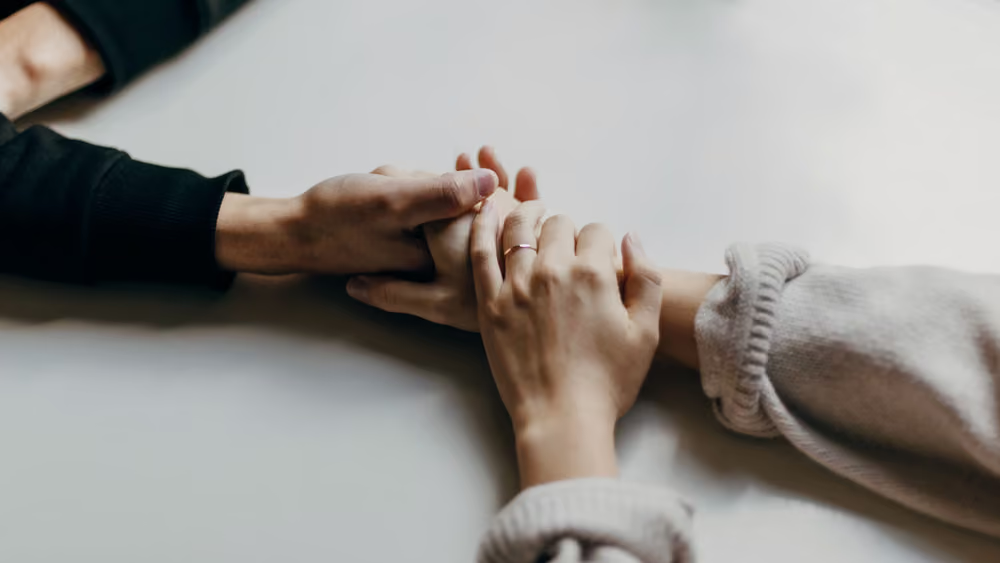
The door opens, and an elderly woman with white hair steps out. It is Emma's mother, Sun. Emma's voice fails her. She collapses into tears. Sun startles at the sound, turns toward Emma, and, in an instant, knows. It is her daughter.
"Euna!" her mother cries. The name no one had spoken aloud for thirty years. "Mom!" Emma answers, and they fall into each other’s arms.
Words fail them. They weep, touching each other's faces and hands as if to make sure the other is real. Emma feels with her palms the smaller body her mother now has, the sharp ridges of her shoulder blades, and cries harder.
"Look how you've grown," her mother manages through tears, cupping Emma's face in both hands. "You've become... a woman."
Emma pulls her closer. "Mom, I'm sorry. I left you alone." Her mother draws her in tighter, and murmurs into her hair: "You are here. You are alive. That is enough. I have missed you."
Sun had prayed to God every day for her daughter's new life, even without fully knowing religion itself.
For the first time since leaving, Emma cries in her mother's arms like a child.
And so for the next several hours, mother and daughter spend their time filling in thirty years of unshared life: how Emma met her husband Sam, how she spent each birthday without family, what it was like to settle into South Korean society.
After a while, Sun asks a kind of question Emma had not expected; a question filled with curiosity, hope, and all the images of South Korea she had imagined from afar.
“Is South Korea really like a K-drama?” Sun asks, her eyes sparkling.
"Yes, it often feels like it" Emma replies with quiet confidence. "I was able to study freely, for the life I wanted."
Sun shakes her head slowly, in something between disbelief and wonder. "To think, if you had stayed in North Korea, none of it would have been imaginable. Graduate school. A life like that. I suppose it really is a drama kind of place."
And yet not everything had felt like a drama. Settlement in South Korea had meant starting from zero: a political system unlike anything she knew, a language full of foreign words that made her feel dizzy just listening to it. She survived by studying fiercely and endured countless hours alone. It was the kind of loneliness that stayed at the back of the throat, the kind you feel when you fall ill and have no one to call, or when you achieve something and have no one to tell.
Emma takes her mother's hand. "Mom, everything will feel enormous and new at first. There will be moments when not knowing even small things makes you feel small too. But I will be there. So don't worry. We'll start this new life together."
As the words leave her mouth, she feels quietly grateful that she had gone through all of it first, knowing the path her mother is about to walk. And she finds herself already picturing it: the two of them sitting across from each other at her favorite pork belly restaurant Dwehyaji (돼야지), near Korea University, sharing a bottle of soju, talking until the night runs out. She smiles to herself at the thought.
The faces of the mentors and friends who had taught her culture and society drift through her mind, one by one, and she carries her gratitude for them again, as the sun goes down over Hyesan.
Emma falls asleep in the very spot where she slept as a child. It still feels like a dream. She closes her eyes, hoping she will not wake if it is.
Author’s note: I dedicate this piece to my father in South Korea, who has never once wavered in encouraging my studies, as if realizing through me the freedom to pursue the dreams that were taken from him. And to my mother, who remains in North Korea: This piece is my proof that your daughter has not turned away from your suffering, but is working, in her own small way, to fight against it. I hope to see you, even if only in my dreams tonight. I love and miss you beyond words.
–
Eunsook is a participant of the LiNK English Language Program (LELP), which serves to not only help North Korean defectors build confidence and skills in English, but develop their capacity as advocates for this issue. To that end, we partnered with select LELP “columnists” to write and polish personal essays through multiple rounds of external feedback and revision. Our goal is to have more North Koreans share their stories directly and lead efforts to change the narrative.
We believe the North Korean people can achieve their liberty in our lifetime.
Opportunities like LELP invest in the people building that future now. Help more North Koreans find their voice, reach their goals, and lead change on this issue.
Give Today
Film Review: Under the Sun

Spoiler alert: The North Korean government suffers from a severe transparency deficit.
How do you reveal the reality of a society where government representatives script each scene you're allowed to shoot?
Simple: leave cameras rolling at all times, and show your audience the scripting and retakes of "real life" in all their glory.
You end up not with a documentary about a family going about their lives, but a behind-the-scenes reveal of a family whose dinner-table conversations, workplace interactions, and even expressed emotions are curated by government propagandists for external consumption.
No North Koreans question this process out loud--except to check their lines.In this system everyone knows the role expected of them, especially with government officials overseeing everything. So before our very eyes, we observe the theatrical production of an ideal 'Kimilsungist socialist society', played out by real citizen-actors. And when citizens know the risks of not playing the part they’re asked to play, they become good actors.
This is of course a very real aspect of life in North Korea, even when no cameras are rolling. The everyday ritualised theatrical production of 'obedient citizens willingly striving as one for the socialist cause' is one of the key means by which the state perpetuates itself. Everyone knows what to say, how to say it, and that you have to say it. Whatever your innermost thoughts may be, it's hard to break role publicly when everyone else is sticking so closely to a ‘script’.
Revealing the nature of this production, warts-and-all, is one of the key contributions of Under the Sun.But as with any behind-the-scenes look, cracks in the facade, tired actors and cock-ups are apparent.'Off stage', strategically placed cameras record poor Pyongyang kids scavenging from a trash can. We see commuters disembarking to push a tram. A government 'set manager' shoos away two women approaching the back door of a milk processing plant with a big jug; we can only guess they were looking for an off-the-books top up, unaware there were foreign filmmakers present that day.
We see a forgetful factory worker reporting they have exceeded production targets by 150%, and in the next take 200%. It doesn't matter to any of her coworkers which fiction is used, and no one bats an eyelid.
And of course, children being less practiced in their roles within the system than adults, the best scenes feature North Korean kids. A small girl struggles to keep her eyes open while an aging war veteran wearing far too many medals bumbles through an anti-American propaganda lecture, punctuating tales of shooting down planes with praise for Kim Il-sung.
Jinmi, the star of the film, breaks down in tears when the pressure of performance becomes too much. Elsewhere, on-screen text tells us that she unwittingly revealed her parents' true occupations of journalist and restaurant worker before the government co-producers scripted them as the more socialist-appropriate textile factory technician and soy milk plant worker.
It's hard to not recall The Truman Show, and it boggles the mind to think there are 25 million people living out their lives in this theater state.
But unlike a Hollywood Movie, the enemy here is not represented by a snarling on-screen character. The propagandists are unnamed and we rarely even see their faces properly. The enemy is in fact the system itself, whose quiet tyranny forces every citizen - including the propagandists - to become complicit in its perpetuation by allowing the expression of only a singular narrative of what it is to be a North Korean.