The Bridge: The Role of North Korean Defectors in a Unified Korea in 2045
By: Eunsook Jang
Eunsook Jang holds a bachelor’s degree in Political Science from Korea University and a master’s degree in International Development from Brandeis University. A Fulbright Scholar and LiNK US Scholarship grantee, she is currently a research intern at the Hudson Institute, where her work focuses on post-conflict recovery, economic development, and human development. Her recent publications include “Slipping through the Cracks in South Korea: The Uncertain Futures for the Children of North Korean Defectors” with the Migration Policy Institute, and “Why Strengthening RFA Is a Strategic Imperative for US Policy on North Korea” in The Diplomat.
The door opens, and an elderly woman with white hair steps out. It is Emma's mother, Sun. Emma's voice fails her. She collapses into tears. Sun startles at the sound, turns toward Emma, and, in an instant, knows. It is her daughter.
"Euna!" her mother cries. The name no one had spoken aloud for thirty years. "Mom!" Emma answers, and they fall into each other’s arms.
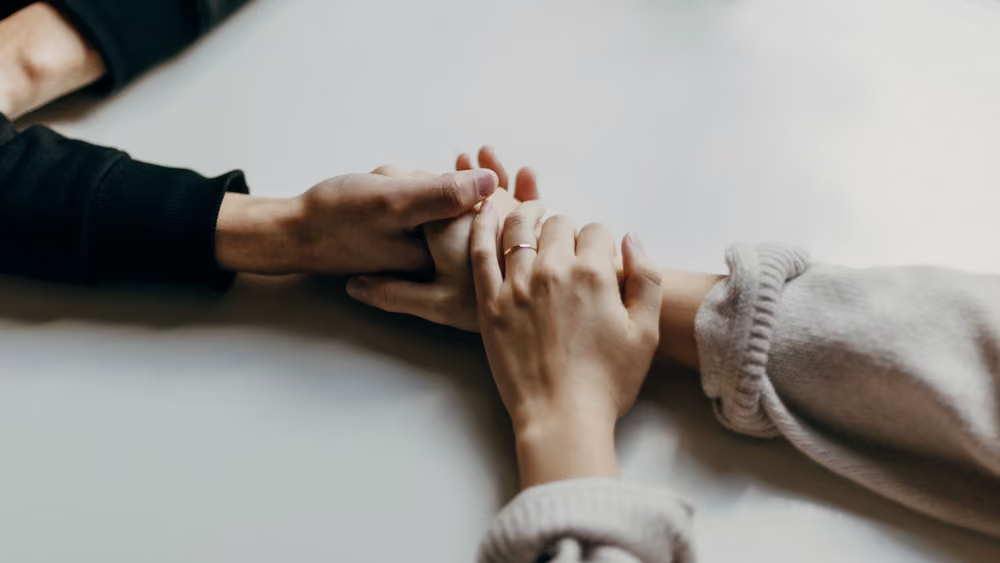
Words fail them. They weep, touching each other's faces and hands as if to make sure the other is real. Emma feels with her palms the smaller body her mother now has, the sharp ridges of her shoulder blades, and cries harder.
"Look how you've grown," her mother manages through tears, cupping Emma's face in both hands. "You've become... a woman."
Emma pulls her closer. "Mom, I'm sorry. I left you alone." Her mother draws her in tighter, and murmurs into her hair: "You are here. You are alive. That is enough. I have missed you."
Sun had prayed to God every day for her daughter's new life, even without fully knowing religion itself.
For the first time since leaving, Emma cries in her mother's arms like a child.
And so for the next several hours, mother and daughter spend their time filling in thirty years of unshared life: how Emma met her husband Sam, how she spent each birthday without family, what it was like to settle into South Korean society.
After a while, Sun asks a kind of question Emma had not expected; a question filled with curiosity, hope, and all the images of South Korea she had imagined from afar.
“Is South Korea really like a K-drama?” Sun asks, her eyes sparkling.
"Yes, it often feels like it" Emma replies with quiet confidence. "I was able to study freely, for the life I wanted."
Sun shakes her head slowly, in something between disbelief and wonder. "To think, if you had stayed in North Korea, none of it would have been imaginable. Graduate school. A life like that. I suppose it really is a drama kind of place."
And yet not everything had felt like a drama. Settlement in South Korea had meant starting from zero: a political system unlike anything she knew, a language full of foreign words that made her feel dizzy just listening to it. She survived by studying fiercely and endured countless hours alone. It was the kind of loneliness that stayed at the back of the throat, the kind you feel when you fall ill and have no one to call, or when you achieve something and have no one to tell.
Emma takes her mother's hand. "Mom, everything will feel enormous and new at first. There will be moments when not knowing even small things makes you feel small too. But I will be there. So don't worry. We'll start this new life together."
As the words leave her mouth, she feels quietly grateful that she had gone through all of it first, knowing the path her mother is about to walk. And she finds herself already picturing it: the two of them sitting across from each other at her favorite pork belly restaurant Dwehyaji (돼야지), near Korea University, sharing a bottle of soju, talking until the night runs out. She smiles to herself at the thought.
The faces of the mentors and friends who had taught her culture and society drift through her mind, one by one, and she carries her gratitude for them again, as the sun goes down over Hyesan.
Emma falls asleep in the very spot where she slept as a child. It still feels like a dream. She closes her eyes, hoping she will not wake if it is.
Author’s note: I dedicate this piece to my father in South Korea, who has never once wavered in encouraging my studies, as if realizing through me the freedom to pursue the dreams that were taken from him. And to my mother, who remains in North Korea: This piece is my proof that your daughter has not turned away from your suffering, but is working, in her own small way, to fight against it. I hope to see you, even if only in my dreams tonight. I love and miss you beyond words.
–
Eunsook is a participant of the LiNK English Language Program (LELP), which serves to not only help North Korean defectors build confidence and skills in English, but develop their capacity as advocates for this issue. To that end, we partnered with select LELP “columnists” to write and polish personal essays through multiple rounds of external feedback and revision. Our goal is to have more North Koreans share their stories directly and lead efforts to change the narrative.
We believe the North Korean people can achieve their liberty in our lifetime.
Opportunities like LELP invest in the people building that future now. Help more North Koreans find their voice, reach their goals, and lead change on this issue.
Give Today
A Realm of Possibilities: Catching Up with Eun Young and Min Gu

Eun Young and her husband Min Gu were unable to support themselves in North Korea through government-approved means, so they found other ways to survive. She worked in an underground market and he traded goods between North Korea and China. This life was difficult, but they continued on in order to provide their child (they asked us not to disclose their child’s gender) with the best future possible. However, they eventually came to realize that their situation would never improve if they stayed in North Korea and resolved to escape in pursuit of a better life.
Today, Eun Young and Min Gu are safely resettled in South Korea and are making lives for themselves in their new society. Our resettlement coordinator, Anna, recently met up with them to talk about their lives in North Korea, what they're doing now, and what their plans are for the future.

Anna: I saw a North Korean restaurant close by your apartment on the way.
Min Gu: The person who owns the restaurant is also from North Korea and she resettled seven years ago, but the food there is not as good as what you can have in North Korea. I asked them to slice and fry tofu thinner because that’s what it is supposed to look and taste like back home.
Eun Young: Those aren’t authentic. It’s not a matter of the thickness, but rather the quality of the tofu, because in North Korea two to three generations of a family will make tofu traditionally and it’s so flavorful and good. But, I still go to the restaurant instead of going to a bigger and nicer restaurant whenever I miss my hometown. They also have corn-noodle soup and stuffed squid, and every bite makes me feel nice and warm. Have you tried any of these foods?
Anna: My friend from North Korea and I once made rice-filled tofu, but I’ve never had corn-noodle soup. It sounds really good!

Min Gu: (Chuckles) It’s not like what you'd expect. People back in North Korea eat it to fill their stomachs. Why would you go to the North Korean restaurant when there are so many better choices? As I said, we go there because it brings back our memories of home.
Anna: Many North Korean people must live around here.
Min Gu: Yes, I’m guessing about 30% of the residents of this apartment complex are North Korean. Many disabled and elderly people who receive housing through the government live in the apartment complex, too.
Anna: By the way, what happened to your leg?
Min Gu: I got hurt at work. I was hospitalized, but I came home for today because you were coming.
Eun Young: Actually, you don’t go to hospital for a sprained ankle in North Korea. You just rest and apply a steamed towel to the ankle. Hospitals here have better technology and service, so he can be treated with the proper procedures.

Anna: When do you remove the bandage?
Min Gu: I now have to wear a cast. It’s terribly boring to spend all my time at the hospital. I’d rather work.
Eun Young: We enjoy working; it’s so rewarding. We both received our first paycheck in November. We sent $2,000 out of $3,000 to our child in North Korea.
Anna: Who is your child staying with?
Eun Young: With an aunt. We recently had a chance to talk to our child on the phone, I recorded the whole conversation and listen to it every single day.

[Recording of the conversation]
Child (age of 9): Mom?
Eun Young: My darling, I miss you, I really do. Mom and dad just sent your aunt $2,000. It’s 100 $20 bills. Okay? If there’s anything you want to eat or have, don’t hesitate to ask your aunt. Ask your aunt to buy you fruits if you want. Don’t cry, Mom and dad will bring you out next year. Please be a little more patient. Also, drink milk. You promise me to drink milk every day, okay?
Child: Mom, don’t worry. Stay healthy.
Eun Young: I’ll be never relieved until we meet. We’ll bring you out. I’ll hand the phone to your dad.
Min Gu: Stay healthy and eat well. Don’t tell other friends and teachers that you’ve talked to us. Always be careful.
Child: (Sobbing) I want to see you, dad. I miss you.

Anna: S/he seems mature.
Eun Young: S/he used to be like a baby sometimes and was very affectionate, but s/he has changed over past few months. My sister-in-law takes good care of my child, but it’s not the same to live with someone other than your immediate family.
Anna: When people first attempt to escape, you can’t predict how it’ll turn out. Is that why you couldn’t bring your child with you?
Min Gu: Yes, exactly. If two of us get caught crossing the river or in China, we can make excuses since I worked as a trader between the two countries. We would be imprisoned for a shorter period. But if we get caught with our child, there’s no explanation other than defecting from North Korea.

Eun Young: But after we succeeded, I regret bitterly not bringing our child. We want to bring him/her out some time next year when we’re more stable and have enough money to support him/her. I’m glad that it’s possible to hear his/her voice through the phone and to be able to mail each other occasionally. My child recently sent me a picture of him/herself in the clothes that I sent him/her for the holidays. It means a lot to him/her when I pick out a piece of clothing and send it instead of cash.
Anna: S/he looks good in yellow!
Eun Young: His/her favorite color is yellow, but I’m worried that people suspect s/he has relatives in South Korea because s/he owns better belongings than his/her friends. We need to bring him/her out as soon as possible. That’s why we work so hard to save money, there’s no time to waste.

Anna: What was your biggest challenge in South Korea?
Eun Young: I struggled to figure out what kinds of job were out there, what I’m good at, and how to make a wise decision when I’m newly resettled.
Min Gu: Nothing too hard, but I’m busy catching up with South Korea’s advanced technology and assimilating in a new society.

Anna: How often do you think about North Korea? What do you think about?
Eun Young: Yes, every second of my life I think about North Korea, especially the food shortage. I wish they could have enough food so they don’t starve to death. I wish people in North Korea could have this freedom that I have now. I have a better life here, but people in North Korea are dying because of starvation.
Min Gu: Even just before we left North Korea, a young-man who lived next door died of starvation although he served in the military for thirteen years. I saw no hope.

Anna: What was your biggest challenge in North Korea?
Min Gu: We had enough to feed our child, but I was always nervous living in an unstable society with fear of getting caught or being imprisoned for irrational reasons.
Eun Young: Day and night, I was always intimidated by someone knocking on the door. That sound was so terrifying because we bribed the head of a company so that my husband could run his own business instead of taking a labor-intensive job that was required by the government.Anna: What was your happiest memory in North Korea?
Min Gu: (Looking at his wife) Did we ever have a happy moment there? Maybe once a year? When were we happy?
Eun Young: (Smiles)

Anna: How did you get involved with your trade job?
Min Gu: My parents were from Japan and taught me about the concept of capitalism. Although it was a highly risky job, I did it to provide a better quality of life for my family. It was all for my child. I was also discriminated against and couldn’t pursue certain careers because my parents were from Japan.
Anna: It seems like you were more aware of the outside world since you had traveled to China many times?
Min Gu: I traveled to different provinces in North Korea for business, and I realized that some of these people have also awoken to the reality of the outside world. Young North Korean women in the bigger city talk and dress like South Korean women. I even saw a group of young people at a restaurant who tried to talk with a South Korean accent and had fun. Without government regulation, North Korean culture is going to be the same as here in the South. They secretly watch the same types of movies and dramas all the time.
Anna: How were you able to travel to many different provinces?
Min Gu: As long as I pay them enough, they’ll issue a travel permit right away. If you pay them in the morning, you’ll be able to obtain the permit in the afternoon even to go to China. Well, if you have certain amount of accumulated capital and a respectful family background, North Korea is not the worst country to live, but you never know when the government will take all of that away from you. Everyone has the same concern.

Anna: Aren’t you worried about the competitive nature of life in South Korea?
Eun Young: No, I’m not worried at all. The more we work, the more we earn. It’s very satisfying and no one will accuse or arrest me. I like that!
Anna: What is it like living in freedom?
Min Gu: It’s so relaxing and fascinating to live like an actual human being.
Eun Young: The effort and time I put into my work pays off. I really appreciate the sense of accomplishment. In North Korea, although you’re healthy and your physical condition is allowing you to work, you never get paid for your labor anywhere. We jokingly said to each other that at least one person per household should go to South Korea because they’re better off. It’s a shame.

Anna: What is something that you started to do in South Korea that you never did before?
Min Gu: Nothing yet.
Eun Young: I thought about it, but I haven’t been able to challenge myself to learn a new thing just yet. I wanted to learn how to use computers and take classes to be a nurse assistant. My husband wanted to get a heavy equipment driving license, but we both agree that it’s more important to save money first to bring our child out. We’ll achieve those goals little by little. I know if I try to achieve too much too fast, I could lose it all, so I’m not in a hurry.

Anna: What advice would you give to someone who just arrived in South Korea?
Min Gu: When you come to South Korea, live your life to the fullest. As long as you keep trying, anything is possible. Some people might have more resources to start with, but it’s important to appreciate what you have, not complain about what you don’t have.
Eun Young: Sometimes I feel shameful to look at myself sweeping the street all day and think ‘Why did I risk my life to escape to do this?’ and I’m so sad that I wasted half of my life in North Korea. The last 40 years of my life seem like a blank sheet of paper. If I was born in South Korea, I would have been able to receive a proper education and achieve more, however, it’s even more depressing when I think of people who are still in North Korea who never had a chance to live in freedom like an actual human being. I’m going to put all of these negative thoughts away, and work hard and do my best to provide a stable and healthy life for my family.
You can help other North Korean refugees escape China and resettle successfully by donating to our work. Donate here.