
The DMZ and North Korea
What Is the DMZ?
The Korean Demilitarized Zone (DMZ) is a strip of land running 160 miles (250km) across the Korean Peninsula that serves as a buffer zone between North Korea and South Korea. It passes just 30 miles north of Seoul but is one of the most heavily guarded borders in the world. It divides the Korean Peninsula approximately in half roughly near the original border at 38°N (the 38th parallel), the line that divided North and South Korea at the end of World War II. The Demilitarized Zone incorporates territory on both sides of the cease-fire line as it existed at the end of the Korean War (1950-1953), and was created by pulling back the respective forces 1.2 miles along each side of the line.
The armistice that ended hostilities was signed here in 1953, but, as an official peace treaty was never signed, the two sides have officially been at war for over seven decades.
A Brief History of the DMZ
With Japan’s surrender to the Allies ending World War II in 1945, Korea gained its independence after 35 years of colonization by Japan. The United States and the Soviet Union agreed to a joint temporary occupation of the Korean Peninsula with the US administering the southern part and the USSR administering the northern part.
The zones were split at the 38th parallel, an arbitrary line on the map chosen because it divided the country roughly in half. The division and international administration was supposed to be temporary until Koreans were considered ready to govern by themselves, but with the onset of the Cold War and growing suspicion between the US and USSR the two sides failed to come to an agreement that could establish a unified Korean government and state.
Instead the Republic of Korea (ROK), supported by the United States, was established in 1948 in the south while the Democratic People’s Republic of Korea, supported by the Soviet Union, was established soon after in the north, with both sides claiming sovereignty over the whole peninsula.
On June 25th, 1950, the new North Korean Army invaded across the 38th parallel in an attempt to quickly reunify the Korean peninsula by force. They nearly succeeded, but US-led international intervention changed the course of the war. The conflict devastated the Korean peninsula for three years and killed three million people. After the conflict reached a stalemate close to the 38th parallel, the Korean Armistice Agreement was signed on July 27th, 1953 between the United Nations Command, North Korea, and China to establish a ceasefire.
Each side agreed to move their troops back 2,000m (1.24 miles) from the front line to create a demilitarized zone, establishing a 2.5 mile wide buffer with established rules of conduct. The Military Demarcation Line (MDL) runs through the middle of the DMZ and indicates where the front was when the agreement was signed.
More than seven decades later, both sides still stand guard on either side of the DMZ, two large armies on constant alert for potential aggression from the other side. The arbitrary division that in 1945 everyone thought would be temporary has ended up with one of the most impermeable borders in human history.
The Security Status at the DMZ
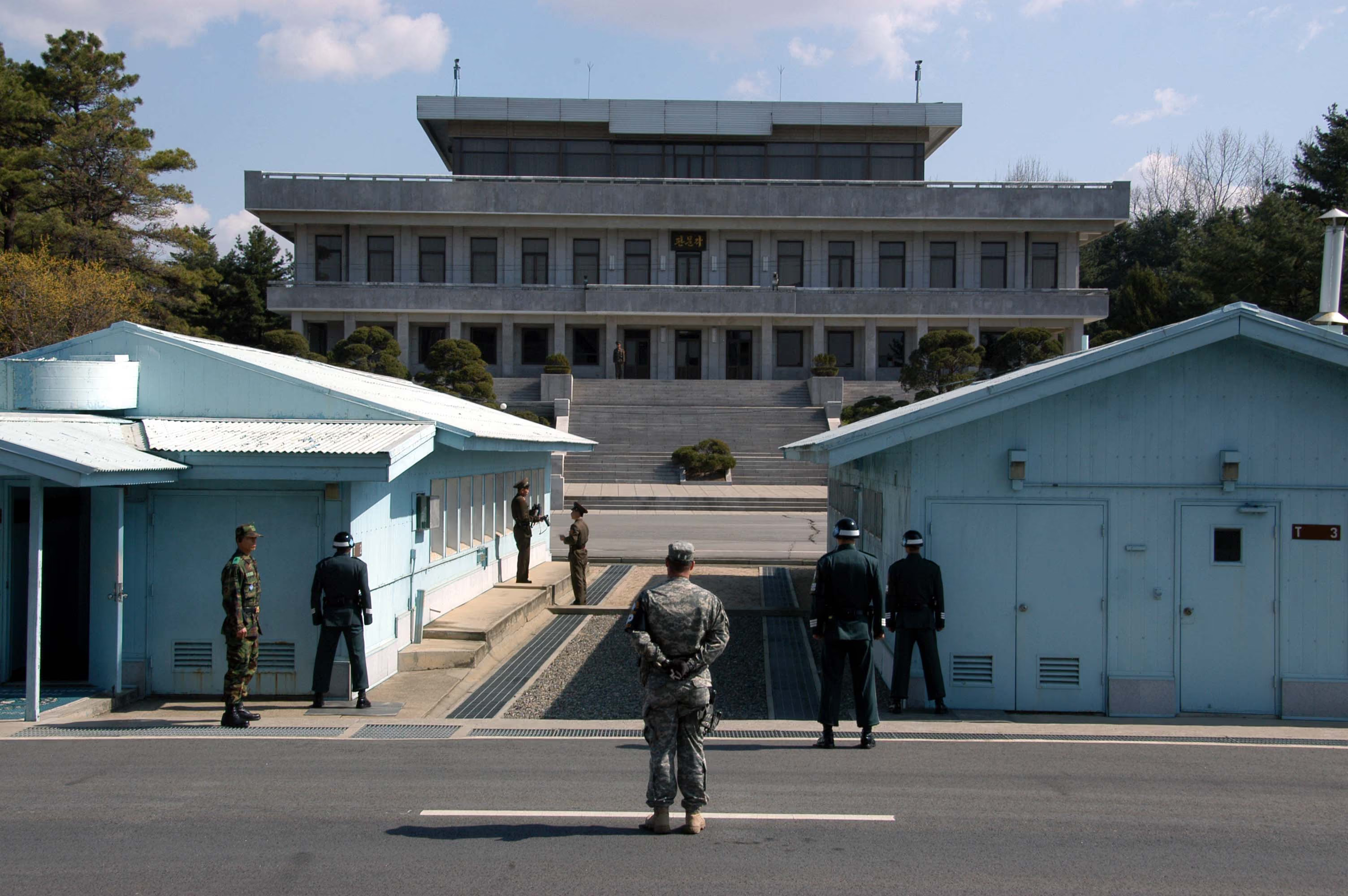
The border between North and South Korea is one of the most heavily guarded stretches of land in the world. The DMZ, littered with scores of mines and barbed-wire fences, is almost impossible to cross, except at the Joint Security Area (JSA). The JSA is a special zone inside what is known as the "truce village" of Panmunjom, about 35 miles north of Seoul. Every year, when it is open to tourists, thousands of people visit the JSA for a chance to see North Korean soldiers standing at attention just dozens of feet away and to officially step into North Korean territory inside a United Nations Command administered conference room that straddles the military border.
A visit there feels like military theater, with stern warnings from the South Korean soldiers under United Nations Command not to make gestures at their counterparts. Since demarcation, the DMZ has had numerous incidents and incursions by both sides, although the North Korean government typically doesn’t acknowledge direct responsibility for any of these incidents.
Human Rights and Repression in North Korea
North Korea is one of the world's most repressive states. The government restricts all civil and political liberties for its citizens, including freedom of expression, assembly, association, and religion. It prohibits all organized political opposition, independent media, civil society, and trade unions. The government routinely uses arbitrary arrest and punishment, torture in custody, forced labor, and executions to maintain fear and control across the country. Beyond the DMZ, North Korea is a highly controlled country where human rights are routinely violated.
The international community has continued to press the North Korean government to expand its engagement with United Nations human rights mechanisms, including action on findings of the UN Commission of Inquiry (COI). The COI report shows that the country has committed crimes against humanity including extermination, murder, enslavement, imprisonment, rape, sexual violence, forced abortion, and other heinous crimes. The citizens of North Korea require a lot of help and support from the international community in order to attain a better life.
The North Korean people face a brutal and repressive government that isolates them from the world and denies their most basic human rights. But you can help to create change. At Liberty in North Korea (LiNK), we help North Korean refugees escape through a 3,000-mile secret rescue route and empower North Koreans who have reached freedom to be changemakers, advocates, and leaders on this issue.
You can help make a difference in the lives of North Korean citizens by learning more about our organization, raising funds, advocating for the people of North Korea, starting a rescue team, or making a donation today!
The North Korea I Remember: School, Family, and Home
By: HyeGyeong Joo
HyeGyeong is a PhD student in the Department of Economics at Korea University, specializing in theoretical economics. Her research looks at developing theoretical models of the North Korean economy. Since 2022, Hye-Gyeong has also participated in LiNK’s English Language Program.
Have you ever wanted to go home even while you were already at home? Because I have. It feels as though I am not longing for a physical house, but for something harder to name: a sense of belonging, of being whole, of belonging not anywhere but somewhere I would truly belong. Instead, I often feel emptiness, as if I do not fully belong. But I am not sure what these feelings mean or where they come from exactly.
I have been living in South Korea for around ten years, but I still miss North Korean food, school life, and above all, the time I spent with my family. There are restaurants in South Korea run by North Korean refugees, and sometimes their dishes bring back memories of home. Foods like injogogi-bap or nongma-guksu remind me not only of North Korean cuisine, but of birthdays, family, and everyday life.
The long strands of nongma-guksu always carry the wish for a long life, while the taste of injogogi-bap brings back the memory of a soybean dish made to resemble the meat we so rarely had.
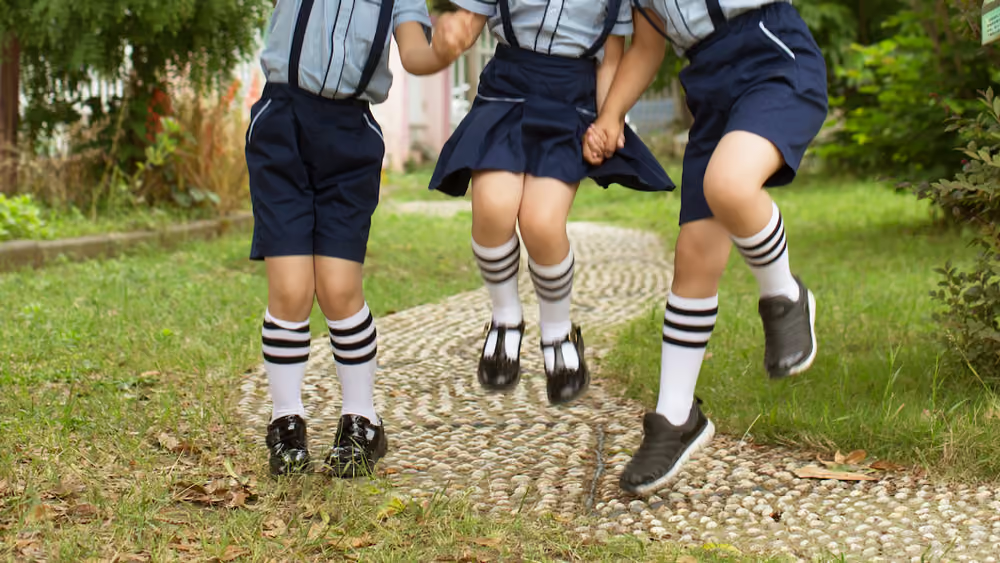
While these foods remind me of home, what I remember most vividly is my school life in North Korea. When I was in fourth grade, the girls in my school would often gather in the schoolyard to play jump rope. I was actually quite good at it. We would start with the rope at ankle height and gradually raise it higher and higher.
One day, when the rope had been raised to about head height, I tried to jump over it. Since I was quite short, I had to lift my leg as high as I could. Unfortunately, I ended up tearing my pants. I was so embarrassed that I almost cried. But what I remember most clearly is my teachers laughing so hard as they watched from the side. Even now, I can still picture that moment vividly.
I also remember winter lunchtime at school. We all brought packed lunches from home. In one corner of the classroom, there was a stove, and before lunch, students would place their lunch boxes on top of it to warm their food.
Sometimes, the lunch box closest to the stove would get burnt. During class, the smell of scorched rice would fill the room and make us so hungry that it was hard to focus. When lunchtime finally came, my friends and I would gather around the stove, sit in a circle, and eat together.
More than anything else, however, I miss the memories of winter. My friends and I would climb the hills near our town, sit on large sacks, and slide all the way down as if we were on sleds. We did it so often that the fabric on the back of our pants would wear thin and eventually tear. When that happened, I would go home only to be scolded by my mother.
Life was not easy in those days. We were often hungry and did not live comfortably. Sometimes we skipped breakfast, and sometimes a thin porridge was all we had for dinner. Yet, despite those hardships, I cannot forget the laughter we shared.
Looking back now, I realize that what I miss is not North Korea as a system. What I miss are the people with whom I laughed and cried, and the memories of my childhood that have stayed with me to this day.
For a long time, however, I could not talk about these feelings to anyone. I kept them to myself, unsure of how others would understand them. That began to change after I met people through Liberty in North Korea (LiNK). For the first time, I found a space where I felt I could speak more honestly about my memories and my life in North Korea.
Through the LiNK English program, I became close to a friend, and together we made a plan to create a book. I would write about real life in North Korea, and she would draw the illustrations for the book. I wanted people to see North Korea not only as a political system, but also as a place where ordinary people live, love, struggle, and create memories.
I shared this plan with someone I trusted deeply in South Korea. But she told me, “No, you can’t!” She said that if I spoke honestly about daily life in North Korea and about how much I miss certain parts of it, despite all the difficulties, people might ask, “Then why are you here? If you miss it so much, why don’t you go back?” Her response hurt me so deeply that I eventually closed my heart to others. After that, I stopped talking about these feelings with anyone. Only later did I finally find a place where I could tell my story freely and without hesitation.
When many people think about North Korea, they often think about politics, missiles, or the regime. But when I think about North Korea, I remember a girl whose pants tore while playing jump rope, students gathering around a stove to eat lunch together, and children laughing as they slid down snowy hills on sacks.
That is why I hope people can see North Korea not only as a political system, but also as a place where ordinary people live their lives. The people living there are not so different from people anywhere else. They laugh, dream, make friends, and create memories. Those are the stories I hope to share.
–
HyeGyeong is a participant of the LiNK English Language Program (LELP), which serves to not only help North Korean defectors build confidence and skills in English, but develop their capacity as advocates for this issue. To that end, we partnered with select LELP “columnists” to write and polish personal essays through multiple rounds of external feedback and revision. Our goal is to have more North Koreans share their stories directly and lead efforts to change the narrative.
We believe the North Korean people can achieve their liberty in our lifetime.
Opportunities like LELP invest in the people building that future now. Help more North Koreans find their voice, reach their goals, and lead change on this issue.










