
The Most Dangerous Contraband in North Korea Isn’t a Weapon. It’s a Wish.
By: Jihyun Kang
Growing up in North Korea, Jihyun took inspiration from the smuggled South Korean dramas she watched to create her own unique clothing. After reaching freedom in 2010, she has continued to pursue her interests in fashion and culture as a catalyst for change. She runs several business ventures, practices fine art under the name “Da Gyeol,” and works with the Ministry of Unification as an advisor. She’s pursuing her Masters in Entrepreneurship, Dept. of Future Science & Technology Business, at Korea University.
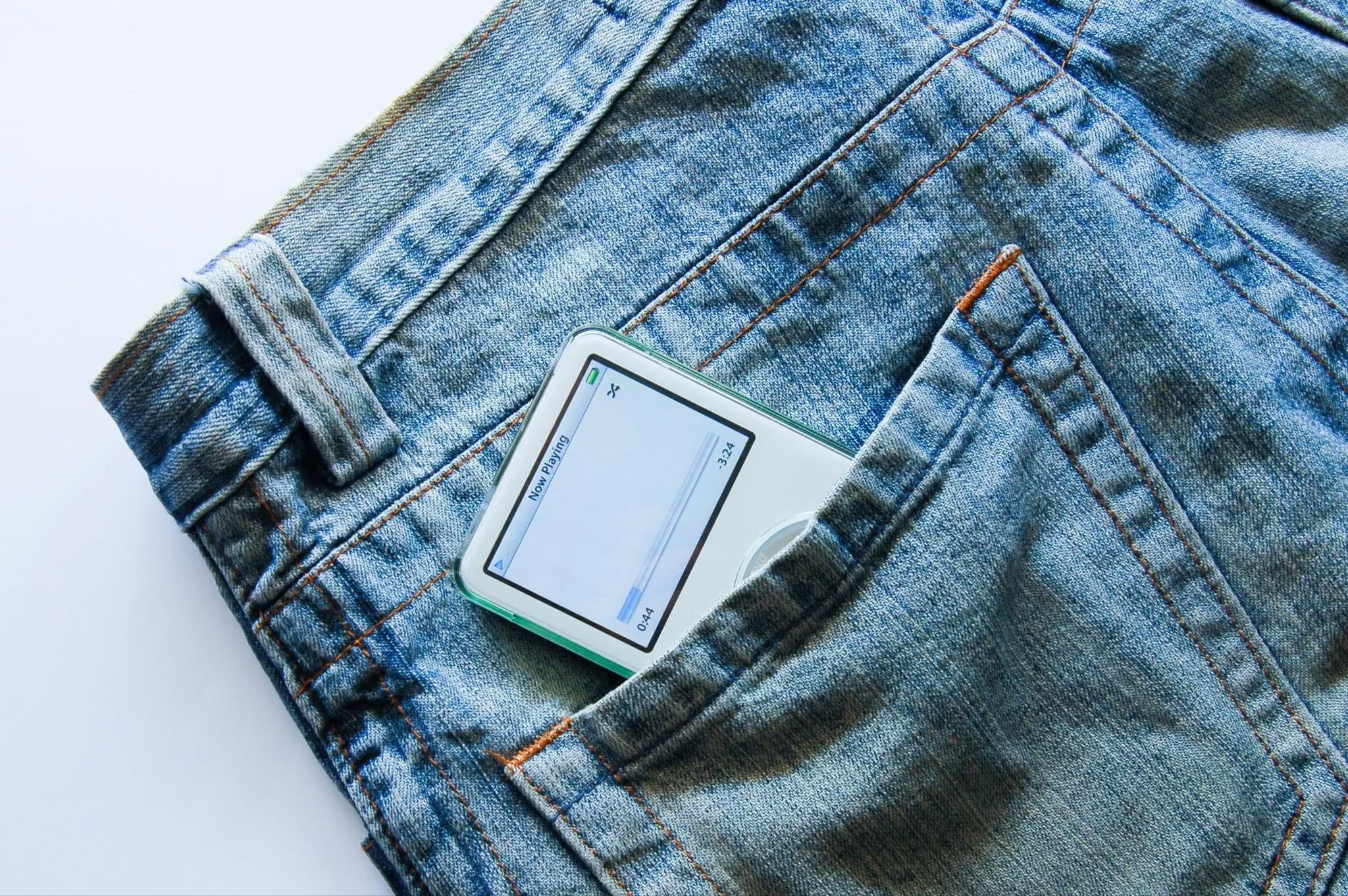
I grew up in North Korea, and at fifteen, I encountered a Westerner for the first time at the top of Mount Paektu. He stood over 190 centimeters tall with a thick beard, wearing ripped jeans and a frayed T-shirt. In North Korea, worn-out clothing was a symbol of deprivation. Yet my father whispered, "He is wearing that for style." With that single remark, the worldview I had been taught, began, the first time, to crack. And I thought: I want to dress like that, too.
Fashion is more than clothing. It is the moment when individual desire moves faster than collective command. People follow taste before ideology, and express themselves through what they wear long before any political declaration.
A state can enforce a dress code, but it cannot manufacture desire. That is why North Korea's fear of blue jeans was not irrational—it was the regime recognizing, however dimly, that something it could not control was already growing.
Clayton Christensen, a professor at Harvard Business School, argued that transformation always begins at the margins—in forms so crude and insignificant that those in power dismiss them entirely. Christensen built his theory around corporations, but the logic applies to any system that holds a monopoly over its people, including a state. North Korea's regime was so focused on maintaining ideological control at the centre that it ignored what was happening at the bottom.
That bottom was the jangmadang—the spontaneous, bottom-up market ecosystem created by ordinary people to survive after the collapse of North Korea's state-led distribution system. When that system imploded during the Arduous March—a famine in the mid-1990s that killed hundreds of thousands—people built informal markets out of sheer necessity: not revolution, not ideology, but survival. Yet by 2018, a CSIS study found 436 officially recognized markets operating across the country. What began as a desperate improvisation had quietly become the infrastructure keeping North Koreans alive.
These markets did not merely sell food. They became conduits for Chinese clothing, USB drives loaded with South Korean dramas, and glimpses of a world no one had taught them existed. When a system ignores what people actually want, the market finds the gap.
The act of choosing—what to eat, what to wear, what to watch—may seem trivial. But a person who has tasted choice cannot fully return to obedience.
The jangmadang was the first place where North Koreans learned they could survive without the state. That desire did not stay underground—it surfaced. People began wearing jeans, dyeing their hair, and pulling on T-shirts printed with foreign letters. The regime could no longer ignore it. Authorities branded jeans and Western fashion as 'anti-socialist infiltrations' and deployed street patrols. Teenagers caught in these sweeps were sent to re-education camps; in severe cases, their names and home addresses were read aloud on state broadcasts as public shaming (Radio Free Asia).
In 2024, state-run Korean Central Television went so far as to blur the jeans worn by British TV presenter Alan Titchmarsh during a broadcast. The ruling party's official newspaper, the Rodong Sinmun, warned that a country could 'become vulnerable and eventually collapse like a damp wall' if it failed to preserve its own way of life (Newsweek, May 2021).
Regulations cannot extinguish human desire; they only raise the price of the forbidden. This is the inflection point Christensen identified: by the time an incumbent recognizes the threat, it is already too late.
To date, more than 34,000 North Koreans have resettled in South Korea (South Korean Ministry of Unification, 2024). At the start of each of those journeys, there was something like my pair of jeans—not ideology, but desire; not a declaration, but a taste; not revolution, but the market.
No government in history has ever successfully suppressed the human impulse to trade, to choose, to want more. Not the Soviet Union. Not Cuba. Not Mao's China. North Korea will not be the exception.
–
Jihyun is a participant of the LiNK English Language Program (LELP), which serves to not only help North Korean defectors build confidence and skills in English, but develop their capacity as advocates for this issue. To that end, we partnered with select LELP “columnists” to write and polish personal essays through multiple rounds of external feedback and revision. Our goal is to have more North Koreans share their stories directly and lead efforts to change the narrative.
We believe the North Korean people can achieve their liberty in our lifetime.
Opportunities like LELP invest in the people building that future now. Help more North Koreans find their voice, reach their goals, and lead change on this issue.
Give Today
Inside North Korea: People still suffer legacy of pandemic-era controls
The path to freedom is harder than ever. But the North Korean people haven’t given up. Join us this World Refugee Day in offering a way forward.
Give Today
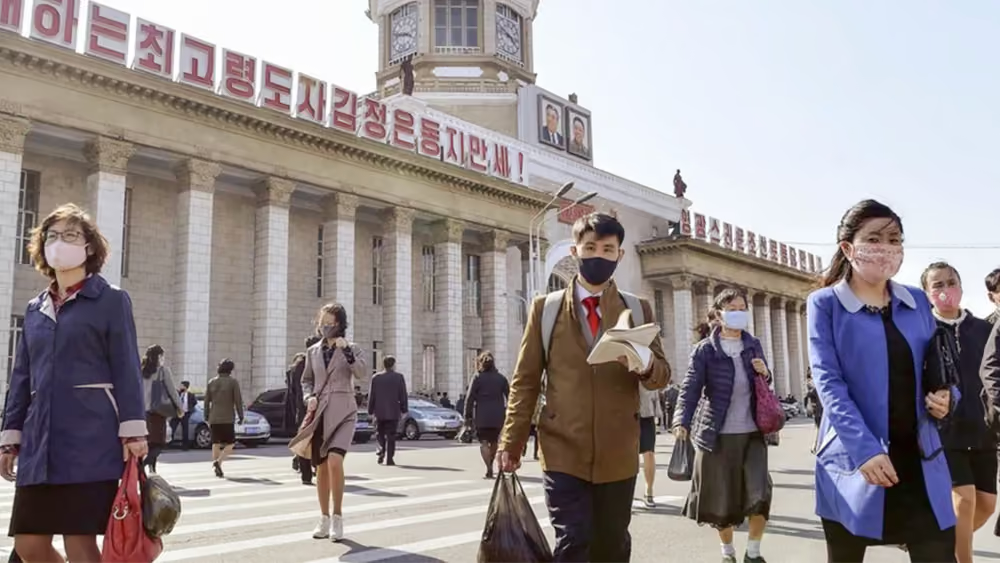
During the pandemic, the regime took every opportunity to tighten its control under the guise of stopping the spread of COVID-19. Borders were sealed and reinforced, isolating the country and its people to an unprecedented extent. Trade was cut off, and the jandmadang—the markets that we’ve long highlighted as hotspots of change—were decimated.
Although the pandemic feels like history, the situation remains difficult as North Koreans recover from their most challenging period for a generation.
Information from inside the country has become increasingly difficult to obtain these last few years. But a landmark 2024 report from Human Rights Watch has offered some visibility into North Korea’s intensifying repression and the increased challenges North Korean people have faced.
Decimated Market Activity
“The prolonged border closures and restrictions on movement in-country have decimated the market activity that has become essential for the general population to access basic necessities.”
– Tomas Ojea-Quintana, then special rapporteur on the situation of human rights in the DPRK in March 2022 (via Human Rights Watch)
When North Korea’s socialist economy collapsed in the mid-1990s, triggering widespread famine, ordinary North Koreans negotiated their own survival through illicit trade and smuggling. Grassroots marketization was leading to opening and change in North Korea, centered around the markets—the jangmadang.
But when the regime closed its borders in 2020, almost all trade was cut off.
Human Rights Watch shares that according to official records, by 2021 North Korea was importing only 6% of what it had been importing in 2011—a staggering decrease. But these numbers still fail to fully capture the lives and needs of ordinary North Koreans, a sentiment echoed by the former North Korean traders that spoke with Human Rights Watch:
“There was a large but unmeasurable gap between what official trade numbers show and the quantities of products ordinary North Koreans need in their daily lives. This gap, previously narrowed by informal trade, became huge when informal trade and economic activity was almost completely choked off starting in 2020.”
Intensified Border Security
“We found a 20-fold increase in the number of new guard buildings or facilities since 2019, with a total of 6,820 facilities placed near new or improved fences… [and] almost 500 kilometers (over 300 miles) of new fences…”
– Human Rights Watch
Through satellite imagery analysis, Human Rights Watch reviewed 321 kilometers, or roughly one-quarter of North Korea’s northern border, to compare security measures from before and after the pandemic.
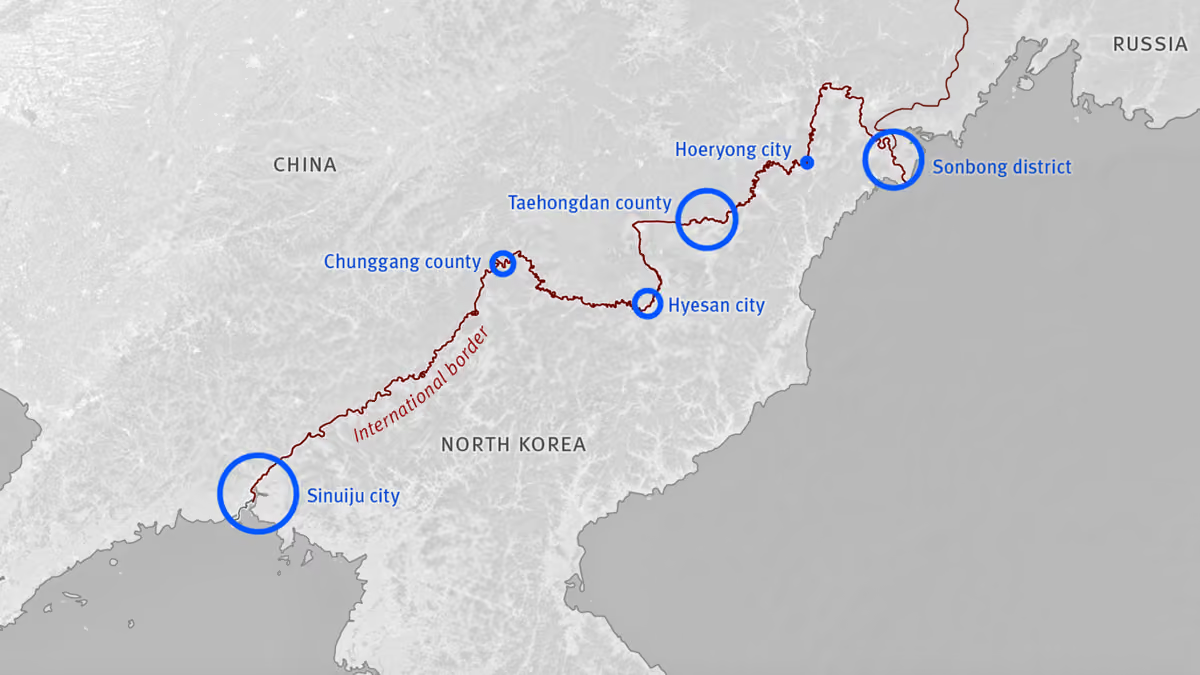
Prior to 2020, approximately 230 kilometers (71%) of the 321 kilometers analyzed were fenced. But in the years since, multiple layers of fencing have been newly constructed, along with new and upgraded guard posts. Based on 2023 satellite imagery, there is now a staggering 743 kilometers (over 460 miles) of fencing within the 321 kilometers analyzed.
Along with infrastructure, in August 2020, the North Korean government created 1-2 kilometer “buffer zones” along its border with China, and instructed guards to “unconditionally shoot” on sight any person or wild animal entering the zones without permission, as “the [COVID-19] pandemic is being spread through air and items.” There were reports of at least 14 people being shot and killed between September 2020 and July 2022.
Human Rights Watch spoke with Young Mi, a former herbal medicine trader in contact with a relative in North Korea, to hear how the extreme restrictions had affected life in border areas:
“It is more the emotional environment and fear more [than the actual physical barriers] … [My relative] is scared to leave because of… a general sense of terror much stronger than a bullet or a wire fence.”
Starvation and Food Insecurity
“North Korea is one of the poorest countries in the world and the government has persistently struggled to ensure food security, adequate childhood nutrition, and access to medicine.”– Human Rights Watch
Chronic oppression in North Korea has created one of the most impoverished countries in the world. A 2023 UN report estimated that 46% of the population face food insecurity. Those 12 million North Koreans aren’t just numbers, but people like Eunju.
Eunju escaped from North Korea in 1999, fleeing starvation during the “Arduous March,” a propagandized name for a period of widespread famine.
“When the Arduous March began, rations from workplaces were nearly cut off. At first, we managed by selling household belongings or trading them for food, but eventually, there was nothing left to exchange. People would sigh, saying, ‘We can’t even trade our empty house for a single block of tofu.’
When spring arrived, we ate every kind of wild plant we could find, even peeling bark off pine trees, boiling and pounding it for days to make it edible. Although I managed to survive, death was everywhere. Some consumed nothing but wild plants and died from poisoning. Some were shot by soldiers while trying to steal corn from farms. Some were publicly executed for slaughtering and eating a cow. Some were orphaned street children, beaten to death for trying to steal food from others.
People lost their lives in different ways, but in the end, they all died trying to survive. The root cause was the same—severe food shortages.”
In 2021, Kim Jong Un urged the people to “wage another more difficult ‘Arduous March.’” Yet the regime continued to restrict cross-border trade and prioritize weapons development, all while neglecting domestic food production.
In the report from Human Rights Watch, Jiro Ishimaru, the director at Asiapress, shared that “In 2021, there were reports of people with disabilities and older people dying of starvation... after over three years of extreme difficulties, in April and May, there was a spike in reports of whole families and ordinary people dying of starvation in urban areas near [North Korea’s] northern border.”
Crackdowns on Foreign Media
“Simply watching [foreign] media content can result in a sentence of forced labor of over 10 years in a forced labor prison camp… Public executions of offenders are permitted, evidently to increase a sense of fear and alarm among the population”
– Human Rights Watch
The near-absolute control of information and media is one of the key ways that the regime disempowers and represses North Korean people. During the pandemic, it imposed several new laws that increase the severity of punishments for being caught with foreign media, and go as far as to restrict how individuals can express themselves.
Human Right Watch outlines the main additions:
- Reactionary Ideology and Culture Rejection Law (December 2020) “bans people from smuggling, viewing, and distributing ‘reactionary’ and ‘anti-socialist ideology and culture’”
- Youth Education Guarantee Law (September 2021) “bans young people from copying foreign culture and reorients them to a ‘socialist lifestyle’”
- Pyongyang Cultural Language Protection Act (January 2023) “permits the authorities to punish people for using South Korean intonations or slang”
Offenders could be sentenced to 6+ years of hard labor, or “if the severity of the crime is deemed high,” the death penalty.
The timing of these new laws is no coincidence. As North Koreans face a reality that is increasingly distant from the propaganda they’ve been told to believe, foreign media has the potential to further erode the regime’s legitimacy and control.
Our North Korean friend, Yulseong, shared how foreign media impacted his perception of the the regime and his ultimate decision to leave in 2018:
“I was introduced to music and movies from other countries through my friends. For movies, I loved James Bond and other Hollywood films. While watching them, I realized that North Korea was truly a poor country, and it made me want to leave as soon as possible.
For songs, I listened to ‘Bingo’ by Turtles, ‘Pure Love’ by Koyote, and music by Jatanpung. Seeking out songs about life and love is a basic human desire. Even if people fear punishment, that desire cannot be suppressed. That’s why, even today, I believe many North Koreans continue to watch foreign content.”
Lack of Access to Healthcare
“The DPRK Socialist Constitution and the country’s Public Health Law provide for free medical care to all citizens. In reality, medical supplies and medication are unavailable to most North Koreans and only those who can afford to purchase them on the private market.”
– Human Rights Watch
North Korea’s defunct healthcare system is another example of how the regime’s constraints create unnecessary hardship for North Korean people. The majority of the country’s public health system collapsed along with North Korea’s socialist economy in the 1990s. In the aftermath, the regime only prioritized hospitals in areas like Pyongyang, leaving ordinary North Koreans to fend for themselves.
According to a 2017 UN report, an estimated 33% of the population (8.4 million people) had limited access to health services, including 50% of people in rural areas.
Human Rights Watch spoke with a former North Korean doctor and nurses who escaped after 2014, who shared that, “most local clinics were only capable of diagnosing basic diseases and setting broken bones, and had barely any working tools, supplies, medicine, or electricity… medical workers relied on market activity and what their patients gave them to eat to survive.”
For our North Korean friend Lily, the most frustrating part was that all this suffering was preventable.
“When my older sister, Hye-Joo, developed acute appendicitis, there was no emergency line to call, or cars or taxis to transport her to the hospital. We loaded her onto a cart that was meant to carry produce, moving at a terribly slow pace.
Desperate to ease my sister’s pain, we exhausted every resource we had. Any surgical or medical equipment a patient needs has to be provided by the family. Gauze, painkillers, blankets–even food and bribes–may be necessary for an operation. Even then, severe shortages made it impossible to fully prepare. The surgery was performed with minimal anesthesia and makeshift sterilization. Later, my sister told me she had felt the knife cutting into her skin, and heard the doctor’s orders during the surgery.
What should have been a simple and safe procedure was a traumatic, life-threatening experience.”
Impact on this Issue
In the face of enormous challenges, we cannot be discouraged, because this work is more important than ever.
There are still things we can and must do to strengthen forces of change. LiNK is one of the few groups still running rescue operations in the underground railroad. We’re cultivating and partnering with North Korean activists and storytellers who are leading efforts to raise global awareness for this issue. And we’re ambitiously expanding our Information Access Programs, devising new strategies and pathways to get information and technology inside North Korea to empower the people.
Join us in reaffirming our commitment to a free North Korea.
Give Today
Change has never been a linear process. But one thing we can always be certain of is the resilience and strength of the North Korean people.










