
The Most Dangerous Contraband in North Korea Isn’t a Weapon. It’s a Wish.
By: Jihyun Kang
Growing up in North Korea, Jihyun took inspiration from the smuggled South Korean dramas she watched to create her own unique clothing. After reaching freedom in 2010, she has continued to pursue her interests in fashion and culture as a catalyst for change. She runs several business ventures, practices fine art under the name “Da Gyeol,” and works with the Ministry of Unification as an advisor. She’s pursuing her Masters in Entrepreneurship, Dept. of Future Science & Technology Business, at Korea University.
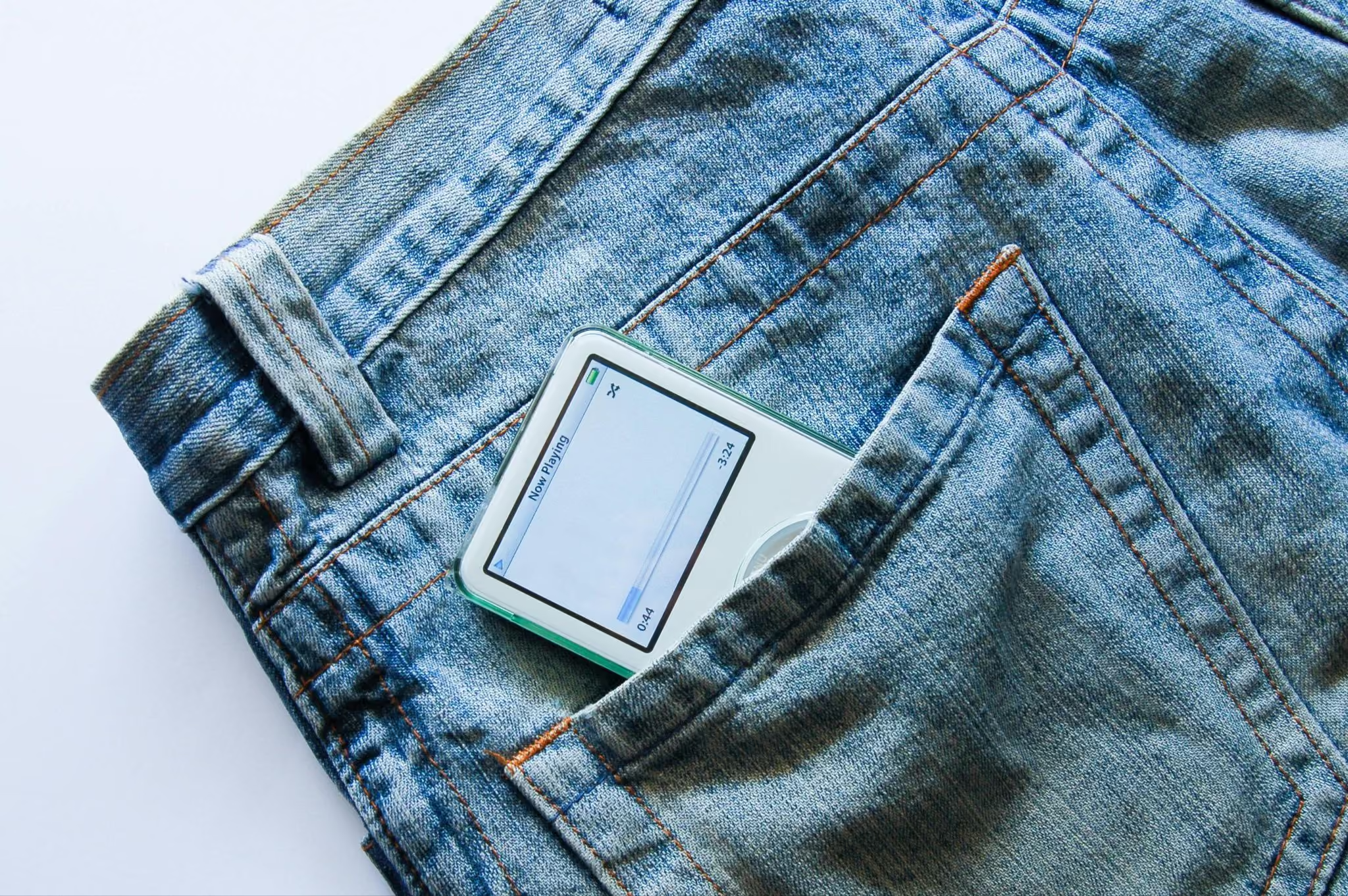
I grew up in North Korea, and at fifteen, I encountered a Westerner for the first time at the top of Mount Paektu. He stood over 190 centimeters tall with a thick beard, wearing ripped jeans and a frayed T-shirt. In North Korea, worn-out clothing was a symbol of deprivation. Yet my father whispered, "He is wearing that for style." With that single remark, the worldview I had been taught, began, the first time, to crack. And I thought: I want to dress like that, too.
Fashion is more than clothing. It is the moment when individual desire moves faster than collective command. People follow taste before ideology, and express themselves through what they wear long before any political declaration.
A state can enforce a dress code, but it cannot manufacture desire. That is why North Korea's fear of blue jeans was not irrational—it was the regime recognizing, however dimly, that something it could not control was already growing.
Clayton Christensen, a professor at Harvard Business School, argued that transformation always begins at the margins—in forms so crude and insignificant that those in power dismiss them entirely. Christensen built his theory around corporations, but the logic applies to any system that holds a monopoly over its people, including a state. North Korea's regime was so focused on maintaining ideological control at the centre that it ignored what was happening at the bottom.
That bottom was the jangmadang—the spontaneous, bottom-up market ecosystem created by ordinary people to survive after the collapse of North Korea's state-led distribution system. When that system imploded during the Arduous March—a famine in the mid-1990s that killed hundreds of thousands—people built informal markets out of sheer necessity: not revolution, not ideology, but survival. Yet by 2018, a CSIS study found 436 officially recognized markets operating across the country. What began as a desperate improvisation had quietly become the infrastructure keeping North Koreans alive.
These markets did not merely sell food. They became conduits for Chinese clothing, USB drives loaded with South Korean dramas, and glimpses of a world no one had taught them existed. When a system ignores what people actually want, the market finds the gap.
The act of choosing—what to eat, what to wear, what to watch—may seem trivial. But a person who has tasted choice cannot fully return to obedience.
The jangmadang was the first place where North Koreans learned they could survive without the state. That desire did not stay underground—it surfaced. People began wearing jeans, dyeing their hair, and pulling on T-shirts printed with foreign letters. The regime could no longer ignore it. Authorities branded jeans and Western fashion as 'anti-socialist infiltrations' and deployed street patrols. Teenagers caught in these sweeps were sent to re-education camps; in severe cases, their names and home addresses were read aloud on state broadcasts as public shaming (Radio Free Asia).
In 2024, state-run Korean Central Television went so far as to blur the jeans worn by British TV presenter Alan Titchmarsh during a broadcast. The ruling party's official newspaper, the Rodong Sinmun, warned that a country could 'become vulnerable and eventually collapse like a damp wall' if it failed to preserve its own way of life (Newsweek, May 2021).
Regulations cannot extinguish human desire; they only raise the price of the forbidden. This is the inflection point Christensen identified: by the time an incumbent recognizes the threat, it is already too late.
To date, more than 34,000 North Koreans have resettled in South Korea (South Korean Ministry of Unification, 2024). At the start of each of those journeys, there was something like my pair of jeans—not ideology, but desire; not a declaration, but a taste; not revolution, but the market.
No government in history has ever successfully suppressed the human impulse to trade, to choose, to want more. Not the Soviet Union. Not Cuba. Not Mao's China. North Korea will not be the exception.
–
Jihyun is a participant of the LiNK English Language Program (LELP), which serves to not only help North Korean defectors build confidence and skills in English, but develop their capacity as advocates for this issue. To that end, we partnered with select LELP “columnists” to write and polish personal essays through multiple rounds of external feedback and revision. Our goal is to have more North Koreans share their stories directly and lead efforts to change the narrative.
We believe the North Korean people can achieve their liberty in our lifetime.
Opportunities like LELP invest in the people building that future now. Help more North Koreans find their voice, reach their goals, and lead change on this issue.
Give Today
A North Korean Refugee’s Legacy of Freedom | Holly & Mia’s Story
As a little girl in North Korea, I dreamt of becoming a musician. When I was 6 years old, I saw my school teacher playing the organ. After class one day, I went up and placed my hands on the keys, trying to mimic what she played. When the teacher got back, she asked who touched the organ. All the kids looked at me and I thought I’d get in trouble, but instead of punishing me, she started teaching me how to read music. Eventually, my teacher came to my home and urged my parents to send me to Pyongyang, North Korea’s capital, to pursue music with some of the country’s best musicians.
But my parents knew I could not achieve my dream. My grandfather had been a landowner before the North Korean regime took power. When the Korean War broke out, he had fled to the South, never to be heard from again. The regime didn’t forget my family’s past - to them, we were traitors. Before I was even born, my future had been decided.
I couldn’t attend a university or get a good job. While others studied, I would have to dig for coal and sell it.
One night, I was gathering firewood on a mountain near the South Korean border with another girl. In the distance, I saw a town that was dazzlingly bright in the dark evening. Electricity is a luxury in North Korea, and I soon realized I was looking across the border. I had secretly watched South Korean movies for years. I had seen the delicious food they ate and the amazing places they traveled. I stared at the lights and dreamed of what my life could be.
The dream was too powerful to ignore. I worked every day from sunrise to sunset to save money for my escape.
I gathered rare mushrooms on the slopes of North Korea’s tallest mountain, through the bitter cold. After sixty trips, I had enough money to hire a broker to help me escape into China.
But I trusted the wrong broker.
The broker betrayed us and sold us out. Soldiers were waiting for us at the meeting point and we were dragged from the river to an interrogation cell. The secret police want you to confess that you were trying to defect to South Korea. They beat you with a stick and slam your head against a wall until you just want the pain to stop. But if you confess, you’re sent to a political prison camp to die like an animal.
So I refused to say anything. They kept beating me and screaming at me, but I closed my eyes and held on to my dream of freedom. It was two weeks before they finally sent me to a detention center.
A woman in my cell told me about another broker who could help me escape. But there was a catch - I would have to be sold to a man in China.
I chose the unimaginable. I was sold for less than $3,000.
It is hard for me to talk about this time in my life. The man who bought me kept me in a small bedroom in his house. In one month, I was pregnant. When he found out, he told me to get an abortion. I refused. He tried to drug me and take me to get an abortion while I was unconscious.
One night I felt sick and thought it was food poisoning, but I was in labor and rushed to the hospital. After twenty hours, the doctor had to perform an emergency c-section. The man who bought me complained about the extra expense.
But when I woke up, there was my beautiful baby. I put her on my chest and knew she was my everything. My new dream was to give my daughter Mia a chance to have a better life than me.
I knew we couldn’t stay in China. The man who bought me didn’t want a child, and every day we stayed was another day we could get caught. But I couldn’t take a newborn baby on the dangerous journey. I waited until Mia was one year old, making secret plans with someone who could help us escape - now I know they were part of LiNK’s rescue network.
The day of our escape finally came, and we went to a safe house. I had Mia on my back and a bag full of diapers, clothes, and a small bracelet that was a gift for her. It was everything we had. We met up with other North Koreans, and they were not happy that Mia and I were joining them. I could not blame them. There were stories about groups that were caught because of a crying baby.
Taking care of a one year old is hard enough. Doing so while avoiding the Chinese police was one of the hardest things I have ever done.
I didn’t want Mia to cry so I never put her down, even when my back and arms ached from rocking her. We never stopped for more than a few hours so I had to breastfeed her along the way. Whenever we did have a break, I’d change her diapers, clean her, and make sure she ate enough. By the time I was done, we had to move again. I didn’t have time to eat so I went days with barely any food.
But every mile we traveled brought us closer to our new life. One hot morning, we climbed into a boat and crossed a river. With Mia in my arms, we were met by LiNK’s field team who welcomed us into freedom.
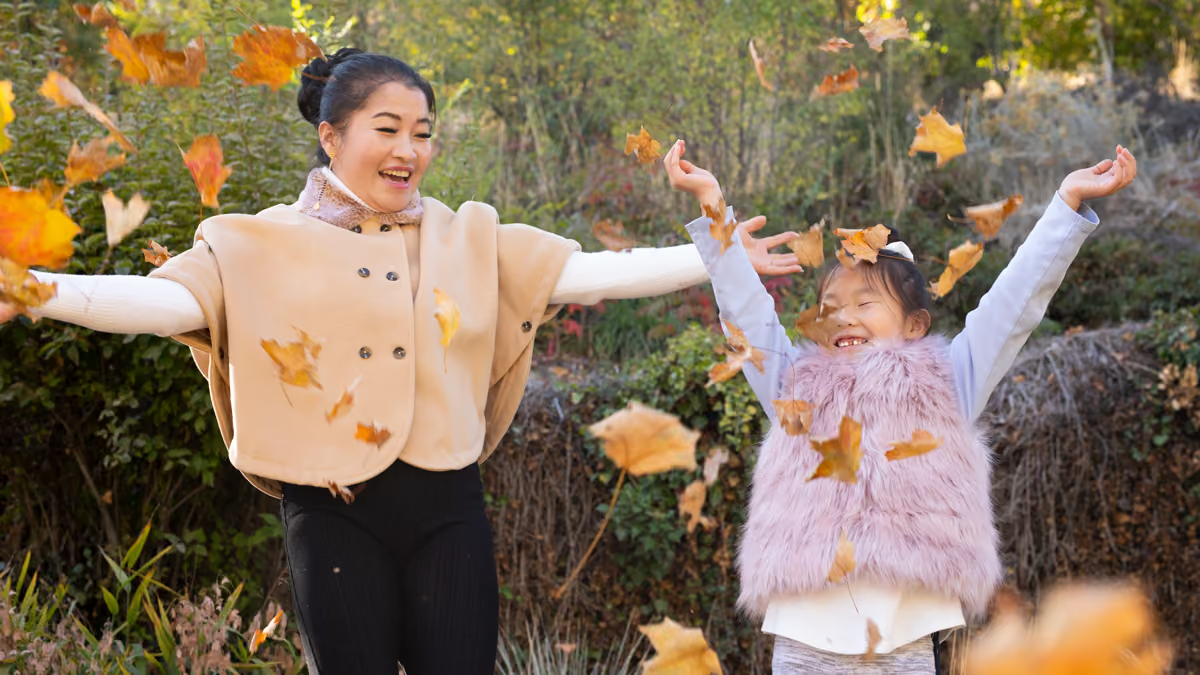
There are two days I will never forget. The day Mia was born and the day I arrived in the United States. I cried so much walking out of the airport. I had no idea what our new life would look like, but we were together and we were finally free.
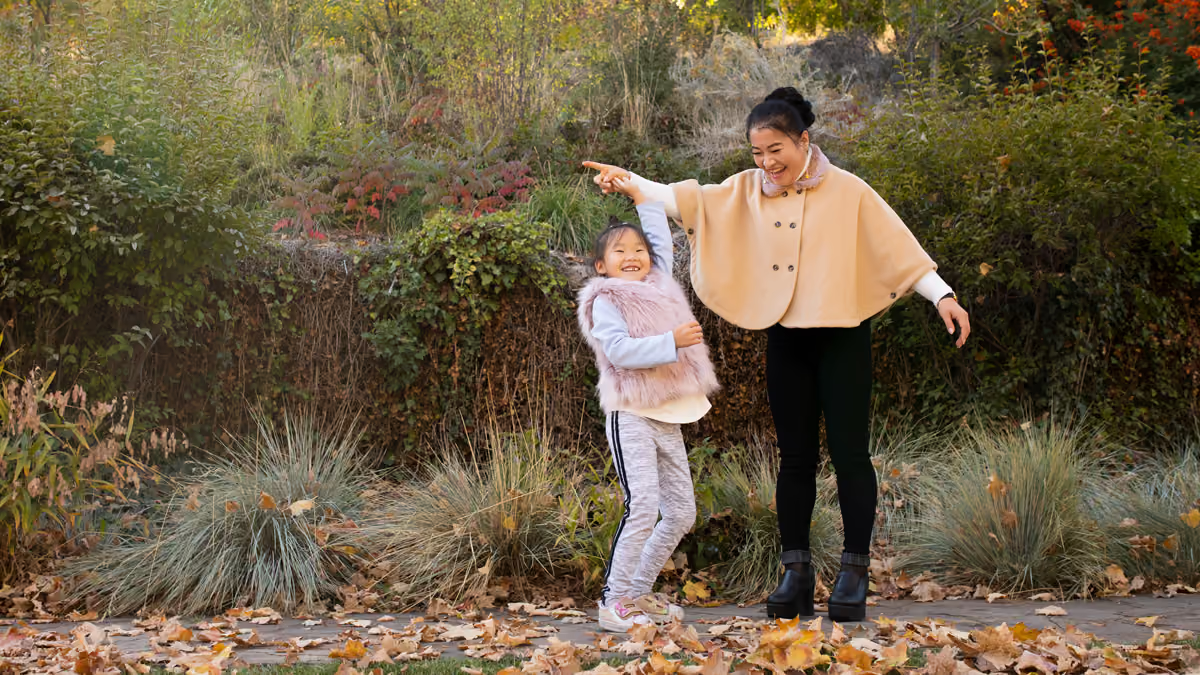
Now when Mia falls asleep in my arms, all I feel is happiness. My story used to only be about my dreams, but now, I am watching my daughter grow into a fearless and curious person. If I never decided to escape and if I didn’t have LiNK’s help, Mia’s life would be so different. Instead of growing hungry, she has a full stomach. Instead of learning North Korean propaganda, she’s learning about science and animals and the world. Instead of fearing we could be sent to a political prison camp, I just worry she’s growing up too soon.
I believe that one day, every North Korean will be free. And every child will be able to write their own story, like my Mia.
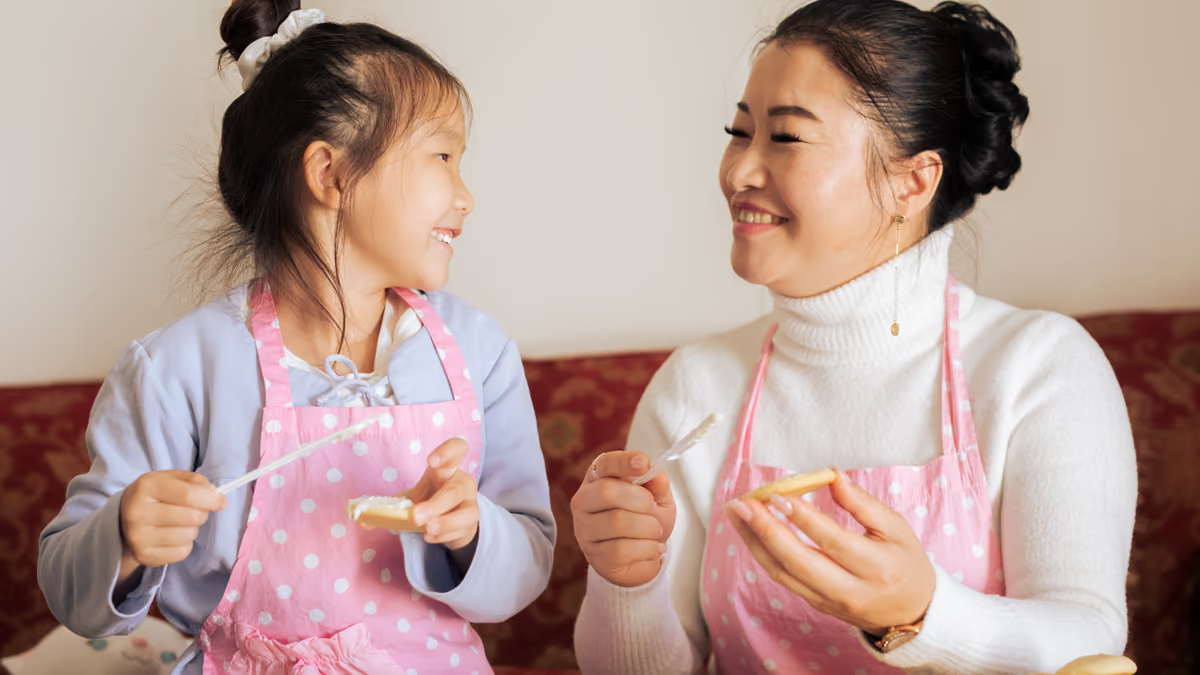
Thanks to Holly’s bravery and the help of LiNK supporters around the world, Mia will never know a life without freedom. Holly will be leaving behind a legacy of freedom for her daughter and for generations to come.
You can help rescue more North Korean refugees and support them as they begin their new lives.










