
The Most Dangerous Contraband in North Korea Isn’t a Weapon. It’s a Wish.
By: Jihyun Kang
Growing up in North Korea, Jihyun took inspiration from the smuggled South Korean dramas she watched to create her own unique clothing. After reaching freedom in 2010, she has continued to pursue her interests in fashion and culture as a catalyst for change. She runs several business ventures, practices fine art under the name “Da Gyeol,” and works with the Ministry of Unification as an advisor. She’s pursuing her Masters in Entrepreneurship, Dept. of Future Science & Technology Business, at Korea University.
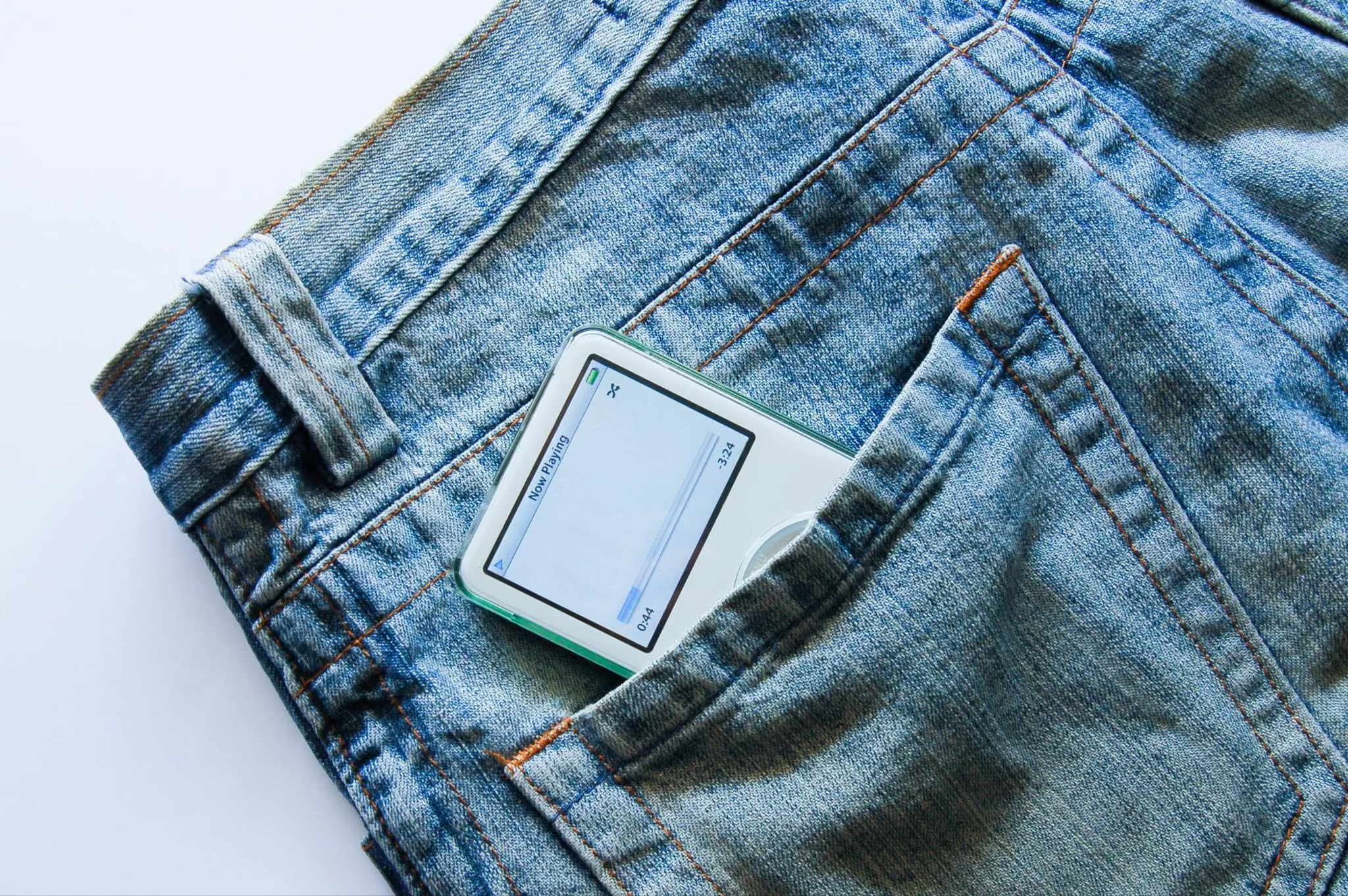
I grew up in North Korea, and at fifteen, I encountered a Westerner for the first time at the top of Mount Paektu. He stood over 190 centimeters tall with a thick beard, wearing ripped jeans and a frayed T-shirt. In North Korea, worn-out clothing was a symbol of deprivation. Yet my father whispered, "He is wearing that for style." With that single remark, the worldview I had been taught, began, the first time, to crack. And I thought: I want to dress like that, too.
Fashion is more than clothing. It is the moment when individual desire moves faster than collective command. People follow taste before ideology, and express themselves through what they wear long before any political declaration.
A state can enforce a dress code, but it cannot manufacture desire. That is why North Korea's fear of blue jeans was not irrational—it was the regime recognizing, however dimly, that something it could not control was already growing.
Clayton Christensen, a professor at Harvard Business School, argued that transformation always begins at the margins—in forms so crude and insignificant that those in power dismiss them entirely. Christensen built his theory around corporations, but the logic applies to any system that holds a monopoly over its people, including a state. North Korea's regime was so focused on maintaining ideological control at the centre that it ignored what was happening at the bottom.
That bottom was the jangmadang—the spontaneous, bottom-up market ecosystem created by ordinary people to survive after the collapse of North Korea's state-led distribution system. When that system imploded during the Arduous March—a famine in the mid-1990s that killed hundreds of thousands—people built informal markets out of sheer necessity: not revolution, not ideology, but survival. Yet by 2018, a CSIS study found 436 officially recognized markets operating across the country. What began as a desperate improvisation had quietly become the infrastructure keeping North Koreans alive.
These markets did not merely sell food. They became conduits for Chinese clothing, USB drives loaded with South Korean dramas, and glimpses of a world no one had taught them existed. When a system ignores what people actually want, the market finds the gap.
The act of choosing—what to eat, what to wear, what to watch—may seem trivial. But a person who has tasted choice cannot fully return to obedience.
The jangmadang was the first place where North Koreans learned they could survive without the state. That desire did not stay underground—it surfaced. People began wearing jeans, dyeing their hair, and pulling on T-shirts printed with foreign letters. The regime could no longer ignore it. Authorities branded jeans and Western fashion as 'anti-socialist infiltrations' and deployed street patrols. Teenagers caught in these sweeps were sent to re-education camps; in severe cases, their names and home addresses were read aloud on state broadcasts as public shaming (Radio Free Asia).
In 2024, state-run Korean Central Television went so far as to blur the jeans worn by British TV presenter Alan Titchmarsh during a broadcast. The ruling party's official newspaper, the Rodong Sinmun, warned that a country could 'become vulnerable and eventually collapse like a damp wall' if it failed to preserve its own way of life (Newsweek, May 2021).
Regulations cannot extinguish human desire; they only raise the price of the forbidden. This is the inflection point Christensen identified: by the time an incumbent recognizes the threat, it is already too late.
To date, more than 34,000 North Koreans have resettled in South Korea (South Korean Ministry of Unification, 2024). At the start of each of those journeys, there was something like my pair of jeans—not ideology, but desire; not a declaration, but a taste; not revolution, but the market.
No government in history has ever successfully suppressed the human impulse to trade, to choose, to want more. Not the Soviet Union. Not Cuba. Not Mao's China. North Korea will not be the exception.
–
Jihyun is a participant of the LiNK English Language Program (LELP), which serves to not only help North Korean defectors build confidence and skills in English, but develop their capacity as advocates for this issue. To that end, we partnered with select LELP “columnists” to write and polish personal essays through multiple rounds of external feedback and revision. Our goal is to have more North Koreans share their stories directly and lead efforts to change the narrative.
We believe the North Korean people can achieve their liberty in our lifetime.
Opportunities like LELP invest in the people building that future now. Help more North Koreans find their voice, reach their goals, and lead change on this issue.
Give Today
Yoon Ha's Story: Part 2 - Life in China

This is the second part of a three-part story. Read part one about the hardships Yoon Ha experienced growing up in North Korea that led her to escape. Part three follows this part with her experience resettling in South Korea.
The couple who helped me escape into China brought me to a house that same night after we crossed the river. There they told me about my options. They said I could work in a restaurant somewhere in China. However, there would be a high risk that I would be caught by the Chinese police and get sent back to North Korea. I already knew that if you get sent back to North Korea from China, you could be severely punished by the North Korean regime.
They said there was another way, which would be safer; I could "marry" a Chinese man. They told me my Chinese husband would protect me from getting caught by the Chinese police. So it seemed that this was the best choice I could make. I had already come to China and I didn’t want to go back to North Korea. I was prepared to do anything to have a better life, so I told the couple that I would live with a Chinese man.
The next morning the couple took me to a car and we started driving.
In the car, I started getting scared. The only thing I knew was that I was going to live with a Chinese man I had never met, and I was just hoping that my life would somehow get better through the marriage. After driving for a while, we arrived in a small city in China. There I met some Chinese people who turned out to be family members of the man I would marry.
I saw one of them give money to the couple who had brought me there. It was then that I realized that I had been sold.

A part of me still felt I could do anything to have a better life. But it didn’t feel good to be sold like an object. Even to this day, there are so many North Korean women being trafficked like I was. This kind of trafficking is now an industry.
I also felt selfish for leaving my mother and sister without letting them know. I came all this way so that I could have a better life, but I missed them a lot. I didn’t know what would happen next or how the Chinese man would treat me. At that point, I wanted to run away, but it was too late and there was nowhere to go. It was a small town in the country and I didn’t know anything, including the Chinese language.
Without having a proper wedding, I started living with the Chinese man - I don’t even want to call him my husband. It was frustrating not knowing any Chinese. And since I was sold into the marriage, I didn’t love the man. So it was really hard for me to live with him.
Despite all of this, I would eventually have my first daughter with him.
He and his family farmed for a living and were very poor. His family didn’t treat me well. They made me do all sorts of hard work on the farm and they would say bad things about me. Sometimes I even got hit. I wasn’t familiar with the area and couldn’t speak the language very well for the first couple of years. And there was always the danger of getting caught by the Chinese police and sent back to North Korea.
I cried a lot whenever I was by myself. I knew I had to keep enduring it for my daughter but it was so tough.

I started hearing from some people around me that I could live safely and freely if I could make it to South Korea. I didn’t want to leave my daughter, but I couldn’t keep living this life without freedom. So I decided to run away, hoping that I could come back for my daughter later.
I soon discovered that it would cost me a lot of money to find people who could take me to South Korea. I had no money, so I ended up getting sold to another Chinese man in order to survive.
Living with the second Chinese man was even worse than with the first one. I still had to do a lot of hard farming work and he was always watching me. He was suspicious that I was going to try to run away. When he went to work he brought me to his workplace so he could still watch me. And he was not kind to me. Whenever I got sick, he didn’t care.
I felt so unloved and suppressed.
Soon, I was pregnant with my second daughter. All the while, my desire to go to South Korea kept growing. I thought about giving up on my unborn daughter, knowing that I couldn’t be a good mother to her while living like this in China. And I knew it would be even harder for me to leave after I gave birth to the baby. But I didn’t want to leave another child of mine for my own freedom.

After hearing from some people that I could raise my child with support from the government in South Korea, I started having hope. I dreamt about living there with my baby. So I looked for opportunities to run away from the second Chinese man, even though he was always watching me. At some point, I met another North Korean woman who lived in my town and who had also been sold into a marriage. She said she could connect me to people in a different city who could help me go to South Korea.
When I was eight months pregnant and my stomach was so big, the Chinese man didn’t watch me as much as he had before. Maybe he thought my body was too heavy to run away. So one day I left home, telling him that I was going to my friend’s house. But actually, I was going to another city to meet people who would connect me to LiNK’s network.
When I was about to leave the town, however, I got caught by the Chinese man. He made me sit behind him on his motorcycle and was taking me back to his house. Riding on the back of the motorcycle, my hat got blown off my head by the wind. I asked him to stop so I could pick it up. It was my favorite hat. He said, “No, we aren’t going to stop. Forget about the hat.”
At that moment, my whole heart and body were telling me, “Do not give up on what you deserve. You deserve to have a simple hat and you deserve to live in freedom like a human being.”

I don’t know how I did it but I jumped off the motorcycle while it was moving. Luckily he wasn’t going too fast and I landed on my back so the baby didn’t get hurt, and I was okay other than scratching my forehead while rolling on the ground.
I got up and started walking toward where the hat fell. The man asked me where I was going and I told him that I was going to get my hat. His motorcycle had lost balance and fallen after I jumped. He didn’t even ask how I was as he started to inspect it for damage. I realized this was my opportunity to run away again. So I grabbed my hat and started running up into the nearby mountains.
I kept going up and up until I was near the top where I could see the road, the man, and his motorcycle. I hid there for a few hours, scared of getting caught by him again. I actually saw him driving around to find me. So I climbed further up and over the other side of the mountain.
Being eight months pregnant, my body was very heavy. But I had to keep moving to get away from the man. I made it over the mountain.
I started heading to the city by taking different vehicles. One time I got on a truck that was transporting dogs. Since all the space was taken by the dogs, I had to sit on one of the guys’ laps in the front seat.
Finally, after some long bus rides that made me feel sick, I connected with LiNK’s network.
Continue reading with Part 3.










