The North Korea I Remember: School, Family, and Home
By: HyeGyeong Joo
HyeGyeong is a PhD student in the Department of Economics at Korea University, specializing in theoretical economics. Her research looks at developing theoretical models of the North Korean economy. Since 2022, Hye-Gyeong has also participated in LiNK’s English Language Program.
Have you ever wanted to go home even while you were already at home? Because I have. It feels as though I am not longing for a physical house, but for something harder to name: a sense of belonging, of being whole, of belonging not anywhere but somewhere I would truly belong. Instead, I often feel emptiness, as if I do not fully belong. But I am not sure what these feelings mean or where they come from exactly.
I have been living in South Korea for around ten years, but I still miss North Korean food, school life, and above all, the time I spent with my family. There are restaurants in South Korea run by North Korean refugees, and sometimes their dishes bring back memories of home. Foods like injogogi-bap or nongma-guksu remind me not only of North Korean cuisine, but of birthdays, family, and everyday life.
The long strands of nongma-guksu always carry the wish for a long life, while the taste of injogogi-bap brings back the memory of a soybean dish made to resemble the meat we so rarely had.
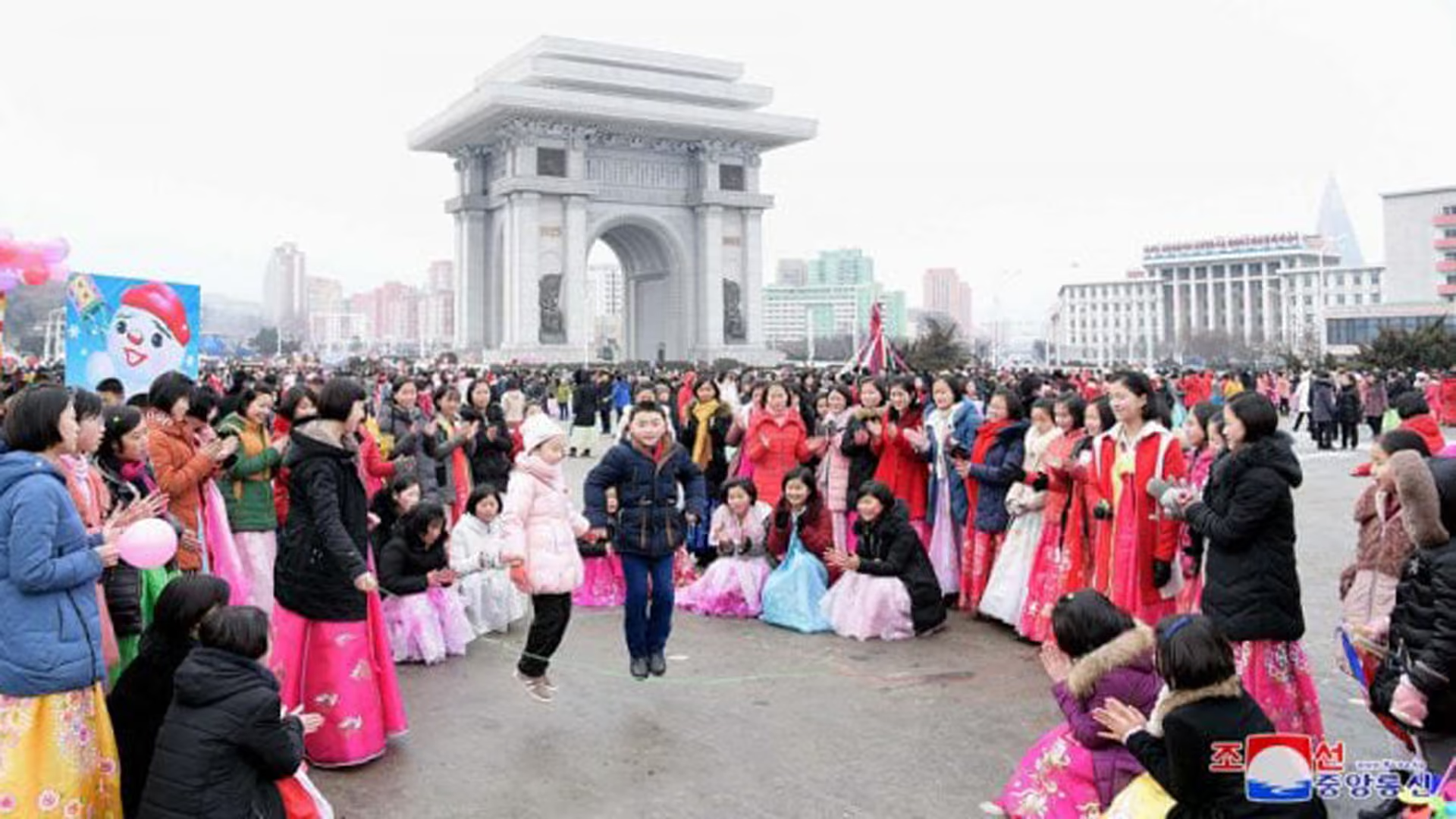
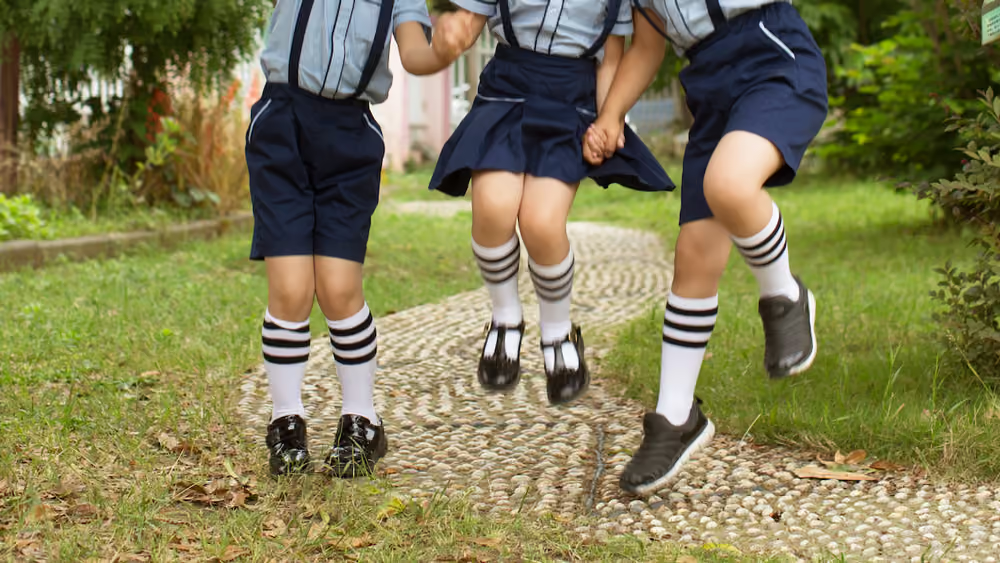
While these foods remind me of home, what I remember most vividly is my school life in North Korea. When I was in fourth grade, the girls in my school would often gather in the schoolyard to play jump rope. I was actually quite good at it. We would start with the rope at ankle height and gradually raise it higher and higher.
One day, when the rope had been raised to about head height, I tried to jump over it. Since I was quite short, I had to lift my leg as high as I could. Unfortunately, I ended up tearing my pants. I was so embarrassed that I almost cried. But what I remember most clearly is my teachers laughing so hard as they watched from the side. Even now, I can still picture that moment vividly.
I also remember winter lunchtime at school. We all brought packed lunches from home. In one corner of the classroom, there was a stove, and before lunch, students would place their lunch boxes on top of it to warm their food.
Sometimes, the lunch box closest to the stove would get burnt. During class, the smell of scorched rice would fill the room and make us so hungry that it was hard to focus. When lunchtime finally came, my friends and I would gather around the stove, sit in a circle, and eat together.
More than anything else, however, I miss the memories of winter. My friends and I would climb the hills near our town, sit on large sacks, and slide all the way down as if we were on sleds. We did it so often that the fabric on the back of our pants would wear thin and eventually tear. When that happened, I would go home only to be scolded by my mother.
Life was not easy in those days. We were often hungry and did not live comfortably. Sometimes we skipped breakfast, and sometimes a thin porridge was all we had for dinner. Yet, despite those hardships, I cannot forget the laughter we shared.
Looking back now, I realize that what I miss is not North Korea as a system. What I miss are the people with whom I laughed and cried, and the memories of my childhood that have stayed with me to this day.
For a long time, however, I could not talk about these feelings to anyone. I kept them to myself, unsure of how others would understand them. That began to change after I met people through Liberty in North Korea (LiNK). For the first time, I found a space where I felt I could speak more honestly about my memories and my life in North Korea.
Through the LiNK English program, I became close to a friend, and together we made a plan to create a book. I would write about real life in North Korea, and she would draw the illustrations for the book. I wanted people to see North Korea not only as a political system, but also as a place where ordinary people live, love, struggle, and create memories.
I shared this plan with someone I trusted deeply in South Korea. But she told me, “No, you can’t!” She said that if I spoke honestly about daily life in North Korea and about how much I miss certain parts of it, despite all the difficulties, people might ask, “Then why are you here? If you miss it so much, why don’t you go back?” Her response hurt me so deeply that I eventually closed my heart to others. After that, I stopped talking about these feelings with anyone. Only later did I finally find a place where I could tell my story freely and without hesitation.
When many people think about North Korea, they often think about politics, missiles, or the regime. But when I think about North Korea, I remember a girl whose pants tore while playing jump rope, students gathering around a stove to eat lunch together, and children laughing as they slid down snowy hills on sacks.
That is why I hope people can see North Korea not only as a political system, but also as a place where ordinary people live their lives. The people living there are not so different from people anywhere else. They laugh, dream, make friends, and create memories. Those are the stories I hope to share.
–
HyeGyeong is a participant of the LiNK English Language Program (LELP), which serves to not only help North Korean defectors build confidence and skills in English, but develop their capacity as advocates for this issue. To that end, we partnered with select LELP “columnists” to write and polish personal essays through multiple rounds of external feedback and revision. Our goal is to have more North Koreans share their stories directly and lead efforts to change the narrative.
We believe the North Korean people can achieve their liberty in our lifetime.
Opportunities like LELP invest in the people building that future now. Help more North Koreans find their voice, reach their goals, and lead change on this issue.
Give Today
Humans of North Korea: Remembering Why I Crossed That River

If I hadn’t crossed the Tumen River [into China], I’d be dead. My mom was already in China and the food shortages in North Korea were getting worse. I didn’t know where to get food. So I made up my mind to cross the river, but the day before I was supposed to go, the broker looked at the river’s water level and asked, “What if you drown in the middle of the river and die?”
I hesitated a little. Because I really could have died. But I didn’t turn back and I told the broker to send me across. I was so adamant about going that she didn’t stop me. If I had stopped or retreated because I was afraid of the water, I wouldn’t be here today. If I had tried to go back, I would have just died. In North Korea, there was no hope. No hope at all.

The morning I crossed everything was still covered in darkness. While I waited for the soldiers’ watch to end, all I could hear was the sound of the river in front of me.
It was completely black but I thought, if only I can reach the other side I can reunite with my mom.
When I stepped into the icy river I thought if I was going to die here in North Korea or trying to cross, I’d rather die trying to find my mother. That’s why I decided to cross the Tumen River that morning. It’s because of that one moment where I made the decision to cross that I can live my own life today.
Now when I’m having a hard time, I remember that moment when I stepped into the river and remind myself that my life has a purpose. I ask myself, “Why did you cross that river?”
- Pilju, escaped North Korea at 17 years old and reunited with his mom in South Korea.
.jpg)