The North Korea I Remember: School, Family, and Home
By: HyeGyeong Joo
HyeGyeong is a PhD student in the Department of Economics at Korea University, specializing in theoretical economics. Her research looks at developing theoretical models of the North Korean economy. Since 2022, Hye-Gyeong has also participated in LiNK’s English Language Program.
Have you ever wanted to go home even while you were already at home? Because I have. It feels as though I am not longing for a physical house, but for something harder to name: a sense of belonging, of being whole, of belonging not anywhere but somewhere I would truly belong. Instead, I often feel emptiness, as if I do not fully belong. But I am not sure what these feelings mean or where they come from exactly.
I have been living in South Korea for around ten years, but I still miss North Korean food, school life, and above all, the time I spent with my family. There are restaurants in South Korea run by North Korean refugees, and sometimes their dishes bring back memories of home. Foods like injogogi-bap or nongma-guksu remind me not only of North Korean cuisine, but of birthdays, family, and everyday life.
The long strands of nongma-guksu always carry the wish for a long life, while the taste of injogogi-bap brings back the memory of a soybean dish made to resemble the meat we so rarely had.
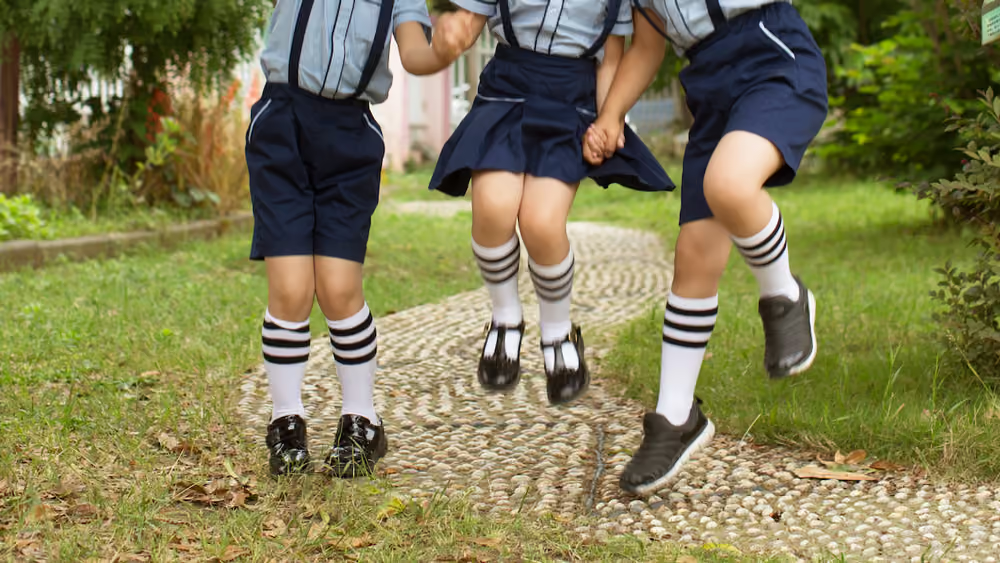
While these foods remind me of home, what I remember most vividly is my school life in North Korea. When I was in fourth grade, the girls in my school would often gather in the schoolyard to play jump rope. I was actually quite good at it. We would start with the rope at ankle height and gradually raise it higher and higher.
One day, when the rope had been raised to about head height, I tried to jump over it. Since I was quite short, I had to lift my leg as high as I could. Unfortunately, I ended up tearing my pants. I was so embarrassed that I almost cried. But what I remember most clearly is my teachers laughing so hard as they watched from the side. Even now, I can still picture that moment vividly.
I also remember winter lunchtime at school. We all brought packed lunches from home. In one corner of the classroom, there was a stove, and before lunch, students would place their lunch boxes on top of it to warm their food.
Sometimes, the lunch box closest to the stove would get burnt. During class, the smell of scorched rice would fill the room and make us so hungry that it was hard to focus. When lunchtime finally came, my friends and I would gather around the stove, sit in a circle, and eat together.
More than anything else, however, I miss the memories of winter. My friends and I would climb the hills near our town, sit on large sacks, and slide all the way down as if we were on sleds. We did it so often that the fabric on the back of our pants would wear thin and eventually tear. When that happened, I would go home only to be scolded by my mother.
Life was not easy in those days. We were often hungry and did not live comfortably. Sometimes we skipped breakfast, and sometimes a thin porridge was all we had for dinner. Yet, despite those hardships, I cannot forget the laughter we shared.
Looking back now, I realize that what I miss is not North Korea as a system. What I miss are the people with whom I laughed and cried, and the memories of my childhood that have stayed with me to this day.
For a long time, however, I could not talk about these feelings to anyone. I kept them to myself, unsure of how others would understand them. That began to change after I met people through Liberty in North Korea (LiNK). For the first time, I found a space where I felt I could speak more honestly about my memories and my life in North Korea.
Through the LiNK English program, I became close to a friend, and together we made a plan to create a book. I would write about real life in North Korea, and she would draw the illustrations for the book. I wanted people to see North Korea not only as a political system, but also as a place where ordinary people live, love, struggle, and create memories.
I shared this plan with someone I trusted deeply in South Korea. But she told me, “No, you can’t!” She said that if I spoke honestly about daily life in North Korea and about how much I miss certain parts of it, despite all the difficulties, people might ask, “Then why are you here? If you miss it so much, why don’t you go back?” Her response hurt me so deeply that I eventually closed my heart to others. After that, I stopped talking about these feelings with anyone. Only later did I finally find a place where I could tell my story freely and without hesitation.
When many people think about North Korea, they often think about politics, missiles, or the regime. But when I think about North Korea, I remember a girl whose pants tore while playing jump rope, students gathering around a stove to eat lunch together, and children laughing as they slid down snowy hills on sacks.
That is why I hope people can see North Korea not only as a political system, but also as a place where ordinary people live their lives. The people living there are not so different from people anywhere else. They laugh, dream, make friends, and create memories. Those are the stories I hope to share.
–
HyeGyeong is a participant of the LiNK English Language Program (LELP), which serves to not only help North Korean defectors build confidence and skills in English, but develop their capacity as advocates for this issue. To that end, we partnered with select LELP “columnists” to write and polish personal essays through multiple rounds of external feedback and revision. Our goal is to have more North Koreans share their stories directly and lead efforts to change the narrative.
We believe the North Korean people can achieve their liberty in our lifetime.
Opportunities like LELP invest in the people building that future now. Help more North Koreans find their voice, reach their goals, and lead change on this issue.
Give Today
Love and Dating ... in North Korea
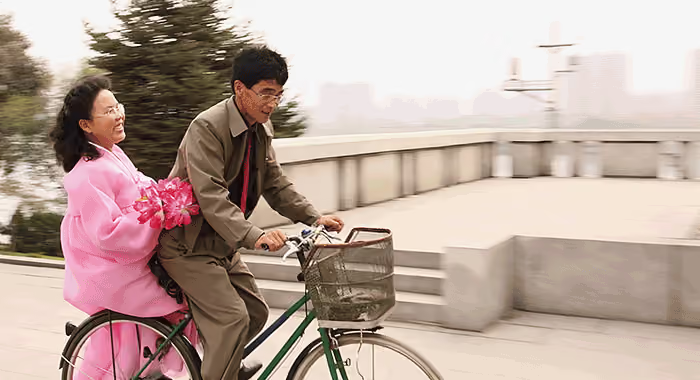
This updated version of Love & Sex in North Korea was originally written by LiNK for Koreaboo.
According to historians who are really good at remembering when things happened in the olden days, sex and love existed before the Internet was even invented. Before 56K dial-up, phones, and even Tinder, humans found ways to interact completely offline and engage in sexual activity. In fact, biologists believe that the human proclivity for sex is universal and plays a major role in producing baby humans, thereby maintaining the human race’s existence. (Go humans!)
So could it be that in North Korea too, people have sex and fall in love and do romantic things with each other?
According to North Korean refugees that I’ve worked with, the answer is: Yes. North Koreans have sex too.
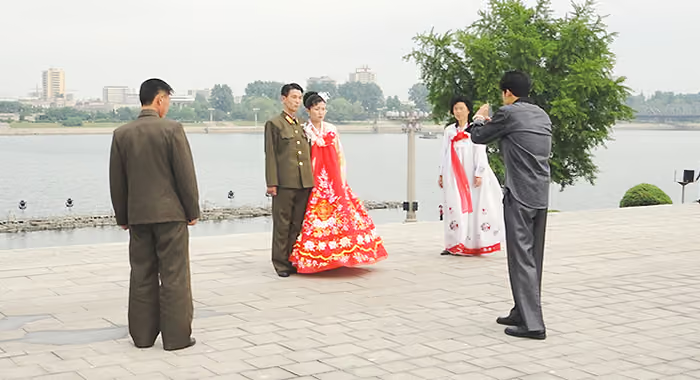
So, how do North Koreans do it?
First of all, the baseline to understand is that overall North Korean dating culture is pretty traditional and conservative. Think South Korea, but 50 years ago. One of the reasons for this is, well, North Korean society is quite conservative and patriarchal in general and North Korean media is super old-fashioned. In North Korean films you don’t see couples kissing or being physically affectionate with each other, so many North Koreans are just not used to PDA and wouldn’t dream of being too affectionate or kissing in public.
Nonetheless North Koreans do meet and date and fall in love like everywhere else. A lot of it starts in school (awww) and people also meet at dances or house parties. That’s right, when the parents are out of town young urban North Koreans will often invite a bunch of friends over and have a party. Once ‘the eyes have met’ the boy often has to do a lot of the pursuing. And guys, spare a thought for our brothers there: Only about 10% of North Koreans have a mobile phone. So for most, it has to be done the old fashioned way.
Either you have to pre-arrange to meet ‘10 trees away from the school gate at 7pm on Wednesday’ or you have to take the risk of going to their house. The danger, of course, is that you knock on the door and their mother answers, causing all that (traditional Asian) embarrassment. So a common trick is to knock and wait for someone to call out “Who is it?” If it’s the mother you say “I’ve come for Eun-kyung” (even though your girlfriend’s name is something else) and pretend you got the wrong house. If your girlfriend answers, then you can say, “It’s me! Come out!” Nicely done.
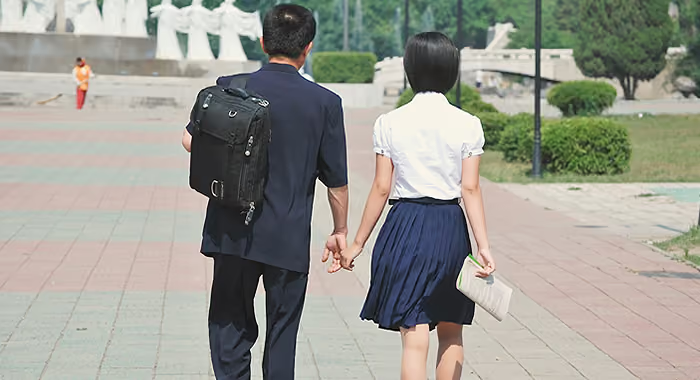
Finding a place to date isn’t so hard; people hang out in the park, or by the river, or around the market. But it’s when you need a bit more privacy that things get more difficult. The vast majority of young North Koreans live in their parents house until they get married (even more so than South Koreans) so there is no privacy at home. So when the relationship heats up, young couples will often go to the North Korean equivalent of a love motel, which is basically paying a middle-aged women to clear out of their own house for a few hours so the couple can get it on. A more risky space for a frisson might be a storage room with an unlocked door, or even a train toilet.
However, there’s a problem here...well, a few in fact. Sex education is almost non-existent in North Korea. And contraceptive pills and condoms can be hard to come by, too (you can’t just stop by the closest 24-hour convenience store). I have a friend who used to smuggle goods from China to sell in North Korea, and she says she saw a pregnancy test for the first time in 2007. She of course promptly smuggled some in to sell to North Korean women. This combination of factors unfortunately leads to a lot of unplanned pregnancies and risky abortions amongst unmarried women.
Like other aspects of North Korean culture, dating culture is not static. And as with other social changes, one of the major drivers is the influx of foreign media being smuggled in on DVDs and USB drives, and now even Micro-SD cards. In fact, one of the reasons South Korean dramas and films are so popular is because, in contrast to North Korean government-produced films, they show compelling human stories of love and relationships, and have addictive plotlines. If all you had access to was government propaganda your whole life and then suddenly you heard that your friends had access to this amazing new foreign stuff, you might risk watching it too.
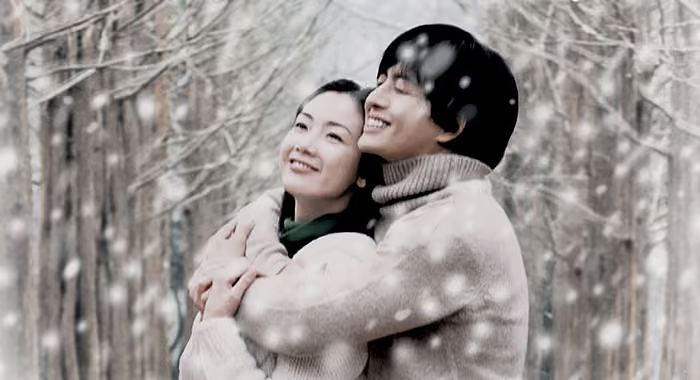
In the first few viewings, these simple South Korean soaps can be revelatory: The PDA, the attitudes of the female characters, even the way they talk and dress. The love story in the Korean drama Winter Sonata, which is credited with starting the Korean Wave across Asia, is still remembered fondly by many North Korean refugees.
Similarly when My Sassy Girl was smuggled in many young women who watched it were driven to imitate not just Jeon Ji-hyun’s fashion and hairstyle, but also the confident and cool way in which her character treats her boyfriend. (And of course in the background of these films and dramas, North Korean viewers can’t help but notice that South Korea looks way richer than North Korea). These information changes are confounding economic changes in their effects on gender relations, as bottom-up marketization has raised the status of women as they play a key role in illegal and semi-legal entrepreneurial business activities.
Humans being humans, porn is also being smuggled into North Korea. And without getting too PG-13, it would be fair to assume that this also opens up and accelerates changes in behaviour between the sheets as well.
It’s worth noting that despite a big growth in flows of foreign media over the last 10 years it is still limited, and especially in the countryside and in the interior of the country away from the border with China, people have much less access (if at all). So there is huge regional variation in North Korea and dating culture will still be very traditional and conservative in the countryside, whilst changing rather quickly in Pyongyang and other major cities and border towns. In addition, young Pyongyangites also mostly have mobile phones now, meaning fewer nervous knocks on doors.
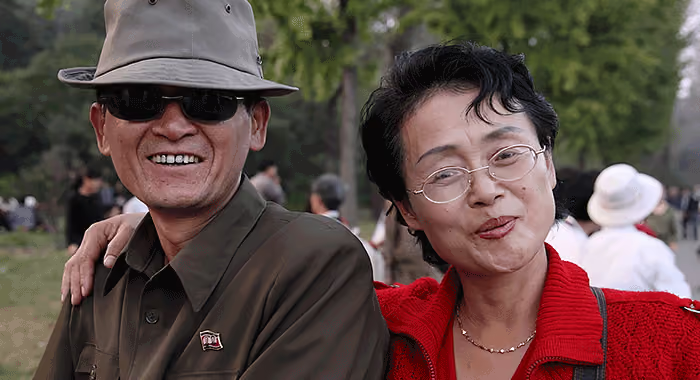
Because of the government’s ongoing restrictions on culture and extreme paranoia over foreign media, North Korea was late to the sexual revolution. But it is now happening, and it is no trivial matter. The emulation of dating culture learned through South Korean and other foreign media, particularly among young urban North Koreans, is contributing to increased sensitivity to foreign trends and a liberalization and modernization of culture and society from the bottom up. And in the long run, it’s this kind of social change that will help usher in a wider transformation and opening of North Korean society, to the benefit of the North Korean people and humanity as a whole.
--SOKEEL PARK - director of research and strategy