
We Call BTS “Bangdan” | Cultural Shifts in North Korea
By: Hannah Oh
Hannah is a North Korea-born intern at Liberty in North Korea’s Seoul office. This article has been reconstructed from her perspective based on DailyNK reports from March 2026.
⏱️ 30-second summary
- K-Pop Power: Young people in North Korea refer to BTS as “BT” to avoid attracting the attention of authorities. They empathize with song lyrics that touch their hearts, in sharp contrast to the ideology prescribed by the state. Even amidst strict crackdowns on South Korean media, people are consuming and sharing K-Pop with their peers.
- Resetting Relationships: It’s now common to see couples in North Korea spending time together in cafes, signaling a change in people’s daily lives. A new culture is emerging where people build relationships by sitting face-to-face over coffee and conversation.
- Expanding Self-Expression: New beauty standards that favor slim bodies and skincare have become popularized. As outside information spreads in North Korea, it’s gradually changing people’s tastes and self-expression.
BTS is a name recognized by people all over the world. This global K-Pop group’s music is even reaching audiences in the most closed country to exist today: North Korea.
The North Korean government severely cracks down on the consumption and spread of foreign media, like South Korean music and dramas. Through foreign media, North Koreans are able to learn things about the outside world that contradict and challenge the regime’s propaganda. In response, the regime passed the “anti-reactionary thought law” in December 2020, which made watching foreign media punishable by 15 years in a political prison camp.
To avoid being caught discussing and sharing about BTS, North Koreans are reportedly shortening the name to “BT.” Even though they cannot directly mention their favorite idol group, they are expressing their fandom by using slang that they understand among themselves.
Changes to daily life in North Korea extend beyond music tastes. From couples quietly conversing in cafes to women experimenting with K-Beauty, this article follows the stories of North Koreans who, despite control and restrictions, are shaping culture and cultivating new standards of leisure, beauty, and expression.
Why North Korean Youth Gravitate Towards K-Pop

It is reported that among young people in North Korea, it is common to refer to BTS, or “Bangtan,” as BT, or “Bangdan,” to avoid the scrutiny of North Korean authorities cracking down on illegal foreign media. Fans in North Korea have cited songs such as “I’m Fine,” “Go,” “Danger,” and “Spring Day” as their favorites, and expressed a desire to dress like the BTS members.
These developments might suggest that instead of foreign media being a taboo topic of discussion, it has become a language of taste shared among peers.
In response to the popularity of South Korean music, North Korean authorities imposed a city-wide lecture series that warned “The only love young people should pursue is revolutionary and comradely love.” However, after the lectures ended, it is reported that the sentiment among young people was that “South Korean song lyrics seem to understand my heart,” and “the emotions they actually feel” over “the emotions permitted by the state.”
Cuppaccinos Over Flowers: Dating Culture in North Korea

In North Korea, there is still a strong perception that cafes are places frequented only by the well-off. However, this year on March 8th for International Women’s Day, reports emerged of husbands visiting coffee shops with their wives, holding hands, and spending time drinking lattes or cappuccinos. Rather than traditional gestures like flowers or doing extra housework, there seems to be a cultural shift of celebrating by spending time together.
After visiting a cafe for the first time, residents reportedly commented that “It’s surprisingly nice because you can talk quietly.” Their perception of this space—previously considered unsuitable for leisure amidst busy lives—changed after actually experiencing it for themselves. The growing popularity of cafes as a space where two people can sit face-to-face and share a private conversation may seem like a minor development, but it is not insignificant.
People’s perceptions and behaviors don’t only change when systems or policies are altered; shifts in how individuals interact and go about their daily lives is also a catalyst for change.
The Far-Reaching Influence of K-Beauty

There have also been reports that interest in beauty treatments and taking care of one’s appearance is growing in North Korea, particularly among affluent women. Younger women have taken to dieting, while middle-aged women are spending money on cosmetic procedures like Botox to reduce wrinkles. North Korean beauty standards have historically favored a fuller figure to look healthy, but now there is an emerging preference to look slimmer. According to one source, this is due to the influence of South Korean culture.
Even in South Korea, there is an ongoing debate as to whether striving for a slim body and youthful appearance is a healthy pursuit. Nevertheless, this shift in North Korean beauty habits is notable.
Individuals are seeking change and acting on their own initiative, influenced by external information, rather than following the standards set out by the regime.
However, it must be noted that these developments seem to be more prominent among wealthy women with financial means, as opposed to the entire population.
Pop Culture as a Catalyst for Change in North Korea
The global influence of K-Pop groups like BTS is usually measured by streaming numbers or chart rankings. But the most significant marker of impact might be found in North Korea, where people risk their lives to listen to their songs. Even in the most closed country in the world, there are people who enjoy heartfelt music, shared conversation over a cup of coffee, and self-care.
If you zoom in past the image of North Korea as a bleak, oppressed country, there are millions of people going about their everyday lives. Small cultural shifts and changing attitudes may seem insignificant. But over time, these compounding changes could bring about transformation in North Korea.
Increasing Information Access for North Korean People
As evidenced by these developments, North Koreans are watching foreign media and have a growing awareness of the outside world. At Liberty in North Korea, we believe that access to uncensored outside information is key to increasing forces of change and opening inside the country. Empowered with information access, North Koreans can imagine a different life for themselves and push the boundaries of the regime’s control.
We work with North Korean partners and engineers to develop and distribute tailored technology and content to help more people inside the country safely access uncensored information.
You can help bring truth to where it’s urgently needed.
Give Today
North Korean Fellows in the United States: Meet the Class of 2025
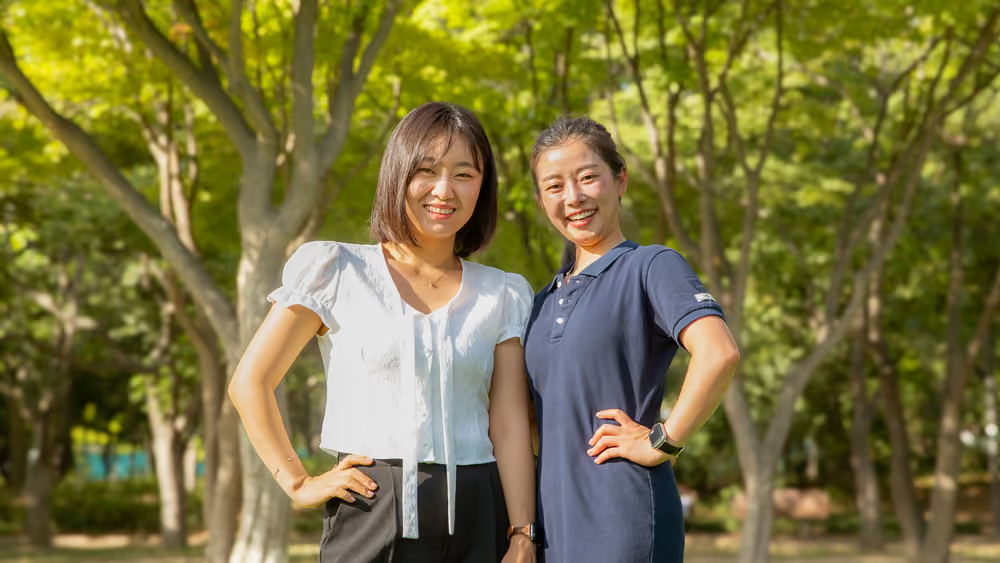
Please join us in welcoming Hannah and Rose, LiNK’s 2025 Advocacy Fellows!
The Advocacy Fellows program partners with young North Korean defectors to build their skills as effective leaders, storytellers, and agents of change for this issue. Hannah and Rose spent the last month training and preparing with our team in South Korea, and will now be traveling across the US to share their stories!
Join us at a Fellows speaking event near you!
Dallas, TX
September 9th, 6pm
Southern Methodist University | Dallas Hall Room 306 (McCord Auditorium)
3225 University Blvd, Dallas TX 75205
RSVP Here
Guest parking information here
Waco, TX
September 11th, 6pm
Baylor University, Foster Campus | Room 240
1621 S 3rd St, Waco, TX 76706
RSVP Here
Parking: 1521 S Fourth St. Waco,TX 76706 (Google maps or Apple Maps)
Madison, WI
September 16th, 12pm
UW-Madison | Lubar Commons (Room 7200)
975 Bascom Mall, Madison, WI 53706
RSVP here
Evanston, IL
September 20th, 5pm
Northwestern University | Harris Hall 107
1881 Sheridan Rd, Evanston, IL 60201
RSVP Here
Palo Alto, CA
September 28th, 1:20pm
True North Church
655 Arastradero Road, Palo Alto, CA 94306
RSVP Here
Berkeley, CA
September 29th, 6pm
UC Berkeley | Stephens Lounge at the MLK Student Union
2495 Bancroft Way, Berkeley, CA 94720
Parking: Lower Sproul Garage
RSVP Here
Washington, D.C.
October 8th, 1pm ET
The Stimson Center
1211 Connecticut Avenue Northwest Washington, DC 20036
RSVP Here
*Online livestream also available: RSVP Here
Washington, D.C
October 9th, 10:30am
ET Hudson Institute
1201 Pennsylvania Ave N.W. Suite 400 Washington, DC 20004
RSVP Here
Philadelphia, PA
October 13th, 5:30pm
University of Pennsylvania
3401 Walnut Street, Philadelphia, PA 19104
RSVP Here
New York, NY
October 16th, 2025, 12 PM
The Korea Society
350 Madison Avenue, 24th Floor
New York, NY 10017
RSVP here
Los Angeles, CA
October 21st, 7:30pm
UCLA
Haines Hall Room A2 Portola Plaza, Los Angeles, CA 90095
Parking available in UCLA Parking Structure 2
RSVP here
Additional details and timely updates will be sent to RSVP’ed guests via email.
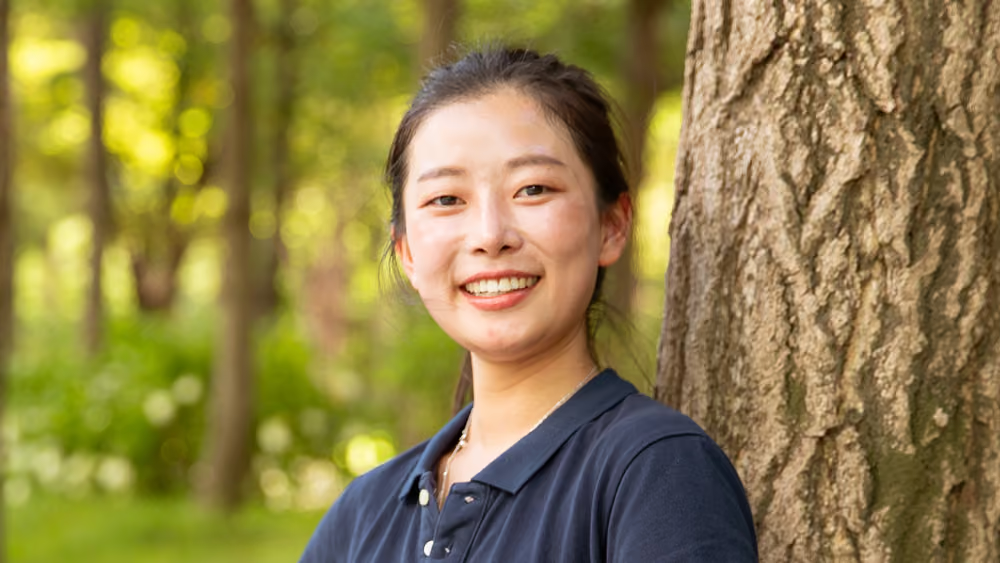
Hannah is a 4th year student at Hongik University studying Electrical and Electronic Engineering. While participating in LiNK’s Changemaker Scholarship Program, she worked on developing devices and strategies that increase information access for people inside North Korea. Her goal as an Advocacy Fellow is to grow as a leader and communicator, and facilitate more collaborative work on this issue.
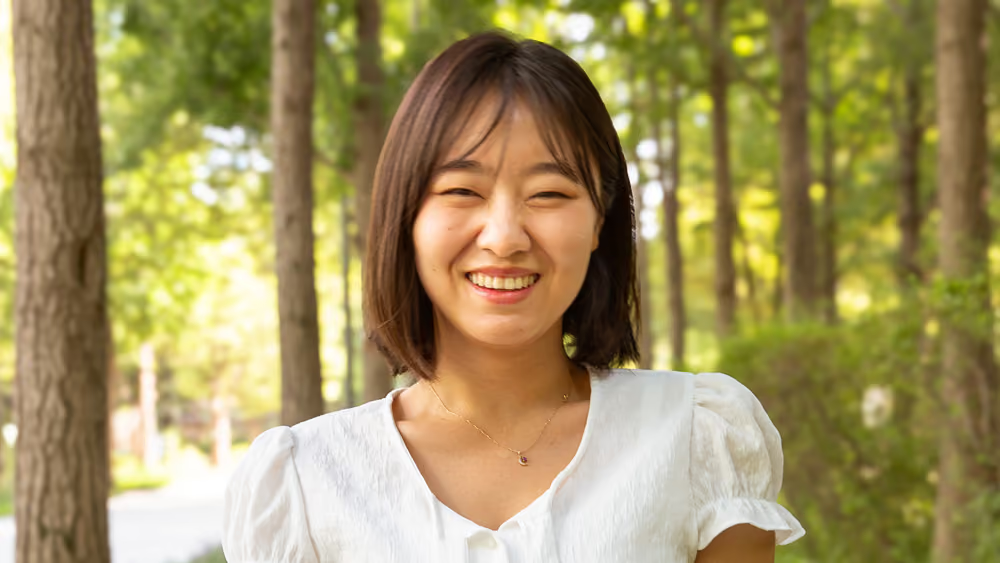
Rose graduated from Hongik University’s Department of Architecture. For her final project, she designed a memorial to honor North Korean human rights and provide comfort to defectors who had to leave their homeland. She drew inspiration from the Holocaust and 9/11 Memorials in the US, and was deeply moved by how such spaces contribute to healing and progress. As an Advocacy Fellow, Rose hopes to continue finding her identity and increase interest in this issue.










