
We Call BTS “Bangdan” | Cultural Shifts in North Korea
By: Hannah Oh
Hannah is a North Korea-born intern at Liberty in North Korea’s Seoul office. This article has been reconstructed from her perspective based on DailyNK reports from March 2026.
⏱️ 30-second summary
- K-Pop Power: Young people in North Korea refer to BTS as “BT” to avoid attracting the attention of authorities. They empathize with song lyrics that touch their hearts, in sharp contrast to the ideology prescribed by the state. Even amidst strict crackdowns on South Korean media, people are consuming and sharing K-Pop with their peers.
- Resetting Relationships: It’s now common to see couples in North Korea spending time together in cafes, signaling a change in people’s daily lives. A new culture is emerging where people build relationships by sitting face-to-face over coffee and conversation.
- Expanding Self-Expression: New beauty standards that favor slim bodies and skincare have become popularized. As outside information spreads in North Korea, it’s gradually changing people’s tastes and self-expression.
BTS is a name recognized by people all over the world. This global K-Pop group’s music is even reaching audiences in the most closed country to exist today: North Korea.
The North Korean government severely cracks down on the consumption and spread of foreign media, like South Korean music and dramas. Through foreign media, North Koreans are able to learn things about the outside world that contradict and challenge the regime’s propaganda. In response, the regime passed the “anti-reactionary thought law” in December 2020, which made watching foreign media punishable by 15 years in a political prison camp.
To avoid being caught discussing and sharing about BTS, North Koreans are reportedly shortening the name to “BT.” Even though they cannot directly mention their favorite idol group, they are expressing their fandom by using slang that they understand among themselves.
Changes to daily life in North Korea extend beyond music tastes. From couples quietly conversing in cafes to women experimenting with K-Beauty, this article follows the stories of North Koreans who, despite control and restrictions, are shaping culture and cultivating new standards of leisure, beauty, and expression.
Why North Korean Youth Gravitate Towards K-Pop

It is reported that among young people in North Korea, it is common to refer to BTS, or “Bangtan,” as BT, or “Bangdan,” to avoid the scrutiny of North Korean authorities cracking down on illegal foreign media. Fans in North Korea have cited songs such as “I’m Fine,” “Go,” “Danger,” and “Spring Day” as their favorites, and expressed a desire to dress like the BTS members.
These developments might suggest that instead of foreign media being a taboo topic of discussion, it has become a language of taste shared among peers.
In response to the popularity of South Korean music, North Korean authorities imposed a city-wide lecture series that warned “The only love young people should pursue is revolutionary and comradely love.” However, after the lectures ended, it is reported that the sentiment among young people was that “South Korean song lyrics seem to understand my heart,” and “the emotions they actually feel” over “the emotions permitted by the state.”
Cuppaccinos Over Flowers: Dating Culture in North Korea

In North Korea, there is still a strong perception that cafes are places frequented only by the well-off. However, this year on March 8th for International Women’s Day, reports emerged of husbands visiting coffee shops with their wives, holding hands, and spending time drinking lattes or cappuccinos. Rather than traditional gestures like flowers or doing extra housework, there seems to be a cultural shift of celebrating by spending time together.
After visiting a cafe for the first time, residents reportedly commented that “It’s surprisingly nice because you can talk quietly.” Their perception of this space—previously considered unsuitable for leisure amidst busy lives—changed after actually experiencing it for themselves. The growing popularity of cafes as a space where two people can sit face-to-face and share a private conversation may seem like a minor development, but it is not insignificant.
People’s perceptions and behaviors don’t only change when systems or policies are altered; shifts in how individuals interact and go about their daily lives is also a catalyst for change.
The Far-Reaching Influence of K-Beauty

There have also been reports that interest in beauty treatments and taking care of one’s appearance is growing in North Korea, particularly among affluent women. Younger women have taken to dieting, while middle-aged women are spending money on cosmetic procedures like Botox to reduce wrinkles. North Korean beauty standards have historically favored a fuller figure to look healthy, but now there is an emerging preference to look slimmer. According to one source, this is due to the influence of South Korean culture.
Even in South Korea, there is an ongoing debate as to whether striving for a slim body and youthful appearance is a healthy pursuit. Nevertheless, this shift in North Korean beauty habits is notable.
Individuals are seeking change and acting on their own initiative, influenced by external information, rather than following the standards set out by the regime.
However, it must be noted that these developments seem to be more prominent among wealthy women with financial means, as opposed to the entire population.
Pop Culture as a Catalyst for Change in North Korea
The global influence of K-Pop groups like BTS is usually measured by streaming numbers or chart rankings. But the most significant marker of impact might be found in North Korea, where people risk their lives to listen to their songs. Even in the most closed country in the world, there are people who enjoy heartfelt music, shared conversation over a cup of coffee, and self-care.
If you zoom in past the image of North Korea as a bleak, oppressed country, there are millions of people going about their everyday lives. Small cultural shifts and changing attitudes may seem insignificant. But over time, these compounding changes could bring about transformation in North Korea.
Increasing Information Access for North Korean People
As evidenced by these developments, North Koreans are watching foreign media and have a growing awareness of the outside world. At Liberty in North Korea, we believe that access to uncensored outside information is key to increasing forces of change and opening inside the country. Empowered with information access, North Koreans can imagine a different life for themselves and push the boundaries of the regime’s control.
We work with North Korean partners and engineers to develop and distribute tailored technology and content to help more people inside the country safely access uncensored information.
You can help bring truth to where it’s urgently needed.
Give Today
The Red Box: Misunderstandings and Stereotypes about North Koreans
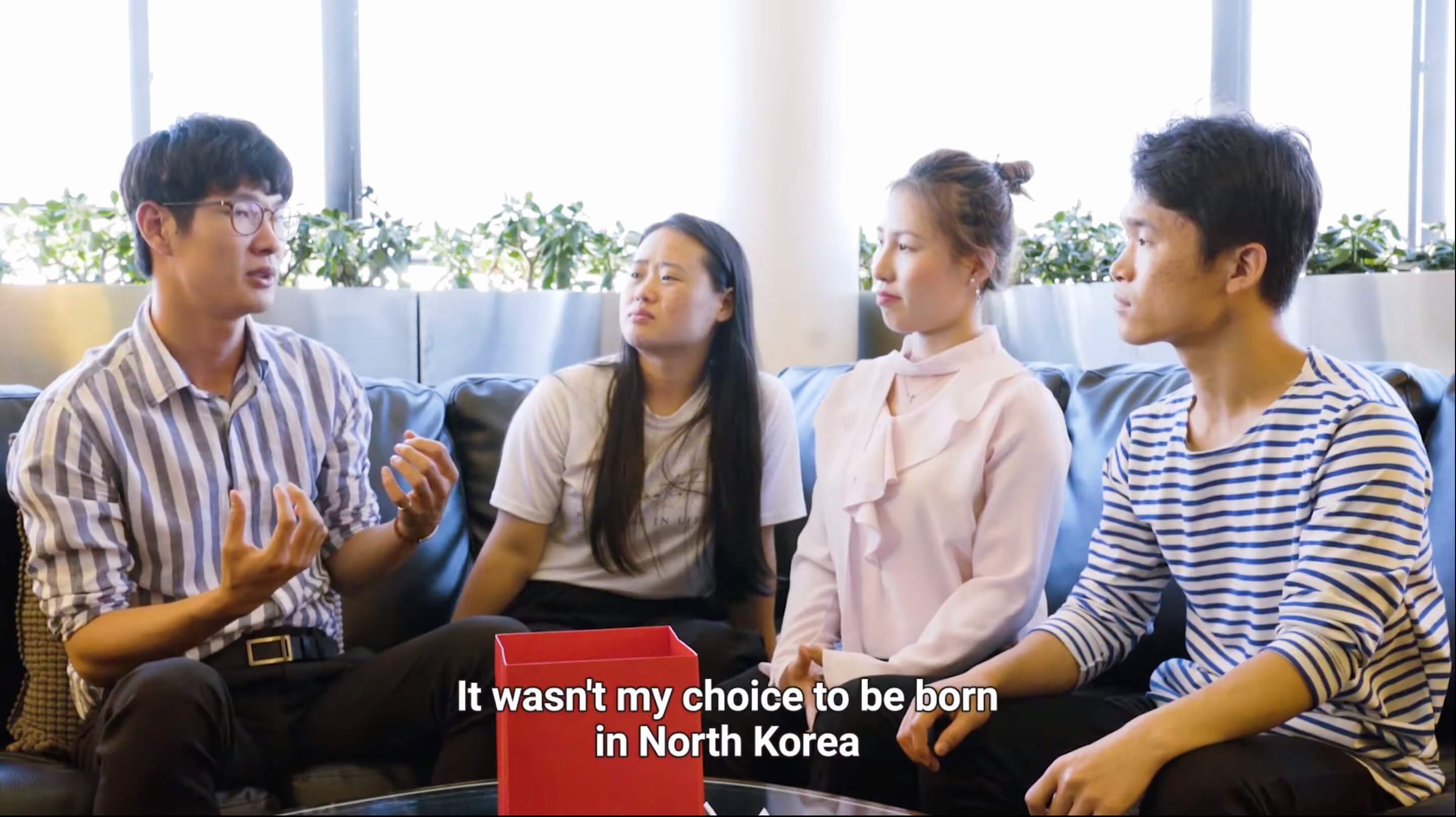
For North Korean refugees, resettling in a new society comes with many challenges. One of these challenges is overcoming the stereotypes about North Korea and the North Korean people.
In the latest episode of The Red Box, our North Korean friends and 2019 LiNK Advocacy Fellows talk about the struggle of of facing stereotypes after resettling in South Korea.
Watch as Jeongyol, Joy, Dasom, and Ilhyeok answer your questions in The Red Box Series!
Read the transcript of this episode below!
All: Welcome to the Red Box!
Jeongyol:
Are there any misunderstandings about the North Korean people that make you feel uncomfortable?
Ilhyeok: Misunderstandings?
Joy: When I first came to South Korea, was working part-time at a convenience store. I was still very young and had a very heavy North Korean accent.
In South Korea, when a customer enters the part-time employees don't really greet them. But I used to greet the customers standing and say "Welcome!" so people would ask me where I'm from.
I'd tell them that I'm from North Korea. They'd say "oh really?" After they get their stuff and put them on the counter, they'd asked me if I ever had jjajangmyun or pork in North Korea? They'd ask me these types of questions. Some people ask because they don't know but sometimes they ask questions that insinuate that we were all so poor in North Korea. Not everyone in North Korea is like that. There's people who live well too
Jeongyol: If someone asked me that, I’d tell them I might've lived a wealthier life there [in North Korea].
Joy: So those types of questions made me feel a little uncomfortable.
Jeongyol: A lot of people think like that.
Dasom: People think that all North Koreans are poor, ignorant, and uneducated. People have told me that even though I must have starved and lived poorly in North Korea, I don't look the part.
Maybe some people did or didn't have enough food to eat. There are poor people and there are rich people too. Every country is the same — it’s the same in South Korea too. There are rich, poor, and homeless people in South Korea too. I don't think it's right to judge someone like that. It made me feel very uncomfortable
Jeongyol: When I was in high school, there was a soccer match between North Korea and South Korea. But all of a sudden they asked me which team I'm cheering for. So I was startled by the question.
Should I say I'm cheering for North Korea or South Korea? What's my identity?
Even though I'm living in South Korea as a South Korean citizen, they didn't recognize the fact that I'm also South Korean. That we were the same people.
So at the time I answered, "I'm not cheering for either team. I don't care who wins. I’m just watching the game for fun.” It went over smoothly but afterward I kept thinking about it. But now that I think about it…It wasn't my choice to be born in North Korea.
Dasom: Right
Jeongyol: I could've been born in the U.S. but somehow I was born in North Korea.
Anyone could've been born in North Korea.
It's not anyone's fault. So from that moment on, I became confident. I am just who I am.
Ilhyeok: I have this older friend from China. During holidays like in January, he'd always ask me if I am visiting my hometown. Whenever he asks me that question, I want to be able to tell him that I'm am going [home] but I can't because I can't go back so I just don’t answer him. When he asked me if I'm going home, I just wished that I could return home one day.
It's heartbreaking not being able to go home.
During Chuseok and New Year's Day, those two holidays are when I miss home the most.
Joy: One uncomfortable question for me was when I was in school or met people was when they asked me why there's no riot or uprising in North Korea. Sometimes people ask because they really don't know but sometimes they insinuate that we're cowards.
And with that viewpoint, they ask why we won't revolt against the government. I try to explain but they still insist and say, ”But you guys still should have done something.” That makes me a little sad.
In North Korea, there's a system of monitoring each other. So if one person says something bad, they'd get reported right away and taken.
Jeongyol: In South Korea there were a lot of civil riots so they ask why we didn't do anything in North Korea.
Joy: But it's a very different situation.
Jeongyol: The system doesn't allow it.
Dasom:
What also made me uncomfortable was if I did something wrong, people would blame it because I'm North Korean.
They say things like, “It's because she's North Korean.” That made me upset. Other people say bad things and make mistakes too. But because of one mistake they say all North Koreans are like that and that I wouldn't know things or be able to do things because I'm from North Korea.
I hated hearing that so I wouldn't tell anyone that I was from North Korea.










