Women’s History Month: Honoring the Bravery of North Korean Women
By: Jennifer Kim
Jennifer* is Liberty in North Korea’s Field Manager. Over the years, she’s carefully stewarded our secret rescue routes and helped countless North Korean refugees reach safety and freedom.
Approximately 70% of North Korean defectors are women. Throughout their journey, they face unimaginable challenges, including human trafficking, confinement, and sexual violence.
For Women’s History Month this year, we asked Jennifer to share her experiences supporting North Korean women who have made the brave decision to escape, and bring light to the stories of real people behind the numbers and statistics.
A Transformative First Mission
When I first began this line of work, I was filled with both excitement and anxiety. “Will I be able to connect well with these people?” “Will the field be too dangerous?” Even in my position as a staff member, there were times when the situations we encountered felt riskier because I was a woman.
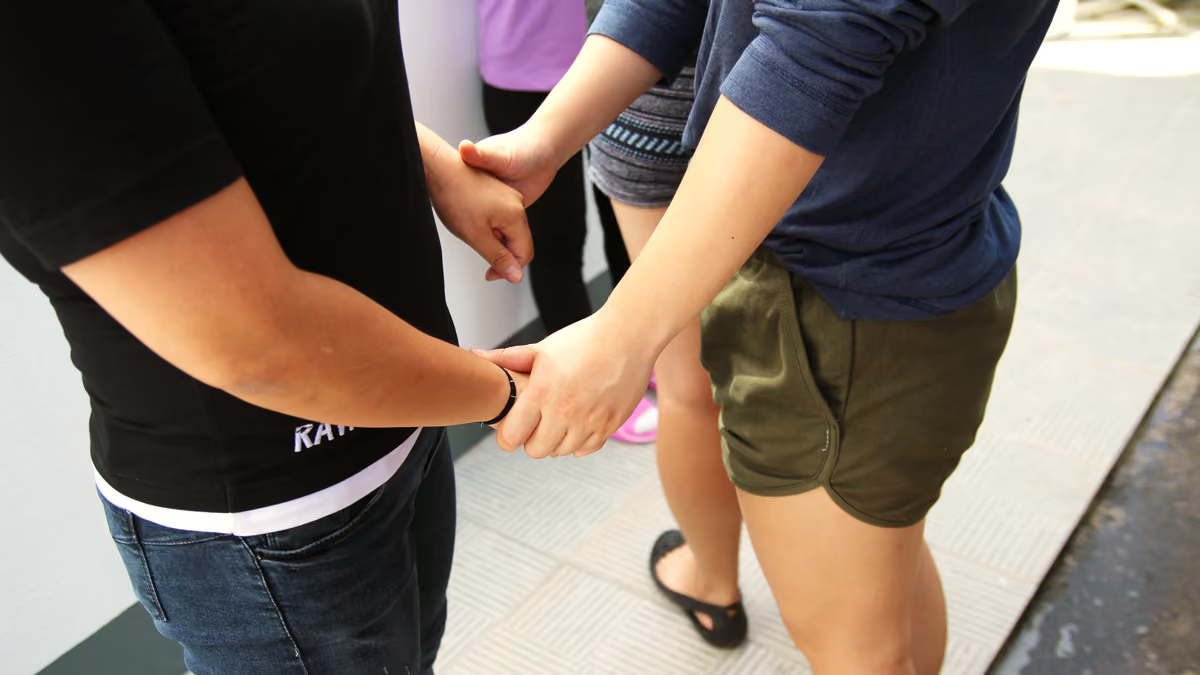
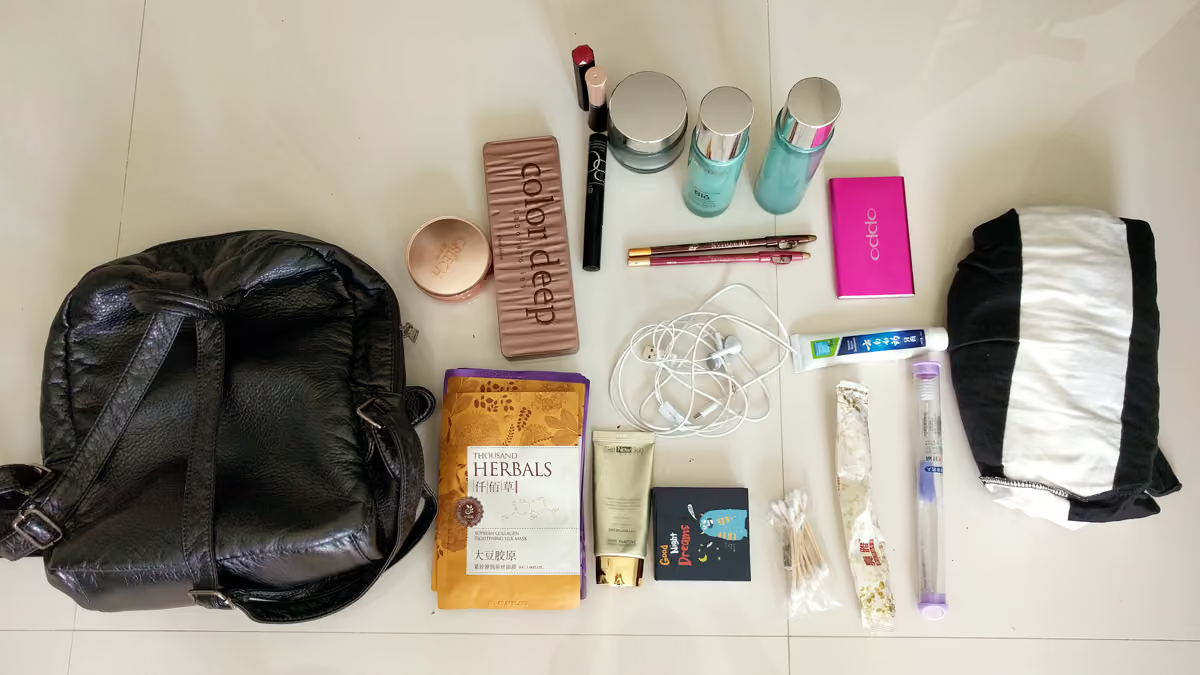
On my first mission, the group we brought to safety were all women. From their small requests, like asking for sanitary pads, to moments where they cautiously shared their harrowing experiences of human trafficking in China, I found that we could connect on a deeper level because I was also a woman. I realized my role wasn’t just to be a staff member, but to stand by these people as they needed me, as a fellow woman. From then on, the fear I had initially felt about this work transformed into conviction.
North Korean Women At the Forefront of Resistance and Survival
After meeting many North Korean women defectors, I’ve come to learn that there are unique challenges and experiences that only they face. Women in North Korea are not as restricted to job assignments as men, so they’re the ones actively engaged in informal economic activities. They’re running their own black-market businesses and trading smuggled goods, shifting economic power from the regime into the hands of the ordinary people.
Women also make up the majority of North Korean defectors at over 70%. In freedom, they’re leading advocacy efforts and raising awareness for this issue.
I've come to think that perhaps women in North Korean society were the first and most desperate to stand up in resistance.
At the same time, the reality is that women are more vulnerable to gender violence and crime. The moment they cross the North Korean border and set foot on Chinese soil, their precarious legal status and the fact that they are women become risk factors that can lead to human trafficking, sexual exploitation, and forced prostitution. If these dangerous situations lead to pregnancy and childbirth, women often remain in China for years, even decades, weighed down by the conflicting emotions of their longing for freedom and their maternal instincts.
All of the women I met during my first rescue mission were survivors of being trafficked into forced marriages. While there are some cases where these women meet kind families and live in a relatively less dangerous environment, most have to endure difficult lives. One woman who we rescued in 2024 said that in the early stages of her life in China, she was confined and tied up in a single room by the man who bought her. Others had to do forced labor in one of China’s many factories.
Not a News Story, But a Person’s Story
About ten years ago, I watched a video of a woman my age testifying about the hardships and sexual violence she experienced during her defection from North Korea. As a South Korean, I couldn't believe that such things were happening just across the border. Shocked and ashamed of my indifference, I cried for a long time, then resolved to do something.
North Korea used to be something I only saw and heard about through a TV screen. Now those distant news stories have become the personal experiences of the North Korean mothers and friends I’ve met in the field.
At first, I simply wanted to help as best I could. But as time went on and I met more North Koreans, my perspective gradually changed. Now, I feel like I'm not so much ‘helping’ as I am meeting incredible superwomen who have overcome tremendous adversity.
My role is to constantly remind them of their resilience and potential, so they don't forget it themselves.
“This is My First Time Being Treated Like a Queen”
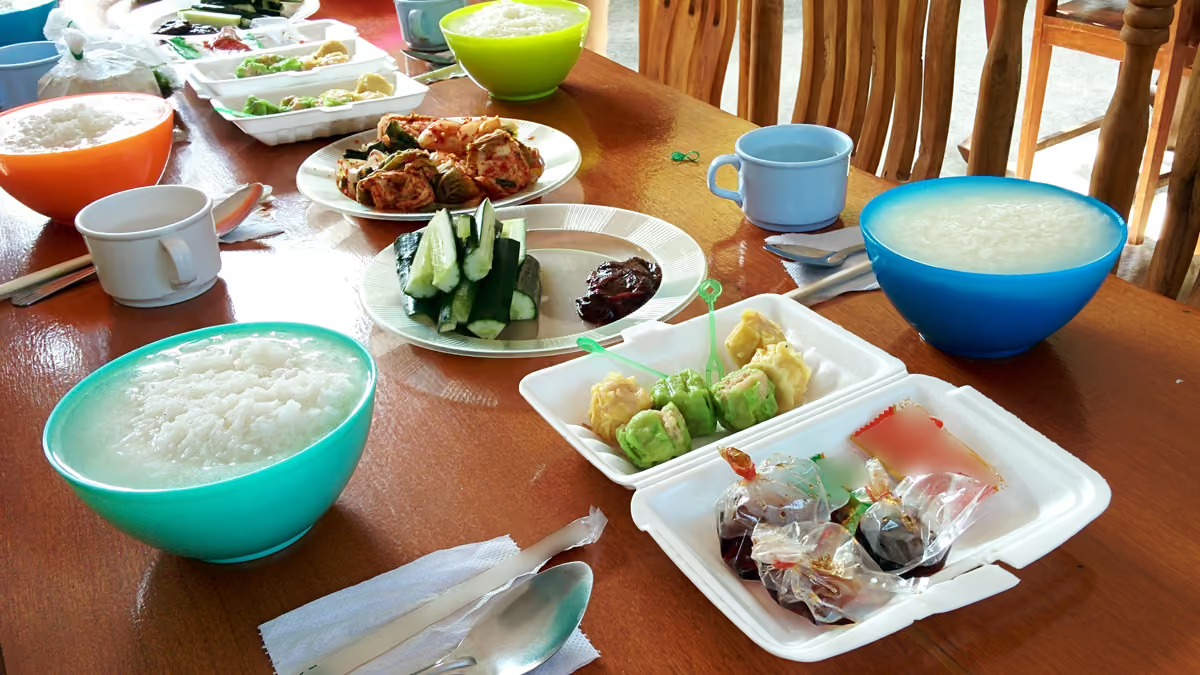
After a successful mission, our team ensures our newly arrived North Korean friends have a proper meal, get some rest, and receive basic necessities. On one occasion, one woman told me, “This is the first time in my life that I have been treated like a queen.”
She had just reached freedom after ten years in a forced marriage to a Chinese man. Her words resonated with me deeply. I realized once again that our work isn't simply about helping people achieve physical freedom; it's about restoring a person's forgotten dignity.
That woman has since resettled in South Korea and runs a small shop. She’s continued to stay in contact with LiNK, sharing updates about her life. One day, she shyly announced her marriage. She’s starting a new chapter with a person she chose and wanted.
Walking Together In Solidarity
Through the friendships I’ve made and stories I’ve witnessed in the field, my connection to this issue has deepened over time. These women aren’t just “nameless” North Koreans, but people like us, living their daily lives; someone’s daughter, sister, or mother. I didn’t set out to do this work for over a decade. But day by day, hearing each story, meeting each person, and holding their hands has naturally led me down this path.
Listen to their stories, and I believe that you too will encounter a heart for the North Korean people.
– Jennifer Kim, LiNK Field Manager
*Jennifer is a pseudonym used to protect our field manager’s identity and avoid compromising this work.

Help North Koreans Win Their Freedom
From inside the country to on the global stage, North Korean women are driving change on this issue. Driven by necessity, desire to care for their loved ones, and aspirations to forge their own path in this world, their pursuit of freedom is both intentional and instinctive.
Liberty in North Korea doesn't just extend a helping hand to North Korean refugees—we’re cultivating the next generation of North Korean leaders, entrepreneurs, and advocates, and doing this work alongside them.
Become a monthly donor today at $20 per month to help more North Koreans reach safety and gain full authorship of their lives in freedom.
Give Monthly
NK Perspectives: 5 North Koreans weigh in on the second Kim-Trump Summit
We asked 5 North Koreans what they thought of the 2nd Kim-Trump summit, their perception of the U.S while growing up, and what they wish the world knew about North Korea.

What went through your mind when you saw Kim Jong Un and President Trump shaking hands last year?

Jessie Kim
27 years old, from Hyesan, escaped in 2011
Jessie: When I saw Trump and Kim Jong Un shaking hands during the first North Korea-U.S. summit, two things came into my mind.
1. With the help of the United States, maybe South and North Korea will actually reunify. And especially when I saw them shaking hands, I couldn’t stop crying thinking how one day I might meet my family again.
2. At the same time, I was worried that the world might forget about the North Korean people who are suffering behind Kim Jong Un’s political showmanship.

Jung Jin
35 years old, from Yanggang Province, escaped in 2014
Jung Jin: In North Korea, everyone is taught to be hostile towards America from an early age. We’re taught that the American imperialists are our mortal enemy with whom we cannot live together under the same sky.
So when I saw Kim Jong Un smiling and shaking hands with the president of the U.S., I really wondered what was going on in his head. For Trump, it’s about nuclear weapons, and for Kim Jong Un, it’s about maintaining his regime. I was worried about who on earth would help the tens of millions of North Korean people who are suffering because of that regime.

Geumhyok Kim
27 years old, from Pyongyang, escaped in 2012
Geumhyok: It didn’t leave me with any particular feeling. Watching the heads of the two countries, which have been enemies for so long, shaking hands and strolling down a garden path together can itself be an emotional and meaningful thing.
However, I feel that the Singapore Summit had far too many shortcomings to solve the nuclear problems of the Korean Peninsula when one considers the highly complex underlying issues and interests involved. In the final analysis, although it may have looked as if the North Korean issue might even be solved immediately after the summit, nothing has changed in reality and it has only served to highlight the difference in the basic positions of the two sides.

Joseph Park
37 years old, from North Hamkyung Province, escaped in 1999
Joseph: To be honest, I was expecting the Trump-Kim moment to be more emotional because the previous summit between president Moon and Kim Jong Un was such a powerful moment, but it didn’t live up to my expectation. Unlike the inter-Korean summit, the U.S-North Korea summit hasn’t produced any tangible results, which is disappointing.

Jinho Kim*
24 years old, from Chongjin, escaped in 2008
Jinho: I felt that many people would fall for the propaganda. Kim Jong Un shook hands with the president of the United States for the first time in history, so the thought that many people expected peace to come and might see Kim Jong Un as a normal leader worried me. The more Kim Jong Un develops his image as a normal leader, the quieter the voices calling for human rights for the North Korean people will become.
*Name changed for privacy reasons
When you were in North Korea, what was your perception of the United States?
Jessie: When I was growing up in North Korea, I really wanted to visit America during my lifetime. When I was young, my grandma used to tell me stories about American soldiers [that she met during the Korean War], and after my mother died I used a lot of American dollars while running my private business. The North Korean government teaches us that America is very bad, but in the jangmadang (markets) the U.S. dollar is valued very highly. These social contradictions made me doubt the state, and ultimately led to my escape.
Jung Jin: Since I received so much anti-American education when I was young, I thought that Americans were all scary looking vicious murderers. But my thinking started to change as I got older and I watched American movies that were smuggled across the border from China. I was able to feel at least a bit like Americans are just human and many of them are good people.
Geumhyok: When I was in North Korea, I received two kinds of education about the U.S. The first was the general anti-American education and the second was a more in-depth strategic analysis of the U.S. when I was enrolled at the Pyongyang Foreign Languages School and Kim Il Sung University as a student of English Literature. I personally felt the power of the U.S, and was afraid of it. I never once thought that North Korea could defeat the U.S. in a war as claimed by the North Korean government. In fact, I dreaded the opposite outcome.
Joseph: We were taught that the United States is our mortal enemy who made the Korean people suffer, and is an invader occupying South Korea. However, when I came to South Korea the people that influenced me the most were Americans. Despite the sanctions imposed on North Korea by the U.S. and the international community, the people doing humanitarian work in the North are Americans. I think the North Korean government demonizes the U.S. for political gain in much the same way American politicians demonize Islam or South Korean right-wing politicians and the Abe administration of Japan demonize North Korea for political gain.
Jinho: I was faithful to what I was taught so I believed the U.S. was our mortal enemy. When I played with my friends, the kids playing the role of ‘bad guys’ always pretended to be Americans. When the U.S. and North Korea made a gesture of peace, I thought that the U.S. was surrendering to North Korea. I only thought of the U.S. as an imperialist power that was oppressing our people.
What are your personal hopes for this summit?
Jessie: Honestly, I don’t have high hopes for the second North Korea-U.S. summit. After the first NK-U.S. summit that seemed would lead to huge change, and after three North-South summits, I think the world has just helped Kim Jong Un to get what he wants. Especially when we consider that the second NK-U.S. summit is being held in Hanoi, Vietnam, we can see more clearly what Kim Jong Un’s objective is. If we really want to achieve peace between North Korea and South Korea, then we need to throw away any hopes of North Korea giving up their nuclear weapons and direct our policy effort at making North Korea reform, open, and develop the economy for the people, not just for Kim Jong Un.
Jung Jin: I know it seems like a really futile hope, but I wish that the North Korean people are in Kim Jong Un’s mind even a little bit when he is doing this summit. I hope rather than only obsessing about how he can maintain his regime, he spares a second’s thought for the people."The one thing I want to tell the world about North Korea is that the people living there are ordinary people just like us."
Geumhyok: To be honest, I am skeptical about the upcoming meeting. A summit is no more than a show. I would say that the series of working-level talks leading up to the summit are more important. There have been many negotiations but denuclearization is becoming less likely by the day, and in fact it seems we might be heading for just a nuclear freeze. It’s hard to see a negotiation that deviates from one’s original goal and gradually finds a point of compromise as a victorious one. That’s why I don’t have high hopes for this summit.
Joseph: I hope North Korea and the U.S. end the armistice and declare an end to the war, sign a peace treaty, and establish diplomatic relations. And I sincerely hope that North Korea dismantles its nuclear weapons and the Korean peninsula turns into a land of peace so that there is no more pain for separated families.
Jinho: I hope the U.S. will take the initiative in the talks and force Kim Jong Un to give up his nuclear weapons and open up the country. I hope that there will be no declaration ending the Korean War or the signing of a peace agreement. Since North Korea still has the ambition of unifying the whole peninsula, if there is a declaration ending the war or peace treaty, the Korean Peninsula could fall into the hands of North Korea, just like what happened in Vietnam which is where Kim Jong Un chose as the venue for the talks.
If North Korea were to sign a peace treaty and improve relations with the United States, a country they have long propagandized as their eternal enemy, how would this influence North Korean society and culture?
Jessie: Personally, I think it’s difficult to expect that signing a peace treaty and ending hostilities will change the perceptions of ordinary citizens who are struggling to make a living, because a peace treaty signed by Kim Jong Un would be for the benefit of the regime, not for the people. A true peace treaty is one that facilitates economic reforms and actually improves the lives of the people.
Jung Jin: North Korean people live with not just their freedom, but even their human instincts repressed. If North Korea ends their hostile relationship with America, the symbol of capitalism, then socially and culturally the winds of capitalism will blow strongly in North Korea. I think there will be a lot of change in people’s fashion particularly. And if people’s fashion changes, then of course people’s consciousness changes too.
Geumhyok: A peace treaty between the U.S. and North Korea has many meanings. I, too, want to see the hostilities between the two countries end and an improvement of bilateral relations. However, to realize this there are many hurdles to be overcome. Realistically, it’s near impossible. First, the situation in South Korea doesn’t allow it. The two Koreas have starkly different systems and their respective constitutions both state that the other side should be reunified under their system. A peace treaty between the U.S. and North Korea will undermine the basis for the deployment of U.S. troops in South Korea and, in turn, destabilize the North-South power balance. This can catalyze new security concerns and affect the Northeast Asian order in an unpredictable way. Without any meaningful change to the authoritarian dictatorship of North Korea, the socio-cultural impact of a peace treaty will not be felt by the people. In fact, it can work towards bolstering North Korea’s dictatorship."...a peace treaty signed by Kim Jong Un would be for the benefit of the regime, not for the people. A true peace treaty is one that facilitates economic reforms and actually improves the lives of the people."
Joseph: People really dislike Japan, but no North Koreans dislike goods made in Japan. It’s the same with the U.S.: people hate the U.S. but there is no one that would say no to Hollywood movies or Apple products. Even Kim Jong Un uses an iMac and an iPad. After the North Korea-U.S. summit last year, the North Korean government has been promising its people a peaceful future with the U.S., ending the hostility between the two countries. I think a new future awaits the North Koreans. But I hope only good things will go into that pure and untouched land.
Jinho: To my knowledge, North Korea will advertise it as the U.S. surrendering to North Korea. Then North Koreans will once again gain hope for the regime and abandon their ideas about human rights. Just because a peace agreement is signed does not mean that Kim Jong Un will give freedom to his people. I think this will only change Kim Jong Un's political position and have no positive impact on the real human rights and lives of the North Korean people.
What do you wish people around the world who will be watching this summit knew about North Korea?
Jessie: As humans born on this earth we all have basic rights. But North Korean people live without even knowing the meaning of such a word. Media portrayals of Kim Jong Un, [his wife] Ri Sol Ju carrying an expensive handbag, and the parts of Pyongyang shown to the world are not the true North Korea. North Korean people are hidden behind the veils of skyscrapers and luxury handbags. The one thing I want to tell the world about North Korea is that the people living there are ordinary people just like us. I hope we don’t forget about the North Korean people who can’t even claim their right to life.\"The more Kim Jong Un develops his image as a normal leader through these summits, the more the international community will lose interest in the oppression and control he has on the people."
Jung Jin: It seems that people think Kim Jong Un represents North Korea, and I guess people around the world can think that. But I wish people knew the fact that behind Kim Jong Un, who is abnormally obese, even in his mid-30s, there are many North Korean children and adults who are skinny and have stunted growth because of food shortages. I can tell you for certain that North Koreans are generally shorter than South Koreans. We’re the same ethnicity and we have the same blood, so I can only conclude that this difference in our physiques must come from the differences in nutrition.
Geumhyok: The North Korea-U.S. summit is a show; a show of a grand scale. What’s important is the series of working-level negotiations happening below that. We need to closely watch what is being negotiated. These shows are dazzling, and when fireworks are too bright people cover their eyes and ears. But when the show finishes and darkness returns, everything will go back to the way it was before. The Singapore Summit was like that. We can’t let people have fantasies about Kim Jong Un’s dictatorship, because such fantasies only strengthen the power of the dictatorship.
Joseph: I hope people remember the 25 million North Koreans when they watch the summit between North Korea and the U.S. Those who’ve had to suffer the most due to the hostile relationship with North Korea are the North Korean people, not the regime. Peace will improve people’s lives. Peace will solve the issue of separated families. Peace will solve people’s hunger. Peace will solve the problems of people in pain. I think this is the most fundamental way of restoring people’s human rights."We can’t let people have fantasies about Kim Jong Un’s dictatorship, because such fantasies only strengthen the power of the dictatorship."
Jinho: Just because the leaders talk, it does not mean that the lives of North Koreans will change. Kim Jong Un is no different from his father Kim Jong Il and his grandfather Kim Il Sung in the sense that they are all dictators. He executed his relatives using anti-aircraft guns in order to maintain his regime, and cleared away homeless orphans and neglected them. North Koreans are still oppressed and are being sent to prison camps to be killed. The only reason the number of starving people is reducing is not because of Kim Jong Un, but because of the jangmadang (markets) developed by the North Korean people themselves. The more Kim Jong Un develops his image as a normal leader through these summits, the more the international community will lose interest in the oppression and control he has on the people. Citizens in the international community must be aware of this, and avoid only watching the political aspects shown through these summits.