
Women’s History Month | Korean Freedom Fighter Yu Gwan-sun
March 1st marks the beginning of Women’s History Month, an opportunity to celebrate the contributions women have made to culture and society through the ages.
For Koreans, it’s also the anniversary of the March 1st Movement, or Sam-il (3-1) Undong. On this day in 1919, Koreans across the peninsula took a stand against Japanese colonial occupation. As peaceful protesters called for independence, an unlikely leader and activist emerged in 16 year old Yu Gwan-sun. As we honor her bravery as a symbol of Korea’s collective fight for freedom, we’re reminded of the North Korean women who are still fighting for free and full lives today.

The Korean Independence Movement
The Sam-il movement began with a declaration of independence issued by thirty-three Korean cultural and religious leaders - many of whom were young adults. In the face of great risk, they laid out a Korean vision of equality, internationalism, human happiness and world peace that is still relevant today. These daring words galvanized the nation, and peaceful protests erupted across the country over the coming weeks, with peasants, tradespeople, housewives, and scholars marching alongside one another. An estimated 2 million Koreans participated in these first public displays of resistance, fostering a sense of national unity; an awareness that each individual was not alone in their desire for freedom.
Ordinary Korean women played a crucial role in the grassroots movement. While traditional Confucian culture and Japanese education policy relegated women to the domestic sphere, they emerged as leaders in the demonstrations following March 1st. Along with freedom for their country, they sought social awakening and an improvement in the status of women.

Canadian journalist Frederick Arthur Mckenzie, who was working as a correspondent in Korea at the time, witnessed the historic culture shift. In his book, Korea’s Fight for Freedom, he recalls how “Female students were most active in Seoul. For instance, most of the people arrested in the morning of the 5th of March were girl students.”
Freedom Fighter Yu Gwan-sun
Yu Gwan-sun was one such student, a brilliant 16-year-old girl who attended Ewha Hakdang. There, she witnessed the beginnings of the Sam-il Movement and took part in the initial protests in Seoul. Yu and her classmates were detained by Japanese authorities, but missionaries from their school were able to negotiate their release.

Following March 1st, schools were shut down in an attempt to stop students and activists from coordinating further protests. Yu returned to her hometown of Cheonan, but her conviction for a free Korea did not waver. She smuggled a copy of the declaration of independence and went from village to village, spreading word about the Sam-il Movement. On March 31st, Yu climbed to the top of Mount Maebong and lit a beacon fire, signaling to protestors that the time had come to make their stand.
The next day, 3,000 people gathered at Aunae marketplace in Cheonan shouting “Mansei!” and “Long live Korean independence!” Yu distributed homemade taegukgi, or Korean national flags, while rallying the villagers. When Japanese military police arrived to shut down the protest, they fired into the crowd and killed 19 people, including Yu’s parents.

The Sam-il Movement was eventually suppressed by Japanese authorities in mid-April. According to The Bloody History of the Korean Independence Movement by Park Eun-sik, there were an estimated 7,500 deaths, 16,000 injuries, and 46,000 arrests.
Yu Gwan-sun was arrested and convicted of sedition. She was sent to Seodaemun Prison but even then, she did not give up the fight for freedom. While incarcerated, she famously wrote:
“Even if my fingernails are torn out, my nose and ears are ripped apart, and my legs and arms are crushed, this physical pain does not compare to the pain of losing my nation. My only remorse is not being able to do more than dedicating my life to my country.”
On the one year anniversary of the Sam-il Movement, Yu organized a large-scale protest with her fellow inmates. They were brutally beaten and tortured for their defiance, and she was
transferred to an isolated underground cell. On September 28th, 1920, at the age of 17, Yu died from the injuries she suffered.

Yu never experienced a free Korea, yet she audaciously fought to see a different future in her lifetime. Twenty-five years after her passing, in August of 1945, Korea finally gained its independence from colonialism, but at the same time was split into North and South Korea. Today, Yu is remembered as Korea’s “Joan of Arc,” and the Sam-il Movement is celebrated annually as a national holiday in South Korea.
North Korea’s Fight For Freedom
As we honor the bravery of Yu Gwan-sun and other women in history, we’re also reminded of the millions of North Koreans still fighting for free and full lives. They’re engaging in everyday acts of resistance and transforming their country from the ground-up.
In North Korea, women are also the ones driving crucial engines of change. Grassroots market activity at the Jangmadang is primarily driven by women, shifting economic power away from the regime and into the hands of the people. Women are smuggling goods across the border, testing the limits of self-expression through fashion and beauty, and becoming breadwinners for their families. From outside of the country, resettled North Korean women are accelerating change as activists and entrepreneurs, sending money and information back home.
While North Korean women still face many obstacles and human rights abuses, they’re challenging the status quo and striving towards freedom.

Liberty in North Korea
LiNK is helping North Korean refugees to reach freedom, begin new lives, and become agents of change on this issue. We’re so excited and grateful to announce that 8 North Korean women have recently reached freedom through LiNK’s rescue routes!
During the three years of heightened surveillance and lockdowns in China, our field team has worked tirelessly to establish new routes and expand our network. We’re excited to finally gain momentum in this area of our rescue work!

Like Yu Gwan-sun, these North Korean women never gave up in their pursuit of freedom. Many of them had crossed the North Korean border into China years ago, but were unable to complete the journey during the pandemic. Now they’ll be able to take full authorship of their lives.
“I tried multiple times to escape China but ended up getting caught and spending time in a Chinese prison. When I left home this time, I knew it would be my last attempt to reach freedom. If I failed, I had planned to drink pesticide and kill myself - if I were caught it would do so much harm to my family in China and even in North Korea. This time with the help of LiNK, I successfully made it to safety. I threw away the pesticide after the journey. I risked my life to come here, and I will live in freedom to the fullest.”
- Yi Hyun, reached freedom through LiNK’s networks in 2023
Thank you for making this possible with your steadfast support, especially through a tumultuous past few years. North Koreans have not given up, and they will not until they achieve their freedom. We can stand with them as they change history.
Fundraise or donate to help rescue more North Korean refugees today!
Disrupting the North Korean Regime’s Control: Increasing Information Access
North Korea is the most closed and isolated information environment in the world. The regime’s control hinges upon suppressing outside sources of information that could contradict or undermine their ideology. This makes their system of repression extremely effective; it also highlights a critical weakness, one that creates an opportunity for us to effect change inside the country.
Information is power. It enables people to scrutinize the world around them, hold governments accountable, and aspire towards a better life.
At Liberty in North Korea, we’re empowering people inside North Korea with tailor-made tools and technologies that increase their information access, and make that access safer and easier. But what does this actually look like? We asked our Chief Strategy Officer, Sokeel Park, to answer some frequently asked questions about our Information Access Programs (IAP).
1. Without the internet, is it really possible to increase information access inside North Korea?
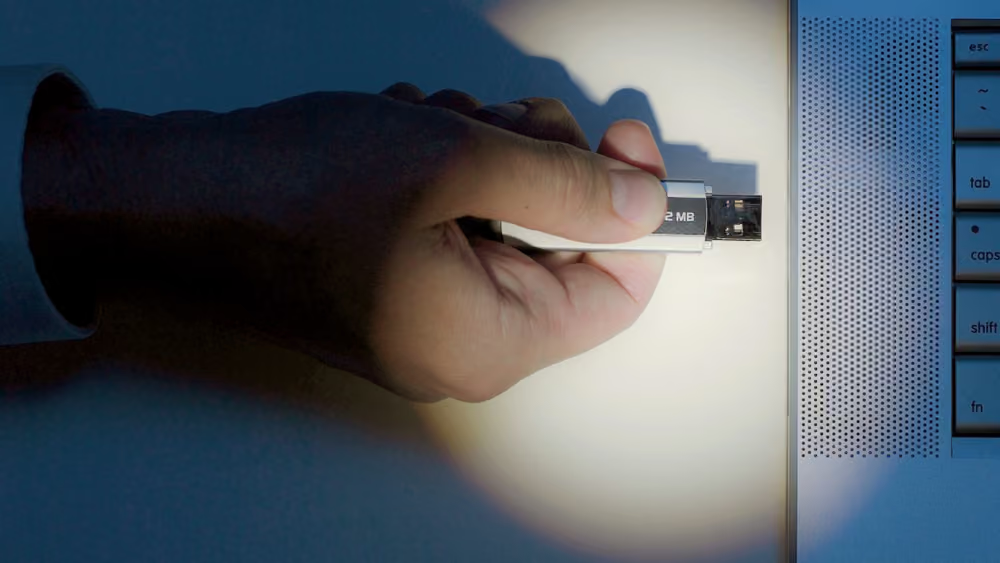
Yes, absolutely. North Korean people are already accessing uncensored information and media without the internet, notably through USB drives and MicroSD cards that are smuggled into the country and spread through sharing networks. These contain K-dramas, movies, music, and information that the North Korean regime tries so hard to keep out of the country.
The devices and hardware are already in use, the demand is there, and the sharing networks and behaviour exists. The need and opportunity is to leverage and build on this, providing new technologies that will help North Korean people access more uncensored information more safely.
2. Isn’t enabling North Koreans to access illegal foreign media putting them in danger?
Accessing uncensored information is risky in North Korea, especially with increased crackdowns and punishments in recent years. Our technologies and digital security tools equip North Koreans to access information more safely.
North Korean people will continue to take risks for information and media that most people in the world would take for granted.
User security is our highest priority in our development process, and this is guided by North Korean defectors who left the country recently, understand the environment, and can advise us on the best ways to protect and empower North Korean people who are trying to access uncensored information.
3. What is LiNK doing to increase North Korean people’s access to information?
LiNK’s IAP work can be broken down into four areas of focus.
We develop lightweight, secure programs help more North Koreans access more uncensored information; protect North Korean users with digital security and anti-surveillance measures; create and curate strategic content that meet North Korean people’s needs and build resilience to the regime’s propaganda; and work with distribution partners to deliver these technologies and content packages to North Koreans as reliably, effectively, and safely as we can.
4. Why did LiNK decide to do Information Access work?
In a 2024 HanVoice Woorion survey of 500 North Korean refugees, 86.2% agreed that “it is important to increase the flow of information to North Korean people.” This is the most effective way that we can support change inside North Korea.
As an organization, LiNK is uniquely positioned to do this work. With our long history of rescuing and supporting North Korean refugees, we have the networks and ability to work closely with a variety of North Koreans, including recent defectors and people who studied and worked in IT in North Korea, who inform and help test our products and strategies from start to finish.
Crucially, because of the support of people like you, we are able to make strategic investments in projects that governments or other funders may not support, which enables us to pursue the most effective long-term strategy possible to support North Korean people to achieve their freedom.
5. What kind of information can North Koreans access, both legally and illegally?
Legally, North Korean people have access to official media which is extremely centrally controlled and produced. There are no newspapers, TV stations or media channels with an alternative viewpoint from the government, and all official media serves to reinforce the regime’s ideologies and narratives about the outside world, their own country and the leadership. This official media includes, for instance, newspapers, North Korean films and dramas, carefully selected foreign (eg. Russian) films, partially censored sports broadcasts, radio, speeches by the ruling Kim family, government-approved books, and government-approved mobile apps.
Illegally accessed information or media could theoretically include anything, but most commonly would be movies and TV dramas from South Korea, China and elsewhere, music, some e-books, and foreign radio broadcasts including news and documentary programs. Close to the border with China, some North Korean people have a smuggled Chinese smartphone that can be used to connect to the Chinese network and communicate with or get information from the outside world.
→ Want to learn more about life inside North Korea? Sign up for North Korea 101, LiNK’s free online course!
6. How do we know increasing North Korean people’s access to information will help change North Korea?
Hundreds of interviews with North Korean refugees conducted by LiNK, and thousands more by other organizations, consistently show how access to outside information reshaped their understanding of the world, undermined regime propaganda, and often was key in their decision to risk their lives and seek freedom. We also see the North Korean regime’s crackdowns on this access to outside information, especially in recent years, as evidence that the regime understands the power of information to undermine their control and change their country as well.
Throughout history, we’ve seen similar dynamics in other authoritarian countries, where greater access to uncensored information has consistently increased aspirations for freedom, expanded people’s sense of what was possible, and played a key role in people overcoming dictatorships and achieving freedom across the world.
It is inherently difficult to capture and measure the long-term effects of information, particularly in a country like North Korea. But when history, logic, the testimony of countless North Koreans, and careful product and strategy validation processes all point in the same direction, investing in increasing North Korean people’s access to information is not a leap of faith. It is the strongest, most evidence-based opportunity to help North Koreans shape their future and ultimately achieve their liberty.
–
In the first half of 2026, our IAP team successfully deployed new information-access technologies across one of the world’s most tightly controlled borders, and reached people inside North Korea.
We believe North Koreans deserve the freedom to access information and make their own choices, and we’re committed to helping them break through the regime’s surveillance and censorship. Increasing information access is one of the most effective ways that we can have a direct impact on North Korean people’s lives right now.
Help drive change from inside North Korea by investing in LiNK’s Information Access Programs.










