
Freedom Walk & Run 2026, Seoul
What Does Freedom Mean to You?
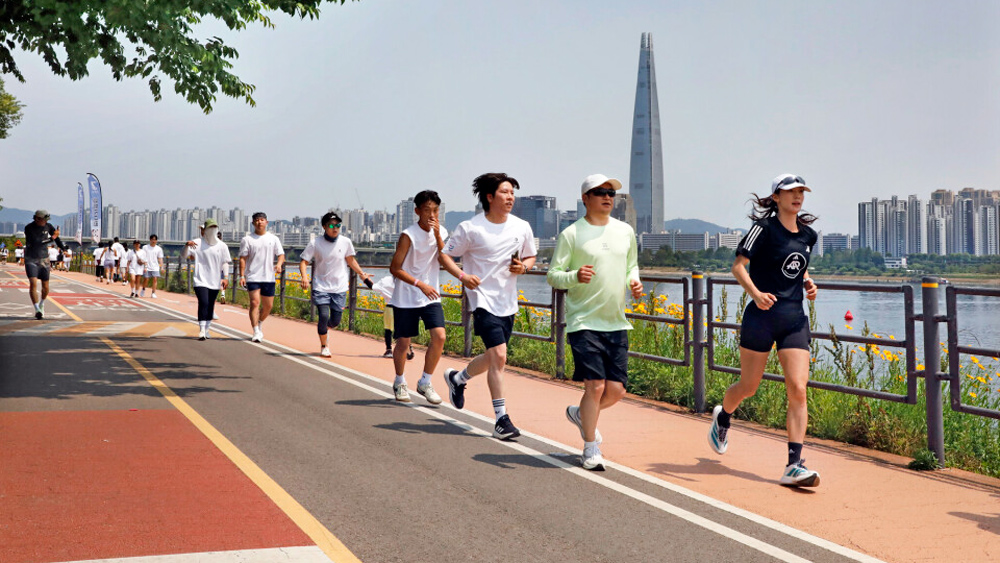
This fall, 200 people will gather along the Han River in Seoul to honor the 26 million people living in North Korea by answering one question: What does freedom mean to you?
Before setting out, every participant in Liberty in North Korea’s Freedom Walk & Run will write their own answers on the race bib they’ll wear for the 6 kilometer race.
The course is divided into three sections, each representing a different freedom: the freedom to leave, the freedom to lead, and the freedom to learn.
Each represents a different part of LiNK’s work and a different way North Korean people are pursuing greater freedom and choice in their own lives.
0-2km: Freedom to Leave
The first two kilometers represent the freedom to leave.
For North Koreans who decide to leave their country, reaching safety can mean a long and dangerous journey through multiple countries.
LiNK helps North Korean refugees navigate a secret route to safety. To date, over 1,400 North Korean refugees have reached freedom through LiNK’s networks. Every person who makes that journey has their own reason for leaving, their own hopes for what comes next, and their own idea of what freedom means to them.
Reaching safety opens the door to the next part of their journey.
2km-4km: Freedom to Lead
The next two kilometers represent the freedom to lead.
Starting over in a new country comes with countless possibilities, but just as many challenges. North Korean people resettling in South Korea or the US are learning a new system, while pursuing education, beginning careers, building relationships, or deciding what they want their future to look like.
LiNK’s programs support resettled North Koreans as they pursue education, language learning, and career development, providing mentorship, scholarships, and so much more.
And then comes the final stretch.
4-6km: Freedom to Learn
The last two kilometers represent the freedom to learn.
For people living inside North Korea, access to information from outside of the country is heavily restricted. Official media is centrally controlled, while foreign films, television, music, news, and other outside information are accessed illegally and often at significant personal risk.
Despite the government’s efforts to control information, curiosity about what freedom looks like proves impossible to suppress.
“No matter how much you try to control it, you can’t get rid of curiosity.”
Information gives someone a new point of reference. It introduces possibilities they had never encountered before. It gives them the chance to imagine a future beyond the North Korean regime.
North Korean people are finding ways to access outside media, through USB drives and microSD cards. LiNK’s Information Access Programs build on these existing channels by working with North Korean defectors and engineers to develop tailor-made technology and content that help people inside the country access more information more safely.
This is a growing part of our work, and one we believe has enormous potential to contribute to long-term change.
Get Involved: Support information access in North Korea
This fall, we’re giving supporters a closer look at this work through an upcoming documentary about information access in North Korea.
Make a gift of $30 or more to LiNK’s Information Access Programs by October 24 and you’ll receive an exclusive preview of the documentary this fall.
Your support helps LiNK enable more North Koreans to access more outside information more safely. This builds people’s resilience against regime disinformation, increases their aspirations for social and economic progress, and builds pressure for change and opening.
Donate today & get the documentary preview
Join us in Seoul
If you’re in Seoul, join us along the Han River on Saturday, October 24, for the Freedom Walk & Run. Participation is limited to 200 people, so reserve your spot today.
RSVP for LiNK’s Freedom Walk & Run
"And We Will Be Free" Jo Eun's Story
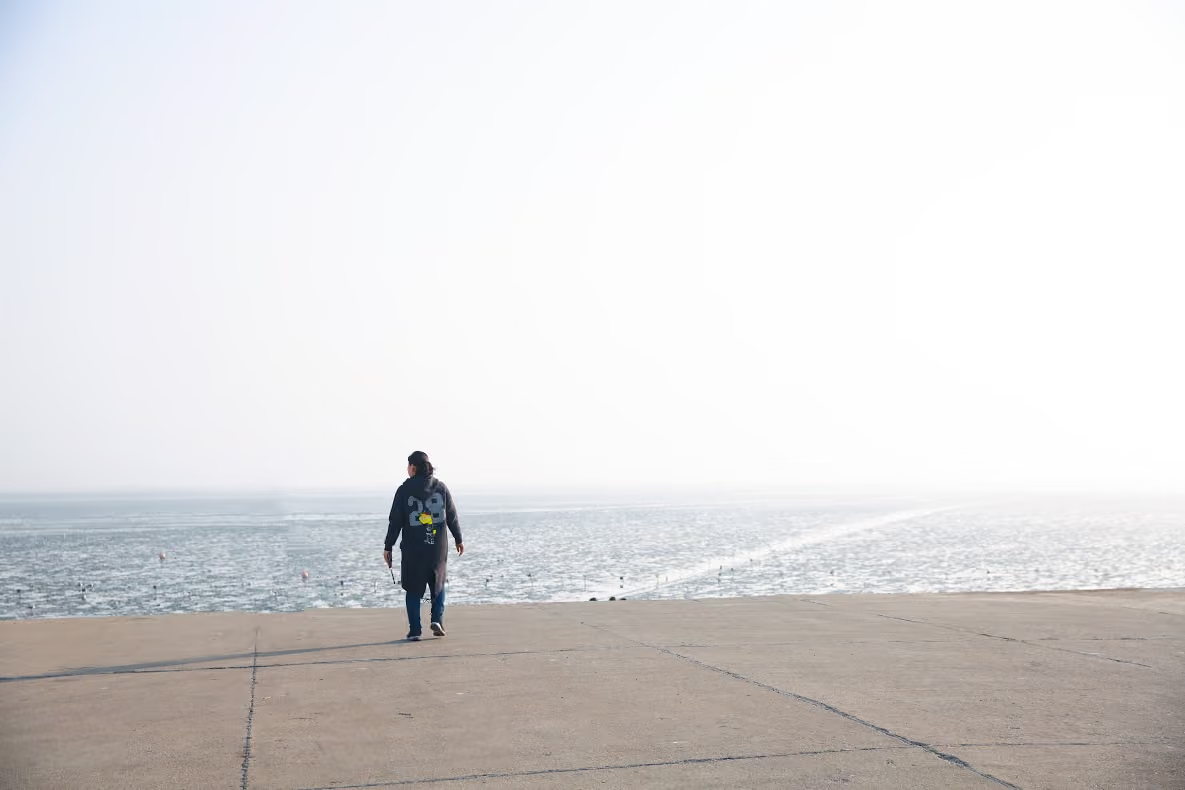
The Tumen River starts on the slopes of Mount Paektu. Its icy waters twist and turn for hundreds of miles before slipping off the Korean peninsula and into the East Sea. In the summer, the reeds along the river grow taller than me and yellow and white wildflowers blossom along the banks.
I was born next to the Tumen. I grew up playing on its rocky shore, splashing and swimming in its waters. In the winter my friends and I would race up and down on ice skates. For my mom’s birthday, we would catch fish and cook them under the shade of a tree. I have many fond memories of the Tumen.
But I want to tell you about the times I tried to cross it. Because those times nearly cost me my life. The Tumen is more than a river. It’s a razor that cuts its way between North Korea and China. It’s a meandering border of shallow water that you can wade across in minutes. And in the winter, you can slide across its ice even faster. Just like I did for the final time last year.
I decided to cross the Tumen for the first time 8 years ago. I did it for my daughter. Her name is Hee-Mang which means hope in Korean. As a baby she was so calm and happy. I would adore her sweet smile and when I held her it melted away the pain and heartache of life in North Korea.
When she started saying “mommy” and took her first steps I was ecstatic. Her laughter was precious and her eyes beamed with life. But I was always worried that I couldn’t be a good mother.
I wanted to give Hee-Mang a better life than I had.
I knew of friends who had defected to South Korea. They sent money back and their families seemed to be much better off. So I decided to leave North Korea to make money and eventually bring Hee-Mang to freedom.
The first time I tried to cross the Tumen I didn’t get far. The broker I hired to help me escape worked for the secret police. They dragged me out of my hiding spot and sent me off to a detention center.
That’s where I first learned how much freedom would actually cost.
It was March and a pregnant woman arrived after being arrested in China. The courtyard of the detention center was covered in snow and ice. The guard forced her to walk around on her hands and knees in the snow for hours. He mocked her, saying that you got pregnant with the baby of a dog so you have to walk like a dog. Then he’d pry open her mouth and spit in it. If any of us cried or pleaded for him to show mercy, he’d force us to do the same.
When we weren’t crammed into our cells, sleeping on a filthy floor, we were forced to work. From 5am to 11pm we’d go into the mountains to gather firewood. The labor left your hands raw with blisters and the cold bit at your fingers and toes.
We were only fed a quarter of an ear of corn per meal. It was never enough and the hunger clawed at our stomachs. People grew so hungry that the guards had to drag them from the toilets so they wouldn’t eat their own feces. Some mornings I woke up to find one of my cellmates stiff and lifeless. We’d march off to gather firewood and their pale body just laid there, their cheeks hollowed out from the hunger.
One afternoon, I decided to escape. I walked over to an unlocked window, flung myself out the opening, and started running. For 4 days I trekked through the wilderness until I reached my hometown. But from the hill above my parent’s house I could see the security agents waiting for me. I had no place to go and I was terrified of being caught. I wanted to see Hee-Mang again but it was too dangerous.
So I returned to the Tumen River. It was summer now – when the rains come up from the south and the river swells into a rage. It was pouring the night I crossed and the current swept me downstream. I waded out on the other side and into China. A Chinese family gave me food and dry clothes and when I told them I needed to go to South Korea, they connected me with a broker.
I moved south through China with a group of 12 other North Korean refugees. We were nearly to Southeast Asia when we stopped to spend the night in a small motel. There were two young boys with us. They were 9 and 10 and they were running around the motel yelling in Korean. The receptionist must have overheard them.
I was on the fourth floor when I heard police sirens outside. I raced to the window but it was bolted shut with metal bars. The Chinese police barged into the room and handcuffed all of us.
There was a teenage girl with us whose mom was waiting for her in South Korea. She wailed and pleaded with the Chinese police: “Please please, can I just go to be with my mom. She’s going to be so worried about me. I just need my mom.” She cried out over and over. As a mother I felt terrible for her. I just wanted to tell her that it would be alright. But we all knew that was a lie.
We were returned to North Korea.
The secret police demanded the women strip naked and they searched our genitals for anything we might have hidden, slapping and whipping us and calling us whores the entire time. My interrogator wanted me to confess to trying to defect to South Korea. I begged her to understand my situation but instead she grabbed my head and slammed it against a nail in the wall. I remember thinking as she took a fistful of my hair “Is this my fate? Is this how I’ll die? The tears mixed with the blood pouring out of the gash in my forehead.
I couldn’t let go of the thought of Hee-Mang growing up without a mom. I wanted to be a good mother, I wanted to give her everything she deserved. I knew I couldn’t die here.
Everyone in my group but me was sent to a political prison camp, even those two little boys. But because I refused to confess to trying to defect, I avoided that fate and was instead transferred to another prison where I was forced to work 18 hours a day in a gold mine to earn money for the regime.
They worked us so hard and fed us so little. But I had a daughter waiting for me. And now more than ever, I wanted her to live in freedom. Life in prison was so difficult that I considered killing myself many times. There is a saying in North Korea “Women are weak, but mothers are strong”. Being Hee-Mang’s mother gave me the strength to withstand the pain. For two years, I endured the back-breaking work hoping for the day I would reunite with Hee-Mang.
3 years after I was released I stood next to the Tumen again, staring north and dreaming of freedom. This time I had Hee-Mang with me. She was 4 years old now and I wanted her to have a happy, fulfilling life. I wanted her to see the world and learn about other cultures. There was nothing for her in North Korea except pain and misery. So I scooped her up from her bed and carried her out of the house.
I put her on my back, her head nestled on my shoulder, and waded into the river. I was almost to the middle of the river when her foot touched the water.
Hee-Mang woke up and whimpered “Oh it’s cold.” That’s all it took.
The border guards heard her and raced down to the water. I waded faster and faster with Hee-Mang’s little arms wrapped tightly around my neck. I lunged with each step trying desperately to get away. Then I felt a hand grab my hair. Hee-Mang started screaming as I tried to fight them off. But when they ripped her from me, I had no choice. I surrendered.
They dragged us back to shore and started kicking me and stomping on my head. And then they kicked my daughter. My precious, beautiful, Hee-Mang. An innocent 4-year old girl. She was sobbing in pain and her cries for mommy were muffled by the blood spilling out from her mouth.
I jumped on top of her to cover her little body from the soldiers’ boots. I pleaded with them to beat me instead. She didn’t know what was going on.
It wasn’t her fault. “It was me, I did this! Punish me, not her!” I screamed.
--
Last year I crossed the Tumen for the final time. I could see my breath as I shuffled across the ice on my hands and knees. I crawled up the other bank into China, bent back the barbed wire, and ran for the van that was waiting for me on the other side. From the van, I looked back at North Korea and wondered if I’d ever come back or see Hee-Mang again.
This time I connected with someone that knew a group helping North Korean refugees reach safety. The group turned out to be Liberty in North Korea and they helped me move quickly out of the border region and then we headed south. I couldn’t eat or sleep until we made it out of China because I was so scared of getting caught. Every time the bus stopped, I was certain that the police had found me again.
But soon I found myself crossing the border into Southeast Asia. When LiNK’s field staffer told me I was finally safe I was overwhelmed. I had endured so much to make it this far - hard labor, imprisonment, and torture. And even though I was overjoyed to make it to freedom, I was deeply saddened that Hee-Mang wasn’t with me.
I left her with my family because I couldn’t bear the thought of her getting caught again and sent to a political prison camp. I question that decision every day.
Today I owe it to my daughter to tell my story. Hee-Mang is like a lighthouse to me. She gives me light and a reason for why I need to keep living and working hard for freedom. I hold onto the dream that one day we will live together again.
Before I left last year I bought us matching watches. It’s just a cheap watch, but to me it has more value than any jewel. When I miss her, I wear it and I have hope that each minute that passes is one minute closer to the day I will see her again.
I wouldn’t be telling this story today without the support of people like you. Thank you for helping me escape and finally reach freedom. Your willingness to help North Koreans even though you do not know our names or see our faces, is unbelievable. Your generosity has changed my life and the lives of so many others.
But most of all, you give me hope that one day I will be able to return to the Tumen River and walk hand in hand with Hee-Mang.
And we will no longer have to be afraid. Because we will be together.
And we will be free.
Thank you.










