
Freedom Walk & Run 2026, Seoul
What Does Freedom Mean to You?
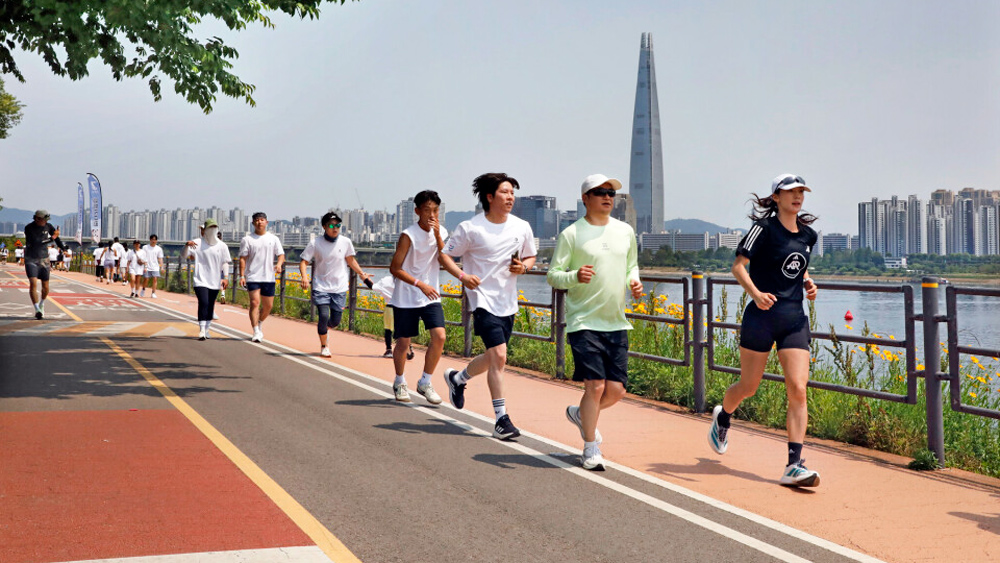
This fall, 200 people will gather along the Han River in Seoul to honor the 26 million people living in North Korea by answering one question: What does freedom mean to you?
Before setting out, every participant in Liberty in North Korea’s Freedom Walk & Run will write their own answers on the race bib they’ll wear for the 6 kilometer race.
The course is divided into three sections, each representing a different freedom: the freedom to leave, the freedom to lead, and the freedom to learn.
Each represents a different part of LiNK’s work and a different way North Korean people are pursuing greater freedom and choice in their own lives.
0-2km: Freedom to Leave
The first two kilometers represent the freedom to leave.
For North Koreans who decide to leave their country, reaching safety can mean a long and dangerous journey through multiple countries.
LiNK helps North Korean refugees navigate a secret route to safety. To date, over 1,400 North Korean refugees have reached freedom through LiNK’s networks. Every person who makes that journey has their own reason for leaving, their own hopes for what comes next, and their own idea of what freedom means to them.
Reaching safety opens the door to the next part of their journey.
2km-4km: Freedom to Lead
The next two kilometers represent the freedom to lead.
Starting over in a new country comes with countless possibilities, but just as many challenges. North Korean people resettling in South Korea or the US are learning a new system, while pursuing education, beginning careers, building relationships, or deciding what they want their future to look like.
LiNK’s programs support resettled North Koreans as they pursue education, language learning, and career development, providing mentorship, scholarships, and so much more.
And then comes the final stretch.
4-6km: Freedom to Learn
The last two kilometers represent the freedom to learn.
For people living inside North Korea, access to information from outside of the country is heavily restricted. Official media is centrally controlled, while foreign films, television, music, news, and other outside information are accessed illegally and often at significant personal risk.
Despite the government’s efforts to control information, curiosity about what freedom looks like proves impossible to suppress.
“No matter how much you try to control it, you can’t get rid of curiosity.”
Information gives someone a new point of reference. It introduces possibilities they had never encountered before. It gives them the chance to imagine a future beyond the North Korean regime.
North Korean people are finding ways to access outside media, through USB drives and microSD cards. LiNK’s Information Access Programs build on these existing channels by working with North Korean defectors and engineers to develop tailor-made technology and content that help people inside the country access more information more safely.
This is a growing part of our work, and one we believe has enormous potential to contribute to long-term change.
Get Involved: Support information access in North Korea
This fall, we’re giving supporters a closer look at this work through an upcoming documentary about information access in North Korea.
Make a gift of $30 or more to LiNK’s Information Access Programs by October 24 and you’ll receive an exclusive preview of the documentary this fall.
Your support helps LiNK enable more North Koreans to access more outside information more safely. This builds people’s resilience against regime disinformation, increases their aspirations for social and economic progress, and builds pressure for change and opening.
Donate today & get the documentary preview
Join us in Seoul
If you’re in Seoul, join us along the Han River on Saturday, October 24, for the Freedom Walk & Run. Participation is limited to 200 people, so reserve your spot today.
RSVP for LiNK’s Freedom Walk & Run
A Little Story about How the Media Gets North Korea Wrong

The North Korean government did not tell the people to prepare for another famine, but you probably saw headlines like this in the last week.
Here's how a mere mention of the 'arduous march' in the North Korean state media blew up and was incorrectly reproduced by media around the world in the space of a couple of days:
On March 28th, an essay by two North Koreans, Park Ok-kyoung and Choi Yoo-il, was published in the Rodong Sinmun (North Korea’s main paper). It included a passage, which roughly translates to “The road of the revolution is long and tough. There may again be times that call for chewing grass roots during an arduous march, and times that call for fighting the enemy single-handedly on a far-flung island...but we have to keep our single-minded loyalty for our dear marshal to the very end even if it costs our lives...”
The reference to the 'arduous march', the same term used to label the North Korean famine of the 1990s, caused a lot of excitement. But the term predates the 1990s famine. The original ‘arduous march’ was actually in 1938-39. It was a supposedly tough period of time that Kim Il-sung's band of guerrilla fighters had to 'march' through to victory in their fight against the Japanese occupiers. This tale credits Kim Il-sung for the defeat and is a classic 'struggle through adversity to final victory' type of story. So when times got tough in the 1990s, the official propaganda machine kicked in and framed it as a national struggle through adversity on the way to a final victory.
It was also about maintaining autonomy in the face of external threats, which was the context for this piece. The piece was meant to build up to the Party Congress in May, which is a massive political event that requires 'ideological preparation of the masses'.
So did the North Korean government tell the North Korean people to prepare to chew grass to survive another famine? Or to prepare to fight the enemy all by themselves on a far-off island? Not particularly. They basically said that the North Korean people must stick with their leader, even if things get tough, and all shall be overcome. And it also wasn't written in the name of Kim Jong-un (that would make it more of a story), but in the name of two individuals writing for the paper.
So, why did this happen?
Far too few journalists can read Korean, let alone know how to read and interpret North Korean propaganda. But there's a lot of international appetite for stories about North Korea. So once a piece like this gets out that makes sense to journalists with a peripheral awareness of North Korea, it is easy for it to bounce around the global media echo chambers, getting picked up by many outlets without any accuracy check on the interpretation.
Furthermore, the North Korean government isn’t going to come out and correct it. Here's where there is some truth in the statement "when it comes to North Korea news, anything goes." At this point it becomes something that ‘happened’ without actually happening.
On a brighter note, thanks to the deeper economic and food security resilience built up by the bottom-up marketization, private-plot farming, and linkage to the Chinese economy, a recurrence of a famine on the scale of the 1990s is extremely unlikely in North Korea now.
[Post edited on 2016-04-11 for clarity and accuracy]










