Freedom Walk & Run 2026, Seoul
What Does Freedom Mean to You?
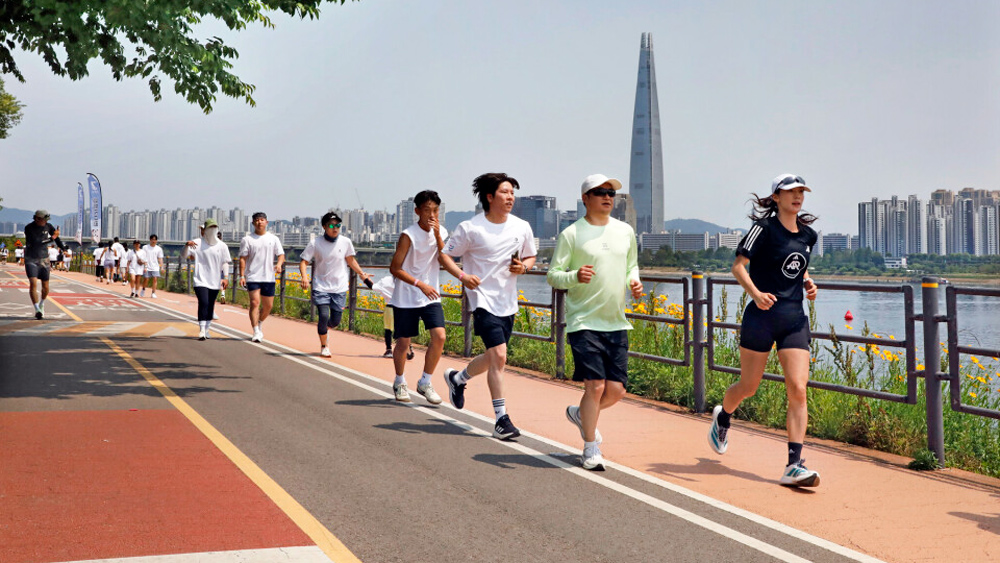
This fall, 200 people will gather along the Han River in Seoul to honor the 26 million people living in North Korea by answering one question: What does freedom mean to you?
Before setting out, every participant in Liberty in North Korea’s Freedom Walk & Run will write their own answers on the race bib they’ll wear for the 6 kilometer race.
The course is divided into three sections, each representing a different freedom: the freedom to leave, the freedom to lead, and the freedom to learn.
Each represents a different part of LiNK’s work and a different way North Korean people are pursuing greater freedom and choice in their own lives.
0-2km: Freedom to Leave
The first two kilometers represent the freedom to leave.
For North Koreans who decide to leave their country, reaching safety can mean a long and dangerous journey through multiple countries.
LiNK helps North Korean refugees navigate a secret route to safety. To date, over 1,400 North Korean refugees have reached freedom through LiNK’s networks. Every person who makes that journey has their own reason for leaving, their own hopes for what comes next, and their own idea of what freedom means to them.
Reaching safety opens the door to the next part of their journey.
2km-4km: Freedom to Lead
The next two kilometers represent the freedom to lead.
Starting over in a new country comes with countless possibilities, but just as many challenges. North Korean people resettling in South Korea or the US are learning a new system, while pursuing education, beginning careers, building relationships, or deciding what they want their future to look like.
LiNK’s programs support resettled North Koreans as they pursue education, language learning, and career development, providing mentorship, scholarships, and so much more.
And then comes the final stretch.
4-6km: Freedom to Learn
The last two kilometers represent the freedom to learn.
For people living inside North Korea, access to information from outside of the country is heavily restricted. Official media is centrally controlled, while foreign films, television, music, news, and other outside information are accessed illegally and often at significant personal risk.
Despite the government’s efforts to control information, curiosity about what freedom looks like proves impossible to suppress.
“No matter how much you try to control it, you can’t get rid of curiosity.”
Information gives someone a new point of reference. It introduces possibilities they had never encountered before. It gives them the chance to imagine a future beyond the North Korean regime.
North Korean people are finding ways to access outside media, through USB drives and microSD cards. LiNK’s Information Access Programs build on these existing channels by working with North Korean defectors and engineers to develop tailor-made technology and content that help people inside the country access more information more safely.
This is a growing part of our work, and one we believe has enormous potential to contribute to long-term change.
Get Involved: Support information access in North Korea
This fall, we’re giving supporters a closer look at this work through an upcoming documentary about information access in North Korea.
Make a gift of $30 or more to LiNK’s Information Access Programs by October 24 and you’ll receive an exclusive preview of the documentary this fall.
Your support helps LiNK enable more North Koreans to access more outside information more safely. This builds people’s resilience against regime disinformation, increases their aspirations for social and economic progress, and builds pressure for change and opening.
Donate today & get the documentary preview
Join us in Seoul
If you’re in Seoul, join us along the Han River on Saturday, October 24, for the Freedom Walk & Run. Participation is limited to 200 people, so reserve your spot today.
RSVP for LiNK’s Freedom Walk & Run
Interview with Charles - North Korean Student at Coding Dojo

Charles escaped from North Korea and made the dangerous journey to safety without the help of a rescue. He resettled to the US in 2012, completing high school and soon after taking the opportunity to participate in a rigorous coding bootcamp through a partner of Liberty in North Korea, Coding Dojo. Charles is now attending community college and pursuing his own coding project. We had a chance to meet with Charles this summer to learn more about his life in North Korea and his new coding passion. Read the interview is below. Charles is also fundraising for rescues with us!
LiNK: Why did you choose to resettle to the US?
Charles: I was born between a North Korean mom and a Chinese dad, which put me in a difficult situation. I wasn’t accepted into South Korea because my Dad is Chinese, even though I had proof of having been captured once in China for being a North Korean refugee. So I applied for refugee status through the United Nations and resettled in the US.
LiNK: You attended Coding Dojo’s coding Bootcamp earlier this year - so cool! Between coding language, English, and borrowed words in Korean, which was the hardest language to learn?
Charles: Coding was hard. You have to know the terms while learning the specific coding language, so that was a challenge. I’m still teaching myself the parts of coding that I find difficult. As for borrowed words in Korean, I didn’t know those existed at all until I started to talk to more Koreans in the US. Borrowed words frequently came up, and I would have to ask people around me to explain the words that I couldn’t understand; part of the challenge was how the same word is pronounced differently in Korean and in English. Shortened words in Korean were tough to learn as well.
LiNK: What’s your favorite thing about programming?
Charles: My favorite thing about programming is I have finally discovered what I truly want to do with my life. I used to want to be a doctor one day, a cop the next day, and maybe a week later, I would want to join the army. Coding first became my hobby and thanks to Coding Dojo, it became something I want to make a career out of. It’s a lot of fun. But aside from that, I’ve also met good friends and instructors at Coding Dojo. I think it’s safe to say coding made me pull a 180 in life. I’m set on computers for now.
LiNK: Can you tell us about a project you’ve been working on?
Charles: Sure. I’ve been working on a project using MEAN stack to make an auction platform for ideas. Users can present ideas, sell ideas, buy ideas… You could say that it’s similar to Ebay in a way, but I think at this stage it’s important to emulate what other people have made to explore and learn about various successful models rather than trying to create something entirely new and different. With the current version, users can upload an idea onto the platform, but there’s been glitches in the idea being transferred to the the auction page. So that’s something I’ve been struggling with, but I think I’m going to finish it pretty soon.
LiNK: How do you get into computer programming as a career in North Korea?
Charles: I’m not sure because I don’t have any friends who went to university, although I do have a relative who was able to go. Most students who go to university come from wealthy families or are people who have been able to make a good amount of money from market activities, and they might find that kind of job. But in North Korea a lot of occupations are passed down from your parents, for example if you’re a politician then your children will also likely become politicians.
LiNK: After coding, what do you like to do in your free time?
Charles: I’m usually at the gym working out. If it’s breezy and not too hot outside, I go to the park and listen to music. You can find me sitting on a bench with my headphones on.
LiNK: What kinds of things do you think about when you’re at a park listening to your music?
Charles: Usually I think about memories from North Korea. When I’m busy my mind is preoccupied with work, but when I have more time on my hands I often think back on my life in North Korea -- both the good days and the hungry days.
LiNK: Can you share one of your favorite memories with us?
Charles: Sure. I had a lot of friends back in North Korea, and we were always outdoors in nature. I lived near Daedong River, so every Sunday, five to six friends of mine and I would have cookouts near the river. We would get rice, a pot, and some firewood to make porridge. Would I do that here? Probably not. I could try, but I think being with my friends was what made it memorable and special. Even when we were hungry, we were hungry together.
LiNK: That sounds really nice. Have you found any foods that you like to eat here?
Charles: Subway! I love sandwiches. My go-to Korean food is Kimchijiggae. I also like Vietnamese noodles — Pho.
LiNK: Cool. What are three things you want to accomplish by the end of this year?
Charles: First is completing my programming project, the Idea Auction project that I mentioned earlier. Second is getting accepted into the community college that I’m applying to. And third would be keeping in good health!
LiNK: Those are some solid goals. You drive Uber sometimes, right? When you’re talking with riders, do you share that you’re from North Korea?
Charles: Well, not a lot of people in the US are aware about North Korea. They say, “Where are you from?” So I would say, “I’m from North Korea,” and they go, “How is it there?” Haha. So I tell them that North Korea is the counterpart of South Korea. The funny thing is that they might not be familiar with North Korea, but they know what I’m talking about when I say the name Kim Jong Un. Then, they don’t believe me and say it’s impossible to escape. When I share my story, they’re very surprised. A lot of my customers stick around to listen to my story even after we’ve arrived at the destination. Even if it’s late at night, people don’t get out of my car until I finish my story.