
How Has the Kim Family Held on to Power So Long?
The following content is adapted from North Korea 101, LiNK’s FREE online course that explains what's happening in North Korea beyond the headlines. Start learning today.
Sign up for NK 101
“This question is fundamental. To understand where we are and where we might be heading, we have to understand where we’ve come from.” – Sokeel Park, LiNK CSO
The North Korean regime is the world’s worst dictatorship, an extreme remnant of 20th century authoritarianism that has stretched across eight decades and three generations of the ruling Kim family. The regime’s all-encompassing system of control constrains the North Korean people’s agency and potential, resulting in an enforced poverty which includes physiological, material, social, informational, and cultural deprivations.
It is not easy for dictators to maintain power for long. During the Kim family’s rule, the world has seen the rise and fall of dozens of other dictatorships. Through many periods of global change and internal instability, they’ve managed to maintain power not by sheer force or luck, but through an array of adaptive strategies. But when the media portrays Kim Jong Un as crazy or irrational, it undermines our understanding and approaches to try to undermine that dictatorship.
There is a formula to their approach, and if we can understand it, then we can counteract it.
The Four Ways Dictators Lose Power
Historically, the fall of dictators can be attributed to four factors. By looking at each of them, we can see how the ruling Kim family has strategically avoided these fates.
1. Military Defeat/International Intervention
An external country or force intervening and overthrowing a dictator through military defeat.
2. Elite Challenges
An internal challenge emerging from within the country’s top political or military circles, forcibly removing the current dictator by assasination or a coup d'état,
3. Popular Uprising
An internal challenge from below, where a mass movement forces a change in leadership. In some cases, parts of the elite may join the side of the masses.
4. Death in Office
The death of the current leader, opening up an opportunity for someone else to assume control and end the dictatorship or make significant changes.
Threat #1: Preventing Military Overthrow
To prevent an external power from overthrowing their dictatorship, the Kim family first needs a strong deterrent against military force. The vast majority of mainstream news coverage of North Korea focuses on one thing: nuclear weapons. Having nuclear weapons and being seen as potentially willing and able to use them is arguably the most effective way to deter a military intervention from the outside.
Second, the Kim family has strategically managed their relations with countries like the Soviet Union / Russia, China, the United States, and South Korea. They go back and forth between periods of warmer and colder relations, effectively balancing opportunities and risks to gain support while preventing too much external influence. It’s unlikely that the Kim family has ever really trusted any of these external powers, even those that are sometimes labelled as “allies”.
Threat #2: Preventing Elite Challenges
Historically, the position of dictator can be very tempting to others within the leadership’s orbit, from competing family members to senior politicians or military leaders. To prevent anyone from building too much power and becoming a threat, the ruling Kim family carefully manages elite politics, alternating between demoting, promoting, and purging top officials.
On top of that, cross-layered surveillance between different institutions also keeps potential challengers under surveillance and in check, and prevents any one person or group of people from launching a challenge for power.
Threat #3: Preventing Popular Uprisings
The next scenario that the regime must prevent is a popular uprising.
A common conception of North Korea is that if the people wanted to rise up and revolt, they would have, and so they must be brainwashed or bought into the regime’s ideologies. While the latter may be true to some degree, it's difficult to fully grasp the extent to which the government’s system of control deprives people of their agency and potential and prevents them from challenging dictatorial rule.
North Korea is the most closed country in the world. The regime has forcibly cut off North Koreans from the rest of humanity, which serves as the baseline for their control. This centers everything—social structure, daily life, resources, information—around the regime, and eliminates sources that could undermine or threaten their authoritarian rule.
Laying the Foundation: Kim Il Sung’s Half-Century in Power
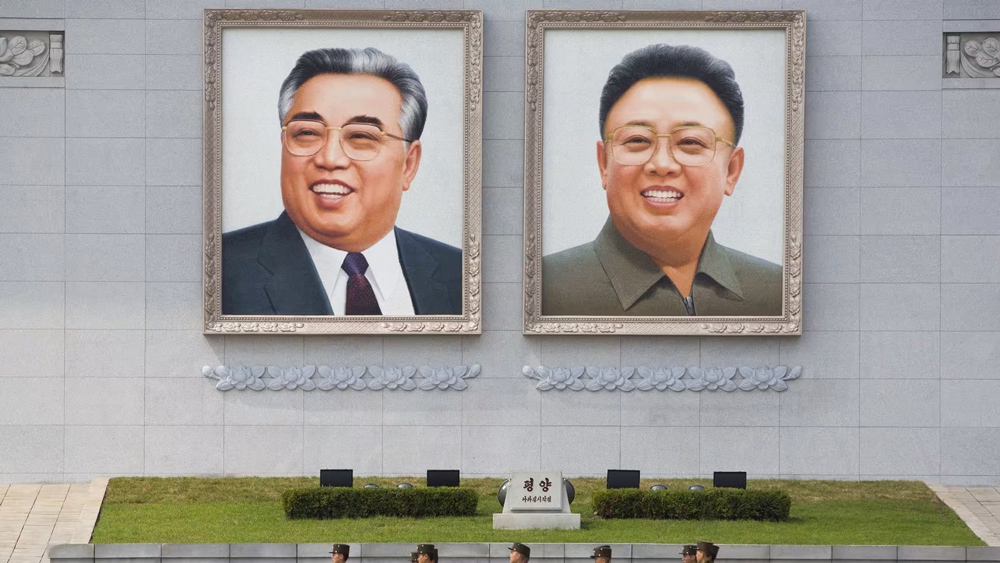
Kim Il Sung was 33 years old when he was installed into power by the Soviet Union—very young in global politics at the time, when most leaders were in their 50s and 60s. This historical happenstance has ended up being a key factor in the longevity of the Kim family’s control.
From his rise to power in 1945 to his death in 1994 at the age of 82, Kim Il Sung had 49 years to mold North Korea’s politics and systems in his image. During this time, he laid the foundation for hereditary succession by:
- Centralizing power around this dictatorship.
- Building a cult of personality around himself and his direct lineage: propaganda and myth-making that legitimized the Kim family as the only North Koreans worthy to lead the country.
- Purging anyone who could have been an alternative leader.
When it came time for Kim Jong Il to assume power, and the Kim Jong Un after that, decades of preparation smoothened the transition.
Now, after three generations of the Kim family, it would be very difficult for anyone else, even among the upper elite, to try and take power. Even if someone did manage to depose the current dictator, they would have to contend with not just managing the power vacuum, but the ideological void left by decades of propaganda and mythmaking that surrounded the Kim family.
Without the legitimacy that had been set up by the Kims, a new leader would likely find it difficult to maintain power for long. This is something that North Korean elites understand, which further discourages any rival officials from challenging the current regime.
Keep Learning with NK 101: Understanding the Country Through Its People
Through in-depth interviews with North Koreans who have escaped and insight from issue experts, this course will expand your understanding of the current state of North Korea. We’ll dive deeper into what’s happening in North Korea beyond the headlines, hone your ability to discern these key trends, and help you impress your friends with your expertise on the issue.
Access hours of exclusive, free content. Sign up for NK 101.
Trafficking and Exploitation of North Korean Refugees
For North Koreans hiding in China, repatriation is synonymous with death. Resolved to avoid such a fate, but with few options or protections, North Korean refugees are left vulnerable to a second wave of human rights abuses.
Among North Korean women and girls who escape to China, an estimated 60% have fallen victim to human trafficking.
Here are the stories of three women who have survived the unimaginable and are now advocating for this issue in freedom.
The Fear of Forced Repatriation
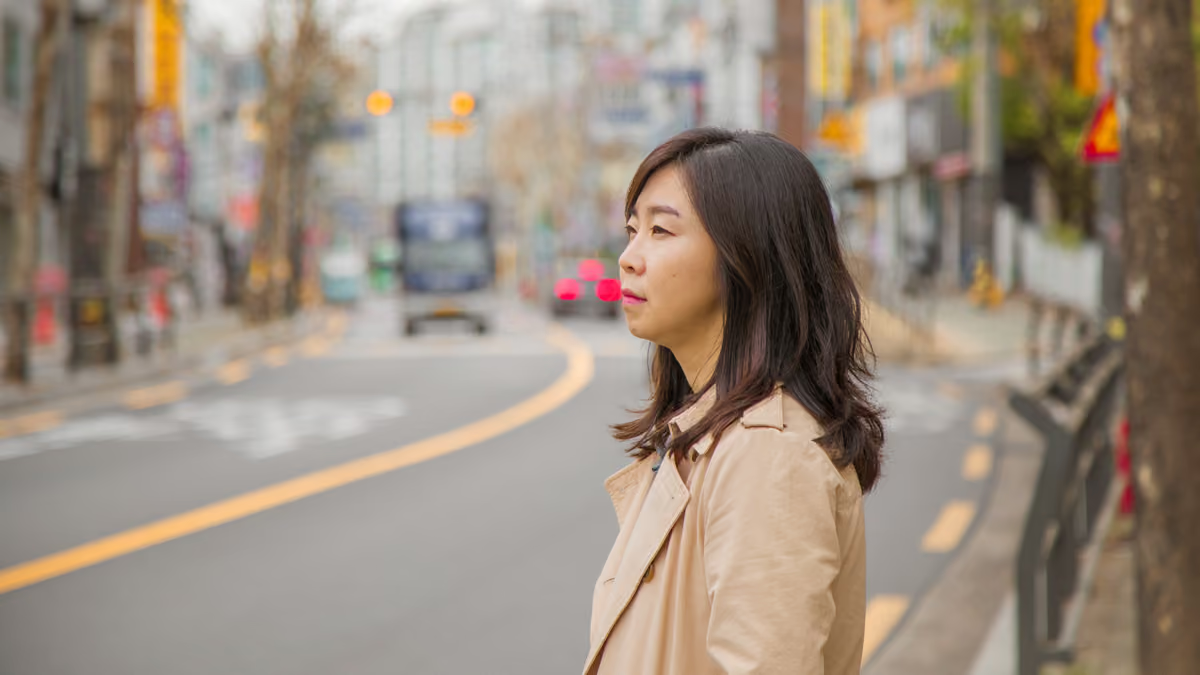
After Eunju fled from North Korea in 1999, she ended up spending years in China before finally reaching freedom.
“In China, North Korean defectors are exposed to various crimes, including sexual assault, human trafficking, forced prostitution, and labor exploitation. Those who seemed kind and willing to help were either traffickers or rapists. Promises of wages to be paid in the fall were replaced with threats—’You're from North Korea, aren't you?’
There is only one reason why the victims—North Korean defectors—remain silent: the fear of forced repatriation. This fear-driven silence perpetuates a vicious cycle of human rights violations against North Koreans in China.
On our first night in China, we were confronted with a trauma that would haunt us for a lifetime. As we walked along the road, not knowing where to go, a car slowed down and pulled up beside us. The door swung open, and someone grabbed my sister. My mother and I clung to her, desperate not to let go, but we couldn’t withstand the force of the accelerating car and were thrown aside. At the time, my sister was still just a young girl who had not even gone through puberty, yet she could not escape sexual violence. My mother couldn’t even bring herself to think about reporting the incident. She knew that if she went to the authorities, the Chinese police would capture us and send us back to North Korea before they ever caught the perpetrator.”
Soon after, Eunju’s mother was trafficked into a forced marriage together with Eunju and her sister, and they were sold for 2000 RMB (~$240 at the time).
Sold on the Way to Freedom
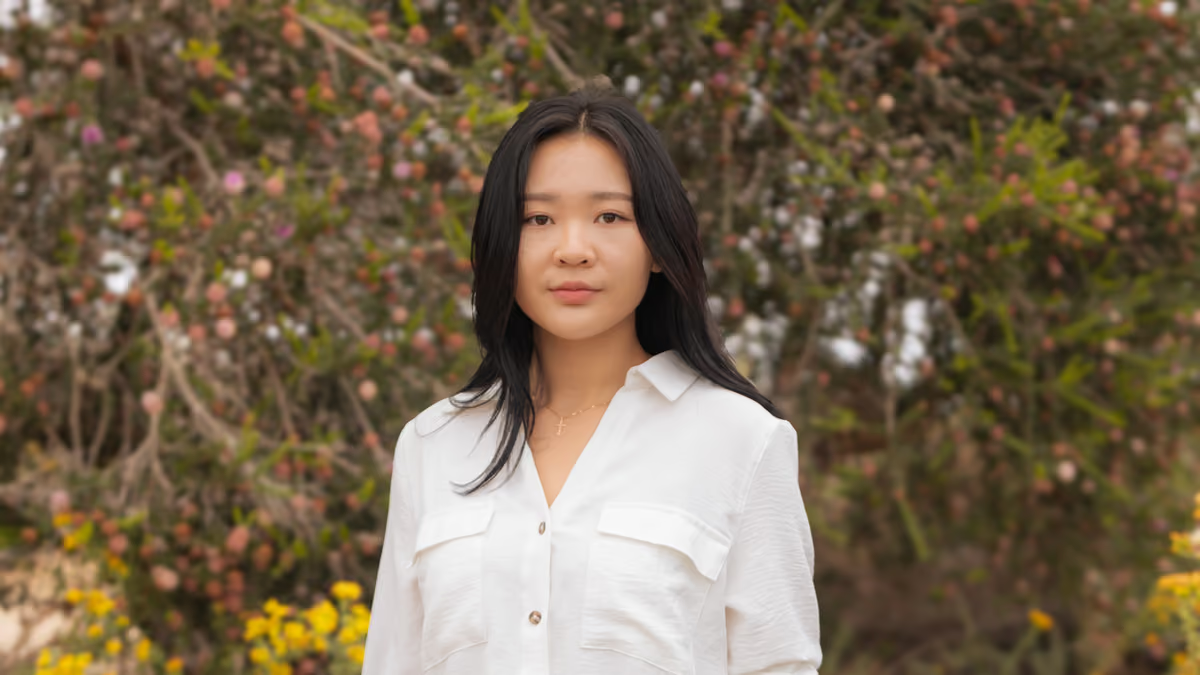
Hannah fondly remembers growing up with a large family in North Korea. But widespread food shortages forced her to leave her beloved hometown at 15 years old. When she finally managed to cross into China, she was trafficked and sold into a forced marriage.
“Do you remember what life was like when you were 15 years old? Maybe you were stressed about highschool, or getting your driver’s license. When I was 15 years old, I was sold to a man in China who was twice my age. For the first 6 months of captivity, I stayed away from him as much as I could. But in the end, there was nothing I could do to protect myself.”
“When I became pregnant, I couldn’t accept it because it wasn’t my choice. But then my baby arrived, and it all hit me. I wanted to give my daughter the same love I had grown up with. But I couldn’t do that without legal status or freedom. So with my one-month-old baby in my arms, I escaped once again.
Even though it was a very hard and dangerous journey, we ran together towards freedom, towards a future that guarantees our safety and hope.”
A Mother’s Impossible Choice
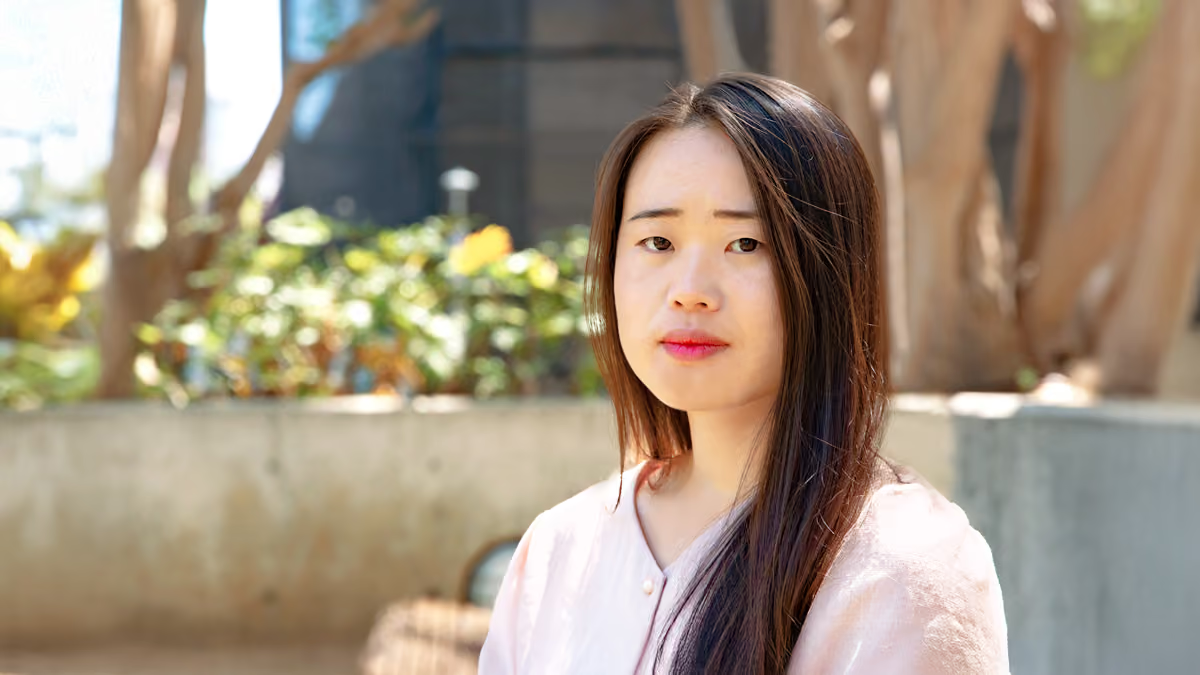
Joy fled from North Korea when she was 18 years old. When she reached China, the broker who arranged her escape went back on their word and immediately demanded to be repaid.
“She told me my only option was to be sold into marriage to a Chinese man so the brokers could take my bridal cost as payment. I couldn't even think of refusing because I was afraid they would do something bad to me or drop me off somewhere alone to get caught by the Chinese police and sent back to North Korea. At that point, I realized that I was trapped.”
Joy was sold to an older Chinese man for $3,000. She searched for any way to escape, but soon became pregnant and gave birth to her daughter. For two years, she raised her child and began to lose hope of ever reaching freedom.
Then in 2013, Joy was connected to LiNK’s network. She felt it was her last chance to take back control of her life. But she faced an impossible decision. Her daughter was still very young, and it would be incredibly risky to escape together. Ultimately, Joy decided to leave her behind.
“I cried every day thinking of my daughter. Before we started moving to get out of China I stayed with some other defectors…I didn't want to cry in front of [them], so I cried behind a curtain. I found another North Korean woman crying there because she also left her child. We ended up hugging each other and crying together.”
Stories of Hope
Eunju, Hannah, and Joy’s stories echo that of thousands of North Korean women who were sold on the way to freedom. But they’ve refused to let their painful experiences prevent them from living full lives, instead turning them into sources of strength, fueling their work on this issue.
Eunju is now living in South Korea with her mom and sister. She co-authored a book about her journey, A Thousand Miles to Freedom, with journalist Sebastein Falletti to make sure stories like hers are not forgotten.
Hannah is also in South Korea raising her daughter, who will never know a life without freedom. In 2022, Hannah joined LiNK’s Advocacy Fellows program to develop her capacity as a leader and advocate for this issue. She traveled across the US alongside other young activists, sharing her story at universities, churches, Fortune 500 companies, and with key stakeholders on Capitol Hill.
Joy was also a LiNK Advocacy Fellow in 2019. Today, her advocacy continues in the classroom, as an educator at an alternative school for the children of North Korean mothers. Some of her students were born in China while the mothers were in forced marriages—a circumstance that is deeply personal. Joy is beloved by the children, and strives to help them navigate their complex identities and relationships with their parents.
All the while, Joy has kept in touch with her daughter through video calls and messages. Last year, she was finally able to bring her daughter to South Korea!
What You Can Do to Help
The trafficking of thousands of North Korean women and girls is one of the most rampant and egregious human rights violations happening today. Yet it often does not get enough dedicated attention amidst all the dangers and abuses that North Koreans face—an alarming reminder of the gravity of this issue.
LiNK rescues North Korean refugees without cost or condition, and provides crucial resettlement support during this period of transition. We’re one of the only organizations still doing this work since the COVID-19 pandemic. To date, we've helped almost 1,400 North Korean refugees and their children reach freedom.
It is more urgent and important than ever that we carry on this work. Right now, our field team is actively in communication with North Korean refugees hiding in China, many of them women who were trafficked or sold into forced marriages, and coordinating their escape. Help bring them to safety and freedom.










