I Watched K-Dramas Inside North Korea. They Gave Me the Courage to Escape | Hannah’s Story
How many times have you checked your phone today? Fifty? A hundred? Every time we look at the screen we are connected to the world around us and an endless stream of information—news, research, entertainment.
Now imagine waking up tomorrow in a place without the internet. A place where people are executed for sharing foreign media, and where families risk their lives just to stay in touch across borders.
For 26 million people in North Korea, this is their reality. And 7 years ago, I was one of them.
I was born in Hoeryong, a city in the northernmost part of North Korea near the Tumen River. Winters were brutal and there were frequent shortages of fuel and electricity.
My father was a high school physics teacher. He was quiet, loyal and diligent. His days started at 7am in the classroom and went late into the night, even on weekends. But despite his dedication, the monthly rations he received were not enough for our family.
So in order to survive, my mother began selling goods at the market. She wanted a better life for us, and that led her to do the unthinkable—escape North Korea. Three times she tried. Three times she was caught. Each time she was imprisoned and sent to a labor camp.
The prison camp was a living hell. My mother saw women waste away from hunger and die from simple illnesses. She was one of the lucky ones; her family brought her food and medicine, an act that made her a witness to the suffering of others.
I was just 13 when I first visited her, carrying a bowl of rice. In North Korea, it falls to families to provide for their imprisoned relatives.
Seeing my mother stand there like a criminal, her head bowed before the guard, I knew this wasn't right. I should have been in school, but instead, I was sneaking food to her, hiding from the stares of strangers.
We were being punished, but I didn't understand why. I felt wronged, and in my anger, I blamed her.
My mother had made a choice to save her family, but North Korean society saw her as a criminal. My father, who had led a quiet life as a teacher, was denied opportunities at work. Our family was labeled as traitors.
In 2013, on her fourth attempt, my mother finally escaped and made it to South Korea. She worked tirelessly to send money back to North Korea to help our family. She also slowly opened a window into another world.
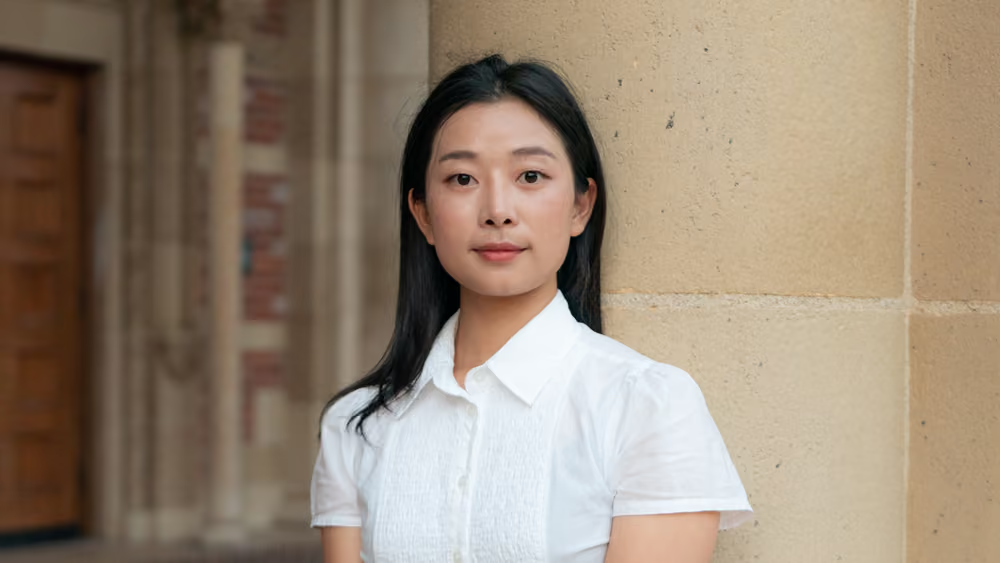
Using a smuggled Chinese cell phone I was able to speak to my mother from time to time. And on our secret calls she shared with me new South Korean expressions and words she was learning. As she settled into a new society, despite numerous differences, she also recognized similarities between North and South Korea and its people, and reminded me that despite decades of division, we are still one people.
I secretly began watching South Korean sitcoms. I’ll never forget one called “High Kick 3.” In one episode, there was a story about a man who fell into debt and was being chased by collectors. But what shocked me was that his family wasn’t punished for it. In North Korea, if one person “sins” the entire family is condemned. But this showed me that in South Korea, life could be different. That even within a family, you were free to make your own choices.
This realization changed me and offered a glimpse of the vast world beyond North Korea. Information, even in the form of a sitcom, was hope. And it was worth risking everything for.
Meanwhile, I continued to face obstacles in my day to day life. I had learned how to code and use software like photoshop, and I dreamed of going to university after graduation. But because my mother had defected, I was rejected. So I used my computer skills to find work as a photographer and photo editor.
Hoping to advance my career, I volunteered for the "shock brigade," a group sent to do manual labor at dangerous construction sites. While others prayed they wouldn't get picked for this kind of work, I went willingly, thinking it could be my way to a promotion.
I was sent to the Samjiyon district, a place known for its harsh winters. For over a month, I demolished buildings in minus 40-degree weather without protective gear. Dust filled my lungs, and sweat froze my clothes solid. My only relief was being able to sleep in a crumbling basement.
When I returned, expecting the promotion I had been promised, my supervisor simply said, "Let's wait a little longer."
That was the moment I understood my mother. She had risked her life to escape because she was after something more fundamental than a better life. She wanted to live like a human being.
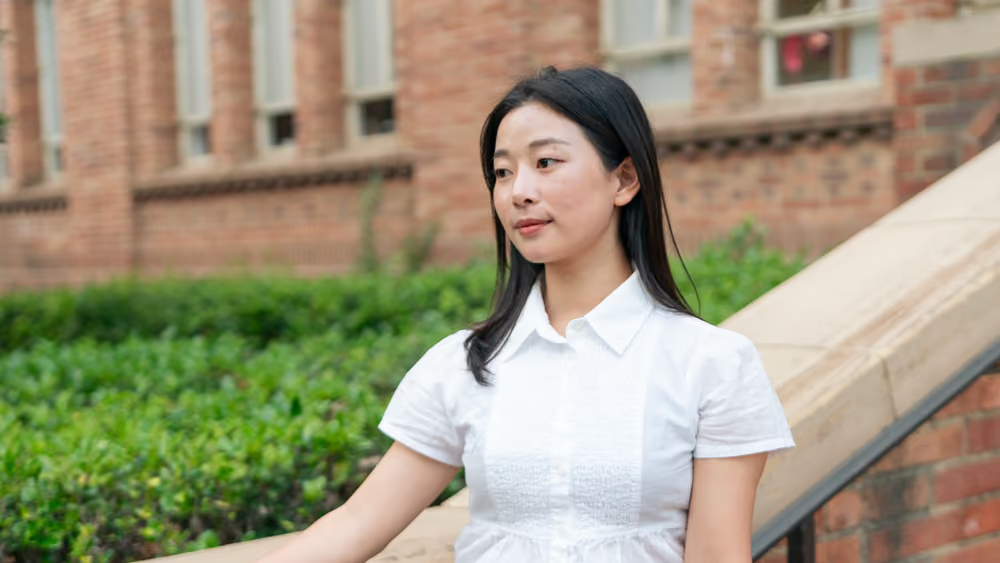
In 2019, I made the same choice and escaped. With the help of Liberty in North Korea, I made it safely to South Korea and reunited with my mom.
Freedom wasn’t as easy as I thought it would be. In North Korea, my tech and computer skills had helped me survive. I had always thought that “no matter where I go, as long as I have a computer, I’ll be fine.” But in South Korea, I struggled with something as simple as a new keyboard layout. In school, subjects like social studies felt foreign because I had grown up in a completely different education system with distorted versions of history and philosophy. My dream of going to college suddenly felt impossible.
Eventually I found my place in science. The formulas and equations in math, chemistry, and physics were the constant, unchanging truths I could always count on.
I decided to major in electrical engineering. It was rare for North Korean defectors to pursue this field. But I was determined to stay ahead and not fall behind in our rapidly changing world. Now my goal is to become an engineer who can help bridge North and South Korea’s science and technology industries when the two countries are one again.
More than ever, I see that information isn’t just about knowledge and convenience—it’s a lifeline. Without access to information, you can’t see a way forward, let alone build a future.
And right now, the people I left behind are more cut off than ever before. During the pandemic, North Korea closed its borders to an unprecedented extent. Soldiers along the border had shoot-to-kill orders for anyone trying to escape. Around 90% of the markets were forced to shut down, leaving families with barely enough to eat. The UN reported that nearly half the population—12 million people—faced food insecurity, while the World Health Organization rated North Korea’s access to medical care as the lowest in the world.
A few years ago, when my father became very sick, I was able to send him money for medicine and hospital care. But most North Koreans don’t have that chance. Without someone on the outside, they are not only cut off from resources and information, but from hope itself. For many, their future depends on a lifeline from the outside world.
Supporting North Korean people and protecting human rights cannot be put off.
We have an opportunity to be a lifeline for people inside North Korea today. To remind them that they have not been forgotten. With your support, we can rescue and support more North Korean refugees, and get more outside information and technology to people inside the country. And that information can empower North Koreans to not only see a way forward, but to ultimately determine their own future.
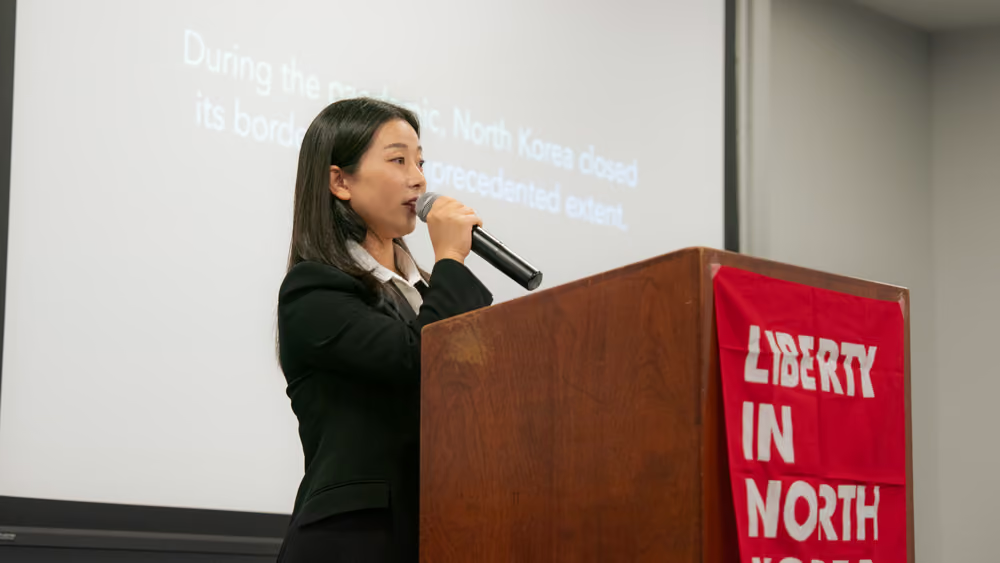
Despite the risks, North Koreans are quietly accessing foreign media and learning about life in the outside world. Increasing their access to uncensored information is one of the most effective ways to increase change inside the country.
Liberty in North Korea partners with North Korean defectors and engineers, like Hannah, to develop technology, content, and tools tailor-made for the North Korea context. Our goal is to empower North Koreans with information about the outside world, increasing their aspirations for social and economic progress, and building pressure for change and opening.
Empower North Koreans with information access.
Give Today
Lost Stories from North Korea — A Life With No Exit
By Jane
Jane is a participant of LiNK’s Intensive English Program (LIEP), designed to build the capacity of North Korean English speakers at the intermediate level. In partnership with the British Council, LIEP aims to cultivate participants’ communication and critical thinking skills in English. LIEP is complementary to our broader LiNK English Language Program (LELP), which supports speakers of all proficiency levels.
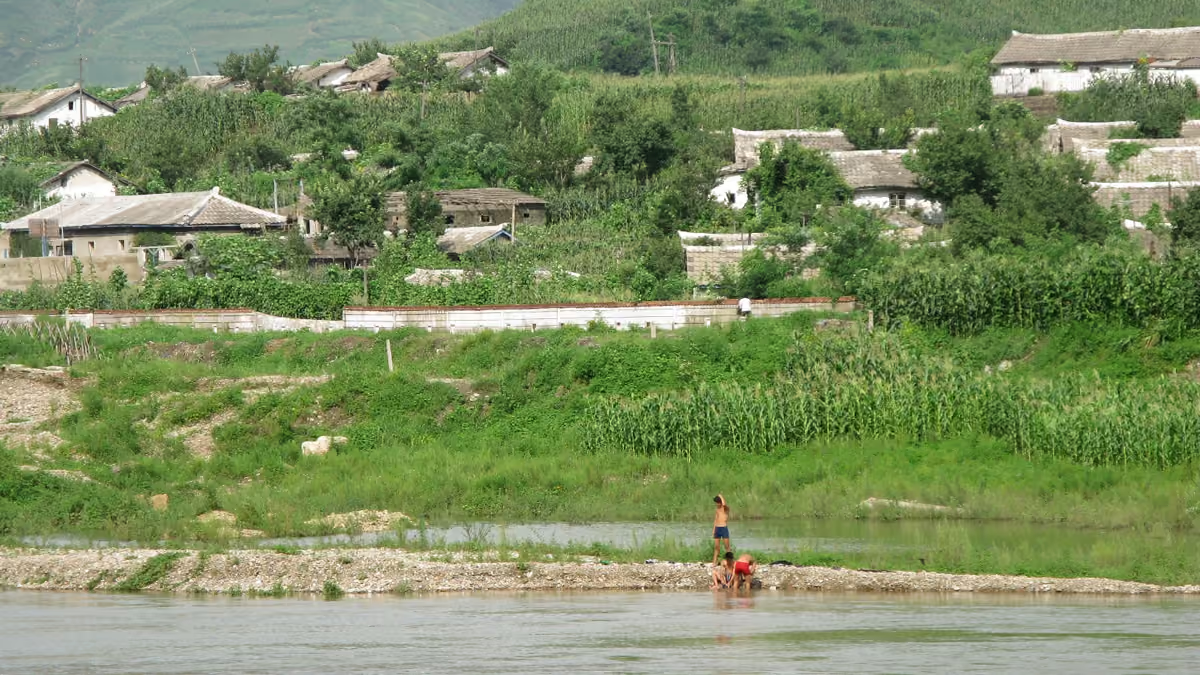
When I was young, we lived in the countryside. Like the other kids, I had to help my mom with farming. It was hard work. From spring to fall, everything was difficult. Carrying a heavy load on my back, climbing up the mountain, my hands covered in blisters from using farming tools—I would often return home late, completely exhausted.
Our field was located at the top of a high mountain. From there, I could look down and see the Amnok River flowing, with a railway track stretching beside it. One spring day when I was around 13, I was resting at the top of the mountain, looking down at the train passing by below.
Watching it move slowly like a caterpillar, I thought to myself, "I want to get on that train and go somewhere far away." That was the first time I dreamed of escaping. We were living in a prison with no exit, no hope.
Eventually, I managed to escape from that life in that prison. But my mother must have continued climbing that mountain and working in that field for many more years. Perhaps, during her moments of rest, she would look down at the river and the railroad. Perhaps, she thought about me, who had left for a place far away.
Now, I am living well in South Korea, as a mother of one myself. I carry dreams and hope in my heart. But not everyone has been as fortunate as I have in finding a way out.
I have a friend, a North Korean defector now living in the United States, who once shared a story that moved me to tears. A few years ago, she fled North Korea with her two young daughters and eventually made her way to America. She attempted to reach South Korea twice. The first time, she set out with her daughters, ages seven and eleven. They wandered for days through the vast Baekdudaegan mountains. When their water ran out, she dug into the earth with her bare hands, squeezing out a few drops to moisten their mouths.
Along the way, they came across the bodies of two people, sitting with their backs leaning against each other in the middle of a field. From their clothes, she could tell they were North Koreans, their bodies already beginning to decompose. Fearing that she and her daughters might meet the same fate, she decided to turn back and return to North Korea.
As I listened to her story, I couldn’t hold back my tears. Who were those two souls lost in the mountains? Where had they been trying to go? How long had they wandered? They might have been so exhausted that after sitting back to back, they couldn’t get up again. What thoughts filled their minds in their final moments?
That’s why I want to be a writer—to share these stories with the world.
For the people in North Korea who still dream of breaking free from a life with no exit, and for the nameless souls who never made it to freedom.
-
Opportunities like LiNK’s Intensive English Program (LIEP) are helping North Koreans find their voice, reach their goals, and lead change on this issue. Your support can help us continue to make an impact in the lives of North Korean refugees, like Jane.
Give Today