
Most North Korean Refugees Are Women. Here’s Why.

Over 33,000 North Korean refugees have made it safely to South Korea. 70% of them are female.
Why?
Firstly, North Korea is both politically and culturally very patriarchal, so women traditionally have a lower status than men, and are actually less tightly controlled by the North Korean system. Starting from the famine of the 1990s, North Korean women had to exploit their official status as “housewives” to engage in private market activities and become the breadwinners to ensure their family’s survival.
This combination of a new found economic role, relatively more mobility, and increased independence led more North Korean women to seek further economic opportunities in China (sometimes with an intention to stay temporarily and return, and sometimes as a more permanent move).
There was also a perception among North Koreans that women would have a better chance of being able to stay under the radar and work informally in China, for instance in restaurants or textile factories. This has in fact been borne out in reality, and there is another more tragic factor pulling North Korean women into China—a demand for North Korean brides among unmarried Chinese men, and a broader demand for North Korean women in the Chinese sex industry (including brothels and online sex chat rooms). This demand is driven by a lack of marriage-aged women particularly in rural Northeast China, a result of China’s ‘one child policy’ and the migration of young Chinese women to the cities.
Regardless of the reason behind their initial escape into China, a higher proportion of women getting out of the country translates to a female majority making it all the way to South Korea.
Another reason that might be thought to hold North Korean men back is that they are tied up in military service for much of their 20s, which is a prime age for defection. Not only do men have less freedom when they are in the military, but they are also often relocated to the interior of the country away from the border with China, decreasing their chances of escape. However this does not exactly play out in the demographic data for arrivals of North Korean refugees in South Korea, which shows no spike in the female to male ratio of refugees in their 20s, so it is hard to say how big of a factor this is.
Finally, anecdotally, it seems that some North Korean women may be more likely to be motivated to make the journey to South Korea after watching dramas and films that are smuggled into North Korea on USBs and Micro-SD cards. North Korean women have told us that visions of life in South Korea where women have much greater freedom in self expression and fashion, and are granted higher status and respect—especially by the romantic heartthrobs of your typical K-drama—fueled their fantasies of life beyond North Korea’s borders and were a significant factor in their decision to escape.

Among the more than twenty thousand female North Koreans who have made it all the way to safe resettlement in South Korea have emerged some of the most effective advocates for the North Korean people. Several North Korea-born women have written books, and are increasingly giving the issue a human face on South Korean television and to audiences around the world.

These advocates, and hundreds of other North Korean women who have quietly strived to successfully resettle and bring their children and other family members to South Korea, are among the people that we’ve been able to support and work with because of your commitment to stand alongside the North Korean people.
So on International Women’s Day, we salute the North Korean women who have been able to emerge as a force of progress despite being born in the most repressive country in the world, and we salute our sisters and brothers around the world who continue to believe in and support them.
- Sokeel Park, Director of Research & Strategy
The North Korea I Remember: School, Family, and Home
By: HyeGyeong Joo
HyeGyeong is a PhD student in the Department of Economics at Korea University, specializing in theoretical economics. Her research looks at developing theoretical models of the North Korean economy. Since 2022, Hye-Gyeong has also participated in LiNK’s English Language Program.
Have you ever wanted to go home even while you were already at home? Because I have. It feels as though I am not longing for a physical house, but for something harder to name: a sense of belonging, of being whole, of belonging not anywhere but somewhere I would truly belong. Instead, I often feel emptiness, as if I do not fully belong. But I am not sure what these feelings mean or where they come from exactly.
I have been living in South Korea for around ten years, but I still miss North Korean food, school life, and above all, the time I spent with my family. There are restaurants in South Korea run by North Korean refugees, and sometimes their dishes bring back memories of home. Foods like injogogi-bap or nongma-guksu remind me not only of North Korean cuisine, but of birthdays, family, and everyday life.
The long strands of nongma-guksu always carry the wish for a long life, while the taste of injogogi-bap brings back the memory of a soybean dish made to resemble the meat we so rarely had.
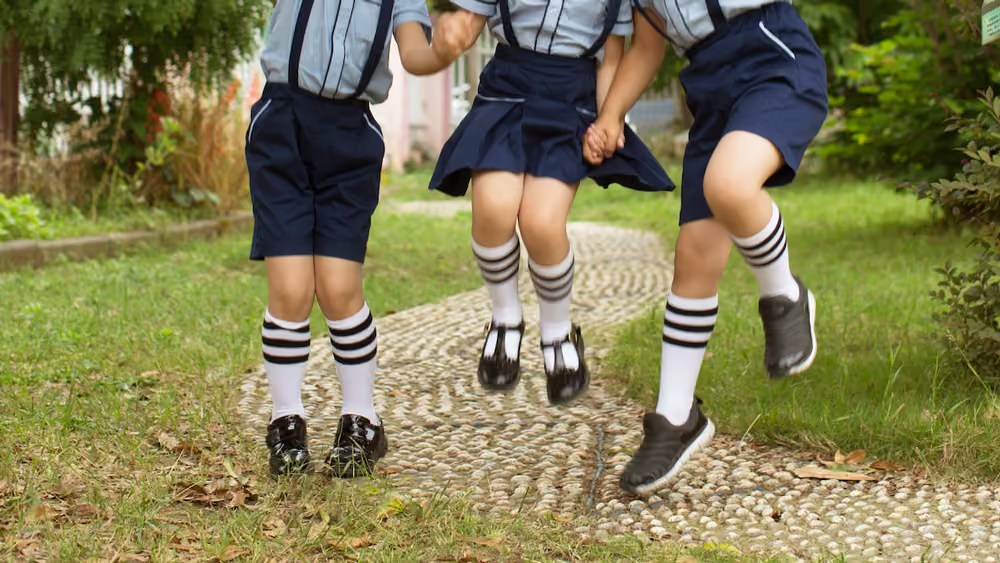
While these foods remind me of home, what I remember most vividly is my school life in North Korea. When I was in fourth grade, the girls in my school would often gather in the schoolyard to play jump rope. I was actually quite good at it. We would start with the rope at ankle height and gradually raise it higher and higher.
One day, when the rope had been raised to about head height, I tried to jump over it. Since I was quite short, I had to lift my leg as high as I could. Unfortunately, I ended up tearing my pants. I was so embarrassed that I almost cried. But what I remember most clearly is my teachers laughing so hard as they watched from the side. Even now, I can still picture that moment vividly.
I also remember winter lunchtime at school. We all brought packed lunches from home. In one corner of the classroom, there was a stove, and before lunch, students would place their lunch boxes on top of it to warm their food.
Sometimes, the lunch box closest to the stove would get burnt. During class, the smell of scorched rice would fill the room and make us so hungry that it was hard to focus. When lunchtime finally came, my friends and I would gather around the stove, sit in a circle, and eat together.
More than anything else, however, I miss the memories of winter. My friends and I would climb the hills near our town, sit on large sacks, and slide all the way down as if we were on sleds. We did it so often that the fabric on the back of our pants would wear thin and eventually tear. When that happened, I would go home only to be scolded by my mother.
Life was not easy in those days. We were often hungry and did not live comfortably. Sometimes we skipped breakfast, and sometimes a thin porridge was all we had for dinner. Yet, despite those hardships, I cannot forget the laughter we shared.
Looking back now, I realize that what I miss is not North Korea as a system. What I miss are the people with whom I laughed and cried, and the memories of my childhood that have stayed with me to this day.
For a long time, however, I could not talk about these feelings to anyone. I kept them to myself, unsure of how others would understand them. That began to change after I met people through Liberty in North Korea (LiNK). For the first time, I found a space where I felt I could speak more honestly about my memories and my life in North Korea.
Through the LiNK English program, I became close to a friend, and together we made a plan to create a book. I would write about real life in North Korea, and she would draw the illustrations for the book. I wanted people to see North Korea not only as a political system, but also as a place where ordinary people live, love, struggle, and create memories.
I shared this plan with someone I trusted deeply in South Korea. But she told me, “No, you can’t!” She said that if I spoke honestly about daily life in North Korea and about how much I miss certain parts of it, despite all the difficulties, people might ask, “Then why are you here? If you miss it so much, why don’t you go back?” Her response hurt me so deeply that I eventually closed my heart to others. After that, I stopped talking about these feelings with anyone. Only later did I finally find a place where I could tell my story freely and without hesitation.
When many people think about North Korea, they often think about politics, missiles, or the regime. But when I think about North Korea, I remember a girl whose pants tore while playing jump rope, students gathering around a stove to eat lunch together, and children laughing as they slid down snowy hills on sacks.
That is why I hope people can see North Korea not only as a political system, but also as a place where ordinary people live their lives. The people living there are not so different from people anywhere else. They laugh, dream, make friends, and create memories. Those are the stories I hope to share.
–
HyeGyeong is a participant of the LiNK English Language Program (LELP), which serves to not only help North Korean defectors build confidence and skills in English, but develop their capacity as advocates for this issue. To that end, we partnered with select LELP “columnists” to write and polish personal essays through multiple rounds of external feedback and revision. Our goal is to have more North Koreans share their stories directly and lead efforts to change the narrative.
We believe the North Korean people can achieve their liberty in our lifetime.
Opportunities like LELP invest in the people building that future now. Help more North Koreans find their voice, reach their goals, and lead change on this issue.










